How to Buy Geometry Sets in Bulk for Schools: A Practical Procurement Checklist
Buying geometry sets in bulk for schools involves more than comparing unit prices. Procurement teams must assess curriculum suitability, student safety, material durability, packaging efficiency, supplier compliance, and delivery reliability.
The right purchase supports consistent learning, controls replacement spending, and simplifies distribution across grades, classrooms, or campuses. The wrong purchase creates missing components, safety complaints, and avoidable teacher workload.
For institutional buyers, the best geometry sets bulk order is usually the one with the lowest total classroom cost, not simply the lowest quoted price.
Start With the School's Actual Classroom Requirements
Before contacting suppliers, confirm who will use the sets, which grades need them, and whether every student requires an identical configuration for lessons and examinations.
Primary-school learners often need larger, simpler tools with rounded edges and highly visible markings. Secondary students may require more precise compasses, rulers, protractors, and set squares.
Ask curriculum leaders for the required instruments before issuing a request for quotation. A generic set may contain unnecessary items while omitting a tool teachers expect.
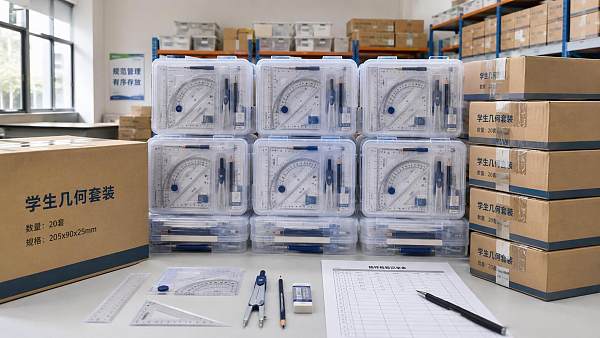
Typical geometry sets include a ruler, protractor, two set squares, compass, pencil, eraser, sharpener, and sometimes a divider. Confirm every component individually.
Do not assume that a larger item count means better educational value. Extra accessories can increase packing size, handling time, and replacement complexity without improving lessons.
Check whether students will use the equipment during standardized assessments. Some examination boards restrict certain compass designs, transparent cases, calculators, or measurement markings.
Teacher input is especially important when schools use specific teaching methods. For example, a mathematics department may prefer a 180-degree protractor rather than a full-circle version.
Create a written specification sheet that separates mandatory items from optional items. This gives suppliers a consistent basis for quotation and makes comparisons more reliable.
Specify Accuracy, Readability, and Student-Friendly Design
Geometry tools must be accurate enough for classroom work, but precision is only useful when students can read markings quickly and use each instrument confidently.
For rulers and set squares, inspect graduation clarity, line thickness, zero-point alignment, and measurement units. Poorly printed scales lead to avoidable calculation and drawing errors.
Transparent or lightly tinted plastic generally helps students see lines beneath the tool. However, excessive tinting, reflections, or decorative printing can reduce readability under classroom lighting.
Choose markings that resist rubbing and fading. Screen-printed scales may be acceptable, but molded or engraved markings usually perform better in high-use school environments.
Compass quality deserves particular attention because it is often the first component to fail. The hinge should move smoothly while maintaining enough tension to hold a radius.
Test whether the compass securely grips a standard pencil or lead insert. A loose holder causes inconsistent circles and frustrates younger students during timed activities.
For younger users, consider compasses with rounded safety points, protected needle covers, or a design that reduces exposed sharp metal parts during storage and transport.
Request physical samples before approving a geometry sets bulk purchase. Suppliers' photos rarely reveal sharp edges, weak hinges, unreadable graduations, or brittle plastic.
Use a simple sample evaluation form completed by teachers and school operations staff. Record measurements, ease of use, component defects, and expected suitability by age group.
Assess Safety and Material Compliance Before Ordering
School procurement teams should treat geometry sets as student-use products, not ordinary stationery. Sharp points, small parts, inks, plastics, and packaging all require review.
Ask suppliers which safety and material standards apply in the destination market. Requirements vary by country, age group, product construction, and whether the set is marketed as a toy.
Depending on your market, relevant documentation may include EN 71 testing, REACH declarations, CPSIA information, phthalate reports, or declarations covering restricted substances.
Do not accept vague statements that products are “non-toxic” or “eco-friendly.” Request current test reports, declarations, laboratory details, and clear references to the tested product.
Verify that the test report matches the materials, colors, factory, and product version being quoted. A report for an unrelated model does not validate the supplied set.
Inspect metal compass points, divider tips, and sharpener blades carefully. Protective caps should fit securely, while sharp edges should not protrude through thin packaging.
Small removable pieces can create a risk for younger students. If purchasing for early grades, confirm local age-labeling requirements and discuss safe component designs with suppliers.
Material selection also affects classroom durability. Virgin polypropylene, polystyrene, acrylic, aluminum, steel, and wood each perform differently in heat, impact, and repeated handling.
For large contracts, include a requirement that suppliers notify the buyer before changing materials, molds, inks, component sources, or manufacturing locations after approval.
Calculate Total Cost, Not Just the Unit Price
A low headline price can become expensive when sets break quickly, arrive with missing pieces, require individual repacking, or create repeated emergency replacement orders.
Calculate the landed cost per usable set. Include product cost, packaging, freight, insurance, duties, inspection, warehousing, campus distribution, and expected replacement rates.
Compare quotations using the same Incoterms. A supplier quoting FOB may appear cheaper than a delivered-price supplier, although the buyer carries additional transport and customs costs.
Ask suppliers to state whether pricing includes individual cases, labels, barcodes, inner cartons, export cartons, spare parts, and any molds for customized branding.
Replacement costs matter because compasses, pencils, and sharpeners are frequently lost or damaged. Consider ordering spare components rather than complete replacement sets where practical.
For multi-campus groups, evaluate whether central delivery and internal distribution costs outweigh the convenience of direct deliveries to individual schools or regional warehouses.
Build a cost comparison table that includes quoted price, minimum order quantity, lead time, defect allowance, payment terms, compliance evidence, and sample evaluation results.
A slightly higher-priced supplier may offer superior value through consistent quality, better carton efficiency, lower breakage, and fewer administrative issues after delivery.
Review Packaging for Distribution, Storage, and Accountability
Packaging is a major operational consideration when buying geometry sets in bulk. It determines how easily schools receive, store, issue, count, and replace the products.
Individual cases should protect tools without being difficult for students to open. Weak plastic boxes crack quickly, while oversized cases consume valuable classroom storage space.
Confirm whether every item has a fixed compartment. Loose components move during shipping, become damaged, and make it harder for teachers to identify missing pieces.
For institutional distribution, request clear external carton labels showing product code, quantity, grade suitability, production batch, destination, and purchase order reference.
Consider whether sets need student name labels, school branding, language-specific instructions, or color coding by grade. These details can reduce misallocation after delivery.
Ask for carton dimensions, gross weight, net weight, and stacking guidance before confirming volumes. This information is necessary for warehouse planning and freight estimates.
Excessive retail packaging may look attractive but creates waste and slows down issue procedures. Schools usually benefit from efficient, durable, easily recyclable packaging.
Where sustainability targets apply, request information about recycled content, plastic type, packaging recyclability, and the supplier's approach to reducing unnecessary materials.
Packaging samples should be tested alongside product samples. A durable geometry set is still a poor choice if it arrives scattered, damaged, or difficult to distribute.
Qualify Suppliers Beyond Their Catalog and Sales Claims
Reliable suppliers of geometry sets bulk orders should demonstrate manufacturing control, documented quality processes, clear communication, and experience serving institutional or export buyers.
Ask whether the supplier is a manufacturer, trading company, or hybrid sourcing partner. Each model can work, but responsibilities for quality and documentation must be clear.
Request factory information, production capacity, quality-control procedures, export markets, and examples of comparable education-sector orders. Verify claims through documents and direct questions.
A capable supplier should explain how it controls measurement accuracy, printing quality, assembly, packaging, metal points, and final inspection before cartons leave the factory.
Review how the supplier manages shortages and defects. Confirm whether they provide replacement parts, credit notes, rework support, or agreed tolerances for damaged units.
Communication quality is a practical risk indicator. Delayed answers, inconsistent specifications, and unclear quotations often become larger problems once production has started.
For significant orders, arrange a factory audit, third-party assessment, or virtual production review. The appropriate level of verification depends on order value and supplier history.
Do not rely solely on certificates displayed on a website. Check validity dates, issuing bodies, scope, factory name, and whether the certificate covers relevant production activities.
Set Quality Controls Before Production Begins
Quality expectations should be documented before the purchase order is released. Verbal agreements are difficult to enforce after goods have been packed and shipped.
Attach the approved sample, component list, packaging artwork, material requirements, and acceptable defect criteria to the purchase order or formal product specification.
Define acceptable quality limits for missing components, cracked cases, inaccurate markings, damaged compass points, incorrect colors, printing defects, and carton shortages.
Specify an approved sample process for customized sets. The supplier should not begin mass production until the buyer confirms the final physical or pre-production sample.
For larger shipments, use pre-shipment inspection. Inspectors can sample cartons, count components, test compass movement, review labels, and identify visible defects before dispatch.
Make clear who pays for reinspection if the goods fail. This encourages both parties to resolve quality concerns before containers or courier shipments leave the origin country.
Batch traceability is valuable for recurring school procurement. Lot codes help buyers identify affected deliveries if a particular compass, case, or printing issue appears later.
Maintain records of approved samples, inspection reports, delivery discrepancies, and teacher feedback. These records improve supplier reviews and strengthen future tender decisions.
Plan Lead Times, Ordering Cycles, and Delivery Risk
Geometry sets are often needed before a term begins, making late delivery especially disruptive. Procurement schedules should work backward from the classroom issue date.
Confirm the production lead time separately from sample approval, artwork development, inspection, inland transport, international freight, customs clearance, and final delivery.
Seasonal demand can affect availability before major school terms. Orders placed late may face higher freight costs, limited production slots, or rushed quality control.
For international sourcing, ask suppliers about their standard export port, shipping options, carton lead times, and contingency plans for material shortages or port delays.
Keep a realistic buffer for customs, regional transport, and school receiving schedules. Delivering during holidays or campus closures can create unnecessary storage and access problems.
For repeat programs, consider framework agreements with scheduled releases. This can stabilize pricing, reserve capacity, and reduce the administrative burden of repeated small orders.
However, avoid committing to volumes without a clear forecast. Enrollment changes, curriculum updates, and existing inventory can quickly turn a large purchase into excess stock.
Use historical loss and breakage data to determine safety stock. A modest reserve of compasses, rulers, and cases can prevent urgent, expensive mid-term purchases.
A Practical Bulk Geometry Set Procurement Checklist
Before placing an order, confirm the set contents match the curriculum, grade level, assessment rules, and classroom teaching methods used by the school or district.
Confirm the measurements are readable, the compass holds its position, tools fit securely in the case, and students can use the set safely.
Obtain current compliance documents that match the quoted product. Review material declarations, test reports, age suitability, labeling, and any destination-market requirements.
Compare landed costs rather than unit prices alone. Include freight, duty, packaging, distribution, replacement allowances, and the operational cost of handling damaged products.
Approve a physical sample and document all agreed specifications. Include quality criteria, packaging requirements, labels, artwork, acceptable defect levels, and inspection procedures.
Verify supplier capacity, quality controls, communication practices, and export experience. Establish clear remedies for shortages, late delivery, defects, and unauthorized specification changes.
Schedule production and shipping with enough buffer before term start. Confirm final delivery locations, receiving contacts, storage capacity, and internal distribution responsibilities.
Conclusion: Buy for Classroom Reliability, Not Catalog Convenience
The strongest geometry sets bulk purchase balances educational suitability, safety, durability, compliance, logistics, and price. Procurement teams should evaluate the complete classroom-use outcome.
When specifications are clear and samples are properly reviewed, buyers can reduce defects, avoid replacement costs, and give teachers consistent tools for effective mathematics instruction.
A disciplined sourcing process turns a routine stationery order into a dependable institutional supply decision, supporting both budget control and a better everyday learning experience.