Paper Guillotines Buying Guide: Manual vs Electric, Cut Size, and Safety Features
Paper Guillotines Buying Guide: Manual vs Electric, Cut Size, and Safety Features
Choosing the right paper guillotines can directly affect accuracy, speed, and operator safety. For procurement decisions, the wrong unit often creates hidden labor costs, rework, and maintenance headaches.
This guide compares manual and electric paper guillotines, explains how cut size shapes daily output, and highlights the safety features that matter in real commercial use.
In offices, schools, print rooms, and copy centers, paper guillotines are not just simple cutting tools. They are workflow equipment, and that changes how they should be evaluated.
Why paper guillotines selection affects total procurement cost
Price is the visible cost. Ownership is the real cost. That difference becomes obvious after the equipment enters daily use.
A lower-cost machine may require slower loading, frequent blade adjustments, or repeated cuts. Over time, those delays raise labor expense and reduce output consistency.
Paper guillotines also affect material waste. Poor alignment or uneven pressure can damage finished sheets, covers, labels, and presentation materials.
In practical sourcing, the goal is not finding the cheapest machine. It is finding paper guillotines that match workload, media type, operator skill, and compliance expectations.
Manual vs electric paper guillotines: which option fits the workload?
The manual versus electric decision should start with output volume. That is usually the clearest signal when comparing paper guillotines.
When manual paper guillotines make more sense
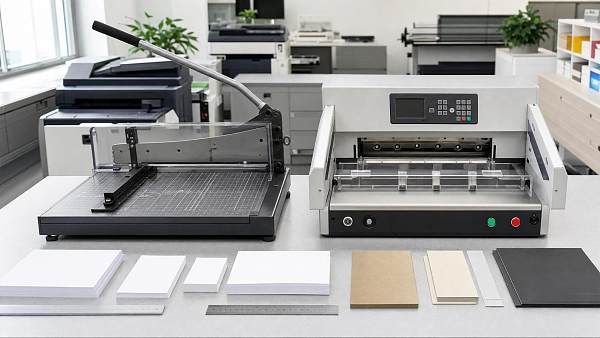
Manual paper guillotines are usually a practical fit for light to moderate workloads. They are common in schools, small offices, studios, and administrative departments.
They cost less upfront, need no motorized drive system, and are easier to position in smaller workspaces. Maintenance is often simpler as well.
However, output depends heavily on operator strength and technique. That can create variation in cut quality, especially with thicker stacks.
- Best for occasional or scheduled cutting tasks
- Lower acquisition cost
- Suitable for standard office paper and lighter media
- Less efficient for repetitive, high-volume production
When electric paper guillotines deliver better value
Electric paper guillotines are built for higher throughput and more repeatable results. They are a stronger choice for print rooms, copy shops, and commercial finishing areas.
Motorized clamping and cutting improve consistency across repeated jobs. This matters when trim accuracy affects presentation, packaging, or customer-facing documents.
Electric paper guillotines also reduce operator fatigue. In multi-shift environments, that is not a minor benefit. It supports output stability and safer working conditions.
- Best for frequent or continuous cutting
- Higher productivity per operator
- Better for thicker stacks and tighter tolerances
- Higher upfront cost, but often lower cost per job
A simple workload rule for selection
If cutting is occasional and straightforward, manual paper guillotines are usually enough. If cutting is daily, repetitive, or tied to deadlines, electric models usually justify the spend.
How cut size changes the usability of paper guillotines
Cut size is often underestimated during sourcing. Yet it directly affects what the machine can process without repositioning, trimming errors, or slower handling.
Paper guillotines are commonly selected around A4, A3, ledger, tabloid, or larger sheet formats. The right choice depends on current jobs and future flexibility.
Small-format cutting
Smaller paper guillotines work well for receipts, handouts, vouchers, cards, and standard office documents. They save space and often cost less.
The tradeoff is flexibility. Once larger sheets appear, operators may need extra steps, and that slows production.
Large-format cutting
Larger paper guillotines support brochures, menus, posters, teaching materials, signage, and packaging inserts. They also reduce the need for multiple passes.
That said, larger machines demand more floor space, stronger tables or stands, and more disciplined handling procedures.
What to check before approving cut size
- Largest sheet size used today
- Expected future jobs or seasonal demand
- Available table or floor space
- Need for single-pass cutting accuracy
- Storage and movement requirements
A slightly larger cut size often protects against future replacement. In many cases, that is a smarter purchasing decision than buying to minimum specifications.
Safety features that matter when buying paper guillotines
Safety should never be treated as an optional add-on. For paper guillotines, it is central to compliance, liability control, and everyday usability.
The right safety features depend on who uses the equipment, how often it is used, and whether the environment includes students, temporary staff, or public access.
Essential safety features to prioritize
- Blade guards that keep hands clear during operation
- Safety locks for storage or non-use periods
- Two-hand activation on electric paper guillotines
- Emergency stop functions on powered units
- Stable clamp pressure to prevent sheet movement
- Non-slip feet or secure stand mounting
Why safety design affects productivity too
Better safety does more than reduce risk. It also improves confidence during operation, especially where paper guillotines are shared by multiple users.
When operators trust the machine, setup becomes faster and cutting tends to be more controlled. That leads to fewer mistakes and less waste.
In regulated commercial environments, documented safety features can also support internal audits and supplier approval processes.
Other specifications that buyers often overlook
Beyond manual or electric operation, several technical details shape long-term performance. These details are easy to miss during a price-driven comparison.
Stack capacity
Stack capacity determines how many sheets paper guillotines can cut in one cycle. Higher capacity reduces repeat handling and improves throughput.
Back gauge and measurement accuracy
A precise back gauge supports repeatable trimming. This matters for branded materials, booklets, training packs, and premium printed pieces.
Blade quality and replacement access
Blade durability affects output quality and maintenance cycles. Confirm replacement blade supply, service support, and sharpening options before purchase.
Media compatibility
Not all paper guillotines handle coated stock, laminated sheets, card, or specialty materials equally well. Match the machine to the actual media mix.
A practical comparison table for procurement review
How to shortlist paper guillotines with fewer sourcing mistakes
A reliable shortlist usually comes from asking a few direct questions before comparing quotations.
- How many cutting jobs happen per day or week?
- What is the largest sheet size actually used?
- How thick is the usual stack per cut?
- Which users will operate the machine?
- What safety standard or internal policy must be met?
- How quickly can blades and parts be supplied?
This process helps separate attractive pricing from true fit. It also makes supplier discussions faster and more objective.
Final decision points for buying paper guillotines
The best paper guillotines are the ones that match real workload, cut size requirements, and safety expectations without overbuying unnecessary capacity.
Manual models fit lighter use and tighter budgets. Electric paper guillotines fit faster, more repetitive production where consistency and labor efficiency matter more.
Cut size should be chosen with future use in mind, not only current jobs. Safety features should be reviewed as core buying criteria, not optional extras.
When procurement decisions follow those principles, paper guillotines become a dependable production asset rather than a recurring operational problem.
Search News
Hot Articles
- Restaurant FurnitureFast-Casual Restaurant Interiors: Design Choices That Improve Speed and Guest FlowOct 04, 2026
- Outdoor RidesHow to Select Leisure Park Equipment for Safe, High-Throughput Visitor AreasOct 03, 2026
- Fashion & Gem JewelryDiamond Tester Wholesale: How to Vet Accuracy, Calibration, and MOQ Before OrderingOct 02, 2026
Popular Tags
Need ExpertConsultation?
Connect with our specialized leisureengineering team for procurementstrategies.
Recommended News
 Sep 21, 2026How Schools Can Cut Printing Costs When Buying Ink Cartridges in BulkSchool ink cartridges wholesale made smarter: cut printing costs with fleet planning, cost-per-page comparisons, reliable suppliers, and inventory controls.● Institutional Buyer
 Sep 17, 2026How to Source Wholesale Packing Tape Without Compromising Carton Seal StrengthWholesale packing tape sourcing guide: compare adhesive, backing, carton conditions, and real-world trials to reduce costs while maintaining reliable carton seal strength.● Institutional Buyer
 Sep 05, 2026How to Buy Geometry Sets in Bulk for Schools: A Practical Procurement ChecklistGeometry sets bulk buying guide for schools: compare safety, quality, compliance, packaging, supplier reliability, and total cost for smarter procurement.● Institutional Buyer
 Aug 31, 2026Microscope Slides Market Outlook: Demand Drivers, Segments, and Sourcing RisksExplore the microscope slides market: key demand drivers, product segments, quality risks, and sourcing strategies for reliable laboratory supply.● Institutional Buyer
 Aug 30, 2026Microscope Slides HS Code: How Importers Classify Laboratory Glass Slides CorrectlyMicroscope slides HS code guide: learn how to classify laboratory glass slides accurately, verify materials, avoid customs delays, and improve import compliance.● Institutional Buyer
 Aug 29, 2026How to Choose Graduation Tassels With Year Charms for Large School OrdersGraduation tassels with year charm: learn how to specify colors, materials, packaging, proofs, and delivery timelines for accurate large school orders.● Institutional Buyer
 Aug 11, 2026How to Choose Alphabet Educational Posters for Different Classroom Age GroupsAlphabet educational posters should match how each age group learns. Discover how to choose safer, clearer, curriculum-ready designs for preschool to primary classrooms.● Institutional Buyer
 Aug 05, 2026How to Evaluate a Marching Band Uniform Manufacturer for Quality and On-Time DeliveryMarching band uniform manufacturer selection starts with delivery risk. Learn how to compare quality, sizing, compliance, and capacity for reliable, on-time orders.● Institutional Buyer
 Jul 20, 2026How to Evaluate a Stationery Distributor for Bulk Office and School Supply PurchasingStationery distributor selection affects cost, delivery, and compliance. Learn how to evaluate suppliers for bulk office and school supply purchasing with confidence.● Institutional Buyer
 Jul 18, 2026How to Choose Custom Hotel Uniforms: Fabric, Branding, Comfort, and DurabilityCustom hotel uniforms guide: learn how to choose the right fabric, branding, comfort, and durability to improve staff performance, strengthen hotel image, and reduce long-term costs.● Institutional Buyer
 Jul 15, 2026How to Choose a Clear Pencil Cases Manufacturer for School and Retail OrdersClear pencil cases manufacturer selection made simple: learn how to compare quality, compliance, customization, pricing, and lead times for school and retail orders.● Institutional Buyer
 Jul 14, 2026How to Evaluate a Hole Punches Wholesale Supplier for Quality, MOQ, and Lead TimeHole punches wholesale supplier selection starts with quality, MOQ, and lead time. Learn practical checks, warning signs, and sourcing tips to reduce risk and buy smarter.● Institutional Buyer
 Jul 13, 2026Wholesale Erasers and Sharpeners: How to Compare Materials, Packaging, and MOQWholesale erasers and sharpeners buying guide: compare materials, packaging, and MOQ to cut risk, improve quality, and choose suppliers with better value.● Institutional Buyer
 Jul 10, 2026Custom Housekeeping Uniforms: What Fabrics and Features Hold Up in Daily Hotel Use?Custom housekeeping uniforms that last: discover the best fabrics, stretch, stain resistance, and hotel-ready features to cut replacement costs and keep staff polished daily.● Institutional Buyer
 Jul 08, 2026Fast Warm Up Laminator Buying Guide: Speed, Film Thickness, and Use Case ExplainedFast warm up laminator buying guide covering warm-up speed, film thickness, and real use cases. Compare specs, avoid buying mistakes, and choose the right model with confidence.● Institutional Buyer
 Jul 08, 2026How to Choose School Supplies for Campuses by Grade Level, Budget, and Daily UseSchool supplies for campuses made simple: learn how to choose by grade level, budget, durability, and daily use to reduce waste, improve sourcing, and support every classroom.● Institutional Buyer
 Jul 05, 2026How to Choose Branded Office Stationery for Corporate Use and Budget ControlBranded office stationery buying guide: learn how to balance quality, customization, supplier comparison, and budget control for consistent branding and smarter corporate sourcing.● Institutional Buyer
 Jul 01, 2026Paper Guillotines Buying Guide: Manual vs Electric, Cut Size, and Safety FeaturesPaper guillotines buying guide covering manual vs electric models, cut size, and safety features. Compare costs, productivity, and key specs to choose the right machine.● Institutional Buyer
 Jun 29, 2026Bingo Cages and Balls: Sizes, Materials, and What Affects Game VisibilityBingo cages and balls guide: compare sizes, materials, contrast, and durability to improve visibility, fairness, and long-term value in commercial and event play.● Institutional Buyer
 Jun 25, 2026School Uniforms in Europe: Materials, Sizing, and Compliance Points for Bulk OrdersSchool uniforms Europe sourcing guide: compare materials, sizing accuracy, and EU compliance points for bulk orders to reduce risk, improve durability, and choose suppliers with confidence.● Institutional Buyer
 Jun 23, 2026Wholesale Playing Cards Casino Buying Guide: Paper Stock, Finish, Security, and MOQWholesale playing cards casino buying guide covering paper stock, finish, security features, and MOQ. Compare suppliers smarter, reduce sourcing risk, and choose casino-grade decks with confidence.● Institutional Buyer
 Jun 22, 2026Eco Friendly Office Stationery: What to Check Before Buying for Daily Business UseEco friendly office stationery buying guide for businesses: learn how to check materials, certifications, durability, supplier reliability, and total cost before choosing daily office supplies.● Institutional Buyer
 Jun 21, 2026How to Choose Custom Promotional Pens for Trade Shows, Schools, and Corporate GiveawaysCustom promotional pens: learn how to choose the right styles for trade shows, schools, and corporate giveaways with tips on quality, branding, durability, and sourcing.● Institutional Buyer
 Jun 16, 2026Microscope Slides Wholesale Buying Guide: Glass Types, Sizes, and MOQ FactorsMicroscope slides wholesale buying guide covering glass types, standard sizes, MOQ factors, and quality risks—compare smarter, reduce waste, and choose reliable bulk supply.● Institutional Buyer