Marching Band Uniforms: Fabrics, Sizing, and Custom Options for School Programs
Choosing marching band uniforms for a school program reaches far beyond appearance. The decision shapes comfort on the field, movement during performance, replacement cycles, and how consistently the ensemble presents its identity across seasons.
That is why fabrics, sizing accuracy, and customization deserve close attention at the sourcing stage. In practice, the strongest results come from balancing visual impact with wearability, maintenance demands, delivery reliability, and budget control.
Within the broader commercial supply landscape, this category sits at the intersection of educational supplies, textile manufacturing, and performance apparel. It also reflects a wider shift seen across GCT coverage: buyers increasingly expect design quality, compliance awareness, and dependable production in one package.
Why marching band uniforms matter beyond ceremony
A uniform is part branding system, part technical garment, and part operational asset. It must look unified from the stands, feel manageable under changing weather, and remain serviceable through rehearsals, travel, and repeated cleaning.
For school programs, marching band uniforms also influence participant confidence. When fit is consistent and materials move well, visual lines look sharper and performers can focus more fully on timing, posture, and musical execution.
The category has changed noticeably in recent years. Heavy legacy garments are no longer the default choice. Many programs now compare lightweight fabric systems, modular components, and custom digital detailing that reduce long-term storage and maintenance pressure.
What defines a strong uniform specification
The best marching band uniforms are specified like performance equipment. Visual design remains important, but procurement decisions become more reliable when the garment is evaluated through measurable criteria.
- Fabric weight and breathability for climate suitability
- Stretch or mobility zones for instrument handling
- Colorfastness and resistance to fading after cleaning
- Sizing range for mixed age groups and body types
- Trim durability, closures, and seam strength
- Replacement availability for damaged or late-added pieces
Simple visual approval is rarely enough. A strong sourcing brief should clarify expected use frequency, regional weather, storage conditions, event calendar, and how many seasons the uniforms are expected to remain in rotation.
Fabric choices that affect performance and lifespan
Fabric selection often determines whether marching band uniforms feel practical after the first season. A polished look may impress initially, yet fabric performance decides comfort, maintenance effort, and replacement cost over time.
Polyester blends for durability and color stability
Polyester remains common because it holds color well and handles repeated use. In many school settings, polyester blends provide a useful balance between structure, wrinkle resistance, and easier care.
The variation matters, though. A dense woven polyester can create a formal silhouette, while lighter performance blends improve airflow and reduce heat buildup during parades or early-season competitions.
Stretch panels and engineered comfort fabrics
Programs that perform complex drill patterns often benefit from fabrics with controlled stretch. These materials support larger movement ranges without making the uniform look soft or oversized from a distance.
Moisture-management linings and ventilation zones also deserve attention. They can reduce discomfort during long rehearsals, especially where temperatures fluctuate between daytime warmups and evening performances.
Decorative materials and hidden maintenance costs
Metallic trims, overlays, appliqués, and specialty finishes can elevate the look of marching band uniforms. Still, these features may increase cleaning restrictions, snag risk, and repair complexity.
More elaborate surfaces are not always a poor choice. They simply require better planning for storage, spare components, and realistic upkeep expectations over the life of the program.
Sizing accuracy is where many programs gain or lose value
Sizing errors are one of the costliest issues in marching band uniforms. Even a well-designed garment can underperform if measurements are inconsistent, growth assumptions are vague, or the supplier uses unclear grading standards.
The challenge is that school ensembles rarely fit into a narrow size curve. Height, torso length, shoulder width, and footwear integration all affect how the uniform reads in motion.
Measurement systems should be standardized early
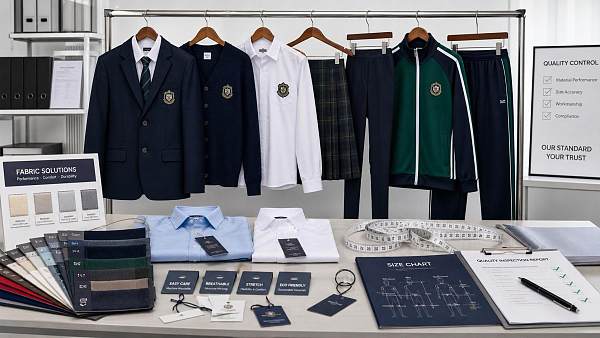
Reliable sizing begins with a documented measurement process. That usually includes chest, waist, hip, inseam, outseam, sleeve length, and body height, captured in a consistent format and verified before production release.
Fit kits or sample sets are especially useful for larger orders. They reduce interpretation errors and help confirm how a specific pattern block behaves on real wearers rather than on a chart alone.
Growth, turnover, and replacement planning
School programs deal with roster turnover and physical growth more often than many commercial uniform categories. Because of that, some flexibility should be built into the sizing plan without making garments appear loose or uneven.
Expandable hems, adjustable waist features, and re-order consistency can extend useful life. More importantly, they make future additions look compatible with the original set rather than visually mismatched.
Custom options should support identity, not complicate execution
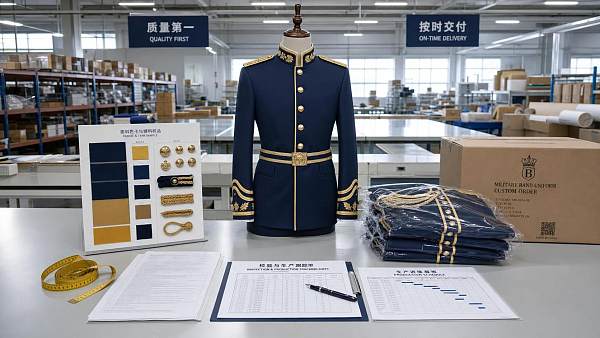
Customization is often where marching band uniforms create the strongest visual signature. Color palettes, front panel shapes, sleeve accents, capes, shakos, plumes, and logo integration all contribute to a recognizable field presence.
Still, custom work performs best when it aligns with practical constraints. A dramatic concept can become difficult if lead times stretch, materials are hard to replace, or visual elements require specialized handling every season.
- Use school colors in ways that stay consistent across dye lots
- Confirm logo placement with visibility from long distance
- Limit fragile embellishments on high-contact areas
- Check whether accessories can be reordered separately
- Request digital renderings and material swatches before approval
From a sourcing perspective, customization should be reviewed like any OEM or ODM project. Technical drawings, bill of materials, color references, and sample sign-off reduce the risk of visual drift between concept and delivered uniforms.
How supplier evaluation changes the outcome
Not all suppliers approach marching band uniforms with the same operational depth. Some focus on decoration and presentation, while others have stronger control over patterning, textile sourcing, repeat orders, and delivery scheduling.
This is where a broader B2B sourcing lens becomes valuable. GCT’s market approach emphasizes the same factors that matter here: verified capability, design execution, compliance awareness, and supply chain dependability.
A credible supplier discussion should cover more than unit price. Sample approval process, production capacity, QC checkpoints, packaging methods, labeling, and post-delivery support are all relevant to total project performance.
Typical use cases and sourcing priorities
Different programs prioritize marching band uniforms differently. The right specification depends on performance style, frequency of use, travel demands, and how much visual customization is required.
Field competition programs
These programs often value lightweight construction, strong movement compatibility, and bold visual identity. Fast changes, weather exposure, and long performance days usually push breathable fabrics higher on the priority list.
Parade-focused ensembles
Here, structure and ceremonial presence may matter more. Long walking durations still make comfort important, but appearance from street-level viewing often drives choices in silhouette, trim, and headwear coordination.
Multi-event school programs
Programs covering assemblies, community events, football games, and competitions often need versatility most of all. Modular marching band uniforms or interchangeable accessories can provide a practical middle path.
A practical way to move from idea to decision
The strongest uniform projects usually begin with a written comparison framework. That framework should connect design intent to measurable criteria, then test supplier responses against those same benchmarks.
- Define expected service life and annual usage level
- Prioritize fabric performance by local climate conditions
- Standardize measurement and fit approval procedures
- Review custom elements for maintenance impact
- Compare reorder terms, lead times, and spare availability
- Validate samples before final volume commitment
In other words, effective sourcing of marching band uniforms depends on seeing the garment as both a creative asset and an operational system. Once those two dimensions are evaluated together, the final choice becomes far easier to justify and sustain.
The next step is usually not to chase the most elaborate concept first. It is to clarify performance conditions, fit requirements, and customization priorities, then compare suppliers against that real-world brief.
Search News
Hot Articles
Popular Tags
Need ExpertConsultation?
Connect with our specialized leisureengineering team for procurementstrategies.
Recommended News
 Oct 19, 2026Choosing a Wholesale Chef Coat Supplier: MOQs, Samples, and Lead TimesChoose a wholesale chef coats supplier with confidence. Compare MOQs, test samples, and verify lead times to avoid excess stock, control costs, and keep your kitchen team ready.● Institutional Buyer
 Sep 21, 2026How Schools Can Cut Printing Costs When Buying Ink Cartridges in BulkSchool ink cartridges wholesale made smarter: cut printing costs with fleet planning, cost-per-page comparisons, reliable suppliers, and inventory controls.● Institutional Buyer
 Sep 17, 2026How to Source Wholesale Packing Tape Without Compromising Carton Seal StrengthWholesale packing tape sourcing guide: compare adhesive, backing, carton conditions, and real-world trials to reduce costs while maintaining reliable carton seal strength.● Institutional Buyer
 Sep 05, 2026How to Buy Geometry Sets in Bulk for Schools: A Practical Procurement ChecklistGeometry sets bulk buying guide for schools: compare safety, quality, compliance, packaging, supplier reliability, and total cost for smarter procurement.● Institutional Buyer
 Aug 31, 2026Microscope Slides Market Outlook: Demand Drivers, Segments, and Sourcing RisksExplore the microscope slides market: key demand drivers, product segments, quality risks, and sourcing strategies for reliable laboratory supply.● Institutional Buyer
 Aug 30, 2026Microscope Slides HS Code: How Importers Classify Laboratory Glass Slides CorrectlyMicroscope slides HS code guide: learn how to classify laboratory glass slides accurately, verify materials, avoid customs delays, and improve import compliance.● Institutional Buyer
 Aug 29, 2026How to Choose Graduation Tassels With Year Charms for Large School OrdersGraduation tassels with year charm: learn how to specify colors, materials, packaging, proofs, and delivery timelines for accurate large school orders.● Institutional Buyer
 Aug 11, 2026How to Choose Alphabet Educational Posters for Different Classroom Age GroupsAlphabet educational posters should match how each age group learns. Discover how to choose safer, clearer, curriculum-ready designs for preschool to primary classrooms.● Institutional Buyer
 Aug 05, 2026How to Evaluate a Marching Band Uniform Manufacturer for Quality and On-Time DeliveryMarching band uniform manufacturer selection starts with delivery risk. Learn how to compare quality, sizing, compliance, and capacity for reliable, on-time orders.● Institutional Buyer
 Jul 20, 2026How to Evaluate a Stationery Distributor for Bulk Office and School Supply PurchasingStationery distributor selection affects cost, delivery, and compliance. Learn how to evaluate suppliers for bulk office and school supply purchasing with confidence.● Institutional Buyer
 Jul 18, 2026How to Choose Custom Hotel Uniforms: Fabric, Branding, Comfort, and DurabilityCustom hotel uniforms guide: learn how to choose the right fabric, branding, comfort, and durability to improve staff performance, strengthen hotel image, and reduce long-term costs.● Institutional Buyer
 Jul 15, 2026How to Choose a Clear Pencil Cases Manufacturer for School and Retail OrdersClear pencil cases manufacturer selection made simple: learn how to compare quality, compliance, customization, pricing, and lead times for school and retail orders.● Institutional Buyer
 Jul 14, 2026How to Evaluate a Hole Punches Wholesale Supplier for Quality, MOQ, and Lead TimeHole punches wholesale supplier selection starts with quality, MOQ, and lead time. Learn practical checks, warning signs, and sourcing tips to reduce risk and buy smarter.● Institutional Buyer
 Jul 13, 2026Wholesale Erasers and Sharpeners: How to Compare Materials, Packaging, and MOQWholesale erasers and sharpeners buying guide: compare materials, packaging, and MOQ to cut risk, improve quality, and choose suppliers with better value.● Institutional Buyer
 Jul 10, 2026Custom Housekeeping Uniforms: What Fabrics and Features Hold Up in Daily Hotel Use?Custom housekeeping uniforms that last: discover the best fabrics, stretch, stain resistance, and hotel-ready features to cut replacement costs and keep staff polished daily.● Institutional Buyer
 Jul 08, 2026Fast Warm Up Laminator Buying Guide: Speed, Film Thickness, and Use Case ExplainedFast warm up laminator buying guide covering warm-up speed, film thickness, and real use cases. Compare specs, avoid buying mistakes, and choose the right model with confidence.● Institutional Buyer
 Jul 08, 2026How to Choose School Supplies for Campuses by Grade Level, Budget, and Daily UseSchool supplies for campuses made simple: learn how to choose by grade level, budget, durability, and daily use to reduce waste, improve sourcing, and support every classroom.● Institutional Buyer
 Jul 05, 2026How to Choose Branded Office Stationery for Corporate Use and Budget ControlBranded office stationery buying guide: learn how to balance quality, customization, supplier comparison, and budget control for consistent branding and smarter corporate sourcing.● Institutional Buyer
 Jul 01, 2026Paper Guillotines Buying Guide: Manual vs Electric, Cut Size, and Safety FeaturesPaper guillotines buying guide covering manual vs electric models, cut size, and safety features. Compare costs, productivity, and key specs to choose the right machine.● Institutional Buyer
 Jun 29, 2026Bingo Cages and Balls: Sizes, Materials, and What Affects Game VisibilityBingo cages and balls guide: compare sizes, materials, contrast, and durability to improve visibility, fairness, and long-term value in commercial and event play.● Institutional Buyer
 Jun 25, 2026School Uniforms in Europe: Materials, Sizing, and Compliance Points for Bulk OrdersSchool uniforms Europe sourcing guide: compare materials, sizing accuracy, and EU compliance points for bulk orders to reduce risk, improve durability, and choose suppliers with confidence.● Institutional Buyer
 Jun 23, 2026Wholesale Playing Cards Casino Buying Guide: Paper Stock, Finish, Security, and MOQWholesale playing cards casino buying guide covering paper stock, finish, security features, and MOQ. Compare suppliers smarter, reduce sourcing risk, and choose casino-grade decks with confidence.● Institutional Buyer
 Jun 22, 2026Eco Friendly Office Stationery: What to Check Before Buying for Daily Business UseEco friendly office stationery buying guide for businesses: learn how to check materials, certifications, durability, supplier reliability, and total cost before choosing daily office supplies.● Institutional Buyer
 Jun 21, 2026How to Choose Custom Promotional Pens for Trade Shows, Schools, and Corporate GiveawaysCustom promotional pens: learn how to choose the right styles for trade shows, schools, and corporate giveaways with tips on quality, branding, durability, and sourcing.● Institutional Buyer