Microscope Slides HS Code: How Importers Classify Laboratory Glass Slides Correctly
A laboratory shipment can look straightforward until it reaches customs: cartons of plain glass microscope slides, clearly labeled, packed for educational or analytical use, with a supplier invoice that simply says “glass slides.” Then the broker asks for the tariff classification, the purchase order shows a different description, and someone notices that the supplier has used a code intended for general glass articles rather than laboratory glassware.
This is a common source of avoidable friction. A microscope slide is physically simple, but customs classification is not based on appearance alone. Material composition, functional use, product form, coating, and the importing country’s tariff schedule can all affect the final declaration. An inaccurate microscope slides HS code may lead to requests for clarification, amended entries, unexpected duty treatment, or documentation that no longer matches the goods on arrival. The practical fix is not to guess from a supplier’s prior shipment; it is to build a short, evidence-based classification process before the shipment is booked.
Start with the product that is actually being imported
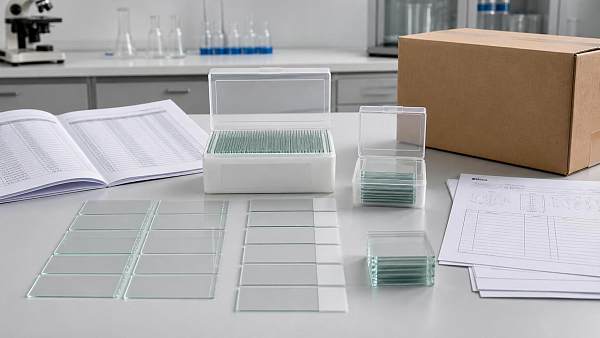
The phrase “microscope slide” covers several products that may look similar in a catalog but require different factual descriptions. A standard rectangular slide made from soda-lime glass is not necessarily documented in the same way as a frosted-end slide, a borosilicate slide, a cavity slide, a cover glass, or a prepared slide containing a mounted specimen.
Before selecting any code, isolate the imported article from its surrounding packaging and from any related laboratory product. Ask: is the shipment made up of empty glass slides for later use, or are the slides already prepared with specimens? Is it a slide, a thin cover glass, a slide storage box, or a kit containing several different articles? Customs classification normally follows the imported condition of the goods, not the intended purchase order category or the end user’s internal stock description.
For ordinary unmounted glass slides intended to hold samples for microscopic examination, the classification discussion commonly begins with HS heading 7017, covering laboratory, hygienic, or pharmaceutical glassware. Within this heading, the glass type is important. The internationally harmonized structure distinguishes fused quartz or fused silica, certain low-expansion glass, and other glass. In many practical cases, standard soda-lime microscope slides are reviewed under the residual “other glass” branch, while slides made from particular technical glass compositions may need closer assessment.
That starting point is useful, but it is not a substitute for verifying the current tariff schedule used by the country of import. The six-digit HS framework is internationally recognized, yet national customs tariffs often add further digits, notes, duty rates, statistical suffixes, or local interpretation rules. A code shown on a supplier’s commercial invoice may be suitable for export documentation in one market and still be incomplete or unsuitable for the import declaration elsewhere.
The detail that changes the classification conversation: glass composition
Many sourcing files describe slides by dimensions, edge finish, and packaging quantity, but omit the type of glass. That omission becomes a problem when a tariff heading separates articles according to the coefficient of expansion or whether the item is fused silica.
Do not assume that “laboratory-grade glass” identifies the material for tariff purposes. It is a commercial phrase, not a precise customs description. Request a supplier specification that states the substrate clearly, such as soda-lime glass, borosilicate glass, aluminosilicate glass, fused quartz, or fused silica. If the relevant tariff distinction depends on thermal expansion properties, ask whether the manufacturer can provide a technical data sheet or material declaration showing the applicable coefficient of linear expansion.
For routine blank slides, soda-lime glass is often the material described by suppliers. It is generally distinct from fused silica and may also fall outside low-expansion categories used in the HS text. However, the correct legal conclusion should come from the tariff language, explanatory guidance where available, and the product evidence—not from an assumption that every rectangular laboratory slide is the same.
When the supplier cannot identify the glass substrate, classification should not be finalized based only on a catalog photo. Escalate the request internally or to the customs intermediary before goods leave the factory. A short delay in documentation is usually easier to manage than correcting an entry after the goods have been declared.
Do not let coatings and surface treatments create vague descriptions
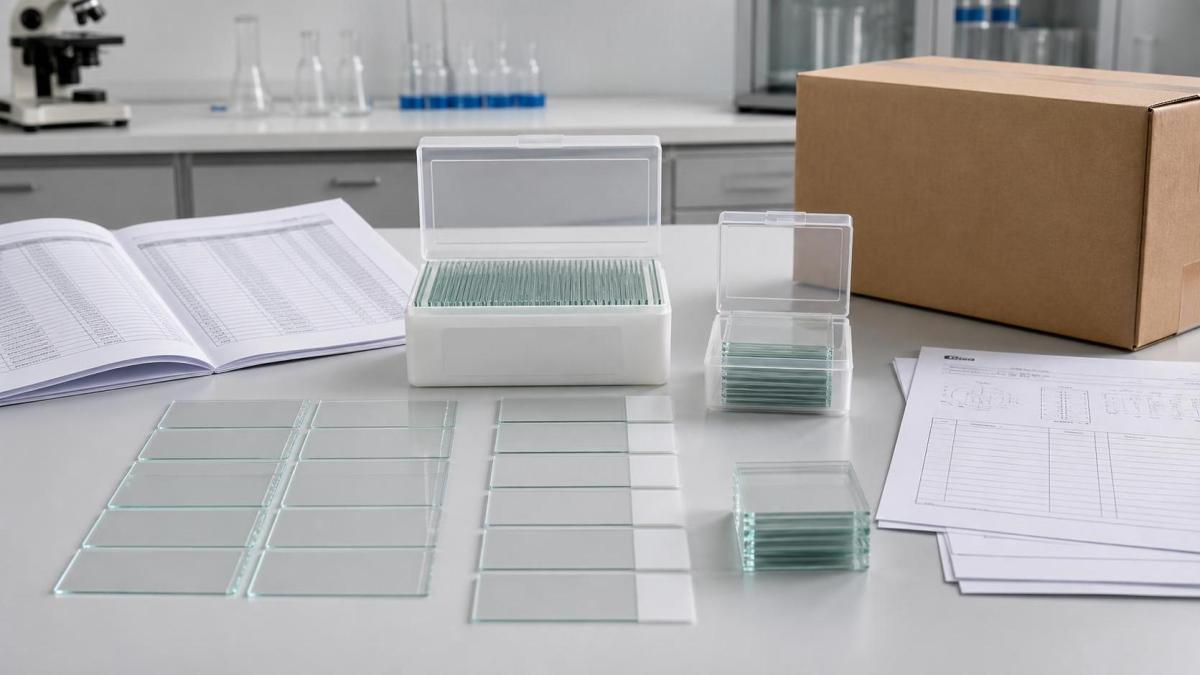
Slides are frequently supplied with frosted labeling ends, ground edges, polished edges, color coding, printed grids, hydrophilic treatments, adhesive coatings, or other surface modifications. These features can be commercially important, particularly where sample identification or specimen retention matters. They should be disclosed in the product description, but they do not automatically move the item out of the laboratory-glassware heading.
The key question is whether the treatment remains an accessory characteristic of a glass microscope slide or changes the essential nature of the imported article. A frosted writing area, for example, usually describes a modified slide rather than a different product family. By contrast, a slide imported with mounted biological material, a diagnostic reagent, or a substantial non-glass component may require a more detailed review of classification rules and applicable product controls.
A practical invoice description is more useful than a shortened label such as “slides” or “lab consumables.” It should identify the article, material, condition, and relevant treatment. For example:
“Unprepared microscope slides, rectangular soda-lime glass, ground edges, frosted labeling end, for laboratory microscopic examination.”
This wording does not itself determine the tariff code, but it gives the broker and customs reviewer facts that can be matched to the tariff text. If the slides are uncoated, state that only when the supplier can support it. If they are coated, name the coating or treatment rather than using broad language such as “special finish.”
Separate slides from cover glass, prepared slides, and mixed kits
One recurring error is treating every thin glass item used with a microscope as a microscope slide. Cover glass is a different form factor: usually much thinner and placed over a specimen on a slide. Although both products may be laboratory glass articles, they should be separately identified on invoices, packing lists, and itemized declarations. Combining them under one generic line makes it harder to confirm whether the stated microscope slides HS code truly applies to all contents.
Prepared slides need even more care. If a glass slide carries a permanently mounted specimen, tissue section, microorganism sample, or educational display material, the imported good may no longer be assessed solely as blank laboratory glassware. The specimen, the degree of preparation, and the purpose of the item can matter. It is not safe to transfer the code used for empty slides to prepared teaching sets or clinical reference slides without review.
Mixed kits also deserve a separate decision. A box containing only slides of different sizes may be simple to describe as a single product line if they share the same material and tariff treatment. A kit containing slides, cover glass, stains, collection tools, plastic holders, and instructions may require application of customs rules for sets, separate line items, or both. The retail packaging does not automatically decide the classification.
A workable review process before the commercial invoice is issued
The most reliable approach is to make classification part of product setup rather than an emergency task performed when cargo is already in transit. The following sequence is useful for recurring laboratory supply purchases and for one-off imports alike.
1. Build a product identity record
Use the manufacturer’s part number as the anchor. Record dimensions, thickness, glass composition, edge type, surface treatment, whether the slide is blank or prepared, and the number of pieces per retail box and master carton. If one part number changes from soda-lime to borosilicate glass, treat it as a material change that may require renewed classification review.
2. Read the tariff wording before searching old invoices
Previous entries can be useful evidence, but they are not binding proof that the same treatment remains appropriate. Search the current national tariff database for heading 7017 and read the hierarchy of headings, subheadings, legal notes, and any relevant explanatory material. First determine whether the product belongs in laboratory glassware; then test which material-based subheading describes it most specifically.
3. Compare the tariff description against supplier evidence
Match each meaningful phrase in the tariff provision with a document. “Glassware for laboratory purposes” can be supported by the product catalog, intended-use statement, and product design. Glass composition can be supported by a specification sheet or declaration. The goal is not to collect paperwork for its own sake; it is to ensure that the declared facts are consistent across the invoice, packing list, catalog, and customs entry.
4. Confirm the country-specific extension
The first six digits of an HS classification may be shared internationally, but customs declarations generally require the local tariff number. Verify the full code required by the import destination, including any extra digits or suffixes. Duty treatment, trade remedies, licensing requirements, and statistical reporting can depend on that more detailed national number.
5. Preserve the reasoning in the shipment file
Keep the tariff extract, product specification, supplier correspondence, and final description together. If the same slide is imported repeatedly, this file becomes a controlled reference. It also makes future reviews faster when a supplier changes factory location, packaging, coating, or material source.
Where classification mistakes usually begin
The first mistake is relying on a broad product name. “Glass microscope accessories” may be understandable to a warehouse team but does not show whether the goods are slides, cover glasses, or another article. The second is copying the export code from a supplier’s quotation without checking the destination tariff. The third is accepting “borosilicate” or “laboratory glass” without a supporting technical specification.
Another issue appears when an internal item master uses a single tariff code for an entire laboratory consumables category. That approach may seem efficient, but it can conceal material differences between products. Blank glass slides, prepared reference slides, plastic specimen containers, and cover glasses should not be assumed to share one classification merely because they are purchased from the same laboratory supplier.
Descriptions can also become inconsistent during handoffs. The purchase order may say “frosted microscope slides,” the invoice may say “glass sheets,” and the packing list may say “medical supplies.” Even where the tariff number is correct, those conflicting descriptions invite questions. Use one approved product description across purchasing, logistics, customs documentation, and inventory records.
When a broker or customs specialist should be involved
Routine blank slides made from clearly identified glass may be relatively straightforward, but some situations warrant professional review before declaration. These include slides made from fused silica or a low-expansion technical glass; prepared specimen slides; kits containing several different laboratory articles; products carrying chemicals or reagents; goods marketed for diagnostic or clinical applications; and shipments where a prior classification has been challenged or changed.
It is also sensible to seek formal guidance when the commercial value or shipment frequency makes an incorrect classification financially material. Depending on the destination, an importer may be able to request an advance classification ruling or similar written decision from the relevant customs authority. Such decisions are jurisdiction-specific and usually depend on complete, accurate product information. They are particularly useful when the same item will be imported repeatedly and the material characteristics are not obvious from visual inspection.
Keeping the classification accurate after the first shipment
A classification record should be revisited when the product changes, even if the catalog name stays the same. A new anti-fog coating, revised glass substrate, added printed grid, different slide thickness, or a shift from blank slides to prepared slides can affect the factual basis of the original decision. The same applies when goods move to a different import market with its own tariff extensions.
For day-to-day control, a concise internal record is usually enough: manufacturer part number, approved commercial description, material evidence, destination-specific tariff number, date of review, and the person or external adviser who confirmed it. This is more dependable than keeping a code only in an email thread or relying on a supplier’s invoice template.
Correct microscope slides HS code classification is ultimately a documentation discipline. Identify the imported article precisely, verify the glass composition, distinguish blank slides from related products, and confirm the destination’s full tariff requirement before the invoice is finalized. When those steps are done early, the customs declaration reflects the goods as they are—not as they were loosely described at the start of the purchase.
Search News
Hot Articles
- Pro Stage AudioDesigning Theater Sound Systems for Clear Dialogue and Even Audience CoverageOct 15, 2026
- Musical InstrumentsHow Do You Choose Music Education Equipment for a New Campus?Oct 15, 2026
- Arcade & VR MachinesChoosing a Racing Simulator Cockpit for an FEC: Durability and Guest FitOct 14, 2026
Popular Tags
Need ExpertConsultation?
Connect with our specialized leisureengineering team for procurementstrategies.
Recommended News
 Sep 21, 2026How Schools Can Cut Printing Costs When Buying Ink Cartridges in BulkSchool ink cartridges wholesale made smarter: cut printing costs with fleet planning, cost-per-page comparisons, reliable suppliers, and inventory controls.● Institutional Buyer
 Sep 17, 2026How to Source Wholesale Packing Tape Without Compromising Carton Seal StrengthWholesale packing tape sourcing guide: compare adhesive, backing, carton conditions, and real-world trials to reduce costs while maintaining reliable carton seal strength.● Institutional Buyer
 Sep 05, 2026How to Buy Geometry Sets in Bulk for Schools: A Practical Procurement ChecklistGeometry sets bulk buying guide for schools: compare safety, quality, compliance, packaging, supplier reliability, and total cost for smarter procurement.● Institutional Buyer
 Aug 31, 2026Microscope Slides Market Outlook: Demand Drivers, Segments, and Sourcing RisksExplore the microscope slides market: key demand drivers, product segments, quality risks, and sourcing strategies for reliable laboratory supply.● Institutional Buyer
 Aug 30, 2026Microscope Slides HS Code: How Importers Classify Laboratory Glass Slides CorrectlyMicroscope slides HS code guide: learn how to classify laboratory glass slides accurately, verify materials, avoid customs delays, and improve import compliance.● Institutional Buyer
 Aug 29, 2026How to Choose Graduation Tassels With Year Charms for Large School OrdersGraduation tassels with year charm: learn how to specify colors, materials, packaging, proofs, and delivery timelines for accurate large school orders.● Institutional Buyer
 Aug 11, 2026How to Choose Alphabet Educational Posters for Different Classroom Age GroupsAlphabet educational posters should match how each age group learns. Discover how to choose safer, clearer, curriculum-ready designs for preschool to primary classrooms.● Institutional Buyer
 Aug 05, 2026How to Evaluate a Marching Band Uniform Manufacturer for Quality and On-Time DeliveryMarching band uniform manufacturer selection starts with delivery risk. Learn how to compare quality, sizing, compliance, and capacity for reliable, on-time orders.● Institutional Buyer
 Jul 20, 2026How to Evaluate a Stationery Distributor for Bulk Office and School Supply PurchasingStationery distributor selection affects cost, delivery, and compliance. Learn how to evaluate suppliers for bulk office and school supply purchasing with confidence.● Institutional Buyer
 Jul 18, 2026How to Choose Custom Hotel Uniforms: Fabric, Branding, Comfort, and DurabilityCustom hotel uniforms guide: learn how to choose the right fabric, branding, comfort, and durability to improve staff performance, strengthen hotel image, and reduce long-term costs.● Institutional Buyer
 Jul 15, 2026How to Choose a Clear Pencil Cases Manufacturer for School and Retail OrdersClear pencil cases manufacturer selection made simple: learn how to compare quality, compliance, customization, pricing, and lead times for school and retail orders.● Institutional Buyer
 Jul 14, 2026How to Evaluate a Hole Punches Wholesale Supplier for Quality, MOQ, and Lead TimeHole punches wholesale supplier selection starts with quality, MOQ, and lead time. Learn practical checks, warning signs, and sourcing tips to reduce risk and buy smarter.● Institutional Buyer
 Jul 13, 2026Wholesale Erasers and Sharpeners: How to Compare Materials, Packaging, and MOQWholesale erasers and sharpeners buying guide: compare materials, packaging, and MOQ to cut risk, improve quality, and choose suppliers with better value.● Institutional Buyer
 Jul 10, 2026Custom Housekeeping Uniforms: What Fabrics and Features Hold Up in Daily Hotel Use?Custom housekeeping uniforms that last: discover the best fabrics, stretch, stain resistance, and hotel-ready features to cut replacement costs and keep staff polished daily.● Institutional Buyer
 Jul 08, 2026Fast Warm Up Laminator Buying Guide: Speed, Film Thickness, and Use Case ExplainedFast warm up laminator buying guide covering warm-up speed, film thickness, and real use cases. Compare specs, avoid buying mistakes, and choose the right model with confidence.● Institutional Buyer
 Jul 08, 2026How to Choose School Supplies for Campuses by Grade Level, Budget, and Daily UseSchool supplies for campuses made simple: learn how to choose by grade level, budget, durability, and daily use to reduce waste, improve sourcing, and support every classroom.● Institutional Buyer
 Jul 05, 2026How to Choose Branded Office Stationery for Corporate Use and Budget ControlBranded office stationery buying guide: learn how to balance quality, customization, supplier comparison, and budget control for consistent branding and smarter corporate sourcing.● Institutional Buyer
 Jul 01, 2026Paper Guillotines Buying Guide: Manual vs Electric, Cut Size, and Safety FeaturesPaper guillotines buying guide covering manual vs electric models, cut size, and safety features. Compare costs, productivity, and key specs to choose the right machine.● Institutional Buyer
 Jun 29, 2026Bingo Cages and Balls: Sizes, Materials, and What Affects Game VisibilityBingo cages and balls guide: compare sizes, materials, contrast, and durability to improve visibility, fairness, and long-term value in commercial and event play.● Institutional Buyer
 Jun 25, 2026School Uniforms in Europe: Materials, Sizing, and Compliance Points for Bulk OrdersSchool uniforms Europe sourcing guide: compare materials, sizing accuracy, and EU compliance points for bulk orders to reduce risk, improve durability, and choose suppliers with confidence.● Institutional Buyer
 Jun 23, 2026Wholesale Playing Cards Casino Buying Guide: Paper Stock, Finish, Security, and MOQWholesale playing cards casino buying guide covering paper stock, finish, security features, and MOQ. Compare suppliers smarter, reduce sourcing risk, and choose casino-grade decks with confidence.● Institutional Buyer
 Jun 22, 2026Eco Friendly Office Stationery: What to Check Before Buying for Daily Business UseEco friendly office stationery buying guide for businesses: learn how to check materials, certifications, durability, supplier reliability, and total cost before choosing daily office supplies.● Institutional Buyer
 Jun 21, 2026How to Choose Custom Promotional Pens for Trade Shows, Schools, and Corporate GiveawaysCustom promotional pens: learn how to choose the right styles for trade shows, schools, and corporate giveaways with tips on quality, branding, durability, and sourcing.● Institutional Buyer
 Jun 16, 2026Microscope Slides Wholesale Buying Guide: Glass Types, Sizes, and MOQ FactorsMicroscope slides wholesale buying guide covering glass types, standard sizes, MOQ factors, and quality risks—compare smarter, reduce waste, and choose reliable bulk supply.● Institutional Buyer