A Practical Guide to Identifying Wooden Orchestral Instruments by Family and Tone
A wooden orchestral instrument is best identified by combining four clues: how sound begins, the shape of the body, the visible hardware, and the character of the sound it produces. Material alone is unreliable. A violin has a wooden body but belongs to the string family; a flute may be made of wood yet belongs to the woodwind family; many instruments called “woodwinds” are now also made from metal, resin, or composite materials. Family classification follows the sound-producing mechanism, while wood species and construction affect tone, response, durability, and appearance.
Start with the player’s physical action. A bow drawn across strings indicates a bowed string instrument. Air directed across an opening, through a reed, or into a cup-shaped mouthpiece indicates a woodwind. Then look for the details that separate close relatives: the number and type of strings, the presence of a double reed, the bore shape, the keywork, and the usual pitch range.
Separate wooden instruments by the source of vibration
In bowed string instruments, the string itself vibrates. The bridge transfers that energy to a thin wooden top plate, and the hollow body amplifies and colors the result. The player changes pitch by pressing strings against a fingerboard and changes articulation with bow speed, pressure, and contact point. These instruments can sustain a note as long as the bow continues to move.
In woodwinds, a column of air vibrates inside a tube. The sound may begin at an exposed edge, as with a flute, at a single reed, as with a clarinet or saxophone, or between two reeds, as with an oboe or bassoon. Keys open and close tone holes to alter the vibrating air column. Their sound can be sustained with breath, but phrasing is naturally shaped by the need to inhale.
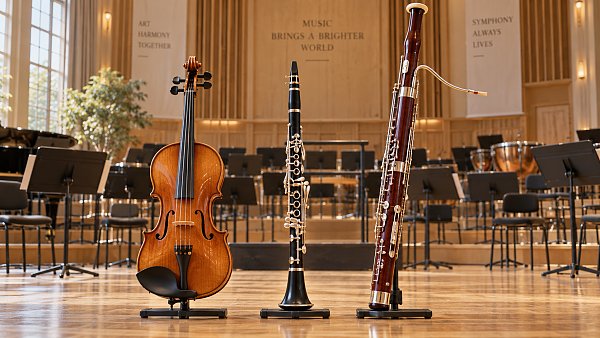
This distinction resolves a common visual mistake. A wooden clarinet and a small wooden violin both have elongated forms and polished surfaces, yet their sound systems have almost nothing in common. The clarinet relies on an enclosed air tube and reed; the violin depends on tensioned strings, bridge vibration, and a resonant wooden body.
Bowed strings: identifying the orchestral core
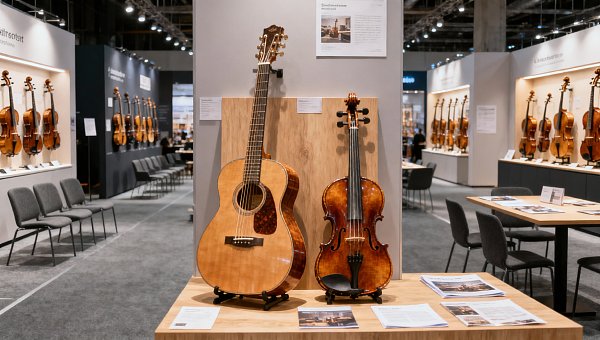
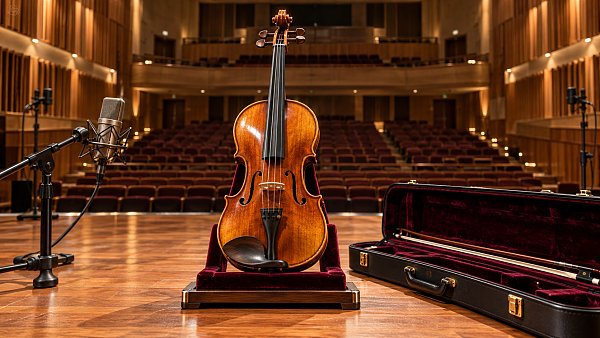
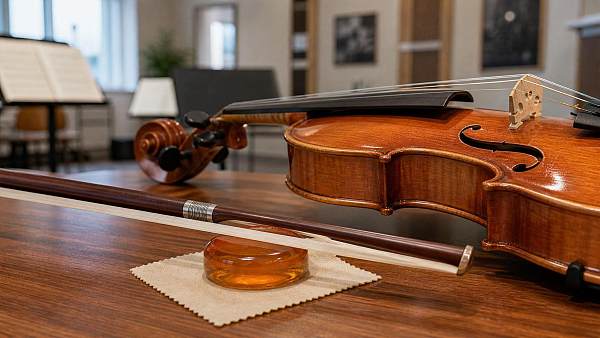
The violin, viola, cello, and double bass share a recognizable construction: curved upper and lower bouts, inward waist curves, f-shaped sound holes, a carved bridge, four strings, and a scroll at the top of the neck. Their bodies are commonly built from several pieces of wood rather than carved from one solid block. Spruce is widely associated with the soundboard because it is light and responsive across the grain, while maple is frequently used for the back, ribs, and neck because its density and stiffness support projection and structural stability. Ebony or a similarly dense material is often used for the fingerboard and fittings.
Violin
The violin is the smallest standard bowed string instrument and has the highest regular orchestral range of the four. Its compact body, short-scale fingerboard, and bright, immediate sound make it easy to recognize beside larger relatives. In a group, violins commonly carry agile melodic material, high sustained lines, and rapid bowing patterns. A warm violin is not necessarily a viola: bow placement, strings, setup, room acoustics, and recording balance can soften a violin’s usual brightness.
Viola
The viola resembles a violin but is larger, lower in pitch, and typically darker in color. Its body is not merely an enlarged violin body. The instrument is proportioned around a lower tuning, and its deeper middle register gives it a husky, covered quality that often blends between violins and cellos. Visual size helps, though viola dimensions vary more than violin dimensions. The most reliable clue is the tuning: a viola has a lower fifth string relationship than a violin and lacks the violin’s highest E string.
A frequent misidentification occurs when a small viola is compared with a large violin. Body length alone can mislead. The lower open-string pitch, broader sound, and slightly slower-feeling response provide better evidence than a few centimeters of outline difference.
Cello and double bass
The cello is played vertically with an endpin resting on the floor. Its body retains the violin-family outline, but its scale, rib depth, and low tuning give it a broad, vocal register. Cellos can sound tender and lyrical in the upper range, but their lower notes retain more weight and resonance than those of a viola. The endpin is a practical visual marker, although a cello without one may be photographed before setup or transport.
The double bass is substantially larger, with a longer neck and a lower register. Its shoulders often slope more noticeably than those of a cello, though shapes differ among orchestral models. It is normally played standing or from a high stool. The double bass may use a bow or be plucked, and its role often supports harmonic foundations and rhythmic pulse. A low bowed line can be difficult to classify by recording alone: close microphones can make a cello seem unusually large, while a lightly played bass can lose much of its expected depth.
Plucked wooden strings within orchestral settings
The harp is a wooden string instrument with an unmistakable triangular frame. Its strings run diagonally from a curved neck to a soundboard, with a vertical column completing the frame. Unlike the violin family, it is plucked rather than bowed. Pedals at the base alter string pitches through a mechanical linkage, allowing chromatic changes without retuning every string by hand. The harp’s sound tends to begin with a clear attack and decay naturally, even when the room adds reverberation.
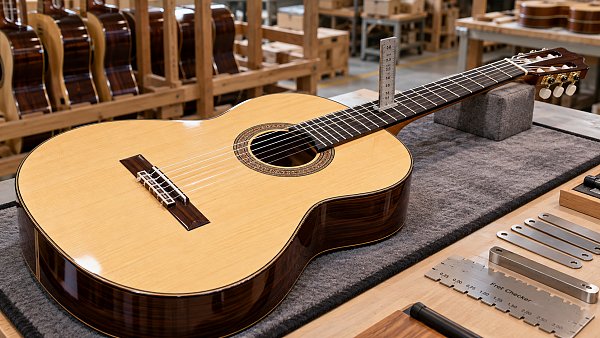
Classical guitar, mandolin, lute, and similar instruments may appear in chamber, theatrical, or crossover orchestral work, but they are not standard members of a symphony orchestra in the same way as violin, viola, cello, bass, and harp. Their wooden construction does not establish their ensemble role. When identifying an instrument in an orchestral inventory, distinguish between a core orchestral instrument and an instrument brought in for a particular score.
Wooden flutes: edge tone rather than reed tone
A wooden flute creates sound when the player directs air across a sharp edge at the embouchure hole. There is no vibrating reed. Traditional transverse flutes are held sideways, while recorders and some folk flutes are held vertically. In orchestral contexts, a wooden transverse flute is most likely a historical-style instrument, a specialist instrument, or a modern flute made in wood for a particular tonal preference.
Wooden flutes often present a rounder, less metallic attack than a metal concert flute, especially in the lower and middle registers. That description has limits. The player’s embouchure, headjoint design, wall thickness, bore geometry, and the recording environment strongly influence perceived brightness. A dark wooden exterior is also not proof of a wooden body; some instruments use stained finishes or composite components.
Look for the open blowing hole near one end and a series of finger holes or keys along the tube. The lack of a mouthpiece-and-reed assembly is the decisive clue. A flute’s tone can be airy, clear, or penetrating, but its sound begins at the edge of the air stream, not from reed vibration.
Single-reed instruments: clarinet and related voices
The clarinet is among the most recognizable wooden orchestral instruments. It has a mouthpiece fitted with one thin reed, a cylindrical body made of joined sections, a flared bell, and complex metal keywork. Many professional clarinets are made from dense hardwoods such as grenadilla, although student instruments are frequently resin-based. A wood-grain appearance should therefore be checked against the construction and model details rather than assumed from color.
Its tonal identity is unusually flexible. In the low register, the clarinet can sound dark, hollow, and rounded; in the middle register it often becomes warm and lyrical; higher notes gain brilliance and focus. This range of color comes partly from its cylindrical bore and its overblowing behavior. A clarinet does not simply become louder as it rises. The character of the sound changes markedly across registers, which is why a single audio excerpt can create confusion with oboe or flute.
The bass clarinet uses the same single-reed principle but has a longer air column, a curved metal neck, and usually a curved or upturned bell. Its lower, velvety sound makes it easy to mistake for a small bassoon in a recording, yet the bass clarinet’s reed is mounted on a mouthpiece rather than placed directly between the lips.
Saxophones also use a single reed, but their brass bodies and conical bores make them visually distinct from traditional wooden clarinets. They are not usually classified as wooden instruments even though their reed system places them in the woodwind family.
Double reeds: oboe, English horn, bassoon, and contrabassoon
Double-reed instruments create sound when two reeds vibrate against each other. The reed is more exposed to the player’s lips than a clarinet reed, and this contributes to their direct, concentrated response. Their tone is often described as reedy, nasal, penetrating, plaintive, or woody, but such labels should be treated as starting points rather than exact identifiers.
The oboe is a slender, straight instrument with a conical bore and a small flared bell. It has a narrow, focused sound that remains present even within dense orchestration. Its high register can be incisive, while slower lines often reveal a speaking, almost vocal quality. Because the oboe’s double reed is small, it may be difficult to see at a distance; the narrow metal tube, called a staple, between reed and body is a useful close-up clue.
The English horn, despite its name, belongs to the oboe family. It is larger, lower in pitch, and usually has a bent metal crook leading to the reed and a pear-shaped bell. Its voice is darker and more veiled than the oboe’s, with a melancholy quality in the middle register. Do not identify it only by its curved crook: some other woodwinds also use curved neck sections. The bulb-shaped bell and oboe-style reed together are more decisive.
The bassoon is built from a long wooden tube folded back on itself, creating two parallel wooden sections joined at the bottom. A curved metal bocal carries the double reed to the player. Its profile is complex, with long key rods, finger holes, and a boot joint at the base. The bassoon can sound dry and articulate in short notes, warm and sonorous in sustained passages, or comical when composers exploit its lower register. Those associations are musical uses, not fixed properties; careful playing produces an unexpectedly lyrical tone.
The contrabassoon is larger and lower than the bassoon, often with additional folded tubing and more visibly extended sections. Its purpose is not simply to make the bassoon louder. It reinforces the bottom of the woodwind spectrum with a rougher, more weighty resonance that can merge with low brass, cellos, and double basses.
Use tone carefully when visual clues are incomplete
Tone is valuable for identification, but it is never independent of context. A close microphone can emphasize breath noise, reed buzz, finger action, or bow friction that would be less apparent in a hall. A player’s technique changes the result substantially: a violin can produce a glassy, near-flute-like harmonic; a clarinet can produce a breathy attack; a bassoon can become remarkably smooth; an oboe can be softened by restrained dynamics and a resonant room.
Construction details that change the conclusion
Wood species influences response, but it cannot reliably identify an instrument family. Dense hardwoods are common in clarinets, oboes, and bassoons because they can be machined into stable, precise bores and tone-hole layouts. Spruce and maple dominate the violin family for different acoustic and structural reasons. Yet modern instruments may combine wood with metal, carbon fiber, resin, laminated components, or protective finishes. Classification still follows the vibrating element and the acoustic design.
Condition also changes what is heard. A loose bridge, worn strings, poorly seated soundpost, or damaged bow hair can make a string instrument sound thin or unstable. On a woodwind, a leaking pad, warped reed, blocked tone hole, or loose tenon can alter tuning and response enough to obscure its expected tonal profile. Cracks in wooden bodies deserve particular attention because humidity changes can affect both structural integrity and sealing. A surface mark is not always a crack, but a line that crosses the grain, opens under light pressure, or appears near a tone hole or joint requires closer inspection.
When the visual and tonal evidence disagree, prioritize the sound-producing mechanism. Identify the reed, embouchure edge, or string-and-bridge system first; then use body shape, range, and tone to determine the specific instrument. This approach avoids confusing material with family and turns a broad category of wooden orchestral instruments into a set of recognizable, practical distinctions.
Search News
Hot Articles
- Musical InstrumentsBuying Light Gauge Guitar Strings in Bulk: Specs, Pricing and Supplier ChecksNov 13, 2026
- Musical InstrumentsMusical Instrument Industry Seeks AI Acoustics and Smart Hardware TalentNov 12, 2026
- Commercial KitchenChoosing Resort Hotel Lobby Chandeliers: Size, Style and MaintenanceNov 12, 2026
Popular Tags
Need ExpertConsultation?
Connect with our specialized leisureengineering team for procurementstrategies.
Recommended News
 Nov 13, 2026Buying Light Gauge Guitar Strings in Bulk: Specs, Pricing and Supplier ChecksBuying light gauge guitar strings bulk? Compare gauges, materials, landed costs, and supplier quality checks to source confidently and avoid costly mistakes.● Pro Audio Engineer
 Nov 12, 2026Musical Instrument Industry Seeks AI Acoustics and Smart Hardware TalentAI acoustics and smart hardware talent are reshaping musical instrument development. Explore the hiring forecast and what it means for manufacturers and buyers.● Pro Audio Engineer
 Nov 02, 2026Choosing a Glockenspiel Supplier: Tuning, Quality and After-Sales SupportChoosing a glockenspiel supplier? Learn how to compare tuning, build quality, pricing and after-sales support to make a confident purchasing decision.● Pro Audio Engineer
 Oct 31, 2026Buying Tenor Ukuleles Wholesale: How to Evaluate Suppliers and MOQsBuying tenor ukuleles wholesale? Learn how to evaluate suppliers, negotiate MOQs, compare landed costs, and secure consistent quality with less inventory risk.● Pro Audio Engineer
 Oct 28, 2026Music China 2026 Opens Tomorrow, With 800-Plus Events Connecting TradeMusic China 2026 runs October 28–31 in Shanghai with 800-plus events. Explore industry forums, business matchmaking and sourcing insights for musical instrument buyers and suppliers.● Pro Audio Engineer
 Oct 20, 2026Choosing a Classical Guitar Manufacturer in China: Quality Checks Before OrderingSearching for “classical guitars manufacturer China”? Discover essential checks for materials, playability, and factory quality control to reduce costly returns and order with confidence.● Pro Audio Engineer
 Oct 17, 2026Professional String Instruments: How to Evaluate Tone, Response, and ProjectionCompare professional string instruments with expert tips on tone, response, and projection. Learn practical tests to choose the right instrument for your performance needs.● Pro Audio Engineer
 Oct 21, 2026How Do You Assess a Musical Instrument Manufacturer’s Export Capability?Learn how to assess a musical instrument manufacturer export capability. Discover six key checks for quality, compliance, shipping, and support to reduce risks and source confidently.● Pro Audio Engineer
 Oct 15, 2026How Do You Choose Music Education Equipment for a New Campus?Learn how to choose music education equipment for a new campus with practical tips on curriculum fit, acoustics, suppliers, and ownership costs. Equip classrooms confidently and avoid costly mistakes.● Pro Audio Engineer
 Oct 10, 2026A Practical Guide to Identifying Wooden Orchestral Instruments by Family and ToneWooden orchestral instruments made simple: identify strings, flutes, clarinets, oboes, and bassoons by sound source, design, and tone.● Pro Audio Engineer
 Sep 11, 2026How to Choose Touring Instrument Cases for Flights, Trucks, and Daily Load-InsInstrument cases for touring: learn how to balance flight protection, truck durability, weight, fit, and serviceable hardware for safer, faster load-ins.● Pro Audio Engineer
 Sep 07, 2026How to Choose Wood Frame Tambourines for Sound Quality and Long-Term UseWood frame tambourines: learn how to compare frame construction, jingle tone, head options, durability, and supplier quality for reliable long-term performance.● Pro Audio Engineer
 Sep 05, 2026How Often Should Music Education Equipment Be Serviced?How often should music education equipment be serviced? Explore practical schedules, maintenance tips, and lifecycle planning to keep instruments and audio systems reliable.● Pro Audio Engineer
 Aug 21, 2026How to Choose Marching Band Drums for Sound Projection, Weight, and DurabilityMarching band drums buying guide: learn how to balance sound projection, weight, and durability for better field performance, easier carrying, and longer-lasting value.● Pro Audio Engineer
 Aug 09, 2026How to Evaluate a MIDI Cable Manufacturer for Audio Quality and OEM ReliabilityMIDI cable manufacturer evaluation guide: learn how to assess signal stability, connector quality, OEM process control, and batch consistency to reduce failures and source with confidence.● Pro Audio Engineer
 Aug 08, 2026How to Evaluate a Trumpets OEM Manufacturer for Quality, MOQ, and Custom DesignTrumpets OEM manufacturer selection starts with quality, MOQ, and custom design control. Learn how to compare suppliers, reduce sourcing risk, and choose a reliable long-term factory partner.● Pro Audio Engineer
 Jul 27, 2026How to Source Conga Drums in Bulk for Schools, Bands, and Event ProgramsConga drums bulk sourcing for schools, bands, and event programs made easier. Learn how to compare quality, durability, compliance, and total cost before you place a large order.● Pro Audio Engineer
 Jul 24, 2026How to Choose Low Dust Violin Rosin for Cleaner Practice and Better Bow ControlLow dust violin rosin buying guide: learn how to compare formula, climate fit, grip, and string compatibility for cleaner practice, better bow control, and smarter purchase decisions.● Pro Audio Engineer
 Jul 15, 2026Plastic Tambourines Bulk Buying Guide: Sizes, Materials, and MOQ QuestionsPlastic tambourines bulk buying guide covering sizes, ABS vs PP materials, sound consistency, customization, and MOQ questions to help buyers cut risk and choose the right supplier.● Pro Audio Engineer
 Jul 13, 2026Acoustic Guitars Wholesale China: How to Evaluate Build Quality and OEM OptionsAcoustic guitars wholesale China guide: learn how to assess build quality, factory consistency, and OEM options to choose reliable suppliers and reduce sourcing risk.● Pro Audio Engineer
 Jul 12, 2026Mini Effect Pedals Wholesale: MOQ, OEM Options, Testing, and Supplier ComparisonMini effect pedals wholesale guide covering MOQ, OEM options, testing standards, and supplier comparison to help buyers reduce risk, improve margins, and choose reliable partners.● Pro Audio Engineer
 Jul 11, 2026DJ Turntables OEM Guide: Key Torque, Drive, and Build Specs to CompareDJ turntables OEM guide covering torque, drive type, speed stability, platter build, and manufacturing consistency. Compare the specs that impact performance, reliability, and sourcing confidence.● Pro Audio Engineer
 Jul 08, 2026Guitar Capos Wholesale: What Materials, Clamp Types, and MOQ Terms Should You Compare?Guitar capos wholesale buying starts with more than price. Compare materials, clamp types, quality checks, and MOQ terms to reduce returns, protect margins, and choose a supplier with confidence.● Pro Audio Engineer
 Jul 07, 2026Birch Drum Kits Manufacturer Comparison: Shell Construction, Hardware Quality, and OEM OptionsBirch drum kits manufacturer comparison covering shell construction, hardware quality, and OEM options to help buyers reduce sourcing risk and choose reliable suppliers.● Pro Audio Engineer