Wholesale Quartz Iced-Out Watches: How to Evaluate Suppliers
When sourcing quartz iced out watches wholesale, the lowest unit quote can conceal the most expensive problems: inconsistent movements, loose stones, plating variation, and unclear responsibility for defects. A supplier worth shortlisting should be able to describe exactly what goes into the watch, produce a representative sample, and commit to inspection and delivery terms that support your retail margins.
The right evaluation depends on your sales model. A promotional buyer may prioritize a controlled landed cost and a short product life, while a private-label retailer needs repeatable finishes, replacement parts, and tighter control over branding. In either case, compare suppliers against the same written specifications before comparing their prices.
Build a comparable supplier brief before requesting quotes
Watch quotations are difficult to compare when one supplier prices a plated alloy case with glass stones and another assumes stainless steel with cubic zirconia. A photograph rarely reveals those differences. Give each supplier the same brief covering case and bracelet materials, finish, movement, stone type, packaging, branding, order quantity, destination, and required delivery window.
Ask suppliers to identify which elements they manufacture, assemble, or purchase from other companies. A trading company may be an effective partner if it can control specifications and resolve problems across its supply chain. Direct factory access can offer clearer production oversight, but a factory may still source movements, stones, plating, or packaging externally. The practical question is who accepts responsibility for the finished watch.
Request an itemized quotation that separates the watch, custom tooling or artwork, packaging, inspection, freight, and any other charges. Where a quote excludes a cost, record that exclusion. This creates a common basis for comparing offers and exposes differences before they become purchase-order disputes.
Assess the watch components that drive quality and cost
Quartz movement and serviceability
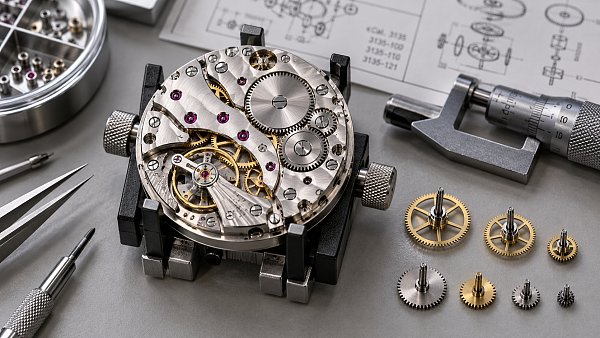
Ask for the movement manufacturer and model, battery specification, and whether the movement is new. A precise model reference makes it easier to assess replacement availability and distinguish a defined component from a generic claim such as “premium quartz movement.” If the supplier proposes an equivalent movement, require approval before substitution; a replacement can affect hands, dial layout, case fit, and servicing.
For fashion-led, short-run promotions, a basic movement may be commercially appropriate if the expected selling price and after-sales policy reflect it. A retailer planning repeat orders or warranty support has a stronger reason to prioritize identifiable movements and access to replacement components. In both cases, the sample should run, set, and reset correctly, with hands aligned and no interference between them.
Stones, settings, and appearance
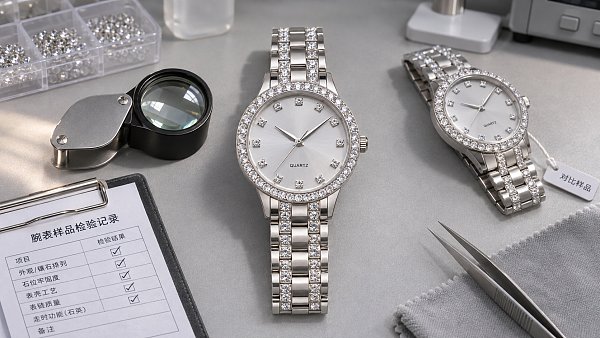
“Iced out” describes a visual style, not a stone specification. Ask whether the decoration uses glass, cubic zirconia, synthetic gemstones, natural stones, or a combination. Obtain the description in writing for each relevant area, including the bezel, dial, case, and bracelet. Stone size, color, arrangement, and setting method also affect appearance and labor cost.
Examine the sample under ordinary retail lighting as well as close inspection. Look for missing or uneven stones, visible adhesive, irregular spacing, and sharp or raised edges that could catch on clothing. Gently handle the bracelet and operate the clasp while checking whether the decorated surfaces remain intact. This is a useful screening step, but it does not establish long-term durability.
Dense decoration increases the number of individual settings that need attention. A heavily iced bracelet may justify a higher inspection effort than a watch with stones confined to the bezel. If your sales channel depends on close-up photography or premium presentation, small visual inconsistencies can be more commercially significant than they would be in a low-cost promotional item.
Case, bracelet, and finish
Specify the base material separately from the visible coating. “Gold tone,” for example, describes an appearance; it does not establish the base metal or the composition of a coating. Ask how the finish is applied and whether different components receive the same treatment. Compare the case, bracelet, clasp, and any exposed case-back edges for color and finish consistency.
Check bracelet articulation, link alignment, clasp closure, and any adjustment mechanism. A sample that looks impressive in a display box may feel uncomfortable or operate poorly when worn. If customers will resize the bracelet, agree on the link-removal method and whether appropriate instructions or tools are included.
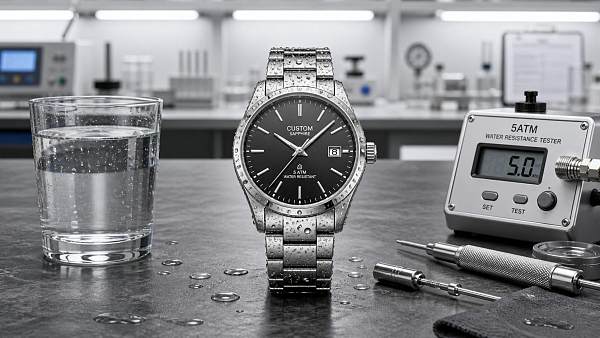
Water-resistance language needs the same discipline. A decorative watch should not be advertised for swimming or other water exposure simply because it has a sealed-looking case. If a water-resistance claim is commercially necessary, specify the claim and the supporting test requirements in the order; consider how battery changes and servicing may affect the seal.
Use samples to test consistency, not just design
Request a sample built to the proposed production specification, including the final movement, finish, stones, logo, clasp, and packaging wherever possible. Identify any component that differs from the intended order. A sample with upgraded materials or hand-selected decoration may demonstrate a design but gives a weak basis for judging the quoted production.
For a meaningful comparison, assess samples from shortlisted suppliers against the same criteria. Keep an approved reference sample and record its specifications, photographs, and any agreed tolerances. The purchase order should identify that reference and state how deviations will be handled.
Where order size justifies it, request more than one sample or review a pre-production batch. Variation between pieces can reveal issues that a single carefully prepared sample will not show. This is especially useful for stone placement, plating color, logo positioning, and bracelet fit. For a small test order, the added sample cost may not be proportionate; a clear specification and inspection agreement remain essential.
Agree on defect categories before production. A nonworking movement or missing stone may make a watch unsellable, while a minor cosmetic variation may be acceptable for a value-priced line. Define what constitutes an unacceptable defect, how inspected units are selected, and what happens if the shipment fails the agreed criteria. Without these decisions, “good quality” leaves too much room for disagreement.
Verify production capability and supply-chain control
Ask for a production schedule that shows material procurement, sample approval, assembly, inspection, packing, and dispatch. A supplier should explain which stages depend on outside partners and what happens if a movement, stone, or packaging component becomes unavailable. The most useful capacity discussion addresses your actual order size and delivery window, including other commitments that could compete for production time.
Request evidence appropriate to the order: business registration details, facility information, recent production examples, and relevant inspection records. For a substantial or ongoing program, a facility visit or independent factory assessment can provide stronger visibility into assembly practices and traceability. For a small trial, a video walkthrough and a controlled first order may provide a more proportionate starting point.
Do not confuse the ability to make one attractive prototype with the ability to reproduce it across a shipment. Ask how the supplier controls incoming movements and stones, separates approved components, checks finished watches, and records defects. If it offers custom work, establish who owns the artwork and tooling, whether the design can be sold to others, and how reorder specifications will be retained.
Compare landed cost and commercial terms
The purchase price is only one part of the decision. A lower quote can lose its advantage when packaging, inspection, freight, import charges, defects, and replacement stock are included. Compare suppliers using the same destination and delivery assumptions, then assess the operational cost of their proposed terms.
Confirm the delivery term and named delivery point in the contract so each party understands its transport and customs responsibilities. Ask how the supplier handles cost changes between quote and reorder, especially if the movement, coating, or packaging comes from another source. A fixed initial quote does not necessarily establish the price of a later production run.
Negotiate payment milestones alongside production and inspection milestones. The balance should reflect the work and materials committed by the supplier while preserving an agreed opportunity to inspect goods before final payment or dispatch. Put the remedy for late delivery, unauthorized substitution, and failed inspection into the purchase order rather than relying on informal assurances.
Plan compliance and after-sales support before placing the order
Requirements depend on the destination, intended customer, materials, and product claims. Provide the supplier with the target market and ask for documentation relevant to the actual watch and packaging, including material information and any applicable product, battery, labeling, or transport requirements. Match documents to the supplied components and production specification; a general certificate or an unrelated model’s report does not establish that the ordered watch meets your requirements.
Agree on how warranty claims will work in practice. Identify which faults qualify, the period and procedure in your agreement, who pays freight, and whether the remedy is repair, replacement, or credit. For private-label programs, ask whether movements, bracelets, clasps, and matching decorative components can be supplied for service or replacement. If the design changes frequently, retaining a modest quantity of agreed spare components may be more useful than a broad promise of future support.
Before authorizing production, reconcile the final quotation, approved sample, component list, delivery schedule, inspection criteria, and purchase order. A supplier that can align those documents and explain responsibility for the finished product is easier to manage than one offering an attractive price with specifications left open.
Search News
Hot Articles
Popular Tags
Need ExpertConsultation?
Connect with our specialized leisureengineering team for procurementstrategies.
Recommended News
 Nov 24, 2026Wholesale Quartz Iced-Out Watches: How to Evaluate SuppliersSourcing quartz iced out watches wholesale? Learn how to compare suppliers, verify quality, control landed costs, and protect your margins.● Luxury Retail Analyst
 Oct 21, 2026Watch Movement Parts: How to Check Compatibility With a Specific CaliberWatchmaking components and movement parts must match your exact caliber. Learn how to verify references, dimensions, and performance to avoid costly mismatches and source with confidence.● Luxury Retail Analyst
 Sep 08, 2026Water-Resistant Commercial Watches: Choosing Ratings for Workwear and Promotional UseWater resistant commercial watch guide: match 3, 5, or 10 ATM ratings to workwear and promotional needs, verify testing, and protect your budget and brand.● Luxury Retail Analyst
 Sep 07, 2026Commercial Watch Bulk Orders: How to Evaluate Pricing Tiers, Lead Times, and SamplesCommercial watch bulk order guide: evaluate pricing tiers, lead times, samples, landed costs, and supplier readiness to protect margins and launch on schedule.● Luxury Retail Analyst
 Sep 06, 2026Private Label Commercial Watches: A Buyer's Checklist for Branding, MOQ, and QCPrivate label commercial watch sourcing made simple: explore branding, MOQ, materials, supplier QC, and approval steps to build a reliable, market-ready watch program.● Luxury Retail Analyst
 Aug 16, 2026Where to Source Moissanite Iced Out Watches Wholesale Without Sacrificing QualityMoissanite iced out watches wholesale buyers: learn how to source factory-direct quality, verify stone setting and plating, and reduce risk before placing bulk orders.● Luxury Retail Analyst
 Aug 12, 2026How to Evaluate Luxury Watch Winders Wholesale for Retail and Gift Supply?Luxury watch winders wholesale buying guide: learn how to assess quality, noise, compatibility, OEM options, and supplier risk for retail, hospitality, and premium gift supply.● Luxury Retail Analyst
 Jul 15, 2026Kids Smart Watches for School: Key Features Parents Should Compare Before BuyingKids smart watches for school: compare school mode, safe calling, GPS accuracy, battery life, comfort, and privacy controls before you buy the best fit for your child.● Luxury Retail Analyst
 Jul 07, 2026Wholesale Mechanical Watches Stainless Steel: What to Check Before Placing a Bulk OrderWholesale mechanical watches stainless steel sourcing guide: learn how to verify movement quality, steel grade, compliance, and supplier reliability before placing a bulk order.● Luxury Retail Analyst
 Jul 05, 2026Nurse Watches Bulk Buying Guide: Styles, Compliance, and Order QuantitiesNurse watches bulk buying made simple: compare styles, compliance checks, MOQ strategy, and supplier reliability to reduce risk and place smarter orders.● Luxury Retail Analyst
 Jul 05, 2026Stainless Steel Watch Bands Clasp Guide: Types, Fit, and Common Locking IssuesStainless steel watch bands clasp guide covering clasp types, fit checks, and common locking issues. Learn how to compare options, avoid failures, and choose a secure, comfortable band with confidence.● Luxury Retail Analyst
 Jun 30, 2026SASO Arabic UI Rule Tightens Smartwatch ExportsSASO Arabic UI Rule Tightens Smartwatch Exports as Saudi Arabia mandates full Arabic support by Oct 1, 2026. Learn the compliance risks, testing impact, and export actions now.● Luxury Retail Analyst
 Jun 30, 2026How to Source Silicone Watch Bands Bulk: MOQ, Material Grades, and OEM OptionsSilicone watch bands bulk sourcing made simple: compare MOQ, material grades, quality control, and OEM options to reduce risk, choose reliable suppliers, and buy with confidence.● Luxury Retail Analyst
 Jun 29, 2026Saudi SASO Adds Arabic UI Check for SmartwatchesSaudi SASO Adds Arabic UI Check for Smartwatches: learn how the 2026 Arabic UI verification may affect OEM models, certification, imports, and retail listings in Saudi Arabia.● Luxury Retail Analyst
 Jun 17, 2026Automatic Watches OEM Explained: Movement Options, Case Materials, and CustomizationAutomatic watches OEM explained: compare movement options, case materials, and customization factors that shape quality, brand value, and supplier reliability.● Luxury Retail Analyst
 Jun 11, 2026REACH SVHC Update Hits Watch OEMs and SmartwatchesREACH SVHC update puts Watch OEM and smartwatch exports to the EU under new pressure. See how SCIP filing, supplier declarations, and material checks can protect shipments before the 2026 deadline.● Luxury Retail Analyst
 Jun 10, 2026REACH SVHC Update Adds New Watch Export Compliance DutiesREACH SVHC update puts Watch OEM and smartwatch exporters under new EU compliance pressure. Learn the new SCIP duties, 0.1% threshold risks, and what teams must do before December 2026.● Luxury Retail Analyst
 Jun 08, 2026Commercial Watch vs Retail Watch: Key Differences in OEM Specs, Pricing, and Use CasesCommercial watch vs retail watch: discover key OEM specs, pricing factors, and use cases to choose the right sourcing strategy, reduce risk, and improve brand fit.● Luxury Retail Analyst
 Jun 05, 2026Watch Hands and Crowns: Key Specs to Check for OEM Repair and AssemblyWatch hands and crowns for OEM repair and assembly: learn the key specs to verify for fit, sealing, durability, and repeatable quality before approval.● Luxury Retail Analyst
 Jun 02, 2026Sapphire Watch Glass vs Mineral Glass: Durability, Clarity, and Cost DifferencesSapphire watch glass vs mineral glass: compare scratch resistance, clarity, impact behavior, and cost to choose the right lens for premium or value-driven watches.● Luxury Retail Analyst
 May 23, 2026What should buyers check before sourcing iced out watches wholesale?Iced out watches wholesale buyers should check material honesty, stone setting, durability, and supplier compliance before ordering to reduce returns and protect profit.● Luxury Retail Analyst
 May 02, 2026Zheng Qinwen’s Madrid Exit Delays EU Orders for Smart Tennis WearablesSmart tennis wearables face EU procurement delays after Zheng Qinwen’s Madrid Open exit — key for manufacturers navigating WTA data privacy guidelines.● Luxury Retail Analyst
 Apr 30, 2026What separates a commercial watch from a fashion driven modelCommercial watch buying explained: discover how durability, precision, serviceability, and channel fit separate true commercial models from fashion-led watches for retail, gifting, and hospitality.● Luxury Retail Analyst
 Apr 30, 2026ODM watches or private label, which model fits betterODM watches or private label? Compare speed, customization, MOQ, and sourcing risk to choose the best watch model for your brand, launch timeline, and profit goals.● Luxury Retail Analyst