ADA Playground Swings: How to Choose Seats for Inclusive Play
Choosing ADA playground swings involves more than selecting a seat that looks accessible. Project managers must balance user needs, safe transfer, support, clearances, surfacing, and long-term maintenance within the wider playground design.
From adaptive bucket seats to high-back options, each solution serves different abilities and project requirements. This guide explains how to evaluate swing seats, engage stakeholders, and assess relevant accessibility and safety standards before procurement.
The practical starting point is to specify a selection of seats within an accessible playground layout. No single swing accommodates every user, and a supportive seat alone does not establish compliance.
What should project managers decide first?
Begin with the people expected to use the playground: their age ranges, transfer needs, postural support requirements, and opportunities to play alongside friends or siblings.
Next, establish the project’s legal and technical requirements with the owner and accessibility adviser. In the United States, applicable obligations depend on the facility, project scope, and governing jurisdiction.
Treat the swing as a system comprising the seat, suspension, frame, approach, protective surfacing, and surrounding circulation. A weakness in any element can limit practical use.
For procurement, define performance and verification requirements before inviting bids. This gives suppliers a consistent basis for pricing and reduces the risk of expensive redesign.
Which swing seat types fit different users?
Compare seat types against real use scenarios rather than marketing labels. The right specification may combine several options so users can choose according to their abilities and preferences.
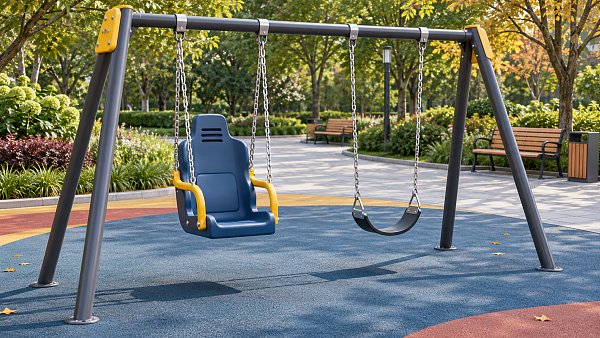
Adaptive bucket seats
Adaptive bucket seats surround the user’s hips and provide more lateral support than a flat belt seat. Some include a higher back or additional positioning features.
These seats can suit children who need help maintaining a seated position. Check the entry opening, usable dimensions, weight limit, and whether assistance is needed for transfer.
A bucket shape may make independent entry difficult for some users. Confirm that caregivers can assist without awkward lifting and that the seat fits the intended age group.
High-back supportive seats
High-back seats provide more support for the trunk and head than many conventional seats. Designs vary considerably in side support, seat depth, and restraint options.
They are useful where users need additional positioning support, but a taller back does not guarantee a good fit. Review head support and adjustment with informed stakeholders.
Check whether the seat’s size and suspension suit the selected frame and swing bay. Ask the supplier to identify compatible components and installation constraints in writing.
Belt and other conventional seats
Conventional belt seats serve many children who can transfer and maintain their position with limited support. They also offer a familiar, flexible play experience.
Including conventional seats alongside supportive options can expand choice and encourage shared play. However, their flexible shape may be unsuitable for users needing substantial postural support.
Group and nest swings
Group or nest swings can allow several users to play together and offer a larger surface for different seated or lying positions, depending on the design.
Do not assume that a larger platform makes transfer easy. Evaluate its height, edge construction, available support, capacity, supervision needs, and compatibility with the surrounding layout.
Group swings can also require substantial space and affect circulation near other equipment. Obtain the manufacturer’s layout and use-zone requirements before approving the site plan.
Wheelchair-accessible swing products
Some products are designed for a user to remain in a wheelchair, but they involve distinct loading, restraint, operational, and supervision considerations that require careful review.
Before considering one, confirm whether the proposed product is suitable and permitted for the site, and obtain the manufacturer’s documented safety, installation, and operating requirements.
Discuss this choice with the owner, accessibility specialists, maintenance team, and prospective users. Consider space, availability of assistance, operating procedures, and the implications for inclusive play.
How do you assess transfer and positioning?
Map the complete journey from the accessible route to the swing and back. Identify where a wheelchair, mobility device, or caregiver must stand during transfer.
Ask whether the user approaches from the side or front, what support is available, and whether the seat moves unexpectedly while someone enters or exits.
Seat height affects transfer, but the best height varies by user and device. Review the installed height under expected conditions rather than relying only on catalog dimensions.
Check for enough maneuvering space without placing a waiting user or caregiver in another swing’s path. Resolve conflicts between transfer areas, circulation, and moving equipment early.
Where possible, evaluate full-size samples or existing installations with disabled users and caregivers. Their feedback can reveal difficulties that drawings and supplier descriptions miss.
Use restraints only as part of a documented plan
Harnesses and belts can help some users maintain position, but they introduce questions about fit, adjustment, release, supervision, and whether the user can exit independently.
Ask the manufacturer which restraints are approved for the specific seat and how they must be inspected. Avoid improvising straps or adding unapproved accessories on site.
Agree who will assist, monitor, and release users when assistance is necessary. Document operational expectations without assuming that every disabled user requires a restraint.
What accessibility and safety requirements apply?
In the United States, start with the 2010 ADA Standards for Accessible Design where applicable, including Section 240 for play areas and Section 1008 for accessible routes and play components.
These provisions address the accessibility of the play area as a whole. Their application depends on factors such as the number and types of play components provided.
The standards do not require every swing seat to be accessible or prescribe one universal “ADA swing” seat. A supplier’s label alone does not establish site compliance.
For scoping, the ADA Standards treat swings as a type of ground-level play component. Have the design professional assess the complete play area and applicable counting rules.
Confirm route connections, clearances, surface properties, and any relevant transfer provisions against the actual design. State or local requirements and other applicable laws may add obligations.
For playground safety, review applicable editions of ASTM F1487 for public playground equipment, ASTM F1292 for impact attenuation, and ASTM F1951 for accessibility of surface systems.
The U.S. Consumer Product Safety Commission’s Public Playground Safety Handbook is another useful design and maintenance reference. Confirm which standards are adopted or specified for the project.
Projects outside the United States require a separate review of local accessibility rules and playground standards. Do not assume that an American product claim satisfies another jurisdiction.
Request test reports or certificates identifying the product, standard, edition, and tested configuration. A document for a different seat, surface depth, or installation may not support the proposed design.
How should the swing area be laid out?
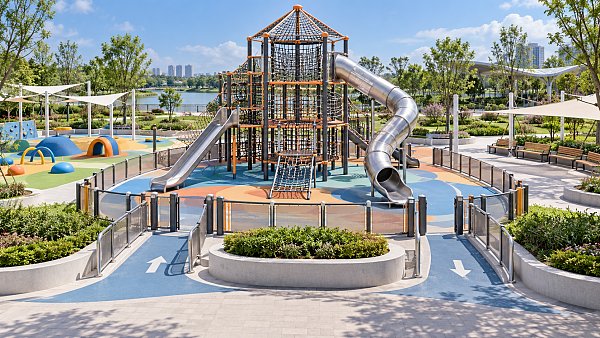
Locate the swing area on an accessible route connected to the playground’s required accessible features. Review the entire approach, including transitions, slopes, openings, and changes in level.
Separate circulation and waiting areas from moving swings wherever the design allows. Users should not have to cross active swing paths to reach another play component.
Apply the equipment manufacturer’s instructions and relevant safety guidance to use zones and clearances. Confirm the requirements for the specific frame, seat, suspension, and surfacing configuration.
Inclusive seating should be part of the playground’s social experience. Consider placing different seat types where users can see and interact with one another, subject to safety requirements.
Provide practical caregiver access without making assistance the only possible way to participate. Also consider seating, shade, sightlines, and space for mobility devices near the activity.
Choose surfacing for both access and impact protection
A surface must support the applicable accessible route requirements and provide the required impact attenuation for the equipment. These are separate performance questions that both need verification.
Poured-in-place rubber, tiles, and loose-fill systems have different installation and maintenance profiles. Compare tested configurations, local climate performance, drainage, repair methods, and total ownership cost.
Loose-fill material can migrate under swings and along routes, changing depth and firmness over time. Plan for inspection, replenishment, and regular leveling where that system is used.
For unitary surfaces, inspect seams, edges, wear spots, and drainage. Confirm that repairs preserve the required accessible and impact performance of the installed system.
What should be included in the procurement specification?
Issue a seat schedule identifying intended users, approximate size ranges, support features, capacity, compatible frame, and required quantities. Avoid specifying a product solely by appearance.
Require suppliers to provide dimensioned drawings showing the installed configuration, including suspension and recommended clearances. Ask them to flag conflicts with the proposed site layout.
For each seat, request the manufacturer’s rated capacity, adjustment range, materials, approved restraints, installation instructions, inspection requirements, and expected replacement parts.
Specify the relevant accessibility and safety standards by edition where appropriate, subject to jurisdiction and project documents. Require evidence applicable to the complete proposed configuration.
Ask bidders to identify exclusions, lead times, spare-part availability, warranty conditions, and responsibilities for installation and commissioning. These details make competing offers easier to compare.
For international sourcing, verify local code acceptance, documentation language, freight arrangements, and after-sales support. Confirm who resolves compatibility issues between separately sourced components.
Do not substitute chains, connectors, seats, or restraints without manufacturer approval. An apparently equivalent component can alter movement, clearances, load capacity, or the validity of supporting documentation.
How can teams control cost and delivery risk?
Compare bids using installed and operating costs, not seat prices alone. Include foundations, surfacing, route work, freight, installation, inspections, spare parts, and anticipated repairs.
A lower initial quote may exclude surfacing transitions or compatible hardware. Require an itemized scope and reconcile it against the drawings before approving the purchase order.
Involve maintenance staff before final selection. They can assess whether the organization has the tools, budget, and access needed to inspect and service the proposed equipment.
Check lead times for specialized seats and replacement parts early. Where a delayed component affects opening, agree on an approved procurement and installation sequence with the project team.
Set acceptance criteria before construction: installed locations and heights, documented component compatibility, surface test evidence where required, accessible routes, and completion of manufacturer installation checks.
At handover, obtain as-built information, inspection schedules, warranties, operating instructions, and supplier contacts. Assign responsibility for resolving defects and maintaining records after opening.
How do you make the final choice?
Score each proposed seat against user fit, transfer practicality, support, inclusion, documented compliance, maintenance, and total cost. Give greater weight to the needs identified for the site.
Review the leading options with disabled users, caregivers, designers, and the operations team. Record unresolved issues and obtain supplier answers before the specification becomes final.
The strongest choice of ADA playground swings is a coordinated mix of seats, routes, surfacing, and management practices that supports participation and meets the project’s applicable requirements.
Search News
Hot Articles
- Outdoor RidesADA Playground Swings: How to Choose Seats for Inclusive PlayNov 23, 2026
- Outdoor RidesChina Theme Parks See Autumn Holiday Surge, With One Reporting 55% Revenue GrowthNov 22, 2026
- Commercial KitchenCommercial Product Compliance Testing: How to Identify Applicable RequirementsNov 22, 2026
Popular Tags
Need ExpertConsultation?
Connect with our specialized leisureengineering team for procurementstrategies.
Recommended News
 Nov 23, 2026ADA Playground Swings: How to Choose Seats for Inclusive PlayADA playground swings: compare inclusive seat options, assess transfer and safety needs, and plan an accessible play space with confidence.● Theme Park Strategist
 Nov 22, 2026China Theme Parks See Autumn Holiday Surge, With One Reporting 55% Revenue GrowthChina theme parks saw an autumn holiday surge, with Shanghai Happy Valley reporting 55% revenue growth. Explore the records, queues and what they mean.● Theme Park Strategist
 Nov 21, 2026IAAPA Expo 2026 Closes With Record 39,550 AttendeesIAAPA Expo 2026 drew a record 39,550 attendees in Orlando. Explore the buyer figures, attractions innovations and what they mean for the industry.● Theme Park Strategist
 Nov 19, 2026IAAPA Expo 2026 Opens in Orlando With Record 630,000 Square FeetIAAPA Expo 2026 brings a reported record 630,000 square feet of attractions to Orlando. Explore key buying considerations for suppliers and operators.● Theme Park Strategist
 Nov 18, 2026IAAPA Expo 2026 Opens in Orlando as Largest Attractions Industry ExpoIAAPA Expo 2026 in Orlando showcases rides, arcade equipment and VR technology. Discover what buyers and suppliers should know before making a deal.● Theme Park Strategist
 Nov 15, 2026Six Flags Reviews Parks for Possible Sale as Buyer Pool Remains LimitedSix Flags reviews parks and real estate for possible sale amid debt pressure. Discover why a limited buyer pool could affect any potential deals.● Theme Park Strategist
 Nov 08, 2026Six Flags to Close California's Great America After 2027 SeasonCalifornia's Great America will close after the 2027 season. Discover the final operating date, why Six Flags is closing the park, and how to plan your visit.● Theme Park Strategist
 Nov 07, 2026Choosing High Speed Electric Go Karts: Speed, Battery Life and SafetyCompare high speed electric go karts by speed, battery life and safety. Discover how to choose a reliable kart that fits your track and keeps sessions running smoothly.● Theme Park Strategist
 Nov 01, 2026Buying Fiberglass Water Slides from China: How to Evaluate SuppliersBuying fiberglass water slides from China? Learn how to assess suppliers, compare total costs, verify compliance, and plan installation with confidence.● Theme Park Strategist
 Oct 29, 2026TEA: Water Parks and Museums Outpace Theme Parks in 2025 Attendance GrowthTEA’s 2025 Global Experience Index shows water parks and museums outpacing theme parks in attendance growth. Explore the key figures and implications for attraction operators.● Theme Park Strategist
 Oct 28, 2026Choosing an Electric Trackless Train Supplier: Safety, Warranty, and Spare PartsChoosing an electric trackless train supplier? Compare safety evidence, warranty terms, and spare parts support to reduce downtime and buy with confidence. Explore what to check before ordering.● Theme Park Strategist
 Oct 26, 2026Aurora Park Phase One Opens at Former SeaWorld Site in OhioAurora Park at Ohio’s former SeaWorld site is scheduled to open phase one on October 25, 2026. Discover its restored dock, pavilion and new public recreation spaces.● Theme Park Strategist
 Oct 25, 2026Six Flags to Add Seat Belts to Goliath and Eight Other Coasters to Improve SafetySix Flags reportedly plans to add seat belts to Goliath and eight other coasters. Explore the planned safety upgrades, ride closures and potential retrofit implications.● Theme Park Strategist
 Oct 23, 2026Comcast Q3 Earnings: Universal Theme Park Revenue Falls 4.4% to $2.6 BillionComcast Q3 earnings: Universal theme park revenue reportedly fell 4.4% to $2.6 billion. Explore what ticket discounts and pricing pressure could mean for operators, ticket sellers and suppliers.● Theme Park Strategist
 Oct 21, 2026IAAPA Launches Insurance Solution for North American Attractions IndustryExplore IAAPA Insurance Solution, a dedicated insurance and risk management offering for North American attractions operators, and discover what it could mean for your business.● Theme Park Strategist
 Oct 20, 2026Energylandia Announces Rokan, Set to Be Europe’s Tallest and Longest B&M Wing CoasterDiscover Energylandia’s Rokan, set to become Europe’s tallest and longest B&M wing coaster. Explore the 62-metre thrill ride planned for spring 2027 in the new Volana themed area.● Theme Park Strategist
 Oct 23, 2026Can Amusement Ride Suppliers Meet Safety Rules Without On-Site Audits?Can a supplier pass amusement safety compliance without on-site audit? Explore accepted evidence, remote checks, and required inspections to make safer sourcing decisions.● Theme Park Strategist
 Oct 03, 2026How to Select Leisure Park Equipment for Safe, High-Throughput Visitor AreasLeisure park equipment selection guide for safe, high-throughput venues—explore capacity, supervision, durability, accessibility, and supplier criteria.● Theme Park Strategist
 Sep 18, 2026What Drives Animatronic Dinosaur Manufacturer Prices for Theme Park Projects?Animatronic dinosaurs manufacturer price guide: compare motion, materials, controls, installation, and lifecycle costs to plan a durable theme park attraction.● Theme Park Strategist
 Sep 06, 2026Do Amusement Ride Safety Compliance Requirements Change Every Year?Do amusement safety compliance requirements change annually? Learn what really changes, from standards and inspections to permits, upgrades, and local approvals.● Theme Park Strategist
 Sep 02, 2026How Long Does It Take to Receive Full Safety Documents From an OEM?How long does it take to get full safety documentation from OEM partners? Discover realistic timelines, common delays, and practical steps to secure compliant files faster.● Theme Park Strategist
 Sep 03, 2026Designing Adventure Park Safety Systems for Zip Lines, Ropes Courses, and Daily InspectionsAdventure park safety systems: learn how to design safer zip lines and ropes courses with daily inspections, defect controls, rescue readiness, and staff training.● Theme Park Strategist
 Aug 22, 2026What to Look for When Choosing Three Seat Jet Skis for Rental or Resort UseThree seat jet skis for rental or resort use should balance stability, safety, maintenance, and guest comfort. Learn how to choose models that boost uptime and guest satisfaction.● Theme Park Strategist
 Aug 17, 2026What Parts Matter Most in a Roller Coaster and How Do They Affect Ride Safety?Roller coaster parts determine ride safety more than most riders realize. Explore how tracks, restraints, brakes, wheels, and control systems work together to protect every ride.● Theme Park Strategist