Buying Fiberglass Water Slides from China: How to Evaluate Suppliers
A low factory quote can make fiberglass water slides from China attractive, but it does not establish what the finished attraction will cost or whether it can be installed and operated at your site. The most useful supplier comparison starts with a defined design brief, evidence of manufacturing capability, a clear compliance route, and an itemized scope covering delivery and installation.
For a straightforward replacement slide, the priority may be matching existing foundations, water systems, and operating procedures. For a new water park attraction, engineering coordination and the supplier’s ability to support approvals can matter just as much as the slide itself. In both cases, assess the supplier against the actual project rather than a catalog image.
Define the project before asking for prices
Manufacturers cannot provide comparable proposals if each is working from different assumptions. A request for quotation should describe the intended users, available footprint, starting height, desired capacity, site location, and operating environment. Include the proposed landing arrangement, such as a runout or pool, and identify any space, accessibility, or architectural constraints.
Also explain what already exists. A slide connecting to an established tower or pool requires accurate interface information, including survey drawings and details of the water supply. For a new development, suppliers need to know whether they are expected to provide structural supports, stairs, pumps, controls, or only the fiberglass flume.
Ask each bidder to state its assumptions and exclusions. A proposal that omits the support structure or water treatment connections may appear less expensive, while leaving substantial work for another contractor. Until those differences are visible, the headline prices are not meaningful.
Establish who will actually manufacture the slide
A polished website or extensive product range does not show whether a company owns a factory, subcontracts production, or acts as a trading intermediary. Any of these arrangements can work, but the buyer needs to understand who controls design, fabrication, quality checks, and after-sales support.
Request the legal name of the contracting company, the manufacturing location, and the identity of any major subcontractors. Check that the company named in the quotation, contract, and payment documents is the intended contracting party. If an intermediary is involved, establish who can authorize engineering changes and who remains responsible if a manufacturing defect appears after installation.
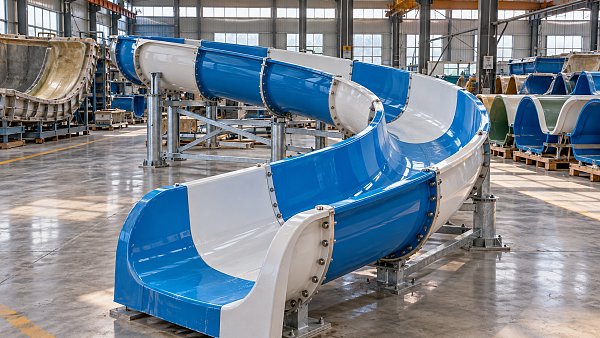
A factory visit or independent audit can help establish whether the proposed production site has the equipment, workforce, and space for the order. Focus on the relevant process: mold preparation, fiberglass layup, curing, trimming, assembly checks, and packing. A general tour alone is less useful than seeing how the supplier controls the product you intend to buy.
Ask for comparable completed projects, preferably involving a similar slide type, scale, and operating environment. Request permission to contact a reference about installation support, documentation, and how issues were resolved. Photographs can illustrate a design, but they do not establish who manufactured it or how well it has performed.
Evaluate the fiberglass construction, not just the finish
Fiberglass water slides are composite structures. Their performance depends on the materials, laminate design, fabrication process, joints, and supporting structure working together. A glossy surface is useful to inspect, but it tells you little on its own about the underlying laminate or the quality of a bolted connection.
Ask the supplier for a project-specific material and construction specification. It should identify the resin system, reinforcement materials, gelcoat, laminate requirements, and the parts of the slide to which they apply. Ask how material batches are documented and how the factory controls storage, curing, and repairs during production.
For slides exposed to strong sunlight, pool chemicals, or a corrosive coastal environment, discuss how the selected materials and finishes suit those conditions. Do not assume that a generic claim of “UV-resistant” or “corrosion-resistant” covers the whole assembly: fasteners, supports, coatings, and interfaces can have different exposure risks.
Pay particular attention to the joints between flume sections. Poor alignment or inconsistent finishing can affect rider comfort and create maintenance work. The proposal should explain how sections are matched, sealed, and inspected, and how accessible the joints will be once the slide is installed. Ask what surface defects are acceptable, how they are measured, and what repair process applies before shipment.
For a custom attraction, confirm who owns or controls the molds and design documents, whether replacement sections can be reproduced, and what happens if a mold is modified or retired. A lower initial price is less compelling if a damaged section later requires extensive redesign or replacement of adjoining parts.
Make compliance part of the design brief
Safety obligations depend on where the slide will be installed, its classification, and the requirements of the authority overseeing the project. Bring the local designer, operator, and relevant approval parties into the discussion early, before the manufacturer finalizes the geometry or support design.
Ask bidders to identify the standards and project requirements they intend to design against, along with the documents they will supply. A certificate shown in a sales presentation may relate to a company’s management system, a different product, or an earlier design. It is not automatically evidence that the proposed slide is approved for your site.
The documentation package should be appropriate to the project and may include design drawings, structural calculations, material records, inspection reports, operating instructions, and maintenance requirements. Establish who prepares each document, in what language, and whether independent review or inspection is included in the price.
Responsibility for interfaces deserves particular attention. The slide designer may specify loads at support points, while a local structural engineer designs the foundations. The pool contractor may handle the landing area and water treatment, while another party supplies pumps and controls. Put those boundaries in writing, including who checks that the separate designs work together.
Compare the full landed and installed cost
A fiberglass slide quotation is only one part of the project budget. To compare bids, use the same scope and separate confirmed prices from allowances. A practical comparison should cover:
- Design and engineering: drawings, calculations, revisions, approval support, and any independent review.
- Manufactured components: flume sections, supports, stairs, platforms, fasteners, finishes, and spare parts.
- Water and controls: pumps, pipework, valves, electrical panels, sensors, and connections, where included.
- Logistics: packing, inland transport, freight, insurance, customs handling, duties, taxes, and delivery to the agreed point.
- Site work: foundations, lifting equipment, installation labor, utilities, pool works, testing, and commissioning.
- Post-handover: training, manuals, warranty response, replacement parts, and foreseeable maintenance.
Use the quoted trade terms to determine where the supplier’s delivery obligation ends and which party handles export, freight, import, and risk during transit. Name the delivery location precisely. A price ending at a port is not equivalent to delivery at a construction site, especially when oversized sections require special handling or access planning.
Compare payment schedules as well as total prices. Link installments to identifiable milestones such as approved drawings, completion of production, inspection, and shipment. Keep enough documentation behind each milestone to show what has actually been completed. The contract should also address changes: who approves them, how they affect cost and lead time, and which drawing revision governs production.
Check whether the supplier can support installation
A slide can arrive with all components present and still delay a project if the installation sequence is unclear or critical dimensions do not match the site. Request an installation plan covering assembly order, lifting points, required equipment, labor responsibilities, tolerances, and site prerequisites.
Clarify whether the supplier will send technicians, supervise a local crew remotely, or provide documents only. Where travel is involved, establish who pays for travel, accommodation, local transport, and additional days caused by site delays. Remote support may suit a standard slide and an experienced installer; a complex custom attraction may justify more direct involvement.
Before shipment, agree on the checks to be completed at the factory and on site. Depending on the design, these may include dimensional inspection, trial fitting of selected sections, review of surface finish, and confirmation that components are labeled against packing lists and drawings. Inspection should be carried out by someone with authority to identify defects and agree on corrective action.
Commissioning responsibilities should be equally specific. The parties need to know who checks the water system, verifies the assembled slide against the approved design, participates in operational testing, and signs the handover documents. The operator also needs instructions for routine inspection, cleaning, maintenance, and restrictions on use before opening.
Put warranty and delivery commitments into workable terms
A broad warranty promise is less useful than a defined process. Establish what is covered, when coverage begins, what evidence is needed for a claim, and whether the remedy covers replacement parts, labor, shipping, or only the component itself. Distinguish manufacturing defects from damage caused by installation, operation, chemicals, or lack of maintenance.
Ask how replacement sections and common consumables will be supplied after the initial order. For a seasonal attraction, response time can affect operating revenue, so agree on the communication channel and the steps for urgent defects. Retain the final drawings, component identifiers, material records, and packing information; these make it easier to identify the correct part later.
Delivery dates should reflect the complete sequence, not just factory production. Drawing approval, mold work, manufacturing, inspection, packing, freight, customs clearance, and site readiness can each affect the opening schedule. Ask the supplier to show dependencies and identify which dates are commitments rather than estimates.
Choose the proposal with the fewest unresolved interfaces
Once bids are normalized, compare the remaining differences in technical scope, evidence, schedule, and support. A more expensive offer may be justified if it includes engineering, inspection, or installation services that would otherwise need separate contracts. Equally, a lower-priced supplier can be a sound choice when its exclusions are understood and the project team has the capability to manage them.
Before issuing the purchase order, close the material gaps: approve the design basis, assign responsibility for foundations and water systems, agree on acceptance criteria, and document the cost of delivery and installation. The strongest supplier is the one that can explain those details clearly and commit to them in the project documents.
Search News
Hot Articles
Popular Tags
Need ExpertConsultation?
Connect with our specialized leisureengineering team for procurementstrategies.
Recommended News
 Nov 01, 2026Buying Fiberglass Water Slides from China: How to Evaluate SuppliersBuying fiberglass water slides from China? Learn how to assess suppliers, compare total costs, verify compliance, and plan installation with confidence.● Theme Park Strategist
 Oct 29, 2026TEA: Water Parks and Museums Outpace Theme Parks in 2025 Attendance GrowthTEA’s 2025 Global Experience Index shows water parks and museums outpacing theme parks in attendance growth. Explore the key figures and implications for attraction operators.● Theme Park Strategist
 Oct 28, 2026Choosing an Electric Trackless Train Supplier: Safety, Warranty, and Spare PartsChoosing an electric trackless train supplier? Compare safety evidence, warranty terms, and spare parts support to reduce downtime and buy with confidence. Explore what to check before ordering.● Theme Park Strategist
 Oct 26, 2026Aurora Park Phase One Opens at Former SeaWorld Site in OhioAurora Park at Ohio’s former SeaWorld site is scheduled to open phase one on October 25, 2026. Discover its restored dock, pavilion and new public recreation spaces.● Theme Park Strategist
 Oct 25, 2026Six Flags to Add Seat Belts to Goliath and Eight Other Coasters to Improve SafetySix Flags reportedly plans to add seat belts to Goliath and eight other coasters. Explore the planned safety upgrades, ride closures and potential retrofit implications.● Theme Park Strategist
 Oct 23, 2026Comcast Q3 Earnings: Universal Theme Park Revenue Falls 4.4% to $2.6 BillionComcast Q3 earnings: Universal theme park revenue reportedly fell 4.4% to $2.6 billion. Explore what ticket discounts and pricing pressure could mean for operators, ticket sellers and suppliers.● Theme Park Strategist
 Oct 21, 2026IAAPA Launches Insurance Solution for North American Attractions IndustryExplore IAAPA Insurance Solution, a dedicated insurance and risk management offering for North American attractions operators, and discover what it could mean for your business.● Theme Park Strategist
 Oct 20, 2026Energylandia Announces Rokan, Set to Be Europe’s Tallest and Longest B&M Wing CoasterDiscover Energylandia’s Rokan, set to become Europe’s tallest and longest B&M wing coaster. Explore the 62-metre thrill ride planned for spring 2027 in the new Volana themed area.● Theme Park Strategist
 Oct 23, 2026Can Amusement Ride Suppliers Meet Safety Rules Without On-Site Audits?Can a supplier pass amusement safety compliance without on-site audit? Explore accepted evidence, remote checks, and required inspections to make safer sourcing decisions.● Theme Park Strategist
 Oct 03, 2026How to Select Leisure Park Equipment for Safe, High-Throughput Visitor AreasLeisure park equipment selection guide for safe, high-throughput venues—explore capacity, supervision, durability, accessibility, and supplier criteria.● Theme Park Strategist
 Sep 18, 2026What Drives Animatronic Dinosaur Manufacturer Prices for Theme Park Projects?Animatronic dinosaurs manufacturer price guide: compare motion, materials, controls, installation, and lifecycle costs to plan a durable theme park attraction.● Theme Park Strategist
 Sep 06, 2026Do Amusement Ride Safety Compliance Requirements Change Every Year?Do amusement safety compliance requirements change annually? Learn what really changes, from standards and inspections to permits, upgrades, and local approvals.● Theme Park Strategist
 Sep 02, 2026How Long Does It Take to Receive Full Safety Documents From an OEM?How long does it take to get full safety documentation from OEM partners? Discover realistic timelines, common delays, and practical steps to secure compliant files faster.● Theme Park Strategist
 Sep 03, 2026Designing Adventure Park Safety Systems for Zip Lines, Ropes Courses, and Daily InspectionsAdventure park safety systems: learn how to design safer zip lines and ropes courses with daily inspections, defect controls, rescue readiness, and staff training.● Theme Park Strategist
 Aug 22, 2026What to Look for When Choosing Three Seat Jet Skis for Rental or Resort UseThree seat jet skis for rental or resort use should balance stability, safety, maintenance, and guest comfort. Learn how to choose models that boost uptime and guest satisfaction.● Theme Park Strategist
 Aug 17, 2026What Parts Matter Most in a Roller Coaster and How Do They Affect Ride Safety?Roller coaster parts determine ride safety more than most riders realize. Explore how tracks, restraints, brakes, wheels, and control systems work together to protect every ride.● Theme Park Strategist
 Aug 15, 20262026 China Sports Expo Sees 45.74% More Overseas Pre-registered Buyers as POB Expands Procurement Matching2026 China Sports Expo boosts overseas pre-registered buyers by 45.74% as POB expands procurement matching for fitness, outdoor, and venue suppliers.● Theme Park Strategist
 Aug 14, 2026What Should Buyers Check Before Choosing a Flying Chair Ride Exporter?Flying chair ride exporter buyers should check safety, structure, export support, and spare parts before purchase to reduce risk and choose a reliable supplier.● Theme Park Strategist
 Aug 04, 2026EU Issues EN 1176-1:2026 for Playground SafetyEU Issues EN 1176-1:2026 for Playground Safety: learn how the new standard impacts Outdoor Rides, CE certification, inventory checks, and EU compliance before March 2027.● Theme Park Strategist
 Aug 03, 2026CPSC Adopts ASTM F1487-26 for Imported Outdoor RidesOutdoor Rides face a major U.S. compliance shift as CPSC adopts ASTM F1487-26. Learn the new certification, testing, and customs risks before November 1, 2026.● Theme Park Strategist
 Jul 26, 2026Revised EN 1176:2026 Triggers Re-Certification for Outdoor RidesOutdoor Rides face immediate EN 1176:2026 re-certification for new CE applications. Learn how testing, documentation, and EU market access rules now affect exports and delivery plans.● Theme Park Strategist
 Jul 21, 2026CPSC Recall Flags Structural Risk in Outdoor RidesCPSC recall flags structural risk in outdoor rides: learn how ASTM F1487-23 failures affect importers, distributors, and compliance teams across the U.S., Canada, and Australia.● Theme Park Strategist
 Jul 19, 2026How to Choose Outdoor Fitness Equipment for Parks Based on Users, Space, and BudgetOutdoor fitness equipment for parks: learn how to choose the right mix based on users, space, and budget to improve safety, usage, and long-term value.● Theme Park Strategist
 Jul 15, 2026Ocean Freight Spike Pressures Outdoor Rides ExportsOcean Freight Spike Pressures Outdoor Rides Exports as Shanghai-Rotterdam rates surge 42%. See how rising freight costs, delays, and rerouting risks could reshape Europe-bound delivery plans.● Theme Park Strategist