How to Choose Outdoor Fitness Equipment for Parks Based on Users, Space, and Budget
How to Choose Outdoor Fitness Equipment for Parks Based on Users, Space, and Budget
Choosing outdoor fitness equipment for parks is not just about filling a site with machines. It is a planning decision that affects safety, usage rates, maintenance pressure, and long-term project value.
For most public projects, the challenge is balance. User demand, site limits, capital budgets, and lifecycle costs rarely move in the same direction.
That is why outdoor fitness equipment for parks should be evaluated as a system, not as a list of standalone products. A well-structured selection process prevents underused zones and expensive corrections later.
In practical procurement work, the best results usually come from matching equipment types to user profiles, space conditions, and realistic operating budgets from the start.
Start with user demand, not equipment catalogs
The first question is simple: who will actually use the park? Without that answer, outdoor fitness equipment for parks often becomes visually impressive but functionally weak.
Most projects serve more than one group. Adults, older users, teenagers, families, and rehabilitation-oriented visitors may all share the same space.
Each group expects different movement patterns. Seniors usually prefer low-impact balance, flexibility, and joint mobility stations. Younger users often want strength, challenge, and bodyweight training options.
This also means capacity matters. A neighborhood park and a destination park require different assumptions about waiting time, peak-hour flow, and equipment duplication.
A practical user-mapping approach
- Estimate daily and peak-hour users by age band.
- Identify whether the site supports casual use or structured exercise.
- Check accessibility needs, especially transfer space and reach ranges.
- Review nearby amenities such as walking loops, seating, shade, and toilets.
- Consider climate and local habits that influence exercise timing.
When user mapping is clear, outdoor fitness equipment for parks can be grouped into meaningful zones. That usually increases participation more than adding more units at random.
Match equipment categories to real park use cases
Not every park needs the same mix. Selection should reflect how people move through the site and how long they are likely to stay.
A compact community park often benefits from versatile, low-maintenance stations. Larger civic parks can support multi-zone fitness layouts with clearer specialization.
Common equipment groups
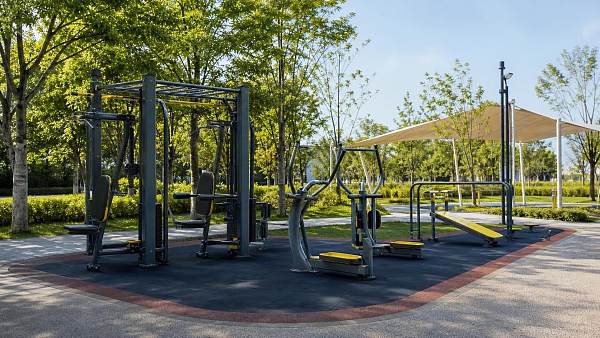
- Cardio stations such as air walkers, steppers, and ski trainers.
- Strength units including push, pull, leg, and combined resistance systems.
- Mobility and stretching frames for warm-up and recovery.
- Balance and coordination products for older users and inclusive design.
- Calisthenics rigs for youth-focused and high-intensity use.
The right outdoor fitness equipment for parks usually combines at least three categories. This creates a more complete workout path and supports a wider range of abilities.
More importantly, mixed programming reduces the risk of dead zones. If one station type loses popularity, the whole area still stays active.
Use space planning as a performance tool
Space is not only about fitting equipment onto a plan. It directly shapes user flow, visibility, supervision, and safety compliance.
Many outdoor fitness equipment for parks projects fail at the layout stage. Machines may fit physically, yet the site feels crowded, confusing, or uncomfortable in use.
Key layout questions
- What is the actual usable area after setbacks, circulation, and safety zones?
- Can users move naturally from warm-up to active training to cooldown?
- Will carers, staff, or guardians have clear sight lines?
- Does the layout avoid conflict with playgrounds, paths, or quiet seating?
- Is there room for future expansion without redesigning the whole site?
Spacing rules from manufacturers are only the baseline. Real planning must also account for approach angles, user overlap, surfacing edges, drainage, and shade structure locations.
In tighter sites, multi-user combo structures may outperform single-function units. They can improve utilization per square meter without making the park feel overloaded.
For larger sites, zoning works better. Separate low-impact, strength, and youth-oriented areas usually create smoother traffic and stronger user satisfaction.
Budget decisions should include lifecycle cost
Price comparison is necessary, but first-cost thinking is not enough. Outdoor fitness equipment for parks should be assessed across installation, maintenance, replacement, and downtime risk.
A lower purchase price can hide expensive realities. Corrosion issues, parts delays, poor coatings, and frequent service calls can erase initial savings quickly.
Budget lines that deserve attention
- Equipment supply cost.
- Foundations, anchoring, and surfacing.
- Freight, customs, and lead-time risk.
- Inspection, spare parts, and service support.
- Warranty coverage and exclusions.
- End-of-life replacement planning.
From a procurement perspective, the stronger question is value per year of reliable use. That gives a clearer basis for comparing suppliers and configuration options.
In many public-sector and commercial developments, phased delivery is also useful. It allows outdoor fitness equipment for parks to launch with a core mix and expand after real usage data appears.
Check materials, compliance, and maintenance early
Technical quality should not be treated as a late-stage checkbox. It affects procurement risk, public safety, and asset durability from day one.
Outdoor fitness equipment for parks is exposed to UV, moisture, vandalism, and heavy repetition. Material choice matters more than brochure appearance.
What to verify with suppliers
- Steel grade, coating system, and corrosion resistance performance.
- Fastener protection, tamper resistance, and replacement access.
- Bearing quality, moving-part durability, and wear testing.
- Compliance with applicable safety and accessibility standards.
- Installation manuals, inspection protocols, and maintenance schedules.
- Spare parts availability over the expected asset life.
This is where supplier credibility becomes visible. Reliable partners can explain testing methods, reference projects, and service response processes without vague claims.
For decision-makers, maintenance simplicity is often underrated. Outdoor fitness equipment for parks with fewer failure points and easier inspections can deliver better long-term returns.
Build a selection matrix before issuing the order
Once user, space, and budget data are clear, a scoring matrix helps turn discussion into a defendable purchasing decision.
This method is especially helpful when comparing multiple outdoor fitness equipment for parks suppliers or balancing local preferences against technical requirements.
The exact weighting can change by project type. Still, a matrix keeps the process transparent and easier to justify internally.
It also makes tradeoffs visible. For example, a premium unit may cost more upfront but score much better on service life and maintenance efficiency.
Common mistakes when selecting outdoor fitness equipment for parks
Several patterns appear repeatedly in weak projects. Most of them begin with assumptions that were never tested against site realities.
- Buying too many single-function units for a small footprint.
- Ignoring senior-friendly or inclusive outdoor fitness equipment for parks.
- Comparing suppliers only on unit price.
- Missing spare parts and warranty limitations in the contract stage.
- Choosing visually complex products that are hard to maintain locally.
- Forgetting shade, drainage, and surfacing integration.
The more obvious signal is that poor selection rarely fails immediately. It usually shows up later through low usage, complaints, and avoidable maintenance cost.
A practical decision path
A disciplined process makes outdoor fitness equipment for parks easier to specify and easier to defend.
- Define target users and expected peak demand.
- Measure usable space, not just total site area.
- Build a balanced equipment mix by function.
- Compare lifecycle cost, not only purchase cost.
- Verify standards, materials, and service support.
- Score suppliers with a clear selection matrix.
When these steps are followed, outdoor fitness equipment for parks becomes a stronger public asset. The result is usually better use, fewer interventions, and more durable project outcomes.
In the end, the smartest choice is rarely the biggest package. It is the one that fits users, respects the site, and performs reliably within the real budget over time.
Search News
Hot Articles
- Indoor PlaygroundTurnkey Playground Installation: What's Included and What Costs Extra?Oct 18, 2026
- Musical InstrumentsProfessional String Instruments: How to Evaluate Tone, Response, and ProjectionOct 17, 2026
- Restaurant FurnitureBuying Hotel Lobby Furniture Wholesale: MOQs, Freight Costs, and Lead TimesOct 16, 2026
Popular Tags
Need ExpertConsultation?
Connect with our specialized leisureengineering team for procurementstrategies.
Recommended News
 Oct 03, 2026How to Select Leisure Park Equipment for Safe, High-Throughput Visitor AreasLeisure park equipment selection guide for safe, high-throughput venues—explore capacity, supervision, durability, accessibility, and supplier criteria.● Theme Park Strategist
 Sep 18, 2026What Drives Animatronic Dinosaur Manufacturer Prices for Theme Park Projects?Animatronic dinosaurs manufacturer price guide: compare motion, materials, controls, installation, and lifecycle costs to plan a durable theme park attraction.● Theme Park Strategist
 Sep 06, 2026Do Amusement Ride Safety Compliance Requirements Change Every Year?Do amusement safety compliance requirements change annually? Learn what really changes, from standards and inspections to permits, upgrades, and local approvals.● Theme Park Strategist
 Sep 02, 2026How Long Does It Take to Receive Full Safety Documents From an OEM?How long does it take to get full safety documentation from OEM partners? Discover realistic timelines, common delays, and practical steps to secure compliant files faster.● Theme Park Strategist
 Sep 03, 2026Designing Adventure Park Safety Systems for Zip Lines, Ropes Courses, and Daily InspectionsAdventure park safety systems: learn how to design safer zip lines and ropes courses with daily inspections, defect controls, rescue readiness, and staff training.● Theme Park Strategist
 Aug 22, 2026What to Look for When Choosing Three Seat Jet Skis for Rental or Resort UseThree seat jet skis for rental or resort use should balance stability, safety, maintenance, and guest comfort. Learn how to choose models that boost uptime and guest satisfaction.● Theme Park Strategist
 Aug 17, 2026What Parts Matter Most in a Roller Coaster and How Do They Affect Ride Safety?Roller coaster parts determine ride safety more than most riders realize. Explore how tracks, restraints, brakes, wheels, and control systems work together to protect every ride.● Theme Park Strategist
 Aug 15, 20262026 China Sports Expo Sees 45.74% More Overseas Pre-registered Buyers as POB Expands Procurement Matching2026 China Sports Expo boosts overseas pre-registered buyers by 45.74% as POB expands procurement matching for fitness, outdoor, and venue suppliers.● Theme Park Strategist
 Aug 14, 2026What Should Buyers Check Before Choosing a Flying Chair Ride Exporter?Flying chair ride exporter buyers should check safety, structure, export support, and spare parts before purchase to reduce risk and choose a reliable supplier.● Theme Park Strategist
 Aug 04, 2026EU Issues EN 1176-1:2026 for Playground SafetyEU Issues EN 1176-1:2026 for Playground Safety: learn how the new standard impacts Outdoor Rides, CE certification, inventory checks, and EU compliance before March 2027.● Theme Park Strategist
 Aug 03, 2026CPSC Adopts ASTM F1487-26 for Imported Outdoor RidesOutdoor Rides face a major U.S. compliance shift as CPSC adopts ASTM F1487-26. Learn the new certification, testing, and customs risks before November 1, 2026.● Theme Park Strategist
 Jul 26, 2026Revised EN 1176:2026 Triggers Re-Certification for Outdoor RidesOutdoor Rides face immediate EN 1176:2026 re-certification for new CE applications. Learn how testing, documentation, and EU market access rules now affect exports and delivery plans.● Theme Park Strategist
 Jul 21, 2026CPSC Recall Flags Structural Risk in Outdoor RidesCPSC recall flags structural risk in outdoor rides: learn how ASTM F1487-23 failures affect importers, distributors, and compliance teams across the U.S., Canada, and Australia.● Theme Park Strategist
 Jul 19, 2026How to Choose Outdoor Fitness Equipment for Parks Based on Users, Space, and BudgetOutdoor fitness equipment for parks: learn how to choose the right mix based on users, space, and budget to improve safety, usage, and long-term value.● Theme Park Strategist
 Jul 15, 2026Ocean Freight Spike Pressures Outdoor Rides ExportsOcean Freight Spike Pressures Outdoor Rides Exports as Shanghai-Rotterdam rates surge 42%. See how rising freight costs, delays, and rerouting risks could reshape Europe-bound delivery plans.● Theme Park Strategist
 Jul 14, 2026EN 1176 Revision Takes Effect for Outdoor Ride Weld TestingEN 1176 revision takes effect for outdoor ride weld testing from Sept 1, 2026. Learn ISO 5817 level B, third-party NDT report rules, and key EU compliance steps.● Theme Park Strategist
 Jul 12, 2026Vietnam Requires AI Anti-Collision Systems for Imported Outdoor RidesVietnam Requires AI Anti-Collision Systems for Imported Outdoor Rides from Sept. 15, 2026. Learn compliance rules, VAST certification needs, and how importers can avoid delays.● Theme Park Strategist
 Jul 11, 2026Vietnam Tightens Rules for Imported Outdoor RidesVietnam Tightens Rules for Imported Outdoor Rides: learn how Vietnam’s 2026 compliance update adds AI anti-collision, Vietnamese logs, and local maintenance duties for importers and manufacturers.● Theme Park Strategist
 Jul 09, 2026How to Evaluate a Lazy River Equipment Supplier for Safety, Flow Design, and MaintenanceLazy river equipment supplier selection affects safety, flow design, and maintenance costs. Learn what to compare, what to ask, and how to choose a reliable partner.● Theme Park Strategist
 Jul 08, 2026RCEP Update Cuts ASEAN Tariffs to Zero for Outdoor RidesRCEP update cuts ASEAN tariffs to zero for outdoor rides from China. Learn how FSC-CoC, PEFC traceability, and e-CO compliance affect exports, sourcing, and buyer decisions.● Theme Park Strategist
 Jul 07, 2026RCEP Guide Adds Dual Wood Traceability for Outdoor RidesOutdoor Rides exporters face a new RCEP traceability rule: dual FSC-CoC and PEFC-STS 2023 codes for wood components. See what changes before Oct. 1, 2026.● Theme Park Strategist
 Jul 06, 2026Vietnam Tightens RCEP Rules for Wooden Ride PartsVietnam Tightens RCEP Rules for Wooden Ride Parts: learn how FSC Chain-of-Custody and QR code requirements now affect outdoor rides, RCEP imports, and shipment compliance.● Theme Park Strategist
 Jul 06, 2026How to Evaluate a Bumper Cars on Ice Manufacturer for Safety, Capacity, and ROIBumper cars on ice manufacturer selection starts with safety, capacity, and ROI. Learn how to compare suppliers, reduce risk, and choose a partner built for long-term commercial success.● Theme Park Strategist
 Jul 04, 2026Electric Drift Bumper Cars vs Traditional Bumper Cars: Which Fits Your Venue Better?Electric drift bumper cars or traditional bumper cars? Compare installation, safety, maintenance, guest appeal, and ROI to choose the best fit for your venue.● Theme Park Strategist