Buying Light Gauge Guitar Strings in Bulk: Specs, Pricing and Supplier Checks
Buying light gauge guitar strings bulk requires more than comparing prices per pack. Procurement teams must assess string gauges, materials, winding methods, packaging, and consistency across production batches while balancing minimum order quantities and landed costs.
Supplier reliability also matters: lead times, quality controls, and documentation can all affect purchasing outcomes. This guide outlines the key specifications, pricing factors, and supplier checks to consider when sourcing light gauge guitar strings for retail, distribution, or institutional use.
The strongest purchase decision starts with an exact product specification, then compares suppliers on delivered cost and their ability to reproduce an approved sample consistently.
Define What “Light Gauge” Means Before Requesting Quotes
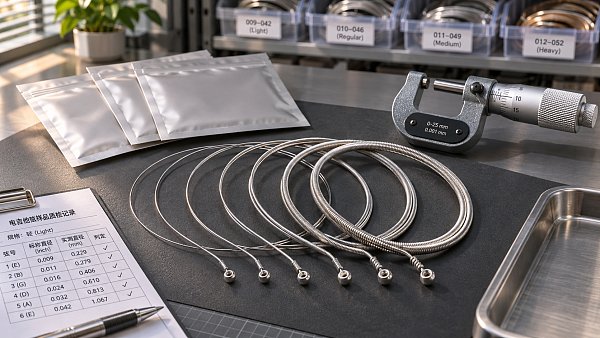
“Light gauge” is a commercial description, not a universal specification. A light electric set and a light acoustic set can contain different string diameters and serve different instruments.
For electric guitar, a common light set runs from .010 to .046 inches, often called a “10–46” set. Some brands describe 9–42 sets as light instead.
For steel-string acoustic guitar, a common light set runs from .012 to .053 or .054 inches. Manufacturers may use different labels, so confirm every diameter individually.
Classical guitar sets usually use nylon or related materials and are often described by tension rather than the electric and steel-string acoustic gauge conventions above.
Do not substitute steel strings for classical strings based on a similar label. Instrument construction and intended string tension matter when selecting a compatible product.
For each stock-keeping unit, specify instrument type, number of strings, individual diameters, units of measurement, and acceptable tolerances. Ask suppliers to confirm these details in writing.
Also identify the scale length or intended instrument where relevant, ball-end or other termination, and any special requirements such as seven-string sets or left-handed packaging.
Which Materials and Construction Details Affect the Purchase?
Materials influence sound, feel, corrosion resistance, cost, and the product claims a retailer can make. Compare complete constructions rather than relying on a single material name.
Nickel-plated steel is common for electric guitar strings, while pure nickel and stainless steel offer different tonal and corrosion characteristics. Confirm the actual winding material with suppliers.
For steel-string acoustic guitars, common wound-string materials include 80/20 bronze and phosphor bronze. Each has a recognizable market position, but tonal preferences remain subjective.
Ask whether the core is round or hexagonal, which strings are wound, and whether the winding is roundwound, flatwound, or another construction specified for the product.
Coated strings may offer longer useful life for some players, but coating type, coverage, feel, and price vary. Request samples and evidence supporting any durability claims.
Confirm whether the stated coating applies to wound strings, plain strings, or both. A partially coated set should not be marketed as fully coated without clarification.
For institutional buyers, dependable tuning, comfortable playability, and clear string identification may matter more than a wide assortment of specialized materials or premium finishes.
Build a Specification Sheet Suppliers Can Quote Accurately
A shared specification sheet reduces quotation errors and makes competing offers easier to compare. Include commercial requirements alongside technical details and send the same version to every supplier.
- Product: Electric, steel-string acoustic, or classical; intended customer; and number of strings per set.
- Dimensions: Diameter of every string, measurement units, tolerances, usable length, and termination style.
- Construction: Core material and shape, winding alloy and method, and coating requirements where applicable.
- Presentation: Individual sleeves, set packaging, barcode, language, branding, carton quantity, and moisture protection.
- Commercial terms: Order quantity, destination, requested delivery date, currency, payment terms, and quotation validity.
- Quality: Inspection criteria, approved reference sample, batch identification, defect handling, and required documents.
Ask suppliers to identify every deviation from the specification rather than assuming silence means compliance. Record approved alternatives separately to prevent substitutions during repeat orders.
If private labeling is required, specify artwork ownership, printing method, color standards, proof approval, and who pays for plates, tooling, or packaging changes.
How Should Buyers Compare Bulk Guitar String Pricing?
Compare the same unit of purchase throughout the sourcing process: one complete set, one individual string, or one carton. A low per-string quote may exclude packaging.
Request a price breakdown covering strings, individual packaging, branded printing, master cartons, sample charges, tooling, and any setup fees. Confirm whether quoted prices include spare strings.
Ask for quantity tiers and the minimum order quantity for each SKU. A supplier may require separate minimums for each gauge, material, packaging design, or custom label.
Calculate landed cost using the quote, freight, insurance where applicable, import duties, customs clearance, and destination handling. Include nonrecoverable taxes and required inspection costs when relevant.
For example, 1,000 sets quoted at $2.00 each cost $2,000 before delivery. If freight, clearance, and nonrecoverable import charges total $600, landed cost becomes $2.60 per set.
A competing offer at $2.20 per set with $300 in equivalent additional costs lands at $2.50 per set. Check that both offers cover identical products and responsibilities.
These figures are illustrative, not market prices. Actual quotations depend on construction, order size, origin, packaging, freight conditions, and the commercial terms negotiated with each supplier.
Use the agreed Incoterms rule and named place to understand which transport costs and risks each party handles. Confirm insurance and import clearance separately where the rule requires it.
Include inventory carrying costs and expected losses in the decision. A larger order may reduce unit price while increasing storage time, cash tied up, and exposure to unsold stock.
What Minimum Order and Lead Time Can Your Business Absorb?
Match order quantities to sales velocity or institutional consumption. Review historical demand by instrument type and gauge, then consider seasonality, promotions, and upcoming contract requirements.
Calculate expected stock coverage by dividing usable inventory by average demand for the same period. Allow a reasonable buffer for demand variation and replenishment delays.
For example, 600 usable sets at an average demand of 100 sets per month provide approximately six months of coverage before accounting for uncertainty or new deliveries.
Confirm production lead time separately from shipping and customs transit. Ask when the production clock starts: purchase order acceptance, deposit receipt, artwork approval, or material availability.
Request a realistic schedule for first orders and repeat orders. Custom packaging, new tooling, or an unapproved artwork proof can make the first shipment slower.
Ask whether the supplier can split deliveries, hold finished inventory, or combine compatible SKUs in a shipment. Confirm fees, ownership, and storage conditions before relying on these arrangements.
How Can Procurement Teams Check a Supplier’s Reliability?
Start by verifying the supplier’s legal business identity, address, and stated role. Determine whether it manufactures the strings, assembles sets, or trades products made by another company.
A distributor can be a suitable supplier, but buyers should know who controls manufacturing, quality records, and changes to materials. Ask how product traceability works across the chain.
Review relevant production capabilities, capacity, and current lead times. Request examples of comparable products or references where available, while respecting customers’ confidentiality and commercial agreements.
Ask how the supplier qualifies wire, winding materials, coatings, and packaging. Find out how incoming materials are identified and how changes in upstream sources are controlled.
Request an outline of in-process checks and final inspection. Useful details include gauge measurement methods, sample sizes, inspection frequency, equipment calibration, and handling of nonconforming products.
Do not treat a certificate as proof of every product claim. Verify its issuer, scope, validity, and relationship to the manufacturing site and activity being assessed.
Agree on a written change-control process for construction, material source, manufacturing location, and packaging. Require advance notice and approval when a change could affect the purchased product.
Evaluate communication as well as technical responses. Clear answers about deviations, corrective actions, and delivery constraints are more useful than broad assurances that every requirement is achievable.
What Should You Test Before Placing a Large Order?
Request production-representative samples for each important SKU, including the intended packaging. A sample made under different conditions may not predict the quality of a regular shipment.
Check the stated gauges, number and order of strings, winding appearance, ball-end attachment, and packaging labels. Note visible corrosion, kinks, contamination, or damaged sleeves.
Have qualified players or technicians install sample sets on compatible instruments. Assess fit, tuning stability after normal stretching, feel, winding defects, and premature breakage under ordinary use.
Player feedback is valuable, but a small trial cannot establish a long-term failure rate. Record the instrument, installation method, playing conditions, and any observed issues.
Inspect packaging after reasonable handling and, where practical, storage conditions representative of your supply chain. Check seals, legibility, barcode readability, and protection against moisture exposure.
Approve a retained reference sample and link it to the written specification, artwork version, and purchase order. Store it appropriately so later shipments can be compared fairly.
For a new supplier, consider a pilot order before committing to a large volume. Use its results to assess consistency, delivery performance, packaging, and responsiveness to issues.
Which Documents and Contract Terms Protect the Order?
Specify the documents needed for customs, internal controls, and customer requirements before ordering. Depending on the transaction, these may include an invoice, packing list, and origin documentation.
If product composition or regulatory compliance claims are required, identify the applicable destination, product, and standard. Request supporting evidence relevant to those requirements rather than generic declarations.
For private-label products, confirm responsibility for label accuracy, trademarks, and any claims about origin, materials, or performance. Have the final artwork approved before production begins.
Define acceptance criteria and inspection timing in the purchase agreement. State how defects are reported, what evidence is needed, and whether remedies include replacement, credit, or refund.
Agree on payment milestones, delivery terms, late-delivery handling, and dispute resolution. For repeat business, document how price changes, material substitutions, and forecast revisions will be communicated.
Require traceable batch or lot identification where practical. If a defect appears after distribution, traceability helps isolate affected inventory and limits the scope of a corrective action.
Make the Final Supplier Decision
When sourcing light gauge guitar strings in bulk, prioritize an accurate specification and a repeatable product before comparing headline prices. Then assess total landed cost and inventory exposure.
Choose the supplier that meets your required construction, demonstrates consistent sample quality, provides credible documentation, and can deliver within your operating schedule at an acceptable overall cost.
Before scaling the order, record the approved sample, commercial terms, inspection criteria, and change-control process. Those details make future purchases easier to evaluate and manage.
Search News
Hot Articles
Popular Tags
Need ExpertConsultation?
Connect with our specialized leisureengineering team for procurementstrategies.
Recommended News
 Nov 13, 2026Buying Light Gauge Guitar Strings in Bulk: Specs, Pricing and Supplier ChecksBuying light gauge guitar strings bulk? Compare gauges, materials, landed costs, and supplier quality checks to source confidently and avoid costly mistakes.● Pro Audio Engineer
 Nov 12, 2026Musical Instrument Industry Seeks AI Acoustics and Smart Hardware TalentAI acoustics and smart hardware talent are reshaping musical instrument development. Explore the hiring forecast and what it means for manufacturers and buyers.● Pro Audio Engineer
 Nov 02, 2026Choosing a Glockenspiel Supplier: Tuning, Quality and After-Sales SupportChoosing a glockenspiel supplier? Learn how to compare tuning, build quality, pricing and after-sales support to make a confident purchasing decision.● Pro Audio Engineer
 Oct 31, 2026Buying Tenor Ukuleles Wholesale: How to Evaluate Suppliers and MOQsBuying tenor ukuleles wholesale? Learn how to evaluate suppliers, negotiate MOQs, compare landed costs, and secure consistent quality with less inventory risk.● Pro Audio Engineer
 Oct 28, 2026Music China 2026 Opens Tomorrow, With 800-Plus Events Connecting TradeMusic China 2026 runs October 28–31 in Shanghai with 800-plus events. Explore industry forums, business matchmaking and sourcing insights for musical instrument buyers and suppliers.● Pro Audio Engineer
 Oct 20, 2026Choosing a Classical Guitar Manufacturer in China: Quality Checks Before OrderingSearching for “classical guitars manufacturer China”? Discover essential checks for materials, playability, and factory quality control to reduce costly returns and order with confidence.● Pro Audio Engineer
 Oct 17, 2026Professional String Instruments: How to Evaluate Tone, Response, and ProjectionCompare professional string instruments with expert tips on tone, response, and projection. Learn practical tests to choose the right instrument for your performance needs.● Pro Audio Engineer
 Oct 21, 2026How Do You Assess a Musical Instrument Manufacturer’s Export Capability?Learn how to assess a musical instrument manufacturer export capability. Discover six key checks for quality, compliance, shipping, and support to reduce risks and source confidently.● Pro Audio Engineer
 Oct 15, 2026How Do You Choose Music Education Equipment for a New Campus?Learn how to choose music education equipment for a new campus with practical tips on curriculum fit, acoustics, suppliers, and ownership costs. Equip classrooms confidently and avoid costly mistakes.● Pro Audio Engineer
 Oct 10, 2026A Practical Guide to Identifying Wooden Orchestral Instruments by Family and ToneWooden orchestral instruments made simple: identify strings, flutes, clarinets, oboes, and bassoons by sound source, design, and tone.● Pro Audio Engineer
 Sep 11, 2026How to Choose Touring Instrument Cases for Flights, Trucks, and Daily Load-InsInstrument cases for touring: learn how to balance flight protection, truck durability, weight, fit, and serviceable hardware for safer, faster load-ins.● Pro Audio Engineer
 Sep 07, 2026How to Choose Wood Frame Tambourines for Sound Quality and Long-Term UseWood frame tambourines: learn how to compare frame construction, jingle tone, head options, durability, and supplier quality for reliable long-term performance.● Pro Audio Engineer
 Sep 05, 2026How Often Should Music Education Equipment Be Serviced?How often should music education equipment be serviced? Explore practical schedules, maintenance tips, and lifecycle planning to keep instruments and audio systems reliable.● Pro Audio Engineer
 Aug 21, 2026How to Choose Marching Band Drums for Sound Projection, Weight, and DurabilityMarching band drums buying guide: learn how to balance sound projection, weight, and durability for better field performance, easier carrying, and longer-lasting value.● Pro Audio Engineer
 Aug 09, 2026How to Evaluate a MIDI Cable Manufacturer for Audio Quality and OEM ReliabilityMIDI cable manufacturer evaluation guide: learn how to assess signal stability, connector quality, OEM process control, and batch consistency to reduce failures and source with confidence.● Pro Audio Engineer
 Aug 08, 2026How to Evaluate a Trumpets OEM Manufacturer for Quality, MOQ, and Custom DesignTrumpets OEM manufacturer selection starts with quality, MOQ, and custom design control. Learn how to compare suppliers, reduce sourcing risk, and choose a reliable long-term factory partner.● Pro Audio Engineer
 Jul 27, 2026How to Source Conga Drums in Bulk for Schools, Bands, and Event ProgramsConga drums bulk sourcing for schools, bands, and event programs made easier. Learn how to compare quality, durability, compliance, and total cost before you place a large order.● Pro Audio Engineer
 Jul 24, 2026How to Choose Low Dust Violin Rosin for Cleaner Practice and Better Bow ControlLow dust violin rosin buying guide: learn how to compare formula, climate fit, grip, and string compatibility for cleaner practice, better bow control, and smarter purchase decisions.● Pro Audio Engineer
 Jul 15, 2026Plastic Tambourines Bulk Buying Guide: Sizes, Materials, and MOQ QuestionsPlastic tambourines bulk buying guide covering sizes, ABS vs PP materials, sound consistency, customization, and MOQ questions to help buyers cut risk and choose the right supplier.● Pro Audio Engineer
 Jul 13, 2026Acoustic Guitars Wholesale China: How to Evaluate Build Quality and OEM OptionsAcoustic guitars wholesale China guide: learn how to assess build quality, factory consistency, and OEM options to choose reliable suppliers and reduce sourcing risk.● Pro Audio Engineer
 Jul 12, 2026Mini Effect Pedals Wholesale: MOQ, OEM Options, Testing, and Supplier ComparisonMini effect pedals wholesale guide covering MOQ, OEM options, testing standards, and supplier comparison to help buyers reduce risk, improve margins, and choose reliable partners.● Pro Audio Engineer
 Jul 11, 2026DJ Turntables OEM Guide: Key Torque, Drive, and Build Specs to CompareDJ turntables OEM guide covering torque, drive type, speed stability, platter build, and manufacturing consistency. Compare the specs that impact performance, reliability, and sourcing confidence.● Pro Audio Engineer
 Jul 08, 2026Guitar Capos Wholesale: What Materials, Clamp Types, and MOQ Terms Should You Compare?Guitar capos wholesale buying starts with more than price. Compare materials, clamp types, quality checks, and MOQ terms to reduce returns, protect margins, and choose a supplier with confidence.● Pro Audio Engineer
 Jul 07, 2026Birch Drum Kits Manufacturer Comparison: Shell Construction, Hardware Quality, and OEM OptionsBirch drum kits manufacturer comparison covering shell construction, hardware quality, and OEM options to help buyers reduce sourcing risk and choose reliable suppliers.● Pro Audio Engineer