Commercial Shawarma Machines: What to Check Before Buying for High-Volume Service
Why does machine selection matter so much in high-volume shawarma service?
When output targets are tight, a shawarma unit becomes a production asset, not a simple countertop purchase.
That is why shawarma machines commercial buyers usually look beyond the entry price.
Daily throughput, recovery speed, even roasting, cleaning time, and spare part access all shape the real ownership cost.
In practical terms, an underpowered machine slows slicing, creates uneven browning, and pushes labor to compensate.
A poor fit also raises food safety risk, especially during long service windows.
Within hospitality sourcing, this is where disciplined evaluation matters.
Global Commercial Trade often frames equipment buying around durability, compliance, and service continuity rather than short-term discounts alone.
That approach is especially relevant for shawarma machines commercial projects tied to hotels, food halls, catering hubs, and multi-site kitchens.
How much capacity is actually enough?
The most common mistake is matching the machine to average demand instead of peak demand.
A better question is this: how many portions must be served during the busiest ninety minutes?
That answer affects skewer size, burner count, motor torque, and the distance between heat source and meat stack.
For shawarma machines commercial installations, usable capacity matters more than advertised maximum load.
Some units can hold a large cone but struggle to maintain stable browning once service starts.
It helps to review four production indicators before comparing quotations.
- Maximum skewer weight under continuous operation, not just static load.
- Burner or heating zone distribution across the full meat height.
- Rotation consistency when the load becomes uneven late in service.
- Expected portion output per hour with the target protein type.
Chicken, beef, lamb, and mixed cones behave differently.
A machine sized for lighter stacks may underperform with denser proteins.
That is why test data or field references are more useful than brochure claims.
What heating system works best for consistent output?
This question usually comes down to gas versus electric, but the real issue is heat control.
Gas models often recover quickly and suit intense service periods.
Electric units can offer cleaner installation and easier positioning where gas infrastructure is limited.
Still, not every electric machine delivers enough surface intensity for high turnover.
The stronger buying decision comes from checking control precision, zoning, and service stability.
For shawarma machines commercial sourcing, the best option is often the one that fits site utilities and menu rhythm together.
A machine with excellent nominal power but weak control usually creates more trimming waste and inconsistent portions.
Which build details tell you the machine will last?
Durability is rarely decided by the outer shell alone.
The more revealing points sit in the drive system, bearings, burner protection, drip management, and cleaning access.
A solid stainless body is expected, but grade and thickness still matter.
High-salt marinades, heat cycling, and aggressive cleaning agents can expose weak fabrication quickly.
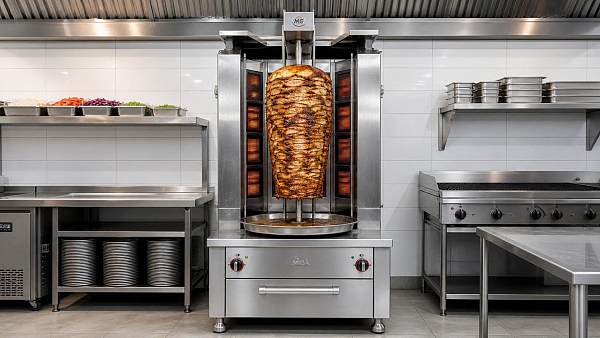
More reliable shawarma machines commercial models usually share a few traits.
- Protected motor placement away from grease and direct heat.
- Removable drip trays that do not distort under frequent washing.
- Smooth welds and rounded internal corners for easier sanitation.
- Stable skewer support that keeps rotation true under heavy load.
- Simple access to igniters, elements, switches, and wear parts.
In actual use, maintenance time can be as important as cooking time.
If a machine is awkward to clean, daily standards usually slip under pressure.
That has direct implications for inspection readiness and product quality.
How should compliance and food safety be checked before placing an order?
This area deserves more than a quick certificate request.
For imported shawarma machines commercial equipment, paperwork should match the exact model, voltage, fuel type, and destination market.
Relevant requirements may include CE, ETL, NSF-related expectations, gas approval, or local electrical standards.
The practical check is whether the documentation supports installation, inspection, and insurance without later disputes.
Food contact surfaces should be clearly identified.
Cleaning instructions, temperature behavior, and splash protection also deserve review.
GCT-style sourcing research often places compliance beside supply reliability for a reason.
A lower quote can become expensive if customs, site approval, or warranty support breaks down later.
Before confirmation, it is worth asking for:
- Model-specific certificates and test reports.
- Material details for food-contact components.
- Installation manuals for local utility conditions.
- Warranty terms covering commercial-duty use.
- Spare part lead times for critical components.
Is the lowest quote ever the best value?
Usually, no.
The more useful comparison is total cost across purchase, installation, energy use, maintenance, downtime, and replacement cycle.
A cheaper unit may need more operator attention, more frequent service, or earlier replacement.
That makes cost planning for shawarma machines commercial projects more nuanced than simple unit pricing.
One practical way to compare offers is to score them against the same operational checklist.
This kind of comparison exposes weak offers quickly.
It also supports internal approval because the reasoning is operational, not just commercial.
What should be confirmed before the final buying decision?
By the time quotations look close, the remaining gaps are usually practical ones.
Will the unit fit the service line?
Does ventilation match the machine type?
Can cleaning be done within shift turnover?
Are spare skewers, knives, guards, and trays available without delay?
For shawarma machines commercial procurement, these final checks often separate a workable installation from a recurring operational headache.
It is also wise to confirm factory lead time against opening schedules or seasonal peaks.
Delays in specialized catering equipment can disrupt launch planning more than the machine price itself.
A sensible close-out process includes a short approval file covering capacity, utilities, compliance, cleaning, support, and landed cost.
That creates a clearer decision trail and reduces surprises after delivery.
In the end, the strongest shawarma machines commercial choice is the one that holds performance during peak service, stays compliant, and remains supportable over time.
The next step is simple: map the real service volume, compare shortlisted models against the same checklist, and verify every claim that affects uptime and food safety.
Search News
Hot Articles
- Restaurant FurnitureFast-Casual Restaurant Interiors: Design Choices That Improve Speed and Guest FlowOct 04, 2026
- Outdoor RidesHow to Select Leisure Park Equipment for Safe, High-Throughput Visitor AreasOct 03, 2026
- Fashion & Gem JewelryDiamond Tester Wholesale: How to Vet Accuracy, Calibration, and MOQ Before OrderingOct 02, 2026
Popular Tags
Need ExpertConsultation?
Connect with our specialized leisureengineering team for procurementstrategies.
Recommended News
 Sep 24, 2026Conveyor Pizza Oven Price: What Buyers Should Budget for Capacity and FeaturesConveyor pizza oven price guide: compare capacity, features, installation costs, and quote factors to choose the right commercial oven for your operation.● Hospitality Sourcing Dir
 Sep 23, 2026How Restaurant Buyers Can Source Hospitality Supplies Without OverorderingHospitality supplies for restaurants: learn practical sourcing strategies to cut excess inventory, protect cash flow, improve supplier reliability, and keep every service running smoothly.● Hospitality Sourcing Dir
 Sep 22, 2026Commercial Kitchen Design Price: Budgeting by Layout, Equipment, and MEP ScopeCommercial kitchen design price explained: budget smarter for layout, equipment, MEP scope, compliance, installation, and long-term operational performance.● Hospitality Sourcing Dir
 Sep 19, 2026How to Select a Spiral Dough Mixer for Bakery Batch Size and Dough HydrationSpiral dough mixer bakery guide: match batch size, flour load, and hydration to select reliable torque, temperature control, and consistent dough results.● Hospitality Sourcing Dir
 Sep 14, 2026How Restaurants Can Choose Disposable Wooden Cutlery for Takeout and CateringDisposable wooden cutlery fork spoon knife guide for restaurants: compare strength, finish, packaging, food-contact needs, and catering performance.● Hospitality Sourcing Dir
 Sep 12, 2026How to Size a Restaurant Walk-In Cooler for Peak Inventory and Kitchen LayoutRestaurant walk in coolers sized for peak inventory and kitchen workflow help improve food safety, staff efficiency, storage access, and long-term operational performance.● Hospitality Sourcing Dir
 Sep 10, 2026How to Choose a CE Hot Dog Roller for Safe, High-Volume Food Service?Choose a CE hot dog roller with confidence: compare compliance documents, heating consistency, cleaning design, capacity, and total cost for safe, high-volume food service.● Hospitality Sourcing Dir
 Sep 04, 2026How to Evaluate a Commercial Food Warmer Manufacturer for Bulk Catering ProjectsCommercial food warmer manufacturer evaluation guide for bulk catering projects: compare thermal performance, compliance, customization, costs, and after-sales support.● Hospitality Sourcing Dir
 Aug 30, 2026How Can Buyers Verify Supplier Qualifications Before a Bulk Order?How to confirm supplier qualifications before placing a bulk order: verify legal identity, factory capability, certificates, samples, quality controls, and payment safeguards.● Hospitality Sourcing Dir
 Aug 28, 2026Commercial Kitchen Design Standards: A Planning Checklist for Code-Compliant LayoutsCommercial kitchen design standards: use this practical checklist to plan safer, code-compliant layouts, streamline approvals, and avoid costly rework.● Hospitality Sourcing Dir
 Aug 06, 2026How to Choose Flake Ice Makers for Seafood Displays, Bars, and Food Prep?Flake ice makers buying guide: compare output, hygiene, storage, energy use, and reliability to choose the best solution for seafood displays, bars, and food prep.● Hospitality Sourcing Dir
 Aug 03, 2026Commercial Kitchen Design Price: What Drives Cost in a New Build Project?Commercial kitchen design price explained: discover what drives cost in a new build, from layout and equipment to ventilation, compliance, and hidden budget risks.● Hospitality Sourcing Dir
 Jul 30, 2026How to Choose a Countertop Commercial Pizza Oven for Capacity, Speed, and Space?Countertop commercial pizza oven buying guide: learn how to match capacity, bake speed, and kitchen space for consistent output, lower costs, and smarter purchasing decisions.● Hospitality Sourcing Dir
 Jul 22, 2026How to Evaluate a Cotton Candy Machine Supplier for Quality, Lead Time, and MOQCotton candy machine supplier selection starts with quality, lead time, and MOQ. Learn how to compare suppliers, reduce sourcing risk, and choose a partner that supports reliable growth.● Hospitality Sourcing Dir
 Jul 21, 2026How to Choose a Charcoal Commercial Grill for Capacity, Heat Control, and Menu FitCharcoal commercial grill buying guide: learn how to match capacity, heat control, and menu fit to boost consistency, service speed, and ROI in commercial kitchens.● Hospitality Sourcing Dir
 Jul 10, 2026FDA Import Alert Adds NSF/ANSI 50-2026 for Commercial Kitchen EquipmentFDA Import Alert now highlights NSF/ANSI 50-2026 for commercial kitchen equipment. Learn how dishwashers, ice machines, and steam cabinets can avoid U.S. port detention.● Hospitality Sourcing Dir
 Jul 05, 2026How to Select Energy Efficient Display Cabinets for Food Retail and HospitalityEnergy efficient display cabinets can cut operating costs while improving food safety, visibility, and service efficiency. Learn how to choose the right model for retail and hospitality.● Hospitality Sourcing Dir
 Jul 04, 2026CPSC Flags New UL 2595 Label Rule for Commercial Ice MakersCPSC flags a new UL 2595 label rule for commercial ice makers entering the U.S. after Aug. 1, 2026. Learn who is affected, key compliance steps, and how to avoid port delays and recall risk.● Hospitality Sourcing Dir
 Jun 29, 2026How to Choose Thermal Receipt Printers for Retail and Restaurant CountersThermal receipt printers for retail and restaurant counters: learn how to compare speed, durability, connectivity, and total operating cost to choose a model that supports smoother service.● Hospitality Sourcing Dir
 Jun 28, 2026Stainless Steel Kitchen Ventilation Systems: Key Specifications for Commercial ProjectsStainless steel kitchen ventilation systems: compare material grades, airflow capture, hygiene, fire safety, and installation specs for commercial projects before you buy.● Hospitality Sourcing Dir
 Jun 27, 2026Commercial Shawarma Machines: What to Check Before Buying for High-Volume ServiceShawarma machines commercial buying guide: learn how to compare capacity, heat control, durability, compliance, and lifecycle cost before choosing equipment for high-volume service.● Hospitality Sourcing Dir
 Jun 26, 2026Restaurant POS Systems: How to Compare Features, Costs, and ScalabilityRestaurant POS systems: compare features, costs, and scalability to find the best fit for your restaurant and boost long-term efficiency.● Hospitality Sourcing Dir
 Jun 25, 2026Kitchen Ventilation Systems Design: How to Size Hoods, Airflow, and Make-Up AirKitchen ventilation systems design explained clearly: learn how to size hoods, set exhaust airflow, and balance make-up air for safer, more efficient commercial kitchens.● Hospitality Sourcing Dir
 Jun 14, 2026Hot Dog Rollers for Convenience Stores and Cafes: Capacity, Heating Zones, and Cleaning TipsHot dog rollers buying guide for convenience stores and cafes: compare real capacity, heating zones, energy use, and cleaning tips to choose a smarter, lower-waste setup.● Hospitality Sourcing Dir