Hot Dog Rollers for Convenience Stores and Cafes: Capacity, Heating Zones, and Cleaning Tips
Hot Dog Rollers for Convenience Stores and Cafes: Capacity, Heating Zones, and Cleaning Tips
Choosing the right hot dog rollers for convenience stores and cafes is not only about hourly output.
In daily service, the better question is how well the machine fits traffic patterns, menu design, cleaning routines, and food safety controls.
That is why technical evaluation usually starts with capacity, heating zone flexibility, power consumption, and ease of maintenance.
For busy stores, poorly matched hot dog rollers can create waste, uneven product quality, and avoidable labor time.
A better-fit unit supports stable holding temperatures, faster recovery after rush periods, and easier end-of-day sanitation.
This guide breaks down the practical specs that matter most when comparing hot dog rollers for convenience retail and cafe counters.
Start with Real Capacity, Not Catalog Capacity
Catalog numbers often show the maximum number of sausages the rollers can physically hold.
In practice, usable capacity is lower because products need space to rotate evenly and heat consistently.
For technical comparison, it helps to separate three values: loading capacity, cooking capacity, and holding capacity.
- Loading capacity shows the maximum number placed on the rollers.
- Cooking capacity reflects how many can heat from refrigerated condition within target time.
- Holding capacity shows how many can stay ready without crowding or drying.
A compact cafe may only need a 9 to 18 hot dog setup if traffic peaks are short and menu variety is limited.
A convenience store near schools, transit stations, or fuel forecourts usually needs more headroom.
From a workflow view, the best hot dog rollers are rarely the largest units.
They are the ones that keep enough product ready during rush periods without leaving excess stock on heat too long.
How to Estimate Daily Requirement
A simple sizing model makes equipment selection much easier.
Start with average hourly sales, then identify the busiest 30 to 60 minutes.
Add a buffer for delayed replenishment, menu expansion, and seasonal spikes.
- Measure peak hourly hot dog sales.
- Check average cooking or reheating recovery time.
- Set a safety margin of 15% to 25%.
- Compare holding loss against expected waste tolerance.
This approach helps avoid oversizing hot dog rollers that consume more power and counter space than the site can justify.
Why Heating Zones Matter More Than Many Buyers Expect
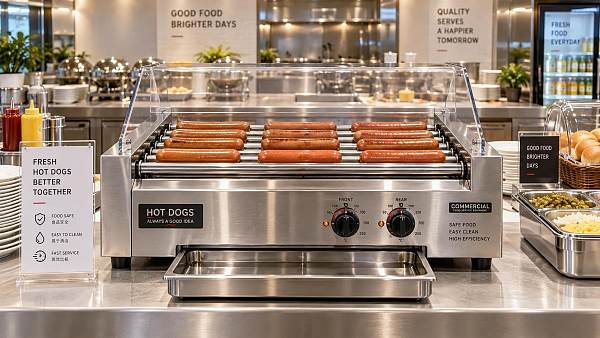
Independent temperature control is one of the most useful features in modern hot dog rollers.
It gives operators the ability to cook on one side and hold on the other.
That sounds simple, but it directly affects consistency, food safety, and waste management.
Single-zone hot dog rollers work for low-volume sites with predictable demand.
However, they can force all products to stay under the same heat profile, even when demand shifts.
That often leads to overholding, skin splitting, or texture loss during slow periods.
Dual-zone or multi-zone systems provide more control.
They also help sites manage different sausage sizes or product types on the same machine.
- Front zone for customer-facing holding.
- Rear zone for heating new product.
- Lower holding temperature during off-peak hours.
- Faster response when demand rises suddenly.
In real operations, heating zones also support better labor control.
Staff can replenish smaller batches more often instead of loading the entire machine at once.
That is usually a better fit for cafes and premium convenience stores where freshness matters as much as speed.
Key Temperature Questions During Evaluation
Build Quality, Roller Design, and Energy Use
When comparing hot dog rollers, build quality affects both uptime and sanitation performance.
Stainless steel construction remains the usual preference for commercial counters because it handles repeated cleaning well.
Roller surface finish also matters.
A smoother finish usually improves wipe-down speed and lowers the risk of residue buildup.
Motor performance should not be overlooked either.
Stable rotation helps sausages heat evenly and keeps presentation consistent across the display area.
If rotation is uneven, products may blister on one side and remain pale on another.
Energy use is becoming a more visible buying factor.
The more obvious signal is that operators now compare lifetime operating cost, not just purchase price.
Hot dog rollers with better insulation and zone control often reduce wasted energy during low-demand periods.
Practical Features Worth Checking
- Removable drip tray for faster cleaning.
- Splash guard or sneeze guard compatibility.
- Clear indicator lights for active heating zones.
- Non-slip feet for counter stability.
- Accessible service parts for maintenance teams.
- Electrical ratings matched to local installation requirements.
Cleaning Tips That Reduce Downtime and Food Safety Risk
Cleaning design is often underestimated until the equipment reaches daily use.
If hot dog rollers are difficult to access, staff may rush the task or leave residue in high-contact areas.
That creates hygiene risk and increases wear over time.
The best units make cleaning straightforward.
They offer removable trays, accessible side panels, and enough clearance to wipe around the rollers safely.
In fast service environments, a few saved minutes every evening quickly add up.
Recommended Daily Cleaning Flow
- Switch off and allow the rollers to cool to a safe handling temperature.
- Remove the drip tray and discard grease or food particles.
- Wipe roller surfaces with approved food-safe cleaner.
- Clean side channels, end caps, and control surfaces carefully.
- Dry fully before restarting or covering the equipment.
It is also useful to separate daily cleaning from periodic deep cleaning.
Weekly checks should include grease accumulation, roller wear, cord condition, and temperature accuracy.
This keeps hot dog rollers performing reliably while supporting food safety documentation and audit readiness.
Matching Hot Dog Rollers to Store Format
Different service formats need different equipment logic.
A downtown cafe usually prioritizes compact footprint, quiet operation, and visual presentation.
A highway convenience store often values volume capacity, faster recovery, and rugged all-day operation.
This kind of matching reduces both overinvestment and underperformance.
It also aligns hot dog rollers with broader counter planning, staffing levels, and menu strategy.
A Smarter Evaluation Checklist
Before making a final decision, compare each model against real operating conditions rather than sales claims.
That usually leads to a much more dependable shortlist.
- Does capacity match peak demand without forcing long holding times?
- Do heating zones support separate cooking and holding tasks?
- Is the unit easy to clean around rollers, trays, and controls?
- Can staff operate it consistently with minimal training?
- Are spare parts and service support available in the target market?
- Does the total cost include energy use, downtime, and replacement frequency?
The most effective hot dog rollers are the ones that stay reliable under routine pressure.
They keep product quality steady, simplify sanitation, and support a profitable hot food program.
For convenience stores and cafes, that balance matters more than any single headline specification.
When evaluating hot dog rollers, focus on fit, control, and cleanability first, then confirm price against long-term operating value.
Search News
Hot Articles
Popular Tags
Need ExpertConsultation?
Connect with our specialized leisureengineering team for procurementstrategies.
Recommended News
 Oct 25, 2026Choosing an Electric Shawarma Machine: Capacity and Power RequirementsChoose the right electric shawarma machine by comparing capacity, power requirements, and peak-hour output. Discover practical buying tips to avoid costly mistakes and keep service moving.● Hospitality Sourcing Dir
 Oct 06, 2026What Is Driving Demand for Commercial Hospitality Projects Across the GCC?Commercial hospitality GCC demand is rising through destination-led tourism, mixed-use development, and premium operational standards. Explore the procurement strategies shaping resilient projects.● Hospitality Sourcing Dir
 Sep 24, 2026Conveyor Pizza Oven Price: What Buyers Should Budget for Capacity and FeaturesConveyor pizza oven price guide: compare capacity, features, installation costs, and quote factors to choose the right commercial oven for your operation.● Hospitality Sourcing Dir
 Sep 23, 2026How Restaurant Buyers Can Source Hospitality Supplies Without OverorderingHospitality supplies for restaurants: learn practical sourcing strategies to cut excess inventory, protect cash flow, improve supplier reliability, and keep every service running smoothly.● Hospitality Sourcing Dir
 Sep 22, 2026Commercial Kitchen Design Price: Budgeting by Layout, Equipment, and MEP ScopeCommercial kitchen design price explained: budget smarter for layout, equipment, MEP scope, compliance, installation, and long-term operational performance.● Hospitality Sourcing Dir
 Sep 19, 2026How to Select a Spiral Dough Mixer for Bakery Batch Size and Dough HydrationSpiral dough mixer bakery guide: match batch size, flour load, and hydration to select reliable torque, temperature control, and consistent dough results.● Hospitality Sourcing Dir
 Sep 14, 2026How Restaurants Can Choose Disposable Wooden Cutlery for Takeout and CateringDisposable wooden cutlery fork spoon knife guide for restaurants: compare strength, finish, packaging, food-contact needs, and catering performance.● Hospitality Sourcing Dir
 Sep 12, 2026How to Size a Restaurant Walk-In Cooler for Peak Inventory and Kitchen LayoutRestaurant walk in coolers sized for peak inventory and kitchen workflow help improve food safety, staff efficiency, storage access, and long-term operational performance.● Hospitality Sourcing Dir
 Sep 10, 2026How to Choose a CE Hot Dog Roller for Safe, High-Volume Food Service?Choose a CE hot dog roller with confidence: compare compliance documents, heating consistency, cleaning design, capacity, and total cost for safe, high-volume food service.● Hospitality Sourcing Dir
 Sep 04, 2026How to Evaluate a Commercial Food Warmer Manufacturer for Bulk Catering ProjectsCommercial food warmer manufacturer evaluation guide for bulk catering projects: compare thermal performance, compliance, customization, costs, and after-sales support.● Hospitality Sourcing Dir
 Aug 30, 2026How Can Buyers Verify Supplier Qualifications Before a Bulk Order?How to confirm supplier qualifications before placing a bulk order: verify legal identity, factory capability, certificates, samples, quality controls, and payment safeguards.● Hospitality Sourcing Dir
 Aug 28, 2026Commercial Kitchen Design Standards: A Planning Checklist for Code-Compliant LayoutsCommercial kitchen design standards: use this practical checklist to plan safer, code-compliant layouts, streamline approvals, and avoid costly rework.● Hospitality Sourcing Dir
 Aug 06, 2026How to Choose Flake Ice Makers for Seafood Displays, Bars, and Food Prep?Flake ice makers buying guide: compare output, hygiene, storage, energy use, and reliability to choose the best solution for seafood displays, bars, and food prep.● Hospitality Sourcing Dir
 Aug 03, 2026Commercial Kitchen Design Price: What Drives Cost in a New Build Project?Commercial kitchen design price explained: discover what drives cost in a new build, from layout and equipment to ventilation, compliance, and hidden budget risks.● Hospitality Sourcing Dir
 Jul 30, 2026How to Choose a Countertop Commercial Pizza Oven for Capacity, Speed, and Space?Countertop commercial pizza oven buying guide: learn how to match capacity, bake speed, and kitchen space for consistent output, lower costs, and smarter purchasing decisions.● Hospitality Sourcing Dir
 Jul 22, 2026How to Evaluate a Cotton Candy Machine Supplier for Quality, Lead Time, and MOQCotton candy machine supplier selection starts with quality, lead time, and MOQ. Learn how to compare suppliers, reduce sourcing risk, and choose a partner that supports reliable growth.● Hospitality Sourcing Dir
 Jul 21, 2026How to Choose a Charcoal Commercial Grill for Capacity, Heat Control, and Menu FitCharcoal commercial grill buying guide: learn how to match capacity, heat control, and menu fit to boost consistency, service speed, and ROI in commercial kitchens.● Hospitality Sourcing Dir
 Jul 10, 2026FDA Import Alert Adds NSF/ANSI 50-2026 for Commercial Kitchen EquipmentFDA Import Alert now highlights NSF/ANSI 50-2026 for commercial kitchen equipment. Learn how dishwashers, ice machines, and steam cabinets can avoid U.S. port detention.● Hospitality Sourcing Dir
 Jul 05, 2026How to Select Energy Efficient Display Cabinets for Food Retail and HospitalityEnergy efficient display cabinets can cut operating costs while improving food safety, visibility, and service efficiency. Learn how to choose the right model for retail and hospitality.● Hospitality Sourcing Dir
 Jul 04, 2026CPSC Flags New UL 2595 Label Rule for Commercial Ice MakersCPSC flags a new UL 2595 label rule for commercial ice makers entering the U.S. after Aug. 1, 2026. Learn who is affected, key compliance steps, and how to avoid port delays and recall risk.● Hospitality Sourcing Dir
 Jun 29, 2026How to Choose Thermal Receipt Printers for Retail and Restaurant CountersThermal receipt printers for retail and restaurant counters: learn how to compare speed, durability, connectivity, and total operating cost to choose a model that supports smoother service.● Hospitality Sourcing Dir
 Jun 28, 2026Stainless Steel Kitchen Ventilation Systems: Key Specifications for Commercial ProjectsStainless steel kitchen ventilation systems: compare material grades, airflow capture, hygiene, fire safety, and installation specs for commercial projects before you buy.● Hospitality Sourcing Dir
 Jun 27, 2026Commercial Shawarma Machines: What to Check Before Buying for High-Volume ServiceShawarma machines commercial buying guide: learn how to compare capacity, heat control, durability, compliance, and lifecycle cost before choosing equipment for high-volume service.● Hospitality Sourcing Dir
 Jun 26, 2026Restaurant POS Systems: How to Compare Features, Costs, and ScalabilityRestaurant POS systems: compare features, costs, and scalability to find the best fit for your restaurant and boost long-term efficiency.● Hospitality Sourcing Dir