Digital Signage for Restaurants vs Printed Menus: Which Fits Your Service Model?
Choosing between digital signage for restaurants and printed menus is no longer just a branding choice. It shapes speed, flexibility, staff workload, and how easily items can be promoted.
For most operators, the better option depends less on trend and more on service model. A fine dining room, a quick-service counter, and a hotel breakfast venue rarely need the same menu system.
This is where a sourcing-minded view helps. GCT often looks at commercial decisions through operational fit, compliance, visual consistency, and long-term maintenance, not just upfront price.
Start with the service model, not the screen
When comparing digital signage for restaurants with printed menus, the first question is simple: how do guests order, wait, and decide in your space?
A menu format works best when it supports the pace of service. If it slows choice, creates confusion, or needs constant manual fixes, it will cost more than expected.
- Use digital displays when menus change often, promotions matter daily, or queue speed directly affects revenue. Printed menus work better when the offer stays stable for weeks.
- Map where customers actually pause and decide. If choices happen at entry, counter, or drive-thru, digital signage for restaurants often improves visibility and ordering confidence.
- Check how many versions must be managed. Breakfast, lunch, happy hour, and seasonal updates are easier on screen than in repeated print runs.
- Review labor impact before design decisions. A system that needs daily staff adjustment without clear control tools usually creates hidden operating friction.
- Measure brand consistency across sites. Multi-location formats often benefit from centralized digital content control, while single venues may manage printed menus more easily.
- Consider viewing distance and lighting. A beautiful design fails fast if guests cannot read prices, modifiers, or combo details within a few seconds.
Where digital signage for restaurants usually wins
Digital menus shine when timing and flexibility matter. They are especially useful in fast-moving environments where product availability, pricing, or promotions shift throughout the day.
They also help create a more consistent commercial experience. That matters in hospitality groups, food halls, travel venues, and branded chains where visual standards need tighter control.
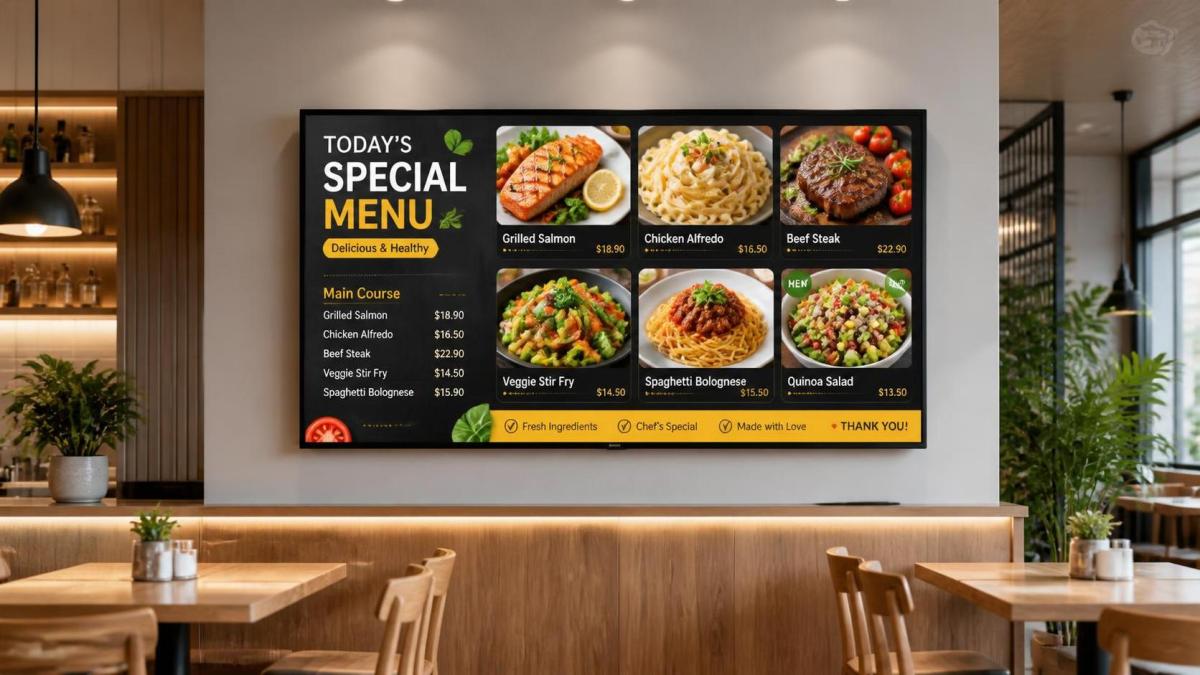
- Fast service formats benefit from dynamic updates. Sold-out items can disappear quickly, while high-margin add-ons stay visible during peak traffic without reprinting anything.
- Daypart switching becomes easier. Digital signage for restaurants can move from breakfast to lunch automatically, reducing manual mistakes and keeping each menu relevant.
- Upselling is usually stronger on screen. Motion, sequencing, and product imagery can highlight bundles, desserts, or beverages more effectively than static printed layouts.
- Multi-site operations gain tighter control. Centralized scheduling helps maintain pricing, messaging, and campaign timing across locations, which supports stronger brand discipline.
- Screens support multilingual communication more easily. This is useful in hotels, tourist districts, and mixed-use commercial spaces with varied visitor profiles.
- Short-term campaigns become more practical. Seasonal events, limited offers, and partner promotions can launch quickly without leftover printed inventory or design waste.
A common point people miss
The advantage is not the screen alone. It is the content workflow behind it. If pricing approval, design edits, and scheduling are slow, digital tools will not feel efficient.
Where printed menus still make sense
Printed menus are not outdated by default. In many cases, they remain the better operational choice, especially where the dining experience depends on calm browsing and physical presentation.
They can also be easier to manage when the menu is stable, the venue has limited technical support, or the interior concept depends on tactile brand cues.
- Fine dining often benefits from printed menus because guests expect a slower, more intimate decision process that screens may interrupt or visually dominate.
- Venues with highly stable offerings can control costs well with print, especially when menu revisions happen rarely and design quality supports the overall atmosphere.
- Printed menus reduce technical dependency. There is no reliance on software updates, network stability, brightness calibration, or hardware maintenance during service hours.
- Table-service settings may find print more practical when guests need to compare wine, modifiers, or tasting options over several minutes without screen cycling.
- Premium material choices can reinforce positioning. Paper stock, embossing, covers, and finishing sometimes communicate value more effectively than a generic display setup.
- Smaller independent venues may prefer print when capital budgets are tight and the expected sales lift from digital signage for restaurants is still uncertain.
Compare the real costs, not just the purchase price
This is where many decisions go wrong. Screens look expensive upfront. Print looks affordable at first. But the total cost depends on update frequency, labor time, waste, and downtime risk.
From a sourcing perspective, GCT often treats menu systems as part of the full commercial environment. That means considering installation quality, display durability, electrical safety, mounting, and content governance together.
Match the format to the setting
Quick-service and counter ordering
This is one of the strongest use cases for digital signage for restaurants. Customers decide fast, look up while queuing, and respond well to simple visual hierarchy.
The key checks are readability, queue visibility, and easy price updates. If service windows run different offers by time slot, digital control becomes especially useful.
Casual dining
Casual formats often work well with a mix. Printed table menus can support relaxed browsing, while digital boards near entry, bar, or pickup areas promote specials and limited items.
This hybrid model is often more practical than going fully one way. It gives flexibility without forcing every guest interaction onto a screen.
Hotel restaurants and breakfast venues
Hotels often need multilingual support, branded consistency, and frequent offer changes across breakfast, lounge, room service, and events. That creates a strong case for digital systems.
Still, printed formats may remain useful for wine, banquet, or in-room presentation. In these settings, the best answer is often operational layering rather than replacement.
Risks that are easy to underestimate
The wrong decision usually comes from underestimating daily execution. A menu system may look polished at launch but fail under real service pressure.
- Do not buy screens before defining content ownership. Without a clear update process, digital signage for restaurants can become outdated surprisingly fast.
- Avoid overly animated layouts. Movement may attract attention, but it can also slow reading and weaken decision speed during busy service periods.
- Check compliance and installation standards early. Mounting, heat, glare, power routing, and public safety requirements affect both cost and long-term reliability.
- Do not ignore backup planning. If a screen fails during peak hours, staff need a printed fallback or another clear method to display current pricing.
- Printed menus also carry risk. Frequent edits, visible wear, and inconsistent versions across shifts can quietly damage trust and create avoidable ordering errors.
A practical way to decide
If the menu changes often, speed matters, and promotions drive margin, digital signage for restaurants is usually the stronger fit.
If the menu is stable, the setting is experience-led, and print quality supports the brand, traditional menus may still be the smarter choice.
And if the operation covers multiple guest touchpoints, a blended model is often best. Use screens where speed and visibility matter. Keep print where browsing and tactile experience add value.
A useful next step is to audit three things: menu update frequency, decision points in the customer journey, and total annual menu maintenance cost. Those answers usually make the direction much clearer.
In commercial sourcing, the strongest solution is rarely the newest one. It is the one that fits the service model, supports the brand, and keeps operations steady every day.
Search News
Hot Articles
- Musical InstrumentsProfessional String Instruments: How to Evaluate Tone, Response, and ProjectionOct 17, 2026
- Restaurant FurnitureBuying Hotel Lobby Furniture Wholesale: MOQs, Freight Costs, and Lead TimesOct 16, 2026
- Pro Stage AudioDesigning Theater Sound Systems for Clear Dialogue and Even Audience CoverageOct 15, 2026
Popular Tags
Need ExpertConsultation?
Connect with our specialized leisureengineering team for procurementstrategies.
Recommended News
 Oct 06, 2026What Is Driving Demand for Commercial Hospitality Projects Across the GCC?Commercial hospitality GCC demand is rising through destination-led tourism, mixed-use development, and premium operational standards. Explore the procurement strategies shaping resilient projects.● Hospitality Sourcing Dir
 Sep 24, 2026Conveyor Pizza Oven Price: What Buyers Should Budget for Capacity and FeaturesConveyor pizza oven price guide: compare capacity, features, installation costs, and quote factors to choose the right commercial oven for your operation.● Hospitality Sourcing Dir
 Sep 23, 2026How Restaurant Buyers Can Source Hospitality Supplies Without OverorderingHospitality supplies for restaurants: learn practical sourcing strategies to cut excess inventory, protect cash flow, improve supplier reliability, and keep every service running smoothly.● Hospitality Sourcing Dir
 Sep 22, 2026Commercial Kitchen Design Price: Budgeting by Layout, Equipment, and MEP ScopeCommercial kitchen design price explained: budget smarter for layout, equipment, MEP scope, compliance, installation, and long-term operational performance.● Hospitality Sourcing Dir
 Sep 19, 2026How to Select a Spiral Dough Mixer for Bakery Batch Size and Dough HydrationSpiral dough mixer bakery guide: match batch size, flour load, and hydration to select reliable torque, temperature control, and consistent dough results.● Hospitality Sourcing Dir
 Sep 14, 2026How Restaurants Can Choose Disposable Wooden Cutlery for Takeout and CateringDisposable wooden cutlery fork spoon knife guide for restaurants: compare strength, finish, packaging, food-contact needs, and catering performance.● Hospitality Sourcing Dir
 Sep 12, 2026How to Size a Restaurant Walk-In Cooler for Peak Inventory and Kitchen LayoutRestaurant walk in coolers sized for peak inventory and kitchen workflow help improve food safety, staff efficiency, storage access, and long-term operational performance.● Hospitality Sourcing Dir
 Sep 10, 2026How to Choose a CE Hot Dog Roller for Safe, High-Volume Food Service?Choose a CE hot dog roller with confidence: compare compliance documents, heating consistency, cleaning design, capacity, and total cost for safe, high-volume food service.● Hospitality Sourcing Dir
 Sep 04, 2026How to Evaluate a Commercial Food Warmer Manufacturer for Bulk Catering ProjectsCommercial food warmer manufacturer evaluation guide for bulk catering projects: compare thermal performance, compliance, customization, costs, and after-sales support.● Hospitality Sourcing Dir
 Aug 30, 2026How Can Buyers Verify Supplier Qualifications Before a Bulk Order?How to confirm supplier qualifications before placing a bulk order: verify legal identity, factory capability, certificates, samples, quality controls, and payment safeguards.● Hospitality Sourcing Dir
 Aug 28, 2026Commercial Kitchen Design Standards: A Planning Checklist for Code-Compliant LayoutsCommercial kitchen design standards: use this practical checklist to plan safer, code-compliant layouts, streamline approvals, and avoid costly rework.● Hospitality Sourcing Dir
 Aug 06, 2026How to Choose Flake Ice Makers for Seafood Displays, Bars, and Food Prep?Flake ice makers buying guide: compare output, hygiene, storage, energy use, and reliability to choose the best solution for seafood displays, bars, and food prep.● Hospitality Sourcing Dir
 Aug 03, 2026Commercial Kitchen Design Price: What Drives Cost in a New Build Project?Commercial kitchen design price explained: discover what drives cost in a new build, from layout and equipment to ventilation, compliance, and hidden budget risks.● Hospitality Sourcing Dir
 Jul 30, 2026How to Choose a Countertop Commercial Pizza Oven for Capacity, Speed, and Space?Countertop commercial pizza oven buying guide: learn how to match capacity, bake speed, and kitchen space for consistent output, lower costs, and smarter purchasing decisions.● Hospitality Sourcing Dir
 Jul 22, 2026How to Evaluate a Cotton Candy Machine Supplier for Quality, Lead Time, and MOQCotton candy machine supplier selection starts with quality, lead time, and MOQ. Learn how to compare suppliers, reduce sourcing risk, and choose a partner that supports reliable growth.● Hospitality Sourcing Dir
 Jul 21, 2026How to Choose a Charcoal Commercial Grill for Capacity, Heat Control, and Menu FitCharcoal commercial grill buying guide: learn how to match capacity, heat control, and menu fit to boost consistency, service speed, and ROI in commercial kitchens.● Hospitality Sourcing Dir
 Jul 10, 2026FDA Import Alert Adds NSF/ANSI 50-2026 for Commercial Kitchen EquipmentFDA Import Alert now highlights NSF/ANSI 50-2026 for commercial kitchen equipment. Learn how dishwashers, ice machines, and steam cabinets can avoid U.S. port detention.● Hospitality Sourcing Dir
 Jul 05, 2026How to Select Energy Efficient Display Cabinets for Food Retail and HospitalityEnergy efficient display cabinets can cut operating costs while improving food safety, visibility, and service efficiency. Learn how to choose the right model for retail and hospitality.● Hospitality Sourcing Dir
 Jul 04, 2026CPSC Flags New UL 2595 Label Rule for Commercial Ice MakersCPSC flags a new UL 2595 label rule for commercial ice makers entering the U.S. after Aug. 1, 2026. Learn who is affected, key compliance steps, and how to avoid port delays and recall risk.● Hospitality Sourcing Dir
 Jun 29, 2026How to Choose Thermal Receipt Printers for Retail and Restaurant CountersThermal receipt printers for retail and restaurant counters: learn how to compare speed, durability, connectivity, and total operating cost to choose a model that supports smoother service.● Hospitality Sourcing Dir
 Jun 28, 2026Stainless Steel Kitchen Ventilation Systems: Key Specifications for Commercial ProjectsStainless steel kitchen ventilation systems: compare material grades, airflow capture, hygiene, fire safety, and installation specs for commercial projects before you buy.● Hospitality Sourcing Dir
 Jun 27, 2026Commercial Shawarma Machines: What to Check Before Buying for High-Volume ServiceShawarma machines commercial buying guide: learn how to compare capacity, heat control, durability, compliance, and lifecycle cost before choosing equipment for high-volume service.● Hospitality Sourcing Dir
 Jun 26, 2026Restaurant POS Systems: How to Compare Features, Costs, and ScalabilityRestaurant POS systems: compare features, costs, and scalability to find the best fit for your restaurant and boost long-term efficiency.● Hospitality Sourcing Dir
 Jun 25, 2026Kitchen Ventilation Systems Design: How to Size Hoods, Airflow, and Make-Up AirKitchen ventilation systems design explained clearly: learn how to size hoods, set exhaust airflow, and balance make-up air for safer, more efficient commercial kitchens.● Hospitality Sourcing Dir