How to Choose Coin-Operated Pool Tables for Bars, Hotels, and Arcade Venues
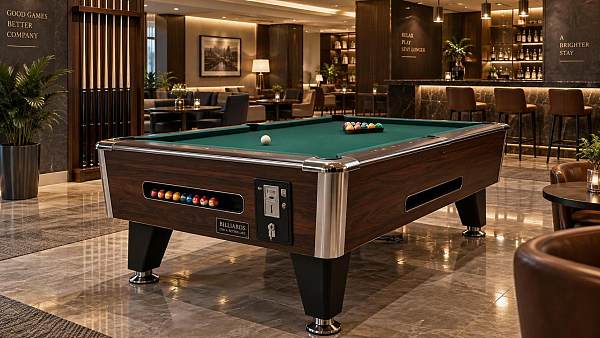
A coin-operated pool table should be selected as a commercial asset, not simply as a piece of bar furniture. The right model must suit the available floor area, the way guests use the venue, the expected level of abuse, local payment habits, and the operator’s ability to maintain it. A table that looks impressive but is difficult to service, too large for its location, or poorly matched to the venue’s audience can create more downtime than revenue.
The most reliable starting point is to define the role the table will play. In a busy arcade, it is a high-frequency paid attraction. In a sports bar, it may be a social anchor that keeps groups on site longer and supports food and beverage sales. In a hotel lounge, it can be an amenity first and a direct revenue source second. Those roles lead to different choices in size, cabinet finish, payment system, and service requirements.
Start with the venue, not the catalog
Commercial pool tables are commonly offered in several playing-field sizes, but the table itself is only part of the space requirement. Players need room to stand, cue, and move around every side. A table placed too close to walls, columns, stools, or service routes may technically fit the floor plan while still being frustrating to use.
Before requesting quotations, map the full playing zone. Include the table footprint, cue clearance, circulation paths, seating, emergency access, and the space needed to open the coin door for collection or maintenance. A smaller table in a comfortable location will usually see more play than a larger table installed where players constantly need short cues or must ask others to move.
Venue character matters as much as square footage:
Do not assume that a hotel requires a domestic-style table because the setting is more refined. A guest-facing environment still benefits from commercial-grade leveling, durable rails, secure ball storage, and serviceable components. The difference is usually in finish and payment policy, not in the need for reliable construction.
Choose the payment system around operations
The payment mechanism is one of the main differences between coin operated pool tables and standard pool tables. It affects revenue collection, guest experience, staffing, and fault diagnosis. The most suitable system depends on how the venue already handles payments and how much operator intervention is acceptable.
A traditional mechanical coin mechanism remains practical where cash play is normal and simplicity is valued. It has fewer electronic dependencies and can be straightforward to understand on site. However, it should accept the local coin denomination reliably and include secure cashbox access. A mechanism designed for another market may create rejected coins, inaccurate pricing, or frequent service calls.
Electronic payment systems can support tokens, card readers, contactless payment, or configurable pricing. They are useful when the venue is reducing cash handling or wants a more consistent guest journey across machines. Their value depends on the wider operating environment. A card-enabled table may be a poor fit in a cash-focused bar with limited connectivity, while a token-only model may be inconvenient in an arcade that already uses a centralized cashless system.
Ask the supplier to clarify exactly what is included: the payment interface, currency or token compatibility, power requirements, configuration access, cashbox locks, and any software or network dependency. “Coin-operated” does not describe one universal mechanism. It describes a category with meaningful operational differences.
Construction quality shows up in downtime
For commercial use, the cabinet, slate or bed material, rail assembly, pockets, ball return, and leveling system deserve more scrutiny than decorative details. These parts determine whether the table remains playable after repeated use and whether routine repairs can be completed without taking the attraction out of service for long.
Cabinet and frame
A commercial cabinet needs to resist impact, side loading, spilled drinks, and repeated contact from stools or cleaning equipment. Check how the body is reinforced, whether corner protection is replaceable, and how the access panel is secured. A heavy table is not automatically a better table, but a light or poorly braced cabinet can shift, twist, or lose level in a demanding environment.
Playing surface and leveling
The playing surface should remain flat and stable under normal commercial conditions. Ask how the table is leveled, how many adjustment points are provided, and whether leveling can be performed without dismantling major components. A table that cannot be re-leveled efficiently becomes difficult to keep attractive to regular players.
Surface cloth should be selected for the operating model. Faster cloth may appeal to experienced players but can reveal wear, burns, and contamination more quickly in a high-turnover public venue. A durable commercial cloth with a color that suits the environment is often the more sensible choice. Dark colors can hide some marks, while very light cloth may look premium at installation but require more frequent cleaning or replacement.
Rails, pockets, and ball return
Players notice rail response immediately. Inconsistent rebounds make even a visually impressive table feel poor. Pocket liners and rails should tolerate regular ball impact, and the ball return should move balls without jams or inaccessible blockage points. In coin-operated designs, the separation between cue ball and object balls is especially important. If the cue-ball release arrangement is unreliable, staff may spend time resolving disputes or opening the table during peak hours.
Request clear information on access to the ball channel, cue-ball mechanism, and return tray. A serviceable design is more valuable than an enclosed system that looks neat but requires extensive disassembly for a minor obstruction.
Match table size to the players you expect
Smaller commercial tables are often easier to place and can encourage casual play, especially in bars with limited space. They work well when the activity is spontaneous and players are likely to rotate frequently. Larger tables offer a more traditional playing experience and may appeal to serious players, but they require more room and can reduce the number of viable locations in a venue.
The decision should not be based on prestige alone. A full-size table may support a stronger billiards identity in a dedicated room, yet it can be a weak investment in a narrow hospitality area where guests cannot use standard-length cues comfortably. Conversely, choosing the smallest available model for a venue that attracts league players can limit repeat play and diminish its reputation as a billiards destination.
Consider the likely mix of players. Casual groups generally prioritize availability, easy payment, and a pleasant setting. More experienced players pay closer attention to level, rail consistency, cloth condition, and room clearance. A venue can accommodate both, but only if the table is installed as a genuine playing area rather than an afterthought between furniture.
Revenue potential depends on turnover, not just the price per game
A higher game price does not necessarily produce better results. Pricing must feel appropriate to the venue, the quality of the table, the expected game length, and the surrounding spend. A bar may benefit from a price that encourages groups to start a game and remain longer. An arcade may need a payment structure that keeps play moving during busy periods. A hotel may choose free play because the table supports the overall guest experience more effectively than direct collection.
When comparing models, evaluate the total operating picture:
- How quickly can a new game begin after the previous game ends?
- Can staff clear a jam or retrieve a stuck ball without specialist tools?
- How secure is the cash or token collection system?
- What parts are most likely to wear, and can they be obtained consistently?
- Will the table require a technician for ordinary adjustments?
- Does its appearance still support the venue after normal wear appears?
This approach prevents a common mistake: selecting the lowest purchase price while overlooking ongoing interruptions. A less expensive table can become costly if poor ball return performance, weak locks, damaged corners, or unavailable parts repeatedly remove it from service.
Service access and spare parts should be part of the purchase decision
Commercial equipment is only as reliable as its support path. Before placing an order, ask for an exploded parts diagram or a clear list of replaceable components. The essential items usually include cloth, rails or cushions, pocket components, cue-ball parts, coin mechanism components, locks, keys, ball-return elements, leg levelers, and exterior trim.
It is also useful to understand which tasks can be handled by venue maintenance staff and which require a billiards technician. Routine cleaning, basic leveling checks, and cashbox collection should be manageable without complicated procedures. Cloth replacement, rail work, or internal mechanical repair may require more skill, but the table should be designed so these jobs are feasible without damaging the cabinet.
For international sourcing, confirm packaging method, assembled or knock-down delivery format, installation responsibility, replacement-part lead time, and documentation language. A table that arrives safely but cannot be correctly assembled or calibrated will not deliver the intended playing experience. In multi-site projects, ordering a small reserve of high-wear parts with the original shipment can reduce avoidable delays later.
Do not treat safety and compliance as paperwork
A pool table is a heavy, public-use item. Stability, secure assembly, accessible edges, suitable electrical protection for electronic payment components, and safe placement all matter. The table should remain stable during normal use and should not obstruct exits, service routes, or accessible circulation areas.
Where electrical payment equipment is included, the power supply, wiring, connectors, and installation conditions need to suit the destination market and venue environment. Indoor tables should not be assumed suitable for humid terraces, poolside areas, or semi-outdoor entertainment zones. Moisture, temperature variation, and direct sunlight can affect cloth, cabinet materials, electronic components, and table level.
The most effective approach is to include destination-market requirements in the supplier brief from the beginning. That allows the manufacturer to quote the appropriate configuration rather than offering a generic export model that later needs changes.
A practical comparison brief for suppliers
Comparable quotations require comparable information. A brief that only asks for “a coin-operated pool table” will produce inconsistent offers that are difficult to evaluate. Specify the intended venue, available playing area, table size preference, finish expectations, payment method, destination market, anticipated usage level, and installation constraints.
Then request photographs of the internal access layout, payment mechanism, ball-return route, cabinet underside, leg-leveling arrangement, and packaging. Exterior images alone cannot show the components most likely to affect maintenance. For customized projects, approve the finish sample and branding position separately from the mechanical specification. A custom cabinet color does not compensate for an unsuitable playing system.
Questions worth resolving before approval
- Is this model designed for continuous public use or for occasional home recreation?
- Does the table accept the required coins, tokens, or payment hardware without modification?
- Can the cue ball be recovered reliably, and can staff access a jam quickly?
- What clearance is required around the installed table for normal cue use?
- Which wear parts are supplied, and which can be reordered individually?
- How is the table leveled after installation and during routine operation?
- Who is responsible for delivery, positioning, assembly, and final setup?
A well-chosen table balances commercial durability with the atmosphere the venue is trying to create. For a high-turnover arcade, mechanical resilience and rapid service usually lead the decision. For a hotel lounge, the same fundamentals remain necessary, but finish quality, quieter operation, and placement may carry more weight. For bars, the best choice is often the one that invites repeat play without disrupting circulation, service, or the wider guest experience.
The final selection should be made after the intended location, payment method, service plan, and operating role are clear. Once those conditions are defined, comparing coin-operated pool tables becomes less about choosing the most elaborate specification and more about choosing a table that can remain playable, presentable, and profitable in its actual environment.
Search News
Hot Articles
- Arcade & VR MachinesHow to Choose Coin-Operated Pool Tables for Bars, Hotels, and Arcade VenuesSep 15, 2026
- Commercial KitchenHow Restaurants Can Choose Disposable Wooden Cutlery for Takeout and CateringSep 14, 2026
- Jewelry Packaging & DisplayHow U.S. Retailers Can Choose Jewelry Displays for Better Security and SalesSep 13, 2026
Popular Tags
Need ExpertConsultation?
Connect with our specialized leisureengineering team for procurementstrategies.
Recommended News
 Sep 15, 2026How to Choose Coin-Operated Pool Tables for Bars, Hotels, and Arcade VenuesCoin operated pool tables for bars, hotels, and arcades: compare sizes, payment systems, durability, service access, and revenue potential.● Theme Park Strategist
 Sep 08, 2026What to Look for in a Flight Simulator Chair Manufacturer for Commercial VR CentersChoose a flight simulator chair manufacturer that delivers durable, safe, customizable seating for commercial VR centers. Explore key sourcing criteria now.● Theme Park Strategist
 Aug 25, 2026What to Evaluate Before Buying Commercial Self Service Photo Booths for VenuesCommercial self service photo booths for venues: learn how to evaluate durability, software stability, branding flexibility, support, and total ROI before you buy.● Theme Park Strategist
 Aug 23, 2026How to Evaluate Wholesale Vending Machines for Multi-Location Business DeploymentWholesale vending machines for multi-location deployment require more than low unit cost. Learn how to compare reliability, payments, telemetry, and supplier support to scale smarter.● Theme Park Strategist
 Aug 17, 2026U.S. CPSC Urges Bilingual Warnings for Arcade and VR MachinesU.S. CPSC urges bilingual safety warnings for Arcade & VR Machines—learn what exporters, importers, and distributors must do now to avoid delays and returns.● Theme Park Strategist
 Aug 16, 2026EU Enforces EN IEC 62368-1:2026 Certification for Arcade and VR MachinesEU Enforces EN IEC 62368-1:2026 certification for arcade and VR machines, reshaping EU market access, customs clearance, and compliance planning for exporters and distributors.● Theme Park Strategist
 Aug 13, 2026UFLPA’s new guidelines take effect: Exports of Arcade and VR equipment face full-link labor compliance requirementsUFLPA’s new guide takes effect: Arcade and VR machine exports to the U.S. now face full-chain labor compliance checks. Discover key risks and action steps.● Theme Park Strategist
 Aug 12, 2026EU PPWR takes effect, Arcade and VR packaging incorporate heavy metal and PFAS restrictionsEU PPWR now applies to Arcade and VR packaging, tightening heavy metal and PFAS compliance. Learn how exporters can avoid delays, fines, and customs risks.● Theme Park Strategist
 Aug 11, 2026CPSC Sets Bilingual Labels for Arcade and VR ImportsCPSC bilingual labels for arcade and VR imports become mandatory on October 1, 2026. Learn the new English-Spanish warning rules, customs risks, and key compliance steps now.● Theme Park Strategist
 Aug 10, 2026EU Rule Takes Effect for Arcade & VR Machine ClearanceArcade & VR Machine clearance in the EU now depends on EN IEC 62368-1:2026+A11:2026 compliance. Learn what changed, who is affected, and how to avoid customs delays.● Theme Park Strategist
 Aug 09, 2026CPSC Requires New Labels for Arcade and VR ImportsCPSC requires new labels for Arcade and VR imports starting Oct 1, 2026. Learn the multilingual warning rules, compliance risks, and key steps exporters and buyers must take now.● Theme Park Strategist
 Aug 08, 2026EU Entry Rule Tightens for Arcade & VR MachinesArcade & VR Machines entering the EU now face stricter CE compliance under EN IEC 62368-1:2026+A11:2026. Learn the new rule, risks, and what exporters must do now.● Theme Park Strategist
 Aug 07, 2026CPSC Notice Tightens U.S. Entry Rules for Arcade and VR MachinesCPSC Notice Tightens U.S. Entry Rules for Arcade and VR Machines: learn the new labeling, FCC, UN38.3, and compliance document requirements before October 1, 2026.● Theme Park Strategist
 Aug 06, 2026EU Rule Takes Effect for CE-UKCA Labels on Arcade & VR MachinesArcade & VR Machines face new CE-UKCA label and ECPD filing rules in the EU and UK. Learn what manufacturers, importers, and distributors must do now to avoid delays.● Theme Park Strategist
 Aug 05, 2026CPSC Recalls Arcade and VR Machines Over UL 62368-1CPSC recalls arcade and VR machines over UL 62368-1 non-compliance. Learn how this 2026 safety action may affect imports, distribution, customs clearance, and market access.● Theme Park Strategist
 Aug 02, 2026EU Sets New Certification Rule for Arcade and VR MachinesArcade and VR Machines face a new EU certification rule from Oct 1, 2026. Learn how EN IEC 62368-1:2026+A11:2026 affects CE marking, customs clearance, and market access.● Theme Park Strategist
 Aug 01, 2026CPSC Moves to Require Bilingual Warnings on Arcade and VR MachinesCPSC bilingual warnings for Arcade and VR Machines may reshape U.S. import compliance. Learn how English-Spanish labels affect packaging, customs risk, and shipment readiness.● Theme Park Strategist
 Jul 31, 2026EU Sets EN IEC 62368-1:2025 Rule for Arcade and VR MachinesEU Sets EN IEC 62368-1:2025 Rule for Arcade and VR Machines. Learn the new EU compliance deadlines, safety updates, and key actions for manufacturers, OEMs, and distributors.● Theme Park Strategist
 Jul 30, 2026CPSC Sets New Warning Label Rule for Arcade & VR MachinesCPSC sets a new warning label rule for Arcade & VR Machines effective August 15, 2026. Learn key compliance risks, multilingual label requirements, and shipment actions now.● Theme Park Strategist
 Jul 29, 2026EU Enforces New Safety Standard for Arcade and VR MachinesEU Enforces New Safety Standard for Arcade and VR Machines: learn how EN IEC 62368-1 affects CE compliance, customs clearance, and EU market access for exporters and buyers.● Theme Park Strategist
 Jul 28, 2026CPSC Sets ASTM F3472-26 Rule for Arcade & VR ImportsCPSC ASTM F3472-26 rule reshapes Arcade & VR imports to the U.S. Learn key compliance deadlines, certification risks, and what exporters, OEM/ODM suppliers, and buyers should do now.● Theme Park Strategist
 Jul 27, 2026EU Rule Takes Effect for Arcade & VR Machine CybersecurityEU Rule Takes Effect for Arcade & VR Machine Cybersecurity: learn how EN IEC 62443-3-3:2025 affects compliance, customs clearance, sales continuity, and supplier planning in the EU market.● Theme Park Strategist
 Jul 25, 2026CPSC Sets Bilingual Warning Rule for Arcade and VR ImportsCPSC bilingual warning rule for arcade and VR imports takes effect August 1, 2026. Learn how OEM/ODM exporters can avoid CBP delays, relabel shipments, and protect U.S. delivery timelines.● Theme Park Strategist
 Jul 24, 2026EU Enforces New Safety Standard for Arcade and VR MachinesEU Enforces New Safety Standard for Arcade and VR Machines: learn how EN IEC 62368-1:2026+A11:2026 reshapes EU compliance, CE documentation, testing timelines, and export readiness.● Theme Park Strategist