What to Look for in a Flight Simulator Chair Manufacturer for Commercial VR Centers
A flight simulator chair is not a standard office seat with gaming-style upholstery. In a commercial VR center, it is a guest-contact component exposed to repeated loading, rapid turnover, cleaning chemicals, headset cables, motion cues, and occasional misuse. A chair that looks convincing in a showroom can become an operating problem if its adjustment mechanisms loosen, its upholstery splits, its base shifts during entry, or its mounting interface does not match the simulator platform.
The right flight simulator chair manufacturer is therefore the one that can demonstrate a repeatable fit between chair design, attraction duty cycle, safety obligations, maintenance resources, and site installation conditions. Product appearance matters to the guest experience, but procurement decisions should be driven by evidence: engineering documentation, material specifications, load assumptions, production controls, service access, and a clear allocation of responsibility between the chair supplier and the simulator integrator.
Start by defining what the chair is required to do
“Flight simulator chair” can describe several materially different products. A fixed cockpit seat used with a stationary VR flight game has different requirements from a seat installed on a motion platform, a replica aircraft cockpit for location-based entertainment, or a multi-seat attraction with synchronized audiovisual effects. Treating these as equivalent during supplier comparison creates avoidable specification gaps.
The procurement brief should state whether the chair is:
- a standalone seating product;
- a seat mounted to a static simulator frame;
- a component attached to a motion base;
- part of a restraint-controlled attraction; or
- a custom enclosure combining seat, controls, display hardware, and themed panels.
This distinction affects structural design, mounting points, electrical routing, restraint needs, center-of-gravity calculations, access for cleaning, and the applicable compliance pathway. A manufacturer may be highly competent at upholstered commercial seating yet have limited experience with vibration, dynamic loads, or the interface discipline required for motion-based equipment.
Operating conditions deserve equal precision. Ask the internal project team to define the expected number of sessions per day, average session length, guest age or body-size range, staff supervision level, cleaning regime, and anticipated downtime tolerance. A center where guests self-board every few minutes places particular stress on armrests, seat edges, swivel mechanisms, pedal assemblies, and entry-side trim. These are not minor details: they determine whether the unit remains presentable and safe after sustained public use.
Assess the structure behind the upholstery
Visible finish is easy to compare; the load-bearing structure is where procurement risk often sits. Request drawings or specifications that identify the frame material, tube or plate construction, joint method, mounting arrangement, seat-shell material where applicable, and the rated load basis. A supplier should be able to explain how the structure handles not only a seated guest’s vertical weight, but also the lateral forces created when a person enters, exits, braces against a control yoke, or reacts to motion.
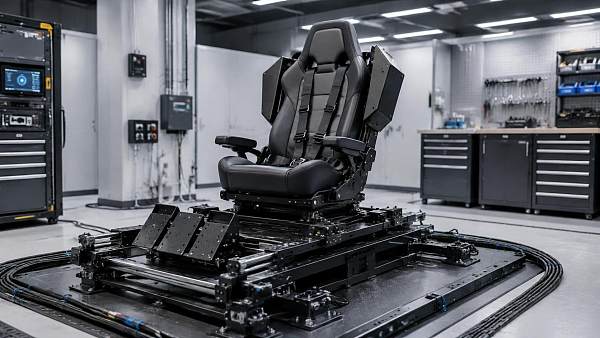
For chairs mounted on a simulator platform, the interface is as important as the chair itself. Confirm the bolt pattern, fastener grade, mounting plate thickness, permitted attachment locations, and required torque values. If the chair is supplied with a pedestal, slide rail, swivel, or recline mechanism, clarify whether those features are approved for the intended operating configuration. A reclining or swiveling seat may improve initial appeal but add failure points and create unwanted movement in a VR setting.
Dynamic applications require a more disciplined review. Motion can amplify fatigue at welded joints, rails, brackets, and cable pass-throughs. The supplier should identify any limits on acceleration, stroke, pitch, roll, vibration, or duty cycle that affect the seat assembly. If it cannot provide those limits, the system integrator cannot reliably validate the combined attraction. “Designed for simulation” is not a substitute for documented compatibility with a specified motion environment.
Where restraints are included, avoid assuming that a belt, harness, or locking bar is automatically suitable for public attraction use. Its anchorage, release mechanism, adjustment range, maintenance intervals, and interaction with emergency evacuation all need review at system level. Restraint design is particularly sensitive because the relevant legal and technical obligations depend on the jurisdiction and on whether the overall installation is regulated as amusement equipment, machinery, furniture, or another category.
Comfort is an operational variable, not a showroom preference
Commercial VR centers need a chair that accommodates a broad guest population without turning every session into a manual fitting exercise. The objective is stable, intuitive positioning: guests should sit down, locate the controls, and remain supported without complex adjustments or staff intervention.
Seat width, usable depth, backrest contour, lumbar shape, armrest placement, and pedal reach all affect the experience. Yet maximum adjustability is not always the best answer. Multiple levers, exposed rails, loose arm pads, and consumer-grade gas lifts can increase misuse and maintenance. For a standardized attraction, a fixed or limited-adjustment configuration may provide better throughput and more consistent control reach.
Ask for dimensional data rather than descriptive claims about ergonomics. Important dimensions include finished seat height, seat depth, internal armrest clearance, backrest height, pedal adjustment range, and the clearance required for guests to enter and exit. If a headset is used, examine headrest geometry as well. A bulky headrest can interfere with rear straps or make it difficult for a guest to maintain a comfortable neutral head position.
Accessibility should be addressed during layout review, not after installation. A low-slung cockpit seat, high sidewall, narrow entrance, or fixed control column can limit use by guests with reduced mobility. Not every attraction can serve every user category, but the operational limitations should be understood before purchasing and reflected in site procedures and guest communication.
Specify materials for public use and cleaning reality
Material selection should reflect frequent contact, fast cleaning, and cosmetic longevity. Upholstery that performs well in domestic or low-use gaming products may not withstand repeated wiping, abrasion from clothing hardware, sunscreen transfer, or disinfectants used between sessions. A procurement specification should identify the upholstery type, backing, foam density or performance criteria, seam construction, thread type, trim method, and approved cleaning agents.
There is a trade-off between visual realism and serviceability. Detailed stitched panels, perforated surfaces, decorative piping, imitation carbon-fiber films, and complex molded inserts may support a premium cockpit aesthetic, but they can also trap dirt or make localized repair difficult. In high-turnover venues, removable and replaceable contact surfaces can be more valuable than a visually elaborate but non-serviceable cover.
Fire performance requires special care. Requirements vary by market, venue type, insurer, and installation context. Do not accept a generic statement that materials are “fireproof” or “fire-resistant.” Request the exact material test report, the standard cited, the product construction covered by that report, and whether the tested configuration matches the supplied upholstery, foam, adhesive, and substrate. A compliant fabric alone does not establish compliance of the finished seat assembly.
Likewise, a CE mark should not be treated as a universal quality or safety certificate for a simulator chair. Its relevance depends on the product and the legislation governing the complete equipment placed on the market. If the chair forms part of electrically powered or motion-controlled equipment, responsibility for conformity may sit with the manufacturer of the complete system rather than the seat supplier alone. The contractual documentation should make this boundary explicit.
Evaluate customization as controlled engineering, not visual flexibility
Commercial operators often need custom colors, branding, themed shells, embroidered logos, altered dimensions, or integrated controls. The key question is not whether a supplier says yes to customization; it is whether it controls the engineering consequences of a change.
A color change is comparatively simple. Moving a mounting hole, altering a shell thickness, fitting a different pedestal, adding a harness opening, or integrating speakers and haptic devices can affect load paths, cable protection, service access, heat dissipation, and compliance documentation. A capable manufacturer distinguishes cosmetic options from structural or functional modifications and issues revised drawings, bills of materials, and approval samples accordingly.
For bespoke programs, establish a formal sample and change-control process. The approved sample should identify finish, stitch pattern, foam feel, dimensions, logo placement, hardware, and mounting configuration. Production units should be traceable to that approved configuration. Without this discipline, a later batch may look broadly similar while using substituted foam, different fasteners, or altered trim details that affect both guest experience and maintenance.
It is also worth separating OEM capacity from genuine design capability. A factory may offer logo application and color selection without having the engineering resources to validate a modified structural design. Where the chair connects to a motion system or contains electrical components, that difference is commercially significant.
Look beyond the factory sample to production consistency
A single prototype proves that a manufacturer can make one acceptable chair. It does not prove that it can make a consistent production batch, pack it safely, maintain revision control, and support replacements months later. Procurement due diligence should examine the production system behind the quotation.
Useful evidence includes incoming-material controls, inspection points for welding and assembly, upholstery inspection criteria, torque-control procedures where relevant, serial-number or batch traceability, and final functional checks. The appropriate depth of review depends on order size and risk, but the principle is constant: acceptance criteria should be written before production begins.
Request clear information about tolerances that affect integration. A small variation in bolt-hole spacing, rail alignment, or seat height can create assembly delays when several units must fit the same fabricated cockpit frame. If the supplier is also responsible for the frame, ask whether it uses jigs, gauges, or fit-check assemblies to control repeatability. If different suppliers provide the chair and simulator structure, nominate one party to own interface verification.
Pre-shipment inspection should focus on function as well as appearance. Check for sharp edges, loose staples, exposed fasteners, unstable bases, damaged trim, inconsistent stitching, seat adjustment operation, correct labels, and completeness of installation hardware. For electrically integrated seats, verify connectors, cable lengths, strain relief, polarity identification, and the condition of all protective covers.
After-sales support determines the real lifecycle cost
The cost of a chair is only one part of the commercial decision. A low initial price can be quickly outweighed by lost operating time if a damaged armrest, torn cushion, failed slider, or broken trim panel cannot be replaced promptly. This is especially important when the seating design is proprietary or highly themed.
Before placing an order, obtain a recommended spare-parts list with part numbers, exploded drawings, replacement procedures, lead times, warranty terms, and minimum-order requirements. Identify consumable or high-contact parts separately from structural components. Upholstery covers, arm pads, adjustment levers, footrest surfaces, mounting hardware, and cable covers may require a different stocking strategy from the seat frame or shell.
A useful warranty discussion distinguishes defects in material or workmanship from damage caused by venue operation, unauthorized modification, cleaning chemicals, improper installation, or use outside stated limits. Vague warranty language is difficult to enforce across borders. The purchase agreement should state the remedy, response process, evidence required for a claim, responsibility for freight, and availability of replacement parts after the warranty period.
Documentation matters because venue staff may need to perform basic maintenance without specialist technicians. Installation instructions, torque requirements, inspection intervals, cleaning guidance, parts diagrams, and safety warnings should be usable in the languages required at the destination. Poor documentation shifts avoidable uncertainty to the operator.
Test the supplier’s delivery capability, not just its quoted lead time
International delivery of cockpit-style seating involves more than carton dimensions. The buyer needs confirmation of packaging method, protection for finished surfaces, moisture precautions where appropriate, stackability limits, palletization, gross weights, customs classification responsibility, and the Incoterms basis used in the quotation. A painted shell or upholstered seat can be damaged by compression and rubbing even when the outer carton appears intact.
For project orders, align production release with site readiness. Shipping too early can create storage and damage risk; shipping too late can delay simulator commissioning. A supplier that provides only a single final delivery date may not be suitable for a phased installation. More useful planning information includes sample approval timing, material procurement, fabrication, upholstery, final inspection, packing, dispatch, and documentation release.
Where a manufacturer is supplying seats into a system assembled elsewhere, define who checks the first-article fit before full-scale production. A remote drawing review does not always reveal interference between seat rails, control cables, platform guards, and surrounding panels. A physical fit check or accurately dimensioned interface mock-up is often the safer commercial choice.
Questions that expose hidden sourcing risk
Supplier conversations become more productive when they move from broad capability claims to specific evidence. The following questions tend to reveal whether a proposed chair is suitable for commercial VR deployment:
- What application loads and operating limits has this seat been designed to withstand?
- Which parts are structural, and which parts are intended to be field-replaceable?
- Can the supplier provide controlled drawings for the mounting interface and all custom changes?
- What exact finished-product or material test reports are available, and what configuration do they cover?
- How are welds, fasteners, upholstery, and adjustment functions inspected during production?
- What is the replacement-part lead time, and which components should be purchased as commissioning spares?
- Who is responsible for validating the chair’s compatibility with the simulator frame, motion platform, restraint system, and electrical integration?
The strongest proposal is rarely the one with the longest feature list. It is the one that reduces ambiguity around usage limits, interfaces, material performance, production consistency, and service responsibility. For a commercial VR center, the chair must preserve immersion while functioning as durable public-use equipment. Selecting a manufacturer on that basis protects guest experience, project schedules, and the operating economics of the attraction long after the initial installation is complete.
Search News
Hot Articles
- Outdoor RidesComcast Q3 Earnings: Universal Theme Park Revenue Falls 4.4% to $2.6 BillionOct 23, 2026
- Restaurant FurnitureHotel Bar Furniture Prices: What to Budget for Stools, Tables, and DeliveryOct 23, 2026
- Pro Stage AudioAudio Production for Streaming: How to Build a Dedicated Live Event MixOct 22, 2026
Popular Tags
Need ExpertConsultation?
Connect with our specialized leisureengineering team for procurementstrategies.
Recommended News
 Oct 14, 2026Choosing a Racing Simulator Cockpit for an FEC: Durability and Guest FitChoosing a racing simulator cockpit for FEC? Discover how to assess durability, guest fit, and maintenance to reduce downtime and select a cockpit built for busy venues.● Theme Park Strategist
 Sep 15, 2026How to Choose Coin-Operated Pool Tables for Bars, Hotels, and Arcade VenuesCoin operated pool tables for bars, hotels, and arcades: compare sizes, payment systems, durability, service access, and revenue potential.● Theme Park Strategist
 Sep 08, 2026What to Look for in a Flight Simulator Chair Manufacturer for Commercial VR CentersChoose a flight simulator chair manufacturer that delivers durable, safe, customizable seating for commercial VR centers. Explore key sourcing criteria now.● Theme Park Strategist
 Aug 25, 2026What to Evaluate Before Buying Commercial Self Service Photo Booths for VenuesCommercial self service photo booths for venues: learn how to evaluate durability, software stability, branding flexibility, support, and total ROI before you buy.● Theme Park Strategist
 Aug 23, 2026How to Evaluate Wholesale Vending Machines for Multi-Location Business DeploymentWholesale vending machines for multi-location deployment require more than low unit cost. Learn how to compare reliability, payments, telemetry, and supplier support to scale smarter.● Theme Park Strategist
 Aug 17, 2026U.S. CPSC Urges Bilingual Warnings for Arcade and VR MachinesU.S. CPSC urges bilingual safety warnings for Arcade & VR Machines—learn what exporters, importers, and distributors must do now to avoid delays and returns.● Theme Park Strategist
 Aug 16, 2026EU Enforces EN IEC 62368-1:2026 Certification for Arcade and VR MachinesEU Enforces EN IEC 62368-1:2026 certification for arcade and VR machines, reshaping EU market access, customs clearance, and compliance planning for exporters and distributors.● Theme Park Strategist
 Aug 13, 2026UFLPA’s new guidelines take effect: Exports of Arcade and VR equipment face full-link labor compliance requirementsUFLPA’s new guide takes effect: Arcade and VR machine exports to the U.S. now face full-chain labor compliance checks. Discover key risks and action steps.● Theme Park Strategist
 Aug 12, 2026EU PPWR takes effect, Arcade and VR packaging incorporate heavy metal and PFAS restrictionsEU PPWR now applies to Arcade and VR packaging, tightening heavy metal and PFAS compliance. Learn how exporters can avoid delays, fines, and customs risks.● Theme Park Strategist
 Aug 11, 2026CPSC Sets Bilingual Labels for Arcade and VR ImportsCPSC bilingual labels for arcade and VR imports become mandatory on October 1, 2026. Learn the new English-Spanish warning rules, customs risks, and key compliance steps now.● Theme Park Strategist
 Aug 10, 2026EU Rule Takes Effect for Arcade & VR Machine ClearanceArcade & VR Machine clearance in the EU now depends on EN IEC 62368-1:2026+A11:2026 compliance. Learn what changed, who is affected, and how to avoid customs delays.● Theme Park Strategist
 Aug 09, 2026CPSC Requires New Labels for Arcade and VR ImportsCPSC requires new labels for Arcade and VR imports starting Oct 1, 2026. Learn the multilingual warning rules, compliance risks, and key steps exporters and buyers must take now.● Theme Park Strategist
 Aug 08, 2026EU Entry Rule Tightens for Arcade & VR MachinesArcade & VR Machines entering the EU now face stricter CE compliance under EN IEC 62368-1:2026+A11:2026. Learn the new rule, risks, and what exporters must do now.● Theme Park Strategist
 Aug 07, 2026CPSC Notice Tightens U.S. Entry Rules for Arcade and VR MachinesCPSC Notice Tightens U.S. Entry Rules for Arcade and VR Machines: learn the new labeling, FCC, UN38.3, and compliance document requirements before October 1, 2026.● Theme Park Strategist
 Aug 06, 2026EU Rule Takes Effect for CE-UKCA Labels on Arcade & VR MachinesArcade & VR Machines face new CE-UKCA label and ECPD filing rules in the EU and UK. Learn what manufacturers, importers, and distributors must do now to avoid delays.● Theme Park Strategist
 Aug 05, 2026CPSC Recalls Arcade and VR Machines Over UL 62368-1CPSC recalls arcade and VR machines over UL 62368-1 non-compliance. Learn how this 2026 safety action may affect imports, distribution, customs clearance, and market access.● Theme Park Strategist
 Aug 02, 2026EU Sets New Certification Rule for Arcade and VR MachinesArcade and VR Machines face a new EU certification rule from Oct 1, 2026. Learn how EN IEC 62368-1:2026+A11:2026 affects CE marking, customs clearance, and market access.● Theme Park Strategist
 Aug 01, 2026CPSC Moves to Require Bilingual Warnings on Arcade and VR MachinesCPSC bilingual warnings for Arcade and VR Machines may reshape U.S. import compliance. Learn how English-Spanish labels affect packaging, customs risk, and shipment readiness.● Theme Park Strategist
 Jul 31, 2026EU Sets EN IEC 62368-1:2025 Rule for Arcade and VR MachinesEU Sets EN IEC 62368-1:2025 Rule for Arcade and VR Machines. Learn the new EU compliance deadlines, safety updates, and key actions for manufacturers, OEMs, and distributors.● Theme Park Strategist
 Jul 30, 2026CPSC Sets New Warning Label Rule for Arcade & VR MachinesCPSC sets a new warning label rule for Arcade & VR Machines effective August 15, 2026. Learn key compliance risks, multilingual label requirements, and shipment actions now.● Theme Park Strategist
 Jul 29, 2026EU Enforces New Safety Standard for Arcade and VR MachinesEU Enforces New Safety Standard for Arcade and VR Machines: learn how EN IEC 62368-1 affects CE compliance, customs clearance, and EU market access for exporters and buyers.● Theme Park Strategist
 Jul 28, 2026CPSC Sets ASTM F3472-26 Rule for Arcade & VR ImportsCPSC ASTM F3472-26 rule reshapes Arcade & VR imports to the U.S. Learn key compliance deadlines, certification risks, and what exporters, OEM/ODM suppliers, and buyers should do now.● Theme Park Strategist
 Jul 27, 2026EU Rule Takes Effect for Arcade & VR Machine CybersecurityEU Rule Takes Effect for Arcade & VR Machine Cybersecurity: learn how EN IEC 62443-3-3:2025 affects compliance, customs clearance, sales continuity, and supplier planning in the EU market.● Theme Park Strategist
 Jul 25, 2026CPSC Sets Bilingual Warning Rule for Arcade and VR ImportsCPSC bilingual warning rule for arcade and VR imports takes effect August 1, 2026. Learn how OEM/ODM exporters can avoid CBP delays, relabel shipments, and protect U.S. delivery timelines.● Theme Park Strategist