Japan METI Amends Electrical Appliance Safety Law: Musical Instruments with Built-in Li-ion Batteries Require PSE Diamond Mark
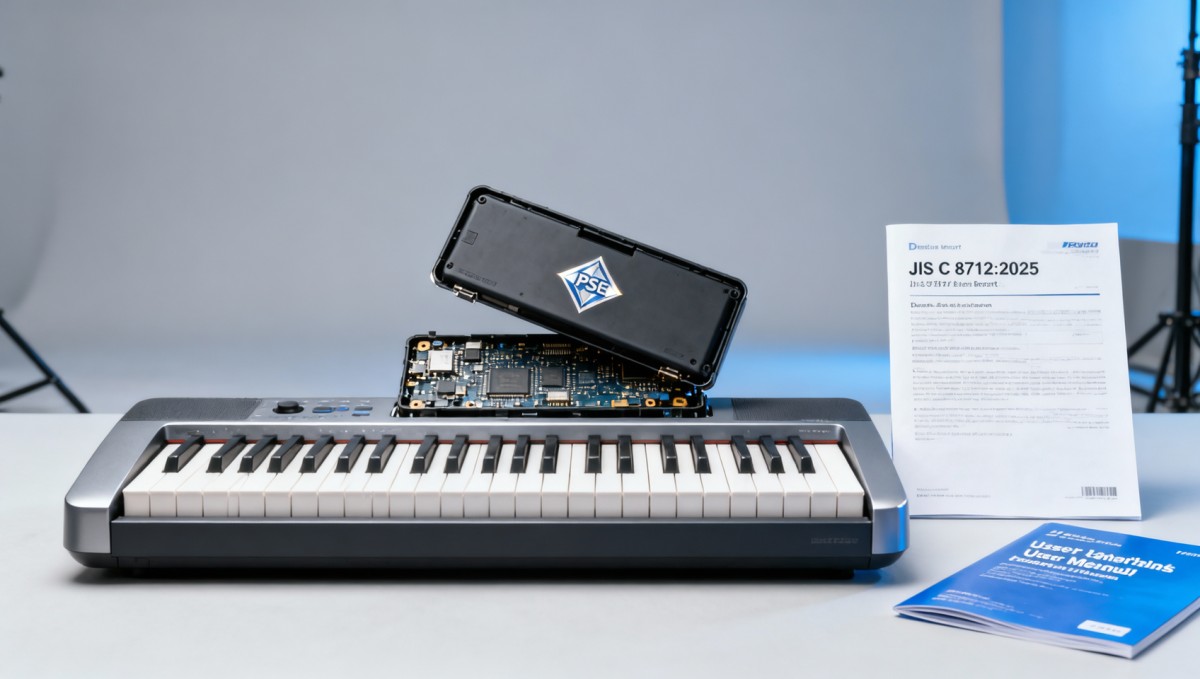
On May 22, 2026, Japan’s Ministry of Economy, Trade and Industry (METI) revised the enforcement regulations of the Electrical Appliance and Material Safety Act, mandating that all musical instruments containing rechargeable lithium-ion batteries—including electronic keyboards, synthesizers, electronic drum kits, and effects processors—be classified as ‘Specified Electrical Appliances’. Starting October 1, 2026, such products must bear the PSE diamond mark. This update directly affects manufacturers, exporters, importers, and distributors of electronic musical instruments targeting the Japanese market—and signals a tightening of regulatory alignment between battery safety and end-product compliance.
Event Overview
On May 22, 2026, METI officially updated the实施细则 (enforcement regulations) of the Electrical Appliance and Material Safety Act. The revision adds all musical instruments equipped with rechargeable lithium-ion batteries to the list of ‘Specified Electrical Appliances’. Enforcement begins on October 1, 2026. During the transition period (May–September 2026), customs clearance is permitted for shipments accompanied by a JIS C 8712:2025 test report and Japanese-language user manual, provided the packaging or documentation clearly states ‘PSE pending’.
Industries Affected by This Revision
Direct Exporters and Importers of Musical Instruments
These entities are directly responsible for regulatory compliance at Japan’s border. Under the new rule, failure to affix the PSE diamond mark after October 1, 2026—or to provide valid documentation during the transition—will result in shipment rejection or delays. Impact includes increased pre-shipment verification requirements, potential rework of labeling and packaging, and added scrutiny from Japanese customs and METI-accredited third-party certifiers.
Original Equipment Manufacturers (OEMs) and Contract Manufacturers
OEMs producing electronic musical instruments for global brands face upstream compliance obligations. Since the PSE diamond mark applies to the final product—not just the battery—the entire instrument must undergo conformity assessment. This means manufacturers must ensure not only battery cell certification but also full-system evaluation per JIS C 8712:2025, including thermal management, charging circuit safety, and mechanical enclosure integrity.
Distributors and Brand Owners Operating in Japan
Brands selling under their own name in Japan assume legal responsibility as ‘importers’ under the law. Even if manufacturing occurs overseas, the brand listed on the Japanese product label becomes the accountable party. This revision therefore increases liability exposure: non-compliant stock cannot be legally sold post-October 1, and recalls or penalties may apply if PSE-marked units are found defective or mislabeled.
Supply Chain Service Providers (Testing Labs, Certification Bodies, Regulatory Consultants)
Providers supporting PSE compliance—including labs accredited for JIS C 8712:2025 testing and METI-recognized certification bodies—face rising demand for system-level evaluations. Unlike previous component-level battery assessments, this revision requires integrated product testing. Capacity constraints and lead-time extensions are already being observed among accredited labs in Japan and neighboring countries.
Key Points for Enterprises and Practitioners to Monitor and Act Upon
Track Official METI Guidance and Recognized Testing Protocols
While JIS C 8712:2025 is cited as the applicable standard, METI has not yet published official interpretation guidelines for musical instrument-specific application (e.g., vibration resistance, pedal-induced mechanical stress, or stage-use thermal cycling). Enterprises should monitor METI’s official notifications and updates from the Japan Electrical Safety & Environment Technology Laboratories (JET) for clarifications ahead of October 2026.
Identify High-Risk Product Categories and Review Existing Inventory
Products with internal, non-removable lithium-ion batteries—especially those using custom battery packs or proprietary charging circuits—are most likely to require full re-evaluation. Companies should audit current SKUs shipped to Japan and prioritize those lacking existing JIS C 8712:2025 system reports or PSE certification history for immediate technical review.
Distinguish Between Policy Signal and Operational Readiness
The May 2026 announcement is an enforceable regulatory amendment—not a draft proposal. However, practical implementation depends on lab capacity, availability of METI-recognized certification bodies, and clarity on acceptable ‘PSE pending’ labeling formats (e.g., placement, font size, multilingual options). Businesses should treat the timeline as binding but verify operational feasibility case-by-case rather than assuming uniform readiness across service providers.
Prepare Documentation, Labeling, and Supplier Coordination Now
Japanese-language manuals must include battery safety warnings, disposal instructions, and charging precautions aligned with JIS C 8712:2025 Annex B. OEMs and importers should initiate translations and layout revisions immediately. Concurrently, procurement teams should confirm battery supplier certifications (e.g., UN38.3, IEC 62133-2) and request updated declarations of conformity to support full-system assessment.
Editorial Perspective / Industry Observation
Observably, this revision reflects METI’s broader shift toward treating embedded energy storage not as a component, but as an integral part of end-product safety architecture. Analysis shows it is less a sudden escalation and more a logical extension of prior battery-focused amendments—now applied to a newly defined product category based on functional integration. From an industry perspective, it functions primarily as a compliance trigger: the legal requirement is clear and effective, but its real-world impact will depend heavily on certification ecosystem responsiveness. Continuous monitoring is warranted—not because the rule is ambiguous, but because execution timelines and interpretation nuances remain subject to refinement.
This development does not introduce new technical standards beyond JIS C 8712:2025, nor does it expand the scope of regulated battery chemistries. Instead, it reclassifies product categories—making previously unregulated instruments newly subject to mandatory third-party certification. For stakeholders, it underscores that regulatory boundaries are increasingly drawn around use context and energy integration, rather than device type alone.
Current understanding is best framed as follows: the rule is finalized and enforceable; its implications are concrete for specific product lines; however, the pace and consistency of certification delivery across the supply chain remain variables requiring active tracking—not assumptions.
Source: Ministry of Economy, Trade and Industry (METI), Japan — Official Notice No. [to be assigned], dated May 22, 2026, amending the Enforcement Regulations of the Electrical Appliance and Material Safety Act. JIS C 8712:2025 (‘Safety requirements for secondary lithium cells and batteries for industrial applications’) remains the referenced technical standard. Note: METI’s official explanatory documents and lists of recognized certification bodies are still pending publication as of May 2026 and warrant ongoing observation.
Search News
Hot Articles
- Fashion & Gem JewelryThermal Diamond Testers: How They Work and When They Can Misidentify StonesOct 07, 2026
- Commercial KitchenWhat Is Driving Demand for Commercial Hospitality Projects Across the GCC?Oct 06, 2026
- Hotel Room AmenitiesHow to Select Hotel Hair Dryers That Balance Guest Safety, Durability, and CostOct 05, 2026
Popular Tags
Need ExpertConsultation?
Connect with our specialized leisureengineering team for procurementstrategies.
Recommended News
 Sep 11, 2026How to Choose Touring Instrument Cases for Flights, Trucks, and Daily Load-InsInstrument cases for touring: learn how to balance flight protection, truck durability, weight, fit, and serviceable hardware for safer, faster load-ins.● Pro Audio Engineer
 Sep 07, 2026How to Choose Wood Frame Tambourines for Sound Quality and Long-Term UseWood frame tambourines: learn how to compare frame construction, jingle tone, head options, durability, and supplier quality for reliable long-term performance.● Pro Audio Engineer
 Sep 05, 2026How Often Should Music Education Equipment Be Serviced?How often should music education equipment be serviced? Explore practical schedules, maintenance tips, and lifecycle planning to keep instruments and audio systems reliable.● Pro Audio Engineer
 Aug 21, 2026How to Choose Marching Band Drums for Sound Projection, Weight, and DurabilityMarching band drums buying guide: learn how to balance sound projection, weight, and durability for better field performance, easier carrying, and longer-lasting value.● Pro Audio Engineer
 Aug 09, 2026How to Evaluate a MIDI Cable Manufacturer for Audio Quality and OEM ReliabilityMIDI cable manufacturer evaluation guide: learn how to assess signal stability, connector quality, OEM process control, and batch consistency to reduce failures and source with confidence.● Pro Audio Engineer
 Aug 08, 2026How to Evaluate a Trumpets OEM Manufacturer for Quality, MOQ, and Custom DesignTrumpets OEM manufacturer selection starts with quality, MOQ, and custom design control. Learn how to compare suppliers, reduce sourcing risk, and choose a reliable long-term factory partner.● Pro Audio Engineer
 Jul 27, 2026How to Source Conga Drums in Bulk for Schools, Bands, and Event ProgramsConga drums bulk sourcing for schools, bands, and event programs made easier. Learn how to compare quality, durability, compliance, and total cost before you place a large order.● Pro Audio Engineer
 Jul 24, 2026How to Choose Low Dust Violin Rosin for Cleaner Practice and Better Bow ControlLow dust violin rosin buying guide: learn how to compare formula, climate fit, grip, and string compatibility for cleaner practice, better bow control, and smarter purchase decisions.● Pro Audio Engineer
 Jul 15, 2026Plastic Tambourines Bulk Buying Guide: Sizes, Materials, and MOQ QuestionsPlastic tambourines bulk buying guide covering sizes, ABS vs PP materials, sound consistency, customization, and MOQ questions to help buyers cut risk and choose the right supplier.● Pro Audio Engineer
 Jul 13, 2026Acoustic Guitars Wholesale China: How to Evaluate Build Quality and OEM OptionsAcoustic guitars wholesale China guide: learn how to assess build quality, factory consistency, and OEM options to choose reliable suppliers and reduce sourcing risk.● Pro Audio Engineer
 Jul 12, 2026Mini Effect Pedals Wholesale: MOQ, OEM Options, Testing, and Supplier ComparisonMini effect pedals wholesale guide covering MOQ, OEM options, testing standards, and supplier comparison to help buyers reduce risk, improve margins, and choose reliable partners.● Pro Audio Engineer
 Jul 11, 2026DJ Turntables OEM Guide: Key Torque, Drive, and Build Specs to CompareDJ turntables OEM guide covering torque, drive type, speed stability, platter build, and manufacturing consistency. Compare the specs that impact performance, reliability, and sourcing confidence.● Pro Audio Engineer
 Jul 08, 2026Guitar Capos Wholesale: What Materials, Clamp Types, and MOQ Terms Should You Compare?Guitar capos wholesale buying starts with more than price. Compare materials, clamp types, quality checks, and MOQ terms to reduce returns, protect margins, and choose a supplier with confidence.● Pro Audio Engineer
 Jul 07, 2026Birch Drum Kits Manufacturer Comparison: Shell Construction, Hardware Quality, and OEM OptionsBirch drum kits manufacturer comparison covering shell construction, hardware quality, and OEM options to help buyers reduce sourcing risk and choose reliable suppliers.● Pro Audio Engineer
 Jul 06, 2026Spruce Top Acoustic Guitars Explained: Tone, Wood Grades, and Who They Suit BestSpruce top acoustic guitars explained: compare tone, wood grades, and build quality to find the best fit for players, retailers, and commercial buyers.● Pro Audio Engineer
 Jun 30, 2026Xylophones and Glockenspiels: Key Differences in Range, Tone, and Classroom UseXylophones and glockenspiels compared: discover key differences in range, tone, durability, and classroom use to choose the right instrument for teaching, buying, or school programs.● Pro Audio Engineer
 Jun 25, 2026Musical Instrument Industry Report: Key Market Segments, Demand Drivers, and Price TrendsMusical instrument industry report covering key market segments, demand drivers, and price trends. Explore sourcing risks, premium growth, and where buyer demand is shifting next.● Pro Audio Engineer
 Jun 23, 2026Metronomes and Tuners Explained: Types, Key Features, and Who Needs BothMetronomes and tuners explained: compare types, key features, and who needs both. Learn how to choose the right tool for better timing, pitch, and practical daily use.● Pro Audio Engineer
 Jun 22, 2026How the Musical Instrument Industry Supply Chain Affects Lead Times, Cost, and QualityMusical instrument industry supply chain trends now shape lead times, cost, and quality. Discover how smarter sourcing and supplier transparency reduce risk and improve buying outcomes.● Pro Audio Engineer
 Jun 20, 2026DJ Headphones Wholesale Buying Guide: OEM Options, MOQ, and Audio Specs to CompareDJ headphones wholesale guide covering OEM options, MOQ strategy, and key audio specs. Compare build quality, compliance, and total cost to source smarter and reduce returns.● Pro Audio Engineer
 Jun 19, 2026Acoustic Guitars Wholesale: 7 Specs Buyers Should Compare Before Placing an OrderAcoustic guitars wholesale buyers can compare 7 key specs before ordering, from tonewoods and playability to OEM, packaging, and QC, to reduce risk and protect margins.● Pro Audio Engineer
 Jun 15, 2026Tambourines Bulk Buying Guide: Materials, Sound Quality, and Pack Size DifferencesTambourines bulk buying guide covering material choices, sound consistency, and pack size differences. Compare suppliers smarter, reduce risk, and choose the best fit for schools, retail, and events.● Pro Audio Engineer
 Jun 14, 2026Professional Musical Instruments Explained: Types, Skill Levels, and Buying CriteriaProfessional musical instruments explained: discover key types, ideal skill levels, and practical buying criteria to choose reliable, high-performance instruments with confidence.● Pro Audio Engineer
 Jun 10, 2026Drum Kits Manufacturer Comparison: What to Check Before OEM or Bulk OrdersDrum kits manufacturer comparison guide for OEM and bulk buyers: check quality, compliance, lead times, packaging, and true cost before placing large orders.● Pro Audio Engineer