Braided Leather Bracelets OEM: Material, Clasp, and MOQ Factors Before Sampling
Braided Leather Bracelets OEM: Material, Clasp, and MOQ Factors Before Sampling
Choosing the right braided leather bracelets OEM partner starts long before sampling.
Material grade, clasp construction, and MOQ shape cost, timing, and product positioning from day one.
That is why early sourcing decisions matter more than many teams expect.
A braided leather bracelets OEM project can look simple on paper, yet small specification gaps often create expensive revisions later.
Why Early Specification Work Matters
In practical sourcing, sampling is not the first step.
The first step is locking the commercial frame behind the sample.
For braided leather bracelets OEM, three inputs usually drive most outcomes.
- Leather type and grade
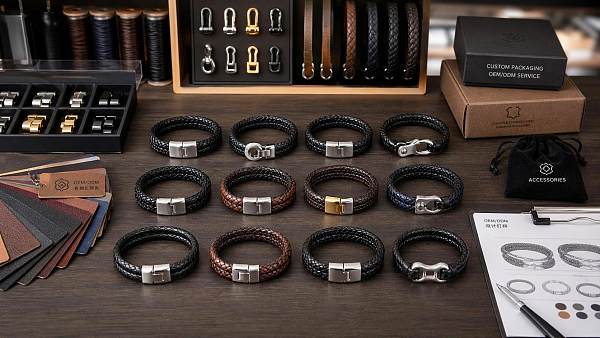
- Clasp material and mechanism
- MOQ structure by style, color, and size
These points influence unit cost, rejection risk, compliance, and replenishment speed.
They also affect whether a supplier is suitable for premium retail, gifting programs, or volume distribution.
Material Choices in Braided Leather Bracelets OEM
Leather is not a minor detail in braided leather bracelets OEM.
It defines feel, aging behavior, visual depth, and price range.
Common leather options
- Genuine leather: cost-friendly, but quality varies widely.
- Top-grain leather: cleaner surface, better consistency, stronger premium appeal.
- Full-grain leather: richer character, stronger story, usually higher cost.
- PU or recycled alternatives: useful for price targets or sustainability positioning.
Recent buyer behavior shows more demand for traceable materials and stable finishing.
That means the supplier should define more than just “real leather.”
Ask for tanning method, thickness tolerance, color fastness, odor level, and surface treatment.
Questions worth asking before sampling
- Is the braid made from round cord, flat strip, or layered leather?
- What is the standard thickness range after finishing?
- Can the supplier match Pantone-like color expectations consistently?
- How does the leather perform under sweat, friction, and light moisture?
- Are there test reports for REACH, nickel release, or other target-market standards?
In braided leather bracelets OEM, poor leather selection often appears first at the edges.
Cracking, color migration, loose braiding, and odor complaints usually start there.
Clasp Construction: Small Part, Big Risk
The clasp is where appearance meets function.
It also becomes the most common source of returns in fashion accessories.
For braided leather bracelets OEM, clasp decisions should never be left until the sample review stage.
Main clasp categories
- Magnetic clasp: easy to use, but magnet strength must be proven.
- Hook clasp: simple look, lower hardware cost, moderate security.
- Screw clasp: premium feel, but thread tolerance matters.
- Buckle style: more adjustable, often heavier and more casual.
Material choice matters just as much as mechanism.
Common options include stainless steel, zinc alloy, brass, and plated base metals.
Stainless steel usually offers better corrosion resistance and a cleaner premium signal.
Zinc alloy can reduce cost, but plating durability should be checked carefully.
Clasp checkpoints before sample approval
When comparing braided leather bracelets OEM suppliers, clasp consistency often separates trading capability from real production control.
How MOQ Changes the Real Cost Picture
MOQ is not just a threshold for placing an order.
It is a pricing tool, a production planning tool, and a risk filter.
In braided leather bracelets OEM, quoted MOQ can hide several layers.
- MOQ per design
- MOQ per leather color
- MOQ per clasp finish
- MOQ for logo customization
- MOQ for gift box or retail packaging
A supplier may quote 300 pieces, but that number may only apply to one color and one clasp finish.
Once size splits and mixed colors enter the order, the cost model changes.
What buyers should clarify
- Can one MOQ cover mixed sizes?
- Can leather colors be combined in one run?
- Does custom logo tooling require a separate MOQ?
- What is the surcharge for low-volume replenishment?
This is where braided leather bracelets OEM becomes a total-cost exercise, not a simple unit-price comparison.
A lower quoted price can still be less competitive if MOQ forces excess inventory.
Sampling Questions That Prevent Delays
Once material, clasp, and MOQ basics are clear, sampling becomes much more useful.
Without that clarity, samples can be attractive but commercially misleading.
For braided leather bracelets OEM, a sample request should include measurable requirements.
- Target bracelet length and size tolerance
- Exact leather color reference
- Clasp finish and logo position
- Packaging expectation
- Required test standards
It also helps to ask whether the sample comes from the production line or a manual prototype process.
That difference can explain later variation in braid tightness, finishing, or clasp fit.
Supplier Evaluation Beyond the Product
A capable braided leather bracelets OEM partner should support more than fabrication.
Operational discipline matters just as much.
Look for these signals
- Clear BOM breakdown for leather, clasp, logo, and packaging
- Documented QC checkpoints before packing
- Stable lead times for repeat orders
- Ability to manage compliance paperwork
- Willingness to discuss defect handling terms in advance
In actual business, response quality during sampling often predicts production performance later.
Late answers, vague material claims, or shifting MOQ terms are early warning signs.
A Practical Pre-Sample Checklist
Before moving forward with any braided leather bracelets OEM program, align these points internally and with the supplier.
- Confirm target market and required compliance standards.
- Define leather grade, color, thickness, and braid style.
- Select clasp type, metal, finish, and performance expectation.
- Clarify MOQ by style, color, size, and packaging format.
- Request sample lead time and mass-production lead time separately.
- Ask for testing, plating, and material declarations before final approval.
This approach keeps sampling focused on proof, not guesswork.
It also helps reduce revision loops that slow launches and weaken margin control.
For braided leather bracelets OEM, the strongest sourcing decisions are usually made before the first sample is shipped.
When material grade, clasp construction, and MOQ are defined early, supplier comparison becomes more accurate.
That creates a cleaner path to sampling, better cost control, and more reliable commercialization.
Search News
Hot Articles
- Indoor PlaygroundHow to Choose Animatronic Haunted House Props for High-Throughput AttractionsOct 08, 2026
- Fashion & Gem JewelryThermal Diamond Testers: How They Work and When They Can Misidentify StonesOct 07, 2026
- Commercial KitchenWhat Is Driving Demand for Commercial Hospitality Projects Across the GCC?Oct 06, 2026
Popular Tags
Need ExpertConsultation?
Connect with our specialized leisureengineering team for procurementstrategies.
Recommended News
 Oct 07, 2026Thermal Diamond Testers: How They Work and When They Can Misidentify StonesThermal diamond tester guide: learn how it works, spot false positives from moissanite, and choose reliable verification methods for jewelry trade and retail.● Luxury Retail Analyst
 Oct 02, 2026Diamond Tester Wholesale: How to Vet Accuracy, Calibration, and MOQ Before OrderingDiamond tester wholesale guide: verify accuracy, calibration records, supplier quality controls, and MOQ terms before ordering. Source reliable testers with confidence.● Luxury Retail Analyst
 Sep 09, 2026Wholesale Coral Earrings: How Buyers Can Assess Quality, Treatments, and Supply RiskCoral jewelry earrings wholesale guide for buyers: assess quality, treatments, secure settings, documentation, and supply risks before ordering.● Luxury Retail Analyst
 Sep 01, 2026How to Choose a Jewelry Laser Engraving Machine Manufacturer for Custom ProductionChoose a jewelry laser engraving machine manufacturer with proven sample testing, precision fixtures, workflow-ready software, and reliable support for custom production.● Luxury Retail Analyst
 Aug 27, 2026Evaluating Luxury Retail Accessories Suppliers: Quality, Lead Times, and Brand FitLuxury retail accessories supplier selection made clearer: assess quality, lead times, compliance, costs, and brand fit to protect premium launches and margins.● Luxury Retail Analyst
 Jul 29, 2026Fine Jewelry Price Guide: What Affects Cost and How to Judge Real ValueFine jewelry price guide for buyers: learn what drives cost in metals, gemstones, craftsmanship, certification, and branding so you can judge real value, reduce sourcing risk, and buy with confidence.● Luxury Retail Analyst
 Jul 14, 2026What to Ask an Enamel Jewelry Manufacturer Before Sampling and Mass ProductionEnamel jewelry manufacturer selection starts with the right questions. Learn what to ask about materials, color matching, MOQ, QC, compliance, and lead times before sampling and mass production.● Luxury Retail Analyst
 Jul 12, 2026Surgical Steel Belly Rings vs Titanium: Material Differences, Safety, and CostSurgical steel belly rings vs titanium: compare safety, nickel exposure, comfort, durability, and cost to choose the best option for sensitive skin or budget-friendly style.● Luxury Retail Analyst
 Jul 12, 2026Natural Coral Jewelry Guide: How to Identify Real Coral, Treatments, and QualityNatural coral jewelry guide covering how to identify real coral, spot treatments, assess quality, and buy with confidence. Learn the key signs before you choose.● Luxury Retail Analyst
 Jul 11, 2026Braided Leather Bracelets OEM: Material, Clasp, and MOQ Factors Before SamplingBraided leather bracelets OEM guide covering material grades, clasp options, and MOQ factors before sampling. Learn how to reduce sourcing risk, control cost, and choose the right supplier.● Luxury Retail Analyst
 Jul 09, 2026Jewelry Craftsmanship Gemstone Setting Methods Explained: Prong, Bezel, Pave, and MoreJewelry craftsmanship gemstone setting explained clearly: compare prong, bezel, pavé, channel, and more to choose secure, beautiful, and commercially smart jewelry designs.● Luxury Retail Analyst
 Jul 06, 2026Photo Locket Necklace Manufacturer Selection Guide: Materials, MOQ, and Custom OptionsPhoto locket necklace manufacturer selection guide covering materials, MOQ, custom options, compliance, and quality checks to help buyers source smarter and build stronger jewelry lines.● Luxury Retail Analyst
 Jul 05, 2026What to Check When Comparing a Sterling Silver Clasp ManufacturerChoosing a sterling silver clasp manufacturer? Learn what to check first: 925 silver claims, finish quality, testing, compliance, lead times, and hidden sourcing costs.● Luxury Retail Analyst
 Jul 02, 2026Jewelry Craftsmanship Techniques Explained: Casting, Stone Setting, Engraving, and PolishingJewelry craftsmanship techniques explained: discover how casting, stone setting, engraving, and polishing shape quality, durability, and sourcing confidence.● Luxury Retail Analyst
 Jul 01, 2026Lost Wax Casting Machines Explained: Types, Capacity, and Metal CompatibilityLost wax casting machines explained: compare types, real capacity, and metal compatibility to choose the right system for precision casting, higher quality, and smarter sourcing.● Luxury Retail Analyst
 Jun 29, 2026How to Evaluate a Luxury Accessories Online Store Before You BuyLuxury accessories online store buying guide: learn how to verify authenticity, compare policies, check reviews, and avoid costly mistakes before you place an order.● Luxury Retail Analyst
 Jun 22, 2026Matching Couple Rings: Popular Materials, Fit Differences, and How to ChooseMatching couple rings guide: compare popular materials, fit differences, comfort, durability, and resizing options to choose a stylish pair that truly lasts.● Luxury Retail Analyst
 Jun 19, 2026How to Build a Fashion Accessories Catalog That Improves Product Discovery and SalesFashion accessories catalog strategies that improve product discovery, filtering, and conversions. Learn how to structure pages, categories, and data to drive more qualified sales.● Luxury Retail Analyst
 Jun 19, 2026How to Choose Luxury Accessories for Women by Material, Style, and Price PointLuxury accessories for women: learn how to choose the right pieces by material, style, and price point for better value, timeless appeal, and smarter buying decisions.● Luxury Retail Analyst
 Jun 18, 2026Stainless Steel Rings Bulk: 304 vs 316L, Finishes, and Custom Order FactorsStainless steel rings bulk guide: compare 304 vs 316L, explore finish options, and learn key custom order factors to reduce sourcing risk and improve product value.● Luxury Retail Analyst
 Jun 18, 2026Body Piercing Jewelry Bulk Buying Guide: Materials, Sizes, and MOQ QuestionsBody piercing jewelry bulk buying guide covering safe materials, size checks, MOQ strategy, supplier screening, and compliance tips to reduce risk and source with confidence.● Luxury Retail Analyst
 Jun 18, 2026How to Evaluate a Luxury Jewelry Exporter for Quality, Compliance, and DeliveryLuxury jewelry exporter evaluation starts with more than design. Learn how to verify quality, compliance, and delivery control to source premium jewelry with less risk.● Luxury Retail Analyst
 Jun 17, 2026Iced Out Watches Wholesale: How to Compare MOQ, Stone Quality, and MarginsIced out watches wholesale guide: compare MOQ, stone quality, and real margins to choose reliable suppliers, reduce risk, and grow resale profits with smarter sourcing.● Luxury Retail Analyst
 Jun 15, 2026How to Evaluate an Amber Jewelry Manufacturer: Quality Grades, OEM Options, and Lead TimesAmber jewelry manufacturer selection starts with quality grades, OEM capability, and realistic lead times. Learn how to compare suppliers, reduce sourcing risk, and choose with confidence.● Luxury Retail Analyst