How to Evaluate an Amber Jewelry Manufacturer: Quality Grades, OEM Options, and Lead Times
Why does choosing the right amber jewelry manufacturer matter so much?
An amber jewelry manufacturer does more than supply finished pieces. That partner influences stone quality, brand consistency, compliance readiness, and delivery performance.
In practical terms, weak supplier screening often creates avoidable problems. Color mismatch, unstable metal findings, unclear origin claims, and delayed launches usually start at the factory evaluation stage.
This is especially relevant in premium retail, hospitality gifting, museum shops, and private-label collections. Buyers are not only purchasing jewelry. They are purchasing repeatability.
That is also why industry platforms such as Global Commercial Trade focus on sourcing intelligence rather than simple product listings. Reliable decisions require evidence on quality systems, OEM depth, and supply chain discipline.
A capable amber jewelry manufacturer should be able to explain grade differences, show process control, and commit to realistic lead times without overpromising.
When suppliers talk about amber grades, what should you actually verify?
Grade language can sound impressive, but it is not always standardized across suppliers. That is why samples and specifications matter more than sales wording.
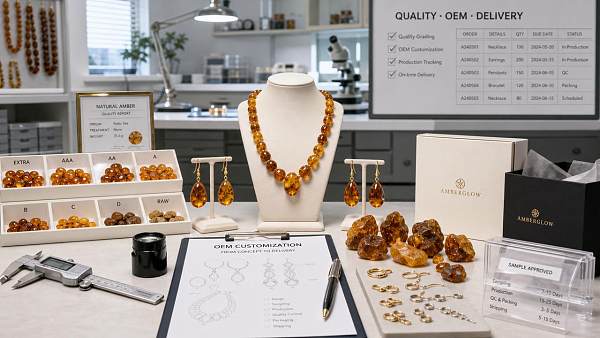
A strong amber jewelry manufacturer should define grade using visible and measurable points. Color tone, clarity, inclusion pattern, cut consistency, surface finish, and piece matching are usually the most useful indicators.
Natural amber often includes internal variation. That is not automatically a defect. In many collections, inclusions support the natural story, provided the appearance remains commercially consistent.
Heat treatment, pressing, reconstitution, and enhancement should be disclosed clearly. More common sourcing problems begin when treated material is presented as premium natural amber without qualification.
It helps to request a written grading matrix before approving bulk production. This creates a shared reference and reduces disputes later.
If a supplier cannot define these points clearly, the grade claim is probably too loose for dependable sourcing.
How can you tell whether OEM capability is real or just marketing?
Many factories say they offer OEM. The real question is how far that capability goes once design files, packaging rules, and compliance details enter the project.
A qualified amber jewelry manufacturer should support more than logo stamping. It should handle CAD interpretation, stone selection by target grade, metal component sourcing, finishing control, and packaging coordination.
In actual sourcing, OEM strength appears in the pre-production stage. Clear drawings, sample revision tracking, and cost breakdown logic usually reveal whether a supplier has a mature system.
It is also worth checking whether the factory understands channel requirements. A souvenir line, a boutique retail collection, and a hotel gift program need different packaging durability, labeling, and assortment planning.
- Ask for past private-label projects with similar positioning.
- Review sample approval records, not only finished photos.
- Confirm who owns molds, CAD files, and packaging artwork.
- Check whether material substitutions require written approval.
A good amber jewelry manufacturer treats OEM as controlled project execution, not as a vague promise to customize anything.
What lead times are realistic for amber jewelry, and where do delays usually begin?
Lead time is rarely just a production number. For amber jewelry, timing depends on raw material selection, sample confirmation, component availability, finishing complexity, and final inspection.
For repeat items, a typical amber jewelry manufacturer may quote several weeks. For new OEM programs, the total cycle often extends much longer once sampling and revisions are included.
The most frequent delay points are not always inside the workshop. They often come from unclear approval criteria, last-minute plating changes, packaging redesign, or incomplete labeling requirements.
Seasonality also matters. Before peak gifting periods, amber sorting and hand-finishing capacity can tighten quickly. A factory that accepts every urgent order may actually be a higher delivery risk.
The best lead-time discussion is specific. Ask for a milestone schedule, not one overall promise.
Which quality and compliance signals separate a dependable supplier from a risky one?
A polished catalog does not prove control. A dependable amber jewelry manufacturer should be able to show how quality is maintained from raw stone intake to packed shipment.
Look for inspection checkpoints around stone grading, drilling, polishing, metal assembly, clasp security, plating finish, and packaging accuracy. Handcrafted products still need documented controls.
Compliance is another separator. Depending on market destination, it may involve metal content limits, labeling rules, packaging safety, and origin transparency.
A strong amber jewelry manufacturer usually responds with test records, material declarations, and clear escalation procedures when defects appear. Vague reassurances are not enough.
- Request defect photos from previous quality cases and how they were resolved.
- Check whether incoming amber lots are recorded by batch.
- Confirm final AQL or equivalent inspection practice.
- Review packaging drop resistance if the line is gift-box heavy.
These checks matter across the wider commercial landscape as well. GCT’s sourcing logic consistently favors suppliers that can support premium presentation and dependable execution together.
What are the most common mistakes when comparing one amber jewelry manufacturer to another?
The first mistake is comparing price without aligning specifications. Amber size variation, treatment status, silver weight, plating thickness, and packaging level can change the quotation significantly.
Another common error is approving a beautiful development sample without checking bulk repeatability. Sample craftsmanship may be done by senior technicians, while mass production follows different capacity limits.
Some buyers also underestimate communication risk. If changes are handled through scattered messages, even a capable amber jewelry manufacturer may produce the wrong result.
A more reliable comparison method is to score suppliers against the same decision points.
A careful comparison often saves more money than chasing the lowest opening quote.
So what should be your next move before shortlisting a supplier?
Start by defining the collection clearly. Lock the target grade, treatment acceptance, metal specification, packaging level, and intended market requirements.
Then send the same brief to each amber jewelry manufacturer under review. Comparable input creates comparable output, which makes supplier evaluation much more accurate.
Before placing a volume order, request benchmark samples, a milestone timeline, and a written quality agreement. These three documents often reveal more than a showroom presentation.
For longer-term programs, it is sensible to build a scorecard covering grade consistency, OEM responsiveness, compliance readiness, and delivery stability. That approach fits the data-driven sourcing discipline promoted across GCT’s commercial coverage.
The right amber jewelry manufacturer is not simply the cheapest or the fastest. It is the one that can match your quality intent, customize with control, and deliver on schedule without creating avoidable risk.
Search News
Hot Articles
- Jewelry Packaging & DisplayHow U.S. Retailers Can Choose Jewelry Displays for Better Security and SalesSep 13, 2026
- Commercial KitchenHow to Size a Restaurant Walk-In Cooler for Peak Inventory and Kitchen LayoutSep 12, 2026
- Musical InstrumentsHow to Choose Touring Instrument Cases for Flights, Trucks, and Daily Load-InsSep 11, 2026
Popular Tags
Need ExpertConsultation?
Connect with our specialized leisureengineering team for procurementstrategies.
Recommended News
 Sep 09, 2026Wholesale Coral Earrings: How Buyers Can Assess Quality, Treatments, and Supply RiskCoral jewelry earrings wholesale guide for buyers: assess quality, treatments, secure settings, documentation, and supply risks before ordering.● Luxury Retail Analyst
 Sep 01, 2026How to Choose a Jewelry Laser Engraving Machine Manufacturer for Custom ProductionChoose a jewelry laser engraving machine manufacturer with proven sample testing, precision fixtures, workflow-ready software, and reliable support for custom production.● Luxury Retail Analyst
 Aug 27, 2026Evaluating Luxury Retail Accessories Suppliers: Quality, Lead Times, and Brand FitLuxury retail accessories supplier selection made clearer: assess quality, lead times, compliance, costs, and brand fit to protect premium launches and margins.● Luxury Retail Analyst
 Jul 29, 2026Fine Jewelry Price Guide: What Affects Cost and How to Judge Real ValueFine jewelry price guide for buyers: learn what drives cost in metals, gemstones, craftsmanship, certification, and branding so you can judge real value, reduce sourcing risk, and buy with confidence.● Luxury Retail Analyst
 Jul 14, 2026What to Ask an Enamel Jewelry Manufacturer Before Sampling and Mass ProductionEnamel jewelry manufacturer selection starts with the right questions. Learn what to ask about materials, color matching, MOQ, QC, compliance, and lead times before sampling and mass production.● Luxury Retail Analyst
 Jul 12, 2026Surgical Steel Belly Rings vs Titanium: Material Differences, Safety, and CostSurgical steel belly rings vs titanium: compare safety, nickel exposure, comfort, durability, and cost to choose the best option for sensitive skin or budget-friendly style.● Luxury Retail Analyst
 Jul 12, 2026Natural Coral Jewelry Guide: How to Identify Real Coral, Treatments, and QualityNatural coral jewelry guide covering how to identify real coral, spot treatments, assess quality, and buy with confidence. Learn the key signs before you choose.● Luxury Retail Analyst
 Jul 11, 2026Braided Leather Bracelets OEM: Material, Clasp, and MOQ Factors Before SamplingBraided leather bracelets OEM guide covering material grades, clasp options, and MOQ factors before sampling. Learn how to reduce sourcing risk, control cost, and choose the right supplier.● Luxury Retail Analyst
 Jul 09, 2026Jewelry Craftsmanship Gemstone Setting Methods Explained: Prong, Bezel, Pave, and MoreJewelry craftsmanship gemstone setting explained clearly: compare prong, bezel, pavé, channel, and more to choose secure, beautiful, and commercially smart jewelry designs.● Luxury Retail Analyst
 Jul 06, 2026Photo Locket Necklace Manufacturer Selection Guide: Materials, MOQ, and Custom OptionsPhoto locket necklace manufacturer selection guide covering materials, MOQ, custom options, compliance, and quality checks to help buyers source smarter and build stronger jewelry lines.● Luxury Retail Analyst
 Jul 05, 2026What to Check When Comparing a Sterling Silver Clasp ManufacturerChoosing a sterling silver clasp manufacturer? Learn what to check first: 925 silver claims, finish quality, testing, compliance, lead times, and hidden sourcing costs.● Luxury Retail Analyst
 Jul 02, 2026Jewelry Craftsmanship Techniques Explained: Casting, Stone Setting, Engraving, and PolishingJewelry craftsmanship techniques explained: discover how casting, stone setting, engraving, and polishing shape quality, durability, and sourcing confidence.● Luxury Retail Analyst
 Jul 01, 2026Lost Wax Casting Machines Explained: Types, Capacity, and Metal CompatibilityLost wax casting machines explained: compare types, real capacity, and metal compatibility to choose the right system for precision casting, higher quality, and smarter sourcing.● Luxury Retail Analyst
 Jun 29, 2026How to Evaluate a Luxury Accessories Online Store Before You BuyLuxury accessories online store buying guide: learn how to verify authenticity, compare policies, check reviews, and avoid costly mistakes before you place an order.● Luxury Retail Analyst
 Jun 22, 2026Matching Couple Rings: Popular Materials, Fit Differences, and How to ChooseMatching couple rings guide: compare popular materials, fit differences, comfort, durability, and resizing options to choose a stylish pair that truly lasts.● Luxury Retail Analyst
 Jun 19, 2026How to Build a Fashion Accessories Catalog That Improves Product Discovery and SalesFashion accessories catalog strategies that improve product discovery, filtering, and conversions. Learn how to structure pages, categories, and data to drive more qualified sales.● Luxury Retail Analyst
 Jun 19, 2026How to Choose Luxury Accessories for Women by Material, Style, and Price PointLuxury accessories for women: learn how to choose the right pieces by material, style, and price point for better value, timeless appeal, and smarter buying decisions.● Luxury Retail Analyst
 Jun 18, 2026Stainless Steel Rings Bulk: 304 vs 316L, Finishes, and Custom Order FactorsStainless steel rings bulk guide: compare 304 vs 316L, explore finish options, and learn key custom order factors to reduce sourcing risk and improve product value.● Luxury Retail Analyst
 Jun 18, 2026Body Piercing Jewelry Bulk Buying Guide: Materials, Sizes, and MOQ QuestionsBody piercing jewelry bulk buying guide covering safe materials, size checks, MOQ strategy, supplier screening, and compliance tips to reduce risk and source with confidence.● Luxury Retail Analyst
 Jun 18, 2026How to Evaluate a Luxury Jewelry Exporter for Quality, Compliance, and DeliveryLuxury jewelry exporter evaluation starts with more than design. Learn how to verify quality, compliance, and delivery control to source premium jewelry with less risk.● Luxury Retail Analyst
 Jun 17, 2026Iced Out Watches Wholesale: How to Compare MOQ, Stone Quality, and MarginsIced out watches wholesale guide: compare MOQ, stone quality, and real margins to choose reliable suppliers, reduce risk, and grow resale profits with smarter sourcing.● Luxury Retail Analyst
 Jun 15, 2026How to Evaluate an Amber Jewelry Manufacturer: Quality Grades, OEM Options, and Lead TimesAmber jewelry manufacturer selection starts with quality grades, OEM capability, and realistic lead times. Learn how to compare suppliers, reduce sourcing risk, and choose with confidence.● Luxury Retail Analyst
 Jun 14, 2026Stainless Steel Rings Bulk Buying Guide: Grades, Finishes, Sizes, and Supplier ChecksStainless steel rings bulk buying guide covering grades, finishes, sizing, and supplier checks to help you reduce returns, protect quality, and source with confidence.● Luxury Retail Analyst
 Jun 14, 2026How to Choose Custom Luxury Jewelry for Private Label: Materials, MOQ, and Lead TimeCustom luxury jewelry buying guide for private labels: compare materials, MOQ, and lead time to reduce sourcing risk, control costs, and choose reliable suppliers with confidence.● Luxury Retail Analyst