What slows down commercial bone saw machines during peak prep hours
During peak prep hours, even high-capacity commercial bone saw machines can lose valuable time to workflow bottlenecks, blade issues, inconsistent raw materials, and cleaning interruptions. For buyers and operators researching performance factors, understanding what truly slows these machines down is essential for improving throughput, maintaining cut quality, and selecting equipment that can handle demanding commercial processing environments.
Why do commercial bone saw machines slow down most during peak prep hours?
The short answer is that peak prep hours expose every weak point at once. In normal operation, commercial bone saw machines may appear fast, stable, and easy to manage. But when demand rises, operators start feeding different cuts more quickly, staff may rotate between stations, sanitation checks interrupt the flow, and raw materials often become less uniform. That combination increases friction across the entire cutting process.
Speed loss is rarely caused by one dramatic failure. More often, throughput drops because of small delays that repeat all morning or all afternoon: repositioning frozen meat, adjusting guides, clearing bone dust, waiting for the next tray, changing dull blades, or pausing to avoid cut drift. For information researchers comparing equipment or suppliers, this matters because headline motor power alone does not explain real-world output.
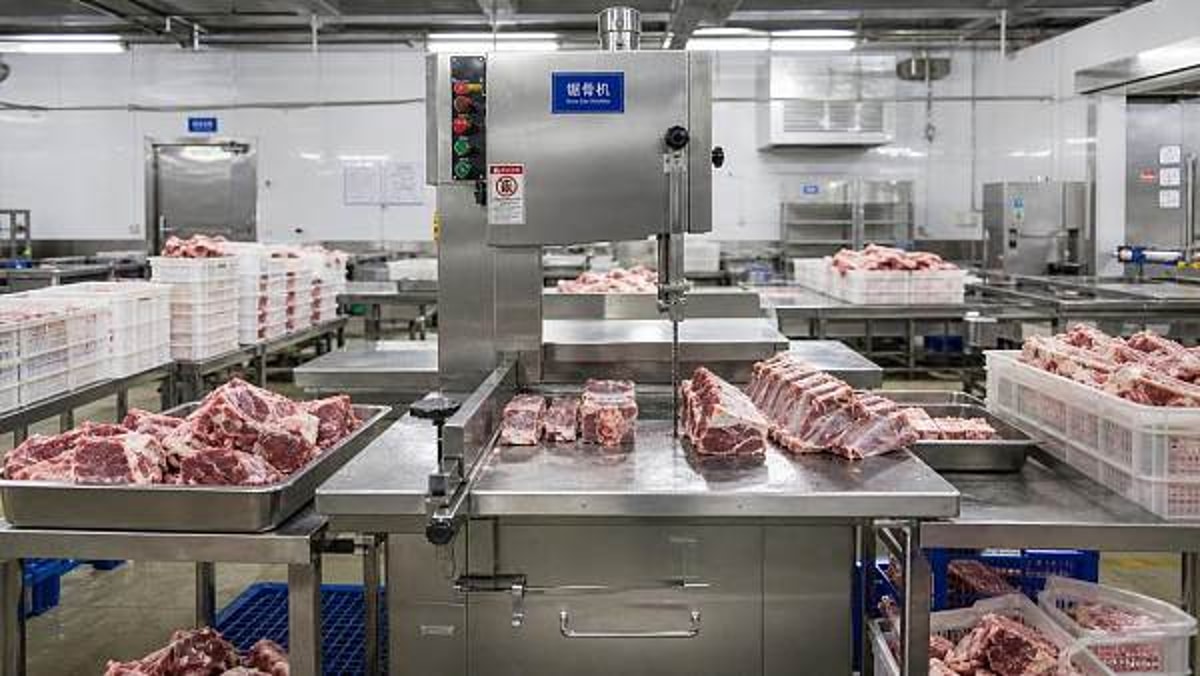
In commercial kitchens, butcher rooms, institutional catering facilities, and meat processing environments, the actual performance of commercial bone saw machines depends on how well the machine, the operator, and the workflow work together. A machine may have strong specifications on paper, yet still underperform when high-volume prep exposes poor ergonomics, unstable feeding, weak blade tension consistency, or hard-to-clean surfaces.
What operational bottlenecks usually reduce throughput first?
The first slowdown usually comes from material handling, not cutting speed. If incoming products are stacked poorly, partially frozen at different levels, or not staged near the saw, operators spend too much time lifting, sorting, and aligning pieces before each cut. Even a few extra seconds per cycle becomes a major output loss during rush periods.
Another common bottleneck is table and guide setup. Commercial bone saw machines cut best when the fence, thickness guide, and work surface support repetitive movement. If the table area is too small for the product mix, or the guide lacks quick adjustment, operators slow down to keep cuts accurate and safe. This is especially noticeable when switching between ribs, marrow bones, frozen blocks, and portioned meat cuts.
Staffing also affects speed more than many buyers expect. A skilled operator can maintain rhythm, detect blade drag early, and reduce waste. A less experienced operator may feed too aggressively, hesitate on dense bone sections, or stop frequently to correct alignment. During peak prep, labor variability makes the same machine behave very differently across shifts.
Finally, output slows when downstream processes are not synchronized. If cut products are not collected quickly, if packaging bins fill up, or if the next trimming station is blocked, the saw station has to pause. For procurement teams evaluating commercial bone saw machines, this means machine speed should be assessed as part of a production cell, not as a standalone number.
How much do blade condition and machine setup affect performance?
They affect performance more than almost any other factor. A blade that is technically still usable may already be slowing production. As teeth wear, the operator needs more pressure to push the product through. That added resistance reduces speed, increases heat, worsens cut finish, and raises the chance of wandering cuts. In peak periods, a slightly dull blade can quietly reduce total hourly output long before anyone calls it a maintenance issue.
Blade tension and tracking are equally important. If the blade is not tensioned correctly, it may flex under load, especially on harder bone or frozen sections. That forces the operator to feed more cautiously. Poor tracking can also create vibration, noise, and uneven cutting resistance, all of which slow the process and may increase product loss.
Setup quality matters at the start of every shift. Commercial bone saw machines that are easy to calibrate, inspect, and restart tend to lose less time over the course of the day. Machines with awkward blade access or inconsistent guide adjustment may look acceptable in a showroom but become frustrating in repeated commercial use.
Buyers should also remember that different blade types match different applications. A blade suited for fresh meat may not deliver the same efficiency on dense frozen material. If one facility processes multiple product states, the wrong blade choice can become a hidden source of chronic slowdown.
Does raw material variation really slow commercial bone saw machines that much?
Yes, often dramatically. Commercial bone saw machines perform most efficiently when product size, temperature, density, and bone structure are relatively consistent. In reality, many operations deal with mixed loads. Some pieces may be deeply frozen, others only surface-firm. Some bones are thick and straight, while others are irregular, joint-heavy, or attached to uneven meat mass. That variation changes resistance from cut to cut.
When products vary too much, the operator must constantly adjust feed pressure and hand position. The machine may still be working properly, but the cutting rhythm breaks down. In fast-paced foodservice prep, that inconsistency can be more damaging than a modestly lower motor rating.
Temperature inconsistency is especially important. Material that is too soft can deform and reduce cut precision, while material that is too hard can increase strain and blade wear. The result is slower feeding, more frequent corrections, and more cleanup from fragmented bone particles. Facilities that control incoming product temperature well typically get more stable performance from commercial bone saw machines than facilities that only focus on machine specifications.
Which design features help prevent slowdowns in real commercial environments?
The best-performing commercial bone saw machines are not just powerful; they are designed for repetitive commercial use with minimal interruption. One critical feature is a stable worktable with enough usable surface area for the target product range. A well-supported product moves faster and more safely than one that needs constant repositioning.
Another important feature is fast blade replacement and simple tension adjustment. Peak prep hours leave little room for long service stops. If maintenance can be completed quickly and correctly, output recovers faster. Similarly, smooth-cleaning surfaces, removable components, and accessible internal zones help reduce sanitation downtime.
Motor durability under load also matters, but not in isolation. A strong motor paired with unstable tracking or poor ergonomics will not fully solve throughput problems. Buyers should look for an integrated design: reliable drive performance, low vibration, practical safety guards, easy guide adjustment, and layouts that support continuous handling.
In sourcing discussions, it is also wise to ask how the manufacturer supports spare parts availability, cleaning guidance, and blade compatibility. Global buyers across hotel catering, institutional foodservice, and specialty meat operations often discover that after-sales readiness has a direct effect on the long-term efficiency of commercial bone saw machines.
What are the most common buyer misconceptions when evaluating commercial bone saw machines?
A common misconception is that higher horsepower automatically means faster throughput. Power is important, but it does not eliminate slowdowns caused by poor workflow, blade mismatch, sanitation interruptions, or inconsistent product loading. In many facilities, process design delivers larger gains than a simple jump in motor size.
Another misconception is focusing too heavily on maximum capacity instead of routine operating efficiency. A machine may be able to cut large bones occasionally, yet still perform poorly in repetitive medium-volume work if the table layout, guide adjustment, or cleaning process is inefficient. For information-stage buyers, this is a crucial distinction between nominal capability and sustained commercial usability.
Some buyers also underestimate sanitation-related downtime. In food environments, cleaning is not optional and cannot be treated as an afterthought. Commercial bone saw machines with difficult disassembly, hidden debris zones, or awkward washdown procedures often lose more production time than expected. This is especially relevant in multi-batch operations with strict hygiene protocols.
A final misconception is assuming all operators will achieve similar output. In reality, equipment that is intuitive, forgiving, and ergonomic usually delivers more stable performance across different staff skill levels. That matters for commercial operations facing shift changes, seasonal hiring, or training gaps.
How can buyers and operators diagnose the real source of slowdown?
The most effective approach is to separate machine factors from process factors. Start by observing one full prep cycle and tracking where time is spent: loading, alignment, actual cutting, clearing debris, rework, blade checks, and cleaning pauses. Many teams discover that the saw itself is active for a smaller share of total time than expected.
Next, compare output across different material types and operators. If the slowdown appears only with frozen products, blade choice or motor load behavior may be involved. If it appears mostly with one team, training or station organization may be the issue. If performance falls sharply after a certain number of cuts, maintenance intervals may be too long.
This kind of simple diagnosis helps buyers make better sourcing decisions and helps operators avoid blaming the wrong factor. For B2B procurement, it also creates a more useful supplier conversation because the discussion shifts from broad claims to measurable workflow performance.
What should buyers ask before choosing commercial bone saw machines for high-demand use?
Before selecting commercial bone saw machines, buyers should define the actual use case clearly. Will the machine process fresh meat, frozen cuts, dense bone sections, or a mix? How many product changes occur per shift? How often must the machine be cleaned? What output level is required during the busiest hour, not just the average day?
It is also important to ask about blade change time, recommended maintenance intervals, spare parts lead times, and compatibility with different blade specifications. In global sourcing, support responsiveness can be as important as equipment price, particularly where downtime affects hospitality service, institutional meal schedules, or specialty retail butchery operations.
Buyers should request evidence of commercial durability in relevant scenarios. That may include case references, operating environment details, sanitation design information, and safety compliance documentation. For a sourcing platform like GCT, this aligns with a practical procurement mindset: the goal is not just to find commercial bone saw machines that look capable, but to identify solutions that sustain performance under real operational pressure.
What is the key takeaway for researchers comparing options?
When commercial bone saw machines slow down during peak prep hours, the root cause is usually a chain of small inefficiencies rather than a single dramatic flaw. Blade condition, raw material consistency, station layout, operator technique, cleaning design, and after-sales support all influence how much productive cutting time is actually achieved. That is why informed buyers evaluate both equipment specifications and workflow reality.
If you need to confirm a specific solution, parameter range, sourcing direction, maintenance cycle, quotation basis, or cooperation model, it is best to start by discussing product type, peak hourly volume, raw material condition, sanitation frequency, operator skill level, and required compliance standards. Those questions will reveal much faster whether certain commercial bone saw machines are truly suitable for demanding commercial processing environments.
Search News
Hot Articles
- Commercial KitchenStainless steel GN pans with reinforced corners last longer in busy kitchensMay 02, 2026
- Hotel Room AmenitiesMemory foam hotel mattresses: when soft comfort leads to faster saggingMay 02, 2026
- Hotel Room AmenitiesElectronic hotel door locks: battery alerts are often less simple than they seemMay 02, 2026
Popular Tags
Need ExpertConsultation?
Connect with our specialized leisureengineering team for procurementstrategies.
Recommended News
 May 02, 2026Stainless steel GN pans with reinforced corners last longer in busy kitchensStainless steel GN pans with reinforced corners help busy kitchens reduce warping, improve hygiene, and cut replacement costs. See why buyers choose longer-lasting performance.● Hospitality Sourcing Dir
 May 02, 2026Commercial induction cookers: power ratings that mislead first-time buyersCommercial induction cookers are not as simple as wattage labels suggest. Learn how to compare real performance, efficiency, pan fit, and reliability before you buy.● Hospitality Sourcing Dir
 May 02, 2026Beverage dispensers wholesale: what causes dripping after heavy useBeverage dispensers wholesale guide: learn what causes dripping after heavy use, how to spot seal, valve, and pressure issues, and choose durable suppliers with confidence.● Hospitality Sourcing Dir
 May 02, 2026Disposable wooden cutlery and the taste issue customers noticeDisposable wooden cutlery can affect taste, texture, and customer perception. Learn what causes woody aftertaste, how to test suppliers, and how to choose better options.● Hospitality Sourcing Dir
 May 02, 2026Sushi display cases: curved glass looks better, but is it practical?Sushi display cases with curved glass look premium, but are they practical? Compare visibility, cleaning, temperature control, and ROI before you buy.● Hospitality Sourcing Dir
 May 02, 2026Vacuum sealing machines food businesses can scale withVacuum sealing machines food businesses can scale with improve shelf life, workflow, and cost control. Explore reliable, compliant solutions for growing food operations.● Hospitality Sourcing Dir
 May 02, 2026Chafing fuel gel bulk: storage and burn-time issues to check firstChafing fuel gel bulk buyers should check storage stability, seal integrity, and real burn-time performance first. Reduce waste, avoid service disruption, and source with more confidence.● Hospitality Sourcing Dir
 May 02, 2026Custom printed napkins that keep logos sharp after unfoldingCustom printed napkins that keep logos sharp after unfolding help hotels, restaurants, and event brands protect presentation quality. Learn what to check before you buy.● Hospitality Sourcing Dir
 May 02, 2026Panini presses commercial models: smooth plate or grooved plate?Panini presses commercial buyers: compare smooth vs. grooved plates for hotels, cafés, catering, and foodservice. Learn which style boosts speed, cleaning, presentation, and value.● Hospitality Sourcing Dir
 May 02, 2026Catering transport carts: how much insulation is actually enough?Catering transport carts: discover how much insulation is truly enough to protect food quality, meet compliance goals, and improve service efficiency across real catering operations.● Hospitality Sourcing Dir
 May 02, 2026What slows down commercial bone saw machines during peak prep hoursCommercial bone saw machines slow down from blade wear, workflow bottlenecks, raw material variation, and cleaning delays. Learn what really cuts throughput and how to choose higher-efficiency equipment.● Hospitality Sourcing Dir
 May 02, 2026Refrigerated display cabinets: glass fogging problems and how to avoid themRefrigerated display cabinets often face glass fogging in humid settings. Learn key causes, smart anti-fog solutions, and how to choose reliable cabinets for clear visibility.● Hospitality Sourcing Dir
 May 02, 2026Commercial food processors: the attachment issue many kitchens overlookCommercial food processors are only as effective as their attachments. Learn how the right system improves consistency, safety, workflow, and ROI before you buy.● Hospitality Sourcing Dir
 May 02, 2026Biodegradable takeout containers that leak less with hot foodsBiodegradable takeout containers that leak less with hot foods: compare materials, heat resistance, grease barriers, and sourcing factors to choose reliable eco packaging.● Hospitality Sourcing Dir
 May 02, 2026Hotel & Catering Equipment checklist for new venue openingsHotel & Catering Equipment checklist for new venue openings: discover must-have items, common planning gaps, compliance checks, and sourcing tips to launch on time and with confidence.● Hospitality Sourcing Dir
 May 02, 2026Commercial waffle makers: flip or fixed plate for busy breakfast serviceCommercial waffle makers: compare flip vs fixed plate models for busy breakfast service. Learn which option improves speed, consistency, labor efficiency, and guest satisfaction.● Hospitality Sourcing Dir
 May 02, 2026Paper coffee cups wholesale: which lid fit causes the most complaintsPaper coffee cups wholesale buyers face the most complaints from loose lids that seem sealed but leak in use. Learn key fit risks, root causes, and sourcing checks before bulk orders.● Hospitality Sourcing Dir
 May 02, 2026Blast chillers commercial buyers regret choosing too smallBlast chillers commercial buyers often regret going too small. Learn how proper sizing protects food safety, peak throughput, compliance, and long-term operating efficiency.● Hospitality Sourcing Dir
 May 02, 2026Commercial wine coolers with dual zones: when are they worth it?Commercial wine coolers with dual zones: learn when the added cost pays off for hospitality, retail, and event venues through better temperature control, display, and service efficiency.● Hospitality Sourcing Dir
 May 02, 2026How to compare stainless steel GN pans by gauge and depthStainless steel GN pans compared by gauge and depth: learn how thickness, capacity, and workflow fit affect durability, heat performance, and smarter catering purchases.● Hospitality Sourcing Dir
 May 01, 2026Hotel and Catering Equipment Trends Shaping 2026 RenovationsHotel & Catering Equipment trends for 2026 renovations reveal smarter, cleaner, and more flexible solutions that cut risk, improve efficiency, and elevate guest experience.● Hospitality Sourcing Dir
 May 01, 2026Outdoor Patio Heaters: What Changes in Windy Dining AreasOutdoor patio heaters in windy dining areas need more than high output. Learn how wind changes comfort, efficiency, safety, and placement to choose smarter commercial heating solutions.● Hospitality Sourcing Dir
 May 01, 2026Food Warmers Commercial Models That Keep Texture, Not Just HeatFood warmers commercial buyers trust do more than hold heat—they preserve crispness, moisture, and presentation. Discover how to reduce waste and improve service quality.● Hospitality Sourcing Dir
 May 01, 2026Bakery Dough Mixers Sized Right for Batch ConsistencyBakery dough mixers sized right improve batch consistency, dough quality, and efficiency. Learn how to match capacity, torque, and dough type for reliable bakery performance.● Hospitality Sourcing Dir