How to Select Hotel Hair Dryers That Balance Guest Safety, Durability, and Cost
How to Select Hotel Hair Dryers That Balance Guest Safety, Durability, and Cost
Selecting a hair dryer for hotels is a procurement decision with consequences beyond guest convenience. The wrong specification can increase safety risk, replacement frequency, maintenance calls, and negative guest impressions.
For most properties, the best choice is not the lowest-priced unit or the highest-wattage model. It is a commercial-grade dryer matched to room type, electrical infrastructure, expected usage, and replacement strategy.
Procurement teams should evaluate hotel hair dryers through three connected lenses: guest safety, operational durability, and total cost of ownership. A balanced specification protects both the guest experience and the budget.
Buyers searching for a hair dryer for hotels usually need a reliable shortlist, not generic product descriptions. They need to understand what standards matter, which features reduce failures, and where spending delivers measurable value.
Start With the Operating Environment, Not the Catalog Price
Before comparing models, define where and how each dryer will be used. Guestroom bathrooms, suites, spas, fitness changing rooms, and serviced apartments create different performance and installation requirements.
A standard guestroom unit may operate briefly several times each week, while a resort, airport hotel, or long-stay property can experience substantially higher usage. Duty cycle directly affects motor selection and replacement expectations.
Room positioning also matters. Dryers installed near washbasins, mirrors, or humid vanity areas require stronger attention to electrical protection, mounting location, cable management, and local bathroom-zone regulations.
Luxury hotels may prioritize quieter operation, premium finish, and stronger airflow. Economy and midscale operators often focus on standardized replacement parts, theft resistance, and fast maintenance across a larger room inventory.
Ask the operations team for data before issuing an RFQ. Useful inputs include room count, occupancy level, average stay duration, existing failure rates, electrical outlet type, and typical guest complaints.
This initial assessment prevents a common sourcing mistake: applying one universal specification across properties with very different guest profiles, climatic conditions, maintenance resources, and room designs.
Make Electrical Safety the First Non-Negotiable Requirement
Guest safety should be treated as a pass-fail criterion rather than a feature comparison. A hair dryer for hotels must meet the legal electrical requirements of the destination market.
Request documentation for the exact model, voltage, plug configuration, and production version being offered. A supplier statement alone is insufficient when certificates, test reports, or marking requirements apply.
Depending on the market, buyers may need evidence of compliance with applicable UL, ETL, CE, UKCA, GS, CB, RoHS, or regional electrical safety requirements.
Certification relevance matters as much as certification presence. A document issued for another voltage, another plug, or a materially different model does not automatically validate the purchased unit.
Overheating protection is essential. Commercial dryers should incorporate thermal cut-out protection that interrupts power when internal temperatures exceed safe operating limits, reducing fire risk caused by blocked airflow or motor stress.
Choose models with a resettable thermal protector and a thermal fuse where appropriate. These components provide layered protection, although they do not replace regular cleaning and correct installation.
Bathroom installations may require compatible residual-current protection, commonly called GFCI or RCD protection depending on the region. Confirm whether protection belongs in the outlet, wall unit, or building circuit.
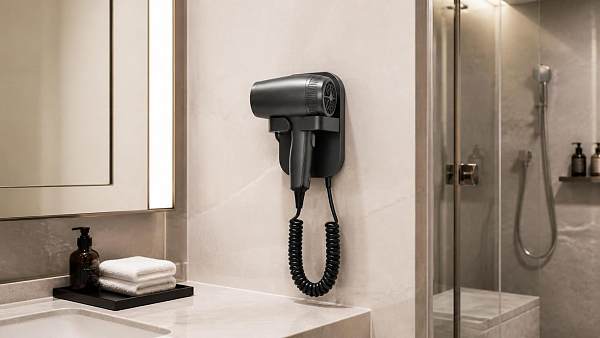
For wall-mounted models, inspect cable routing and strain relief. The power lead should not hang loosely where guests can pull it, trap it in drawers, or expose it to standing water.
Safety specifications should also address exterior temperature, switch reliability, insulation quality, and resistance to accidental drops. A safe product performs predictably after repeated real-world guest handling.
Choose the Right Format: Wall-Mounted, Drawer-Mounted, or Portable
The physical format of a hotel hair dryer affects guest usability, housekeeping workflow, loss prevention, and room design. No single format is best for every hotel segment.
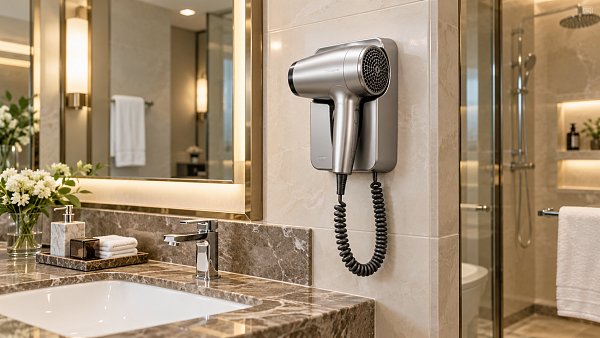
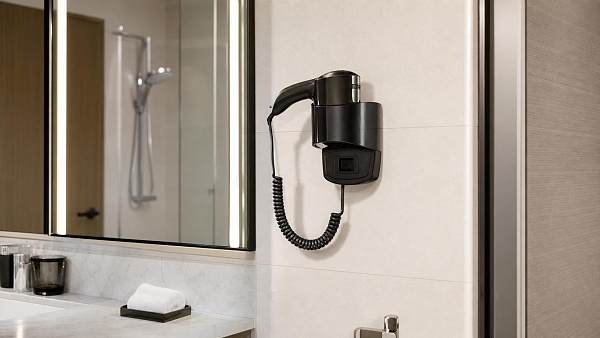
Wall-mounted dryers are widely used in standard guestrooms because they remain visible, reduce theft, and create a designated storage location. They also simplify room inspections for housekeeping staff.
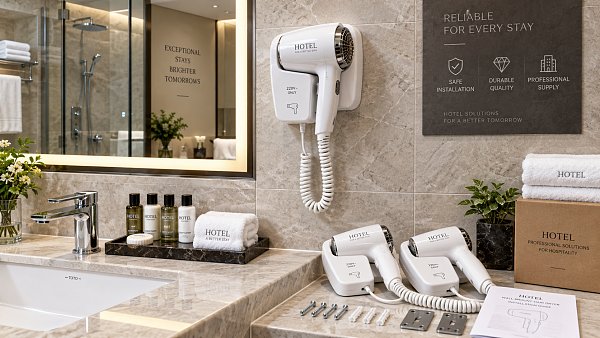
However, wall-mounted units require careful installation. Buyers should confirm bracket strength, mounting-surface compatibility, cable length, service access, and whether the electrical connection requires a qualified installer.
Drawer-mounted or bag-stored portable dryers can support a more residential guestroom aesthetic. They are common in upscale suites where designers prefer uncluttered bathrooms and concealed amenities.
Portable units offer flexibility, but they require stronger asset-control processes. Housekeeping teams must verify that every unit remains in the room, and replacement costs can increase if losses are frequent.
For premium rooms, a removable dryer with a durable storage bag may improve perceived quality. The bag should protect the appliance, dry quickly, and avoid trapping moisture after guest use.
Integrated wall units with a detachable handpiece can provide a middle option. They improve retention and cable management while allowing guests to use the dryer more comfortably around the vanity.
During sample evaluation, test the format with room attendants and engineering staff. A product that appears elegant in a showroom may be difficult to clean, repair, reset, or inspect at scale.
Assess Durability by Components, Not Marketing Claims
Terms such as “professional,” “heavy-duty,” and “long-life” are not procurement specifications. Buyers should evaluate the internal components and construction details that determine actual service life.
The motor is the central durability consideration. DC motors are often lighter and economical, while AC motors generally provide stronger airflow and longer operating life for higher-use hospitality environments.
Brushless motors can offer excellent longevity and lower maintenance, but their added cost is not always justified in standard rooms. Their value increases where usage frequency and service disruption are high.
Ask suppliers to state the expected motor life in operating hours, not vague years of use. Compare this claim with warranty conditions, test methods, and expected occupancy-driven utilization.
Heating elements should resist repeated thermal cycling without developing hot spots or uneven airflow. Durable designs also use stable internal wiring, secure connectors, and heat-resistant plastic components.
The inlet grille deserves close attention. It should be easy to remove or clean, because lint accumulation restricts airflow, increases heat, reduces drying performance, and shortens motor life.
Hair dryers with difficult-to-clean filters may appear acceptable during installation but become a maintenance burden after several months. Ask for a demonstration of cleaning procedures before approval.
Switches, speed controls, and cool-shot buttons are frequent wear points. Select controls that feel firm, remain usable with damp hands, and do not become loose after repeated operation.
Examine the cord, plug, and strain-relief assembly carefully. In hotel environments, cable failures are common because guests wrap cords tightly, pull units from drawers, or use them at awkward angles.
A commercial-grade cord should remain flexible, resist kinking, and maintain its protective sheath after thousands of bends. For fixed units, retractable cords require particularly rigorous cycle testing.
Balance Drying Performance With Noise and Energy Use
Guest satisfaction depends on drying performance, but maximum wattage alone does not guarantee a better experience. Airflow, heat control, nozzle design, and motor efficiency all influence drying speed.
Higher wattage can shorten drying time, especially for guests with long or thick hair. Yet it may also increase energy consumption, noise, surface temperature, and electrical load across occupied rooms.
For many full-service hotels, a moderate-to-high commercial rating with effective airflow provides better results than an inexpensive high-wattage dryer with weak motor performance or inconsistent heat delivery.
Procurement teams should compare airflow measurements, heat settings, and actual drying trials. Supplier wattage figures should be considered alongside guest comfort and operating cost, not in isolation.
Noise is especially important in upscale hotels, wellness resorts, and compact urban properties. A loud dryer can disturb a sleeping companion or neighboring room occupants in poorly insulated buildings.
Request a stated decibel measurement and test samples in a quiet room. Perceived noise can differ significantly between products with similar technical ratings because motor tone and airflow turbulence vary.
Multiple heat and speed settings allow guests to adapt the dryer to their hair type. They also reduce overheating complaints by giving users a lower-temperature option for extended styling sessions.
A cool-shot function is useful but should not outweigh more important criteria. Its mechanism must be reliable, and the button should not be positioned where it is accidentally pressed during normal use.
Calculate Total Cost of Ownership Across the Replacement Cycle
Unit price is only one part of the financial decision. A lower-cost hotel hair dryer can become more expensive when early failures create emergency purchasing, labor costs, guest compensation, and inconsistent room standards.
Build a total cost of ownership model using purchase price, freight, installation, expected lifespan, failure rate, spare parts availability, warranty recovery, energy use, and maintenance labor.
For example, a unit costing slightly more may be financially preferable if it lasts twice as long and reduces engineering callouts. The calculation should reflect each property’s labor rate and occupancy pattern.
Include the cost of room downtime. A missing or failed appliance can require a room move, rapid housekeeping intervention, or guest-service recovery, particularly when the property operates near full occupancy.
Standardization can improve purchasing economics. Using one approved model across similar properties reduces training requirements, simplifies spare-part inventory, and enables larger-volume negotiations with qualified suppliers.
However, standardization should not force an unsuitable product into every location. Hotels operating on different voltages, design standards, or guest-service levels may require separate approved specifications.
Evaluate warranty terms closely. A long warranty has limited value if the supplier requires costly international returns, does not stock replacement units locally, or excludes common operational failures.
Ask whether the supplier can provide a small buffer stock, replacement handpieces, wall brackets, cords, filters, and installation components. Fast access to parts often matters more than headline warranty duration.
Use a Structured Supplier Qualification Process
A reliable product depends on a reliable supplier. Procurement teams should assess manufacturing controls, documentation quality, export experience, responsiveness, and after-sales capacity before placing a large hotel order.
Request product specifications, compliance documents, factory audit information, quality-control procedures, packaging details, lead times, and references from comparable hospitality or institutional projects.
For OEM or private-label programs, clarify ownership of tooling, artwork approval steps, minimum order quantities, product-change notification procedures, and whether replacement units will remain visually consistent over time.
Product consistency is critical for hotels. A supplier should not substitute plugs, internal components, cable lengths, finishes, or mounting hardware without written approval from the buyer.
Insist on pre-production samples before approving branded or customized orders. Test samples under realistic conditions, including repeated switch use, lint exposure, cord handling, mounting, and extended operating periods.
For larger projects, establish an inspection plan. This may include pre-shipment inspection, random sample testing, barcode verification, packaging checks, and confirmation that certificate markings match the approved production model.
Clear packaging requirements reduce receiving problems. Cartons should identify model numbers, voltage, plug type, finish, room allocation, and batch information so properties can manage installation efficiently.
When sourcing internationally, confirm Incoterms, customs documentation, electrical labeling, local service arrangements, and realistic lead times. A low factory quote can lose value quickly through avoidable logistics failures.
Create an Approval Matrix Before Placing the Order
An approval matrix converts subjective opinions into a repeatable sourcing decision. It also gives procurement, engineering, operations, and design teams a shared basis for evaluating competing samples.
Assign the highest weighting to safety compliance, electrical suitability, thermal protection, and durability. These factors should eliminate unsuitable products before aesthetics or minor feature differences are discussed.
Then score serviceability, airflow, noise, mounting format, finish quality, supplier support, warranty practicality, and total cost of ownership. Weightings should reflect the property’s operational priorities.
For a budget hotel, replacement cost and theft resistance may receive higher scores. For a luxury resort, noise, finish quality, ergonomic comfort, and premium styling may justify more weight.
Include feedback from the people who will handle the product daily. Engineering teams identify installation risks, housekeeping identifies cleaning challenges, and guest-service teams understand recurring complaints and expectations.
Document the approved specification in enough detail to prevent future substitutions. Include model reference, voltage, plug type, finish, mounting hardware, cable configuration, certification requirements, and required spare parts.
Revisit the specification periodically using warranty claims, maintenance tickets, review comments, and replacement records. This turns purchasing data into a practical basis for improving the next sourcing cycle.
Conclusion: Buy Reliability Where Guests Can Feel It
The right hair dryer for hotels is a controlled operational asset, not a minor bathroom accessory. It should protect guests, perform consistently, fit the room design, and remain economical throughout its working life.
Begin with compliance and electrical safety, then evaluate motor life, thermal protection, maintainability, noise, mounting requirements, and supplier capability. These factors matter more than promotional claims or initial unit price.
A disciplined sample test and total-cost analysis will usually reveal the strongest option. Hotels that specify carefully reduce failures, protect brand standards, and give guests a dependable everyday amenity.
Search News
Hot Articles
- Hotel Room AmenitiesHow to Select Hotel Hair Dryers That Balance Guest Safety, Durability, and CostOct 05, 2026
- Restaurant FurnitureFast-Casual Restaurant Interiors: Design Choices That Improve Speed and Guest FlowOct 04, 2026
- Outdoor RidesHow to Select Leisure Park Equipment for Safe, High-Throughput Visitor AreasOct 03, 2026
Popular Tags
Need ExpertConsultation?
Connect with our specialized leisureengineering team for procurementstrategies.
Recommended News
 Oct 05, 2026How to Select Hotel Hair Dryers That Balance Guest Safety, Durability, and CostHair dryer for hotels: learn how to select safe, durable, cost-efficient models with the right certifications, performance, maintenance, and supplier support.● Hospitality Sourcing Dir
 Oct 01, 2026How Hotels Can Choose Amenity Bottles That Balance Brand Image and Refill CostsHotel amenity bottles: learn how to balance premium brand presentation, refill costs, hygiene, durability, and efficient housekeeping workflows.● Hospitality Sourcing Dir
 Sep 25, 2026How to Evaluate a Wall-Mounted Hotel Hair Dryer Manufacturer for Bulk ProjectsHotel hair dryers wall mounted manufacturer evaluation guide: compare safety, durability, installation fit, OEM options, total cost, and reliable bulk-project support.● Hospitality Sourcing Dir
 Sep 03, 2026What Lead Times Should Buyers Expect for Custom Luxury Fixtures?What delivery lead times should I expect for custom luxury fixtures? Discover realistic 12–24 week timelines, approval milestones, freight factors, and ways to avoid costly delays.● Hospitality Sourcing Dir
 Sep 05, 2026Hotel Hair Dryers Compared: Wattage, Safety Features, and Guest-Room DurabilityHair dryer for hotels: compare wattage, thermal safety, noise, mounting, and durability to select reliable guest-room dryers that elevate comfort and reduce maintenance costs.● Hospitality Sourcing Dir
 Aug 04, 2026What to Check Before Buying Space Saving Ironing Boards Wholesale for HotelsSpace saving ironing boards wholesale for hotels: learn what to check before buying, from room fit and mounting to durability, compliance, and total installed cost.● Hospitality Sourcing Dir
 Jul 12, 2026Saudi e-SABER Label Rule Hits Hotel Amenities ExportsSaudi e-SABER label rule will reshape hotel amenities exports from August 1, 2026. Learn how SASO compliance, port clearance risks, and supplier readiness may impact shipments.● Hospitality Sourcing Dir
 Jul 11, 2026SASO Requires e-SABER Labels for Hotel AmenitiesSASO requires e-SABER labels for hotel amenities from August 1, 2026. Learn how QR code, SABER, and GCC compliance rules may impact Saudi shipments and port clearance.● Hospitality Sourcing Dir
 Jul 10, 2026Saudi SABER Update Adds GCC and Arabic Manual RuleSaudi SABER Update Adds GCC and Arabic Manual Rule: learn how the new SABER requirements affect hotel amenities certification, timelines, costs, and Saudi market access planning.● Hospitality Sourcing Dir
 Jul 03, 2026Wet and Dry Vacuum Cleaners Quiet Enough for Hotels: What Noise Level and Features Matter?Wet and dry vacuum cleaners quiet enough for hotels: compare ideal dB ranges, filtration, maneuverability, and lifecycle cost to choose cleaner, quieter machines with confidence.● Hospitality Sourcing Dir
 Jul 01, 2026How to Choose Hotel Hospitality Supplies for Different Property TypesHotel hospitality supplies buying guide for resorts, boutique, business, and economy hotels. Learn how to match supplies to property type, durability, brand image, and lifecycle value.● Hospitality Sourcing Dir
 Jun 27, 2026Memory Foam Hotel Mattresses vs Hybrid Beds: Which Option Fits Your Property?Memory foam hotel mattresses or hybrid beds? Compare comfort, durability, cooling, and lifecycle cost to find the best fit for your property and guest experience.● Hospitality Sourcing Dir
 Jun 26, 2026Hotel Desks: Types, Materials, and Layout Tips for Modern Guest RoomsHotel desks guide covering desk types, durable materials, and smart layout tips for modern guest rooms. Discover practical ideas to improve comfort, style, and space efficiency.● Hospitality Sourcing Dir
 Jun 23, 2026How to Choose Hotel Wardrobes: Materials, Storage Layout, and Durability StandardsHotel wardrobes guide: learn how to compare materials, storage layout, and durability standards to choose wardrobes that improve guest experience and reduce long-term maintenance costs.● Hospitality Sourcing Dir
 Jun 20, 2026Artificial Plants for Hotels: How to Compare Fire Ratings, Materials, and Maintenance NeedsArtificial plants for hotels: compare fire ratings, materials, and maintenance needs to choose safer, longer-lasting greenery that protects design quality and lifecycle cost.● Hospitality Sourcing Dir
 Jun 17, 2026How to Choose Hotel Hair Dryers Wall Mounted for Safety, Power, and Room TypeHotel hair dryers wall mounted buying guide: learn how to compare safety features, power levels, noise, and room-fit options to choose reliable models for every hotel segment.● Hospitality Sourcing Dir
 Jun 04, 2026Wholesale Hotel Safes Buying Guide: Lock Types, Size Options, and Installation PointsWholesale hotel safes buying guide covering lock types, size options, and installation points. Compare models, reduce procurement risk, and choose the right safe for your hotel project.● Hospitality Sourcing Dir
 May 30, 2026Is glamping furniture worth the higher project cost?Glamping furniture can justify higher project costs when it boosts bookings, durability, guest reviews, and long-term ROI. Learn where premium upgrades truly pay off.● Hospitality Sourcing Dir
 May 29, 2026Do blackout curtains for hotels Cut Energy Costs?Blackout curtains for hotels can lower HVAC costs, improve guest comfort, and boost room performance. Learn when they save energy and how to specify the right system.● Hospitality Sourcing Dir
 May 09, 2026Glamping furniture mistakes that make premium stays feel cheapGlamping furniture mistakes can make premium stays feel cheap. Learn how to choose durable, comfortable, brand-aligned pieces that elevate guest experience and protect long-term value.● Hospitality Sourcing Dir
 May 04, 2026Commercial Carpet Tiles for Hotels: What Wears Out First?Commercial carpet tiles hotel buyers: discover what wears out first in entrances, corridors, and transition zones, and learn how to specify longer-lasting, guest-ready flooring.● Hospitality Sourcing Dir
 May 04, 2026Custom Hotel Signage That Looks Premium and Stays ReadableCustom hotel signage that balances premium aesthetics with readability, durability, and compliance. Discover a practical checklist to improve guest experience and streamline hotel projects.● Hospitality Sourcing Dir
 May 04, 2026Luxury Vinyl Tile Commercial Flooring in High-Traffic AreasLuxury vinyl tile commercial flooring for high-traffic spaces: discover how to compare durability, maintenance, installation risks, and lifecycle value before you specify.● Hospitality Sourcing Dir
 May 03, 2026AC Milan’s Smart Locker Room Procurement Triggers UNI 11743 Compliance ReviewAC Milan’s smart locker room procurement triggers UNI 11743:2025 compliance review — critical for sports infrastructure suppliers, EU exporters & integrators.● Hospitality Sourcing Dir