Do blackout curtains for hotels Cut Energy Costs?
Do Blackout Curtains for Hotels Cut Energy Costs?
For hospitality properties, energy efficiency is no longer only a sustainability goal. It directly affects operating cost, room comfort, and asset performance.
Blackout curtains for hotels can reduce heat gain, limit HVAC workload, and improve guest satisfaction across rooms, suites, and public spaces.
Their real value depends on fabric density, lining quality, track design, window orientation, installation accuracy, and supplier reliability.
This guide explains where blackout curtains for hotels deliver measurable savings and how commercial buyers should evaluate sourcing decisions.
Energy Savings Depend on the Hotel Scenario
A curtain is not an isolated decorative item. It is part of the room envelope, alongside glass, glazing film, seals, and HVAC zoning.
Blackout curtains for hotels help most when solar heat gain, room cooling demand, or nighttime heat loss creates recurring energy pressure.
The impact is different in tropical resorts, urban towers, airport hotels, serviced apartments, and heritage properties with older windows.
A south-facing suite with full-height glass needs a different curtain specification than a shaded standard room with compact windows.
This is why energy assessment should begin with scenes of use, not only fabric price or catalog appearance.
Guest Rooms With Strong Sun Exposure
Guest rooms facing intense afternoon sun are the clearest scenario for blackout curtains for hotels to support lower cooling demand.
Dense face fabric, thermal lining, and proper overlap can reduce radiant heat entering the occupied space during peak sunlight hours.
This allows HVAC systems to reach the set temperature with less strain, especially before check-in and during early evening occupancy.
For these rooms, fabric opacity alone is not enough. Thermal backing and side light control matter just as much.
Core judgment points
- Window orientation and daily sunlight duration.
- Glass area compared with room volume.
- Curtain overlap beyond the frame.
- Thermal lining weight and reflectance.
- Track position relative to ceiling and wall.
In this scenario, blackout curtains for hotels should be specified as a performance layer, not only as a visual finish.
Suites, Villas, and Premium Rooms With Large Glazing
Premium rooms often use wide glass panels to create views, daylight, and a sense of spaciousness.
The same design choice can increase heat gain, glare, and cooling cost when shading is poorly planned.
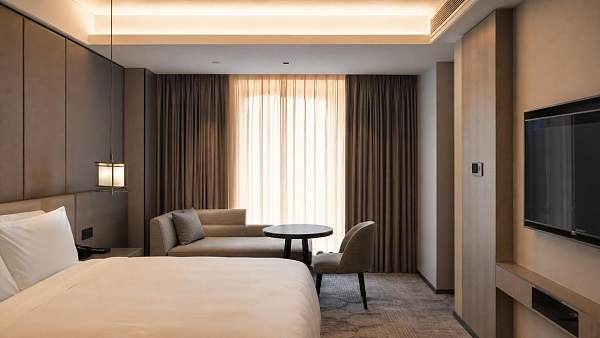
Blackout curtains for hotels in suites must balance energy control, acoustic comfort, privacy, and luxury interior design.
Layered systems are often effective. A sheer layer manages daylight, while the blackout layer controls heat, privacy, and sleep quality.
Motorized tracks may improve use consistency. Curtains only save energy when guests or staff actually close them at the right time.
Best-fit specification approach
- Use heavyweight blackout fabric with stable dimensional performance.
- Select lining that supports thermal insulation.
- Add side channels or generous returns where possible.
- Consider automation for large or hard-to-reach openings.
For premium assets, blackout curtains for hotels should support both comfort metrics and brand-level room presentation.
Urban Business Hotels With High Occupancy Turnover
Urban business hotels often operate with dense occupancy, frequent check-ins, and varied guest schedules.
In these properties, blackout curtains for hotels help stabilize room temperature between occupancy cycles.
When rooms are vacant during daytime, closed curtains can reduce unnecessary solar loading before the next guest arrives.
The operational question is simple. Can housekeeping routines include curtain positioning without slowing room turnover?
If yes, blackout curtains for hotels become part of a repeatable energy control routine.
Operational fit matters
Durability is important in high-turnover settings. Tracks, hooks, headings, and hems must tolerate frequent handling.
Low-quality curtains may sag, gap, fade, or lose lining integrity, reducing both comfort and energy performance.
For this scenario, source blackout curtains for hotels from suppliers with commercial project references and documented production consistency.
Resorts in Hot or Coastal Climates
Coastal and resort environments create specific performance challenges, including humidity, salt air, intense UV exposure, and long cooling seasons.
Blackout curtains for hotels in these settings should be assessed for fabric stability, colorfastness, mildew resistance, and lining durability.
Energy savings can be meaningful because rooms often require cooling for much of the year.
However, poor material selection can shorten product life and create replacement costs that offset energy benefits.
The best solution combines thermal control with commercial textile resilience.
What to verify before sourcing
- UV resistance for long-term color stability.
- Mildew resistance for humid conditions.
- Washability or professional cleaning compatibility.
- Fire safety compliance for hospitality interiors.
In resort projects, blackout curtains for hotels should be evaluated through total lifecycle value, not unit cost alone.
Cold-Climate Hotels and Winter Heat Retention
Blackout curtains are often associated with cooling, but they can also support heat retention in colder regions.
Blackout curtains for hotels create an added insulating air layer when they sit close enough to the window area.
This can reduce heat loss during winter nights, particularly in rooms with older glazing or large exposed windows.
The benefit depends on reducing gaps at the top, bottom, and sides of the curtain installation.
A decorative panel with loose edges will not deliver the same insulation as a well-fitted commercial system.
Public Areas, Meeting Rooms, and Ballrooms
Energy-saving discussions should not stop at guestrooms. Public areas may have larger glass surfaces and longer operating hours.
Blackout curtains for hotels can support temperature control in conference rooms, event spaces, lounges, and private dining rooms.
They also improve projection visibility, privacy, and acoustic softness, making them useful beyond HVAC efficiency.
For large venues, track strength and fabric weight become critical. Oversized panels must move smoothly and safely.
Motorization may be justified when staff need fast scene changes between daylight events, presentations, and evening functions.
Scenario Differences That Affect Energy Performance
This comparison shows why blackout curtains for hotels should be selected by usage environment and building conditions.
How to Specify Blackout Curtains for Hotels More Accurately
Accurate specification begins with measurable room data, not only interior design preference.
Window dimensions, orientation, ceiling height, wall clearance, and HVAC behavior should all influence curtain selection.
Blackout curtains for hotels perform best when fabric, lining, hardware, and installation details are planned together.
- Map rooms by sun exposure and glazing size.
- Identify zones with high cooling or heating loads.
- Choose blackout fabric with verified opacity and weight.
- Add thermal lining where climate conditions justify it.
- Specify track placement to reduce light and air gaps.
- Request commercial safety and maintenance documentation.
This process helps connect energy goals with practical installation outcomes.
Common Misjudgments That Reduce Savings
The first mistake is assuming that any opaque curtain provides meaningful thermal performance.
A thin blackout coating may block light but provide limited insulation against heat transfer.
The second mistake is ignoring installation gaps. Heat and light can bypass fabric through poor side returns.
The third mistake is selecting residential-grade materials for commercial rooms with heavy usage.
Blackout curtains for hotels must handle repeated movement, cleaning schedules, fire safety rules, and consistent visual standards.
The fourth mistake is focusing only on purchase price. Replacement, maintenance, and guest complaints can cost more later.
Can Energy Savings Be Measured?
Yes, but results vary by building type, climate, glass specification, and guest behavior.
A practical method is to compare similar rooms with and without upgraded blackout curtains for hotels.
Track room temperature recovery time, HVAC runtime, guest comfort feedback, and seasonal utility patterns.
The strongest business case usually appears where high solar exposure overlaps with long cooling seasons.
Even when direct savings are moderate, blackout curtains for hotels may improve sleep quality and reduce service complaints.
Sourcing Guidance for Commercial Projects
Reliable sourcing is essential because curtain performance depends on consistent production and accurate installation support.
Global Commercial Trade focuses on sourcing intelligence for hospitality, commercial interiors, specialty retail, and experience-driven spaces.
For blackout curtains for hotels, supplier evaluation should include material testing, sample approval, project capacity, and compliance evidence.
- Request fabric samples under real daylight conditions.
- Check flame-retardant standards required by the target market.
- Confirm batch consistency for color and lining thickness.
- Review hotel project references and production lead times.
- Clarify packaging, labeling, and room-by-room delivery support.
These checks reduce project risk and help ensure the selected solution performs after installation.
Conclusion: When Do Blackout Curtains for Hotels Pay Off?
Blackout curtains for hotels can cut energy costs when matched to the right room conditions and installed correctly.
They are most effective in sun-facing rooms, large-glass suites, hot-climate resorts, and cold regions with nighttime heat loss.
The best results come from thermal lining, proper overlap, durable hardware, and clear operational routines.
Before sourcing blackout curtains for hotels, compare scenarios, request performance samples, and verify commercial compliance.
A well-specified curtain system supports energy control, guest comfort, interior design quality, and long-term hospitality asset value.
Search News
Hot Articles
- Arcade & VR MachinesChoosing a Racing Simulator Cockpit for an FEC: Durability and Guest FitOct 14, 2026
- Office Furniture & EquipChoosing Commercial Air Conditioners for Offices: Capacity, Zoning, and NoiseOct 13, 2026
- Fashion & Gem JewelryHow to Choose Designer Eyewear That Fits Your Store’s Customer ProfileOct 12, 2026
Popular Tags
Need ExpertConsultation?
Connect with our specialized leisureengineering team for procurementstrategies.
Recommended News
 Oct 05, 2026How to Select Hotel Hair Dryers That Balance Guest Safety, Durability, and CostHair dryer for hotels: learn how to select safe, durable, cost-efficient models with the right certifications, performance, maintenance, and supplier support.● Hospitality Sourcing Dir
 Oct 01, 2026How Hotels Can Choose Amenity Bottles That Balance Brand Image and Refill CostsHotel amenity bottles: learn how to balance premium brand presentation, refill costs, hygiene, durability, and efficient housekeeping workflows.● Hospitality Sourcing Dir
 Sep 25, 2026How to Evaluate a Wall-Mounted Hotel Hair Dryer Manufacturer for Bulk ProjectsHotel hair dryers wall mounted manufacturer evaluation guide: compare safety, durability, installation fit, OEM options, total cost, and reliable bulk-project support.● Hospitality Sourcing Dir
 Sep 03, 2026What Lead Times Should Buyers Expect for Custom Luxury Fixtures?What delivery lead times should I expect for custom luxury fixtures? Discover realistic 12–24 week timelines, approval milestones, freight factors, and ways to avoid costly delays.● Hospitality Sourcing Dir
 Sep 05, 2026Hotel Hair Dryers Compared: Wattage, Safety Features, and Guest-Room DurabilityHair dryer for hotels: compare wattage, thermal safety, noise, mounting, and durability to select reliable guest-room dryers that elevate comfort and reduce maintenance costs.● Hospitality Sourcing Dir
 Aug 04, 2026What to Check Before Buying Space Saving Ironing Boards Wholesale for HotelsSpace saving ironing boards wholesale for hotels: learn what to check before buying, from room fit and mounting to durability, compliance, and total installed cost.● Hospitality Sourcing Dir
 Jul 12, 2026Saudi e-SABER Label Rule Hits Hotel Amenities ExportsSaudi e-SABER label rule will reshape hotel amenities exports from August 1, 2026. Learn how SASO compliance, port clearance risks, and supplier readiness may impact shipments.● Hospitality Sourcing Dir
 Jul 11, 2026SASO Requires e-SABER Labels for Hotel AmenitiesSASO requires e-SABER labels for hotel amenities from August 1, 2026. Learn how QR code, SABER, and GCC compliance rules may impact Saudi shipments and port clearance.● Hospitality Sourcing Dir
 Jul 10, 2026Saudi SABER Update Adds GCC and Arabic Manual RuleSaudi SABER Update Adds GCC and Arabic Manual Rule: learn how the new SABER requirements affect hotel amenities certification, timelines, costs, and Saudi market access planning.● Hospitality Sourcing Dir
 Jul 03, 2026Wet and Dry Vacuum Cleaners Quiet Enough for Hotels: What Noise Level and Features Matter?Wet and dry vacuum cleaners quiet enough for hotels: compare ideal dB ranges, filtration, maneuverability, and lifecycle cost to choose cleaner, quieter machines with confidence.● Hospitality Sourcing Dir
 Jul 01, 2026How to Choose Hotel Hospitality Supplies for Different Property TypesHotel hospitality supplies buying guide for resorts, boutique, business, and economy hotels. Learn how to match supplies to property type, durability, brand image, and lifecycle value.● Hospitality Sourcing Dir
 Jun 27, 2026Memory Foam Hotel Mattresses vs Hybrid Beds: Which Option Fits Your Property?Memory foam hotel mattresses or hybrid beds? Compare comfort, durability, cooling, and lifecycle cost to find the best fit for your property and guest experience.● Hospitality Sourcing Dir
 Jun 26, 2026Hotel Desks: Types, Materials, and Layout Tips for Modern Guest RoomsHotel desks guide covering desk types, durable materials, and smart layout tips for modern guest rooms. Discover practical ideas to improve comfort, style, and space efficiency.● Hospitality Sourcing Dir
 Jun 23, 2026How to Choose Hotel Wardrobes: Materials, Storage Layout, and Durability StandardsHotel wardrobes guide: learn how to compare materials, storage layout, and durability standards to choose wardrobes that improve guest experience and reduce long-term maintenance costs.● Hospitality Sourcing Dir
 Jun 20, 2026Artificial Plants for Hotels: How to Compare Fire Ratings, Materials, and Maintenance NeedsArtificial plants for hotels: compare fire ratings, materials, and maintenance needs to choose safer, longer-lasting greenery that protects design quality and lifecycle cost.● Hospitality Sourcing Dir
 Jun 17, 2026How to Choose Hotel Hair Dryers Wall Mounted for Safety, Power, and Room TypeHotel hair dryers wall mounted buying guide: learn how to compare safety features, power levels, noise, and room-fit options to choose reliable models for every hotel segment.● Hospitality Sourcing Dir
 Jun 04, 2026Wholesale Hotel Safes Buying Guide: Lock Types, Size Options, and Installation PointsWholesale hotel safes buying guide covering lock types, size options, and installation points. Compare models, reduce procurement risk, and choose the right safe for your hotel project.● Hospitality Sourcing Dir
 May 30, 2026Is glamping furniture worth the higher project cost?Glamping furniture can justify higher project costs when it boosts bookings, durability, guest reviews, and long-term ROI. Learn where premium upgrades truly pay off.● Hospitality Sourcing Dir
 May 29, 2026Do blackout curtains for hotels Cut Energy Costs?Blackout curtains for hotels can lower HVAC costs, improve guest comfort, and boost room performance. Learn when they save energy and how to specify the right system.● Hospitality Sourcing Dir
 May 09, 2026Glamping furniture mistakes that make premium stays feel cheapGlamping furniture mistakes can make premium stays feel cheap. Learn how to choose durable, comfortable, brand-aligned pieces that elevate guest experience and protect long-term value.● Hospitality Sourcing Dir
 May 04, 2026Commercial Carpet Tiles for Hotels: What Wears Out First?Commercial carpet tiles hotel buyers: discover what wears out first in entrances, corridors, and transition zones, and learn how to specify longer-lasting, guest-ready flooring.● Hospitality Sourcing Dir
 May 04, 2026Custom Hotel Signage That Looks Premium and Stays ReadableCustom hotel signage that balances premium aesthetics with readability, durability, and compliance. Discover a practical checklist to improve guest experience and streamline hotel projects.● Hospitality Sourcing Dir
 May 04, 2026Luxury Vinyl Tile Commercial Flooring in High-Traffic AreasLuxury vinyl tile commercial flooring for high-traffic spaces: discover how to compare durability, maintenance, installation risks, and lifecycle value before you specify.● Hospitality Sourcing Dir
 May 03, 2026AC Milan’s Smart Locker Room Procurement Triggers UNI 11743 Compliance ReviewAC Milan’s smart locker room procurement triggers UNI 11743:2025 compliance review — critical for sports infrastructure suppliers, EU exporters & integrators.● Hospitality Sourcing Dir