Memory Foam Hotel Mattresses vs Hybrid Beds: Which Option Fits Your Property?
Why does this mattress choice matter more than it seems?
Choosing between memory foam hotel mattresses and hybrid beds affects more than sleep comfort. It shapes guest reviews, replacement cycles, housekeeping workload, and the overall feel of the room product.
In practice, a mattress decision sits at the intersection of comfort, durability, compliance, and sourcing reliability. That is why hospitality buyers increasingly compare mattress construction with the same care used for FF&E planning.
Across the sourcing coverage tracked by Global Commercial Trade, mattress selection often becomes a brand issue. Guests may not ask what is inside the bed, but they quickly notice pressure relief, motion control, heat buildup, and edge support.
The real question is not which mattress is universally better. It is which option fits your property type, nightly rate, guest profile, and total operating model.
What is the practical difference between memory foam hotel mattresses and hybrid beds?
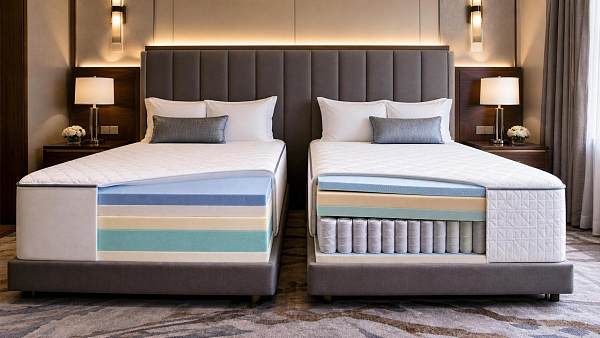
Memory foam hotel mattresses rely mainly on foam comfort layers over a foam support core. Their best-known strength is body contouring. They absorb motion well and usually create a quieter, more cushioned sleep surface.
Hybrid beds combine foam or latex comfort layers with a coil support system. That structure usually produces more bounce, stronger airflow, and better edge stability, especially in premium hospitality installations.
This difference matters because guest expectations vary. Some guests want the slow, pressure-relieving feel of memory foam hotel mattresses. Others prefer a more lifted, responsive surface that feels easier to enter and exit.
A simple comparison helps clarify where each construction tends to perform best.
So, the comparison is less about trend and more about sleep behavior. A mattress can test well in a showroom and still underperform if it mismatches actual room use.
Which option usually fits different hotel segments?
Memory foam hotel mattresses often work well in properties that want a quieter, more cocooning sleep experience. Boutique hotels, extended-stay formats, and rooms designed around relaxation often lean this way.
Hybrid beds usually suit full-service hotels, upscale business properties, and resorts with broad guest demographics. Their balanced feel tends to satisfy more sleepers without creating a highly specific comfort profile.
There is also an operational angle. Hybrid beds may perform better where guests frequently sit on the bed edge, use luggage benches less, or create higher room turnover stress.
Memory foam hotel mattresses can be a strong fit when motion reduction matters. In urban properties, for example, couples and light sleepers may rate that comfort benefit more highly than bounce or edge firmness.
A useful way to judge fit is to ask which complaint you are trying hardest to prevent. If it is partner disturbance and pressure points, foam often wins. If it is heat, sagging edges, or broad comfort neutrality, hybrids usually lead.
A quick property-fit checklist
- Choose memory foam hotel mattresses when sleep isolation, plush feel, and premium quietness matter most.
- Choose hybrids when varied guest body types, stronger edges, and cooler sleep are recurring priorities.
- Test both options in rooms with actual bedding, not only in a supplier showroom.
- Check whether the mattress height fits existing bed bases, linen specs, and accessibility expectations.
How should cost be evaluated beyond the unit price?
This is where many mattress decisions go wrong. The cheapest quotation rarely represents the lowest ownership cost. For hospitality use, replacement timing and performance consistency matter more than first-purchase savings.
Memory foam hotel mattresses can look cost-efficient upfront, especially in midscale specifications. But lower-density foam may soften faster under high occupancy, leading to earlier comfort complaints or uneven room standards.
Hybrid beds often cost more at purchase. However, their coil support can hold shape better over time, particularly in rooms with heavier use or wider guest weight variation.
More important than category is build quality. A well-made foam mattress can outperform a poorly engineered hybrid. The procurement task is to compare verified specifications, not just mattress labels.
What should be included in the real cost review?
- Foam density and layer thickness, not only firmness description.
- Coil count, coil gauge, and edge reinforcement for hybrid models.
- Warranty terms tied to body impression thresholds.
- Expected replacement cycle under actual occupancy levels.
- Freight, compression packaging limits, and installation labor.
- Local fire compliance, labeling, and hygiene barrier requirements.
In many sourcing reviews, the most reliable comparison is cost per occupied room year. That framework makes hidden durability differences much easier to see.
What quality risks are easy to miss when comparing suppliers?
The biggest mistake is buying by feel alone. A mattress can feel comfortable during a ten-minute test and still fail on resilience, odor control, or edge retention after months of commercial use.
Another common issue is incomplete specification language. Terms such as “luxury foam” or “premium hybrid” say very little unless they are backed by measurable construction data.
For memory foam hotel mattresses, watch for excessive heat retention, slow recovery that affects bed presentation, and foam densities too low for heavy turnover environments.
For hybrids, confirm noise control, coil durability, and the bonding quality between comfort layers and the spring unit. Poor assembly can create inconsistent feel across the mattress surface.
Supplier reliability matters as much as product design. Global Commercial Trade consistently highlights that commercial sourcing works best when documentation, compliance evidence, and replenishment capacity are reviewed together.
When does memory foam make more sense, and when is hybrid the safer bet?
Memory foam hotel mattresses make sense when you want a distinct sleep signature. They are especially useful when room positioning emphasizes deep rest, low motion transfer, and a soft, premium impression.
Hybrid beds are usually the safer broad-market choice. Their support profile often satisfies a larger share of guests, which reduces the risk of polarized comfort feedback after rollout.
If the property serves short-stay business travelers, mixed age groups, or high room turnover, hybrid often provides the more operationally forgiving solution.
If the brand promise centers on calm, quiet, and longer restorative sleep, memory foam hotel mattresses deserve serious consideration, provided the foam specification is commercial grade.
A balanced sourcing process usually includes three steps: shortlist by specification, test by room scenario, and validate by lifecycle cost. That sequence tends to produce better decisions than buying from comfort perception alone.
So how should the final decision be made?
Start by defining the sleep experience your rooms are meant to deliver. Then compare memory foam hotel mattresses and hybrids against actual usage conditions, not generic consumer ratings.
The better choice is the one that aligns comfort with durability, compliance, maintenance, and replenishment confidence. In other words, the mattress should fit the property model as closely as it fits the guest.
For the next step, build a short evaluation sheet covering feel, edge stability, heat management, construction data, warranty triggers, and estimated replacement timing. That will make supplier comparisons far clearer and far more defensible.
When those points are reviewed carefully, the decision between memory foam hotel mattresses and hybrid beds becomes less subjective. It becomes a practical sourcing choice tied to guest satisfaction and long-term operating value.
Search News
Hot Articles
- Outdoor RidesHow to Select Leisure Park Equipment for Safe, High-Throughput Visitor AreasOct 03, 2026
- Fashion & Gem JewelryDiamond Tester Wholesale: How to Vet Accuracy, Calibration, and MOQ Before OrderingOct 02, 2026
- Hotel Room AmenitiesHow Hotels Can Choose Amenity Bottles That Balance Brand Image and Refill CostsOct 01, 2026
Popular Tags
Need ExpertConsultation?
Connect with our specialized leisureengineering team for procurementstrategies.
Recommended News
 Oct 01, 2026How Hotels Can Choose Amenity Bottles That Balance Brand Image and Refill CostsHotel amenity bottles: learn how to balance premium brand presentation, refill costs, hygiene, durability, and efficient housekeeping workflows.● Hospitality Sourcing Dir
 Sep 25, 2026How to Evaluate a Wall-Mounted Hotel Hair Dryer Manufacturer for Bulk ProjectsHotel hair dryers wall mounted manufacturer evaluation guide: compare safety, durability, installation fit, OEM options, total cost, and reliable bulk-project support.● Hospitality Sourcing Dir
 Sep 03, 2026What Lead Times Should Buyers Expect for Custom Luxury Fixtures?What delivery lead times should I expect for custom luxury fixtures? Discover realistic 12–24 week timelines, approval milestones, freight factors, and ways to avoid costly delays.● Hospitality Sourcing Dir
 Sep 05, 2026Hotel Hair Dryers Compared: Wattage, Safety Features, and Guest-Room DurabilityHair dryer for hotels: compare wattage, thermal safety, noise, mounting, and durability to select reliable guest-room dryers that elevate comfort and reduce maintenance costs.● Hospitality Sourcing Dir
 Aug 04, 2026What to Check Before Buying Space Saving Ironing Boards Wholesale for HotelsSpace saving ironing boards wholesale for hotels: learn what to check before buying, from room fit and mounting to durability, compliance, and total installed cost.● Hospitality Sourcing Dir
 Jul 12, 2026Saudi e-SABER Label Rule Hits Hotel Amenities ExportsSaudi e-SABER label rule will reshape hotel amenities exports from August 1, 2026. Learn how SASO compliance, port clearance risks, and supplier readiness may impact shipments.● Hospitality Sourcing Dir
 Jul 11, 2026SASO Requires e-SABER Labels for Hotel AmenitiesSASO requires e-SABER labels for hotel amenities from August 1, 2026. Learn how QR code, SABER, and GCC compliance rules may impact Saudi shipments and port clearance.● Hospitality Sourcing Dir
 Jul 10, 2026Saudi SABER Update Adds GCC and Arabic Manual RuleSaudi SABER Update Adds GCC and Arabic Manual Rule: learn how the new SABER requirements affect hotel amenities certification, timelines, costs, and Saudi market access planning.● Hospitality Sourcing Dir
 Jul 03, 2026Wet and Dry Vacuum Cleaners Quiet Enough for Hotels: What Noise Level and Features Matter?Wet and dry vacuum cleaners quiet enough for hotels: compare ideal dB ranges, filtration, maneuverability, and lifecycle cost to choose cleaner, quieter machines with confidence.● Hospitality Sourcing Dir
 Jul 01, 2026How to Choose Hotel Hospitality Supplies for Different Property TypesHotel hospitality supplies buying guide for resorts, boutique, business, and economy hotels. Learn how to match supplies to property type, durability, brand image, and lifecycle value.● Hospitality Sourcing Dir
 Jun 27, 2026Memory Foam Hotel Mattresses vs Hybrid Beds: Which Option Fits Your Property?Memory foam hotel mattresses or hybrid beds? Compare comfort, durability, cooling, and lifecycle cost to find the best fit for your property and guest experience.● Hospitality Sourcing Dir
 Jun 26, 2026Hotel Desks: Types, Materials, and Layout Tips for Modern Guest RoomsHotel desks guide covering desk types, durable materials, and smart layout tips for modern guest rooms. Discover practical ideas to improve comfort, style, and space efficiency.● Hospitality Sourcing Dir
 Jun 23, 2026How to Choose Hotel Wardrobes: Materials, Storage Layout, and Durability StandardsHotel wardrobes guide: learn how to compare materials, storage layout, and durability standards to choose wardrobes that improve guest experience and reduce long-term maintenance costs.● Hospitality Sourcing Dir
 Jun 20, 2026Artificial Plants for Hotels: How to Compare Fire Ratings, Materials, and Maintenance NeedsArtificial plants for hotels: compare fire ratings, materials, and maintenance needs to choose safer, longer-lasting greenery that protects design quality and lifecycle cost.● Hospitality Sourcing Dir
 Jun 17, 2026How to Choose Hotel Hair Dryers Wall Mounted for Safety, Power, and Room TypeHotel hair dryers wall mounted buying guide: learn how to compare safety features, power levels, noise, and room-fit options to choose reliable models for every hotel segment.● Hospitality Sourcing Dir
 Jun 04, 2026Wholesale Hotel Safes Buying Guide: Lock Types, Size Options, and Installation PointsWholesale hotel safes buying guide covering lock types, size options, and installation points. Compare models, reduce procurement risk, and choose the right safe for your hotel project.● Hospitality Sourcing Dir
 May 30, 2026Is glamping furniture worth the higher project cost?Glamping furniture can justify higher project costs when it boosts bookings, durability, guest reviews, and long-term ROI. Learn where premium upgrades truly pay off.● Hospitality Sourcing Dir
 May 29, 2026Do blackout curtains for hotels Cut Energy Costs?Blackout curtains for hotels can lower HVAC costs, improve guest comfort, and boost room performance. Learn when they save energy and how to specify the right system.● Hospitality Sourcing Dir
 May 09, 2026Glamping furniture mistakes that make premium stays feel cheapGlamping furniture mistakes can make premium stays feel cheap. Learn how to choose durable, comfortable, brand-aligned pieces that elevate guest experience and protect long-term value.● Hospitality Sourcing Dir
 May 04, 2026Commercial Carpet Tiles for Hotels: What Wears Out First?Commercial carpet tiles hotel buyers: discover what wears out first in entrances, corridors, and transition zones, and learn how to specify longer-lasting, guest-ready flooring.● Hospitality Sourcing Dir
 May 04, 2026Custom Hotel Signage That Looks Premium and Stays ReadableCustom hotel signage that balances premium aesthetics with readability, durability, and compliance. Discover a practical checklist to improve guest experience and streamline hotel projects.● Hospitality Sourcing Dir
 May 04, 2026Luxury Vinyl Tile Commercial Flooring in High-Traffic AreasLuxury vinyl tile commercial flooring for high-traffic spaces: discover how to compare durability, maintenance, installation risks, and lifecycle value before you specify.● Hospitality Sourcing Dir
 May 03, 2026AC Milan’s Smart Locker Room Procurement Triggers UNI 11743 Compliance ReviewAC Milan’s smart locker room procurement triggers UNI 11743:2025 compliance review — critical for sports infrastructure suppliers, EU exporters & integrators.● Hospitality Sourcing Dir
 May 03, 2026Hotel room minibar fridges: silent operation is not enoughHotel room minibar fridges now require more than silent operation. Explore how energy efficiency, design fit, compliance, and lifecycle value shape smarter hotel sourcing.● Hospitality Sourcing Dir