How to Choose Hotel Wardrobes: Materials, Storage Layout, and Durability Standards
Choosing hotel wardrobes is not a minor furniture decision. It shapes guest convenience, room flow, housekeeping efficiency, and the long-term cost of ownership. In hospitality projects where design, durability, and sourcing discipline must work together, hotel wardrobes deserve the same level of evaluation as beds, casegoods, or bathroom fixtures.
That matters even more in a market shaped by premiumization and experience-led travel. Guests expect storage that feels intuitive, quiet, clean, and visually integrated. At the same time, operators need hotel wardrobes that withstand frequent use, resist damage, and fit commercial compliance requirements without creating avoidable maintenance issues.
From a sourcing perspective, the best choice usually comes from balancing three areas: material quality, storage layout, and durability standards. When these are assessed together, hotel wardrobes become a practical asset rather than a recurring replacement problem.
Why hotel wardrobes require a commercial mindset
Residential furniture logic does not translate well into hospitality. A hotel room may host hundreds of stays each year, with wardrobes opened, closed, loaded, cleaned, and inspected every day. What looks acceptable in a showroom can fail quickly under operational pressure.
Hotel wardrobes also sit at the intersection of guest experience and back-of-house performance. Poor layouts cause clutter. Weak hinges create noise. Fragile finishes chip at corners. Insufficient ventilation can lead to odor retention in humid climates.
This is why commercial buyers increasingly evaluate wardrobes through a wider lens. Global Commercial Trade, or GCT, reflects that broader sourcing environment by focusing on design credibility, safety compliance, and supply chain reliability across commercial sectors where user experience directly affects business value.
Materials set the baseline for performance
The material specification of hotel wardrobes influences lifespan, appearance retention, cleaning tolerance, and repair complexity. Surface beauty matters, but substrate integrity matters more over time.
Common core materials
Engineered wood panels are widely used because they support scalable production and stable dimensions. MDF can deliver a smooth finish, especially for painted surfaces, while particle board is often more economical but may perform less well in wet or impact-prone settings.
Plywood is typically stronger in screw-holding and edge durability. For hotel wardrobes in upscale or high-turnover properties, it often justifies a higher initial cost through better structural resilience.
Surface finishes and edge protection
High-pressure laminate, melamine, wood veneer, and painted finishes all serve different project goals. Laminate and melamine usually offer stronger scratch resistance and easier cleaning. Veneer delivers a premium visual effect, though it requires stricter quality control and better environmental stability.
Edges deserve close review. Many hotel wardrobes fail first at corners and exposed edges. Impact-resistant edge banding, proper adhesive bonding, and moisture-resistant sealing reduce chipping and swelling during housekeeping routines.
Moisture, fire, and emissions
In coastal resorts, humid cities, or properties with limited ventilation, moisture resistance is essential. Panels with improved humidity stability help prevent warping, odor issues, and premature delamination.
Low-emission materials also matter. E1, CARB, or equivalent formaldehyde standards may be relevant depending on destination market requirements. In some projects, fire-rated components or compliance with local flame performance regulations may also influence wardrobe selection.
Storage layout affects both guest use and room efficiency
Well-designed hotel wardrobes do more than hold clothes. They support shorter stays, extended stays, business travel, family occupancy, and branded room concepts without wasting space.
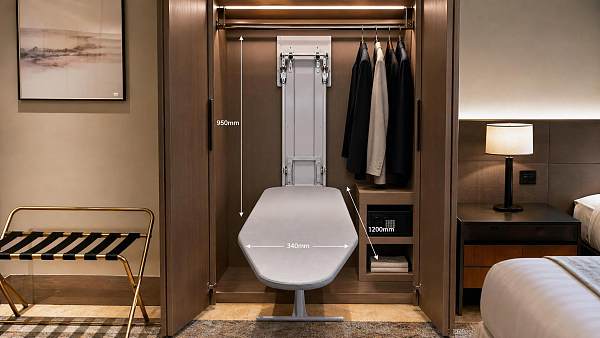
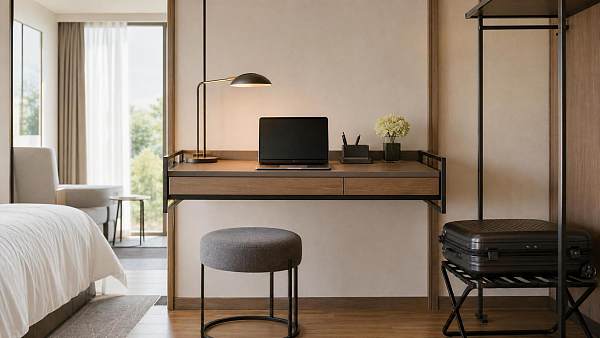
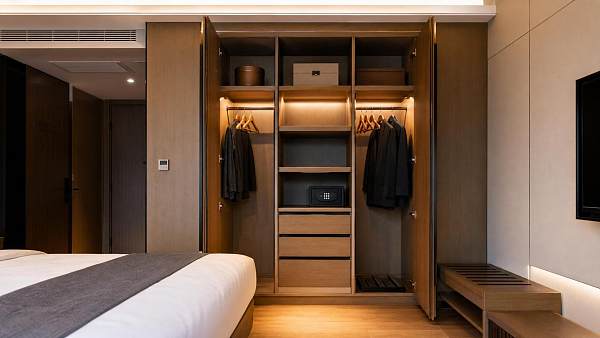
A compact city hotel may need open hanging space, a luggage bench, and a safe integrated below. A resort suite may require long-hang sections, drawers, robe storage, and concealed compartments for premium presentation. The right layout depends on room typology and guest behavior, not on catalog dimensions alone.
The most useful layout components
- Short-hang and long-hang zones for mixed garments.
- Upper shelves for infrequent storage and spare bedding.
- Drawers with smooth runners for accessories or guest essentials.
- Integrated luggage platforms that protect room circulation.
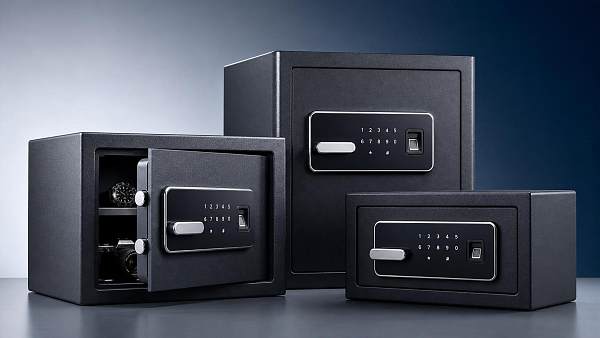
- Hidden sections for safes, minibars, or laundry bags where needed.
In actual use, access matters as much as capacity. Doors should open without blocking entries or bedside movement. Internal lighting may improve usability in higher-end projects, but it should be easy to maintain and safe for commercial installation.
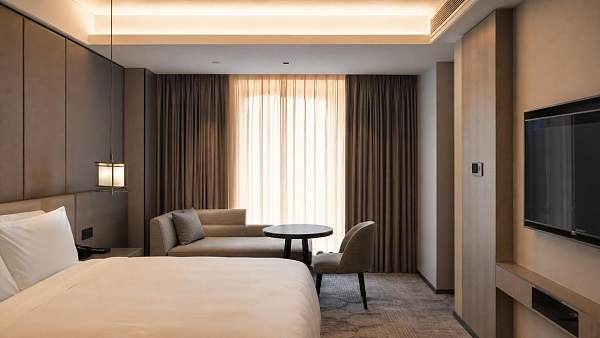
Open wardrobes have become more common in lifestyle hotels because they make smaller rooms feel less enclosed. Still, they expose stored items to dust and visual disorder. Closed hotel wardrobes often remain the better fit for full-service properties and longer-stay formats.
Durability standards are where cost control becomes visible
The price of hotel wardrobes should never be judged by unit cost alone. The real comparison includes lifecycle stability, spare part access, installation accuracy, and how quickly visible wear appears after opening.
Hardware is one of the clearest indicators. Hinges, drawer slides, handles, hanging rails, and connectors should be tested for repeated cycles and commercial loading. Soft-close features are useful, but only when they are backed by proven hardware quality rather than decorative marketing claims.
Joinery details also matter. Loose cam fittings, weak anchors, and poor screw alignment often create field failures that are expensive to fix after guestroom installation. Hotel wardrobes should arrive with consistent tolerances, clear assembly logic, and packaging that protects finished edges during transport.
Questions worth raising during evaluation
- What cycle testing has been completed for doors and drawers?
- How are corners protected during shipment and site handling?
- Can replacement hardware be supplied across multiple project phases?
- How does the finish respond to cleaning chemicals and abrasion?
- Are mock-up units available for inspection before mass production?
Matching wardrobe choices to hotel segment and project type
Not all hotel wardrobes should be specified the same way. A luxury urban brand, an airport hotel, and a serviced apartment property operate with different expectations, turnover patterns, and budget structures.
In upscale projects, finish alignment, integrated lighting, veneer consistency, and quiet hardware often carry more weight. In midscale properties, durable laminate surfaces and efficient internal zoning may create better value. For extended-stay rooms, drawer count, shelf depth, and laundry-related storage become more important than purely decorative detailing.
Renovation projects introduce another layer. Existing wall conditions, MEP coordination, and site access may limit wardrobe size or assembly method. In those cases, modular hotel wardrobes can reduce installation friction, provided the joints remain stable and visually clean.
Sourcing signals that help separate reliable suppliers from risky ones
Specification sheets alone do not reveal whether hotel wardrobes will perform well after handover. Strong sourcing decisions usually combine technical review with supplier capability checks.
This is where platforms such as GCT add value. In complex commercial categories, buyers increasingly need verified insight into OEM and ODM capability, quality consistency, compliance awareness, and export readiness, not just attractive product images.
- Review project references in comparable hotel segments.
- Check whether samples match mass-production tolerances.
- Confirm documentation for emissions, fire, and hardware testing.
- Assess lead times for repeat orders and phased openings.
- Clarify who manages installation guidance and after-sales issues.
More broadly, reliable hotel wardrobes come from suppliers that understand hospitality operations, not only furniture manufacturing. That distinction often becomes visible in prototype quality, packing discipline, and the ability to refine layouts around real room constraints.
A practical way to move from options to decision
A useful evaluation process begins with room type mapping. Then compare hotel wardrobes by storage function, material risk, hardware grade, compliance needs, and installation method. Mock-ups should be reviewed under realistic conditions, including opening force, finish touchpoints, and luggage interaction.
It also helps to define non-negotiable standards before quotations are compared. That may include moisture-resistant board in specific climates, minimum hinge cycle performance, low-emission certification, or edge protection thickness. Without those benchmarks, low prices can hide future replacement costs.
When hotel wardrobes are assessed with that level of discipline, the selection becomes clearer. The strongest option is usually the one that fits the room concept, protects operational efficiency, and stays visually consistent after thousands of guest interactions. The next step is to turn those priorities into a shortlist, request detailed samples, and evaluate each proposal against real use conditions rather than catalog appeal alone.
Search News
Hot Articles
- Stationery & UniformsHow Schools Can Cut Printing Costs When Buying Ink Cartridges in BulkSep 21, 2026
- Jewelry Packaging & DisplayHow to Evaluate a Luxury Retail Packaging Supplier for Premium Brand ConsistencySep 20, 2026
- Commercial KitchenHow to Select a Spiral Dough Mixer for Bakery Batch Size and Dough HydrationSep 19, 2026
Popular Tags
Need ExpertConsultation?
Connect with our specialized leisureengineering team for procurementstrategies.
Recommended News
 Sep 03, 2026What Lead Times Should Buyers Expect for Custom Luxury Fixtures?What delivery lead times should I expect for custom luxury fixtures? Discover realistic 12–24 week timelines, approval milestones, freight factors, and ways to avoid costly delays.● Hospitality Sourcing Dir
 Sep 05, 2026Hotel Hair Dryers Compared: Wattage, Safety Features, and Guest-Room DurabilityHair dryer for hotels: compare wattage, thermal safety, noise, mounting, and durability to select reliable guest-room dryers that elevate comfort and reduce maintenance costs.● Hospitality Sourcing Dir
 Aug 04, 2026What to Check Before Buying Space Saving Ironing Boards Wholesale for HotelsSpace saving ironing boards wholesale for hotels: learn what to check before buying, from room fit and mounting to durability, compliance, and total installed cost.● Hospitality Sourcing Dir
 Jul 12, 2026Saudi e-SABER Label Rule Hits Hotel Amenities ExportsSaudi e-SABER label rule will reshape hotel amenities exports from August 1, 2026. Learn how SASO compliance, port clearance risks, and supplier readiness may impact shipments.● Hospitality Sourcing Dir
 Jul 11, 2026SASO Requires e-SABER Labels for Hotel AmenitiesSASO requires e-SABER labels for hotel amenities from August 1, 2026. Learn how QR code, SABER, and GCC compliance rules may impact Saudi shipments and port clearance.● Hospitality Sourcing Dir
 Jul 10, 2026Saudi SABER Update Adds GCC and Arabic Manual RuleSaudi SABER Update Adds GCC and Arabic Manual Rule: learn how the new SABER requirements affect hotel amenities certification, timelines, costs, and Saudi market access planning.● Hospitality Sourcing Dir
 Jul 03, 2026Wet and Dry Vacuum Cleaners Quiet Enough for Hotels: What Noise Level and Features Matter?Wet and dry vacuum cleaners quiet enough for hotels: compare ideal dB ranges, filtration, maneuverability, and lifecycle cost to choose cleaner, quieter machines with confidence.● Hospitality Sourcing Dir
 Jul 01, 2026How to Choose Hotel Hospitality Supplies for Different Property TypesHotel hospitality supplies buying guide for resorts, boutique, business, and economy hotels. Learn how to match supplies to property type, durability, brand image, and lifecycle value.● Hospitality Sourcing Dir
 Jun 27, 2026Memory Foam Hotel Mattresses vs Hybrid Beds: Which Option Fits Your Property?Memory foam hotel mattresses or hybrid beds? Compare comfort, durability, cooling, and lifecycle cost to find the best fit for your property and guest experience.● Hospitality Sourcing Dir
 Jun 26, 2026Hotel Desks: Types, Materials, and Layout Tips for Modern Guest RoomsHotel desks guide covering desk types, durable materials, and smart layout tips for modern guest rooms. Discover practical ideas to improve comfort, style, and space efficiency.● Hospitality Sourcing Dir
 Jun 23, 2026How to Choose Hotel Wardrobes: Materials, Storage Layout, and Durability StandardsHotel wardrobes guide: learn how to compare materials, storage layout, and durability standards to choose wardrobes that improve guest experience and reduce long-term maintenance costs.● Hospitality Sourcing Dir
 Jun 20, 2026Artificial Plants for Hotels: How to Compare Fire Ratings, Materials, and Maintenance NeedsArtificial plants for hotels: compare fire ratings, materials, and maintenance needs to choose safer, longer-lasting greenery that protects design quality and lifecycle cost.● Hospitality Sourcing Dir
 Jun 17, 2026How to Choose Hotel Hair Dryers Wall Mounted for Safety, Power, and Room TypeHotel hair dryers wall mounted buying guide: learn how to compare safety features, power levels, noise, and room-fit options to choose reliable models for every hotel segment.● Hospitality Sourcing Dir
 Jun 04, 2026Wholesale Hotel Safes Buying Guide: Lock Types, Size Options, and Installation PointsWholesale hotel safes buying guide covering lock types, size options, and installation points. Compare models, reduce procurement risk, and choose the right safe for your hotel project.● Hospitality Sourcing Dir
 May 30, 2026Is glamping furniture worth the higher project cost?Glamping furniture can justify higher project costs when it boosts bookings, durability, guest reviews, and long-term ROI. Learn where premium upgrades truly pay off.● Hospitality Sourcing Dir
 May 29, 2026Do blackout curtains for hotels Cut Energy Costs?Blackout curtains for hotels can lower HVAC costs, improve guest comfort, and boost room performance. Learn when they save energy and how to specify the right system.● Hospitality Sourcing Dir
 May 09, 2026Glamping furniture mistakes that make premium stays feel cheapGlamping furniture mistakes can make premium stays feel cheap. Learn how to choose durable, comfortable, brand-aligned pieces that elevate guest experience and protect long-term value.● Hospitality Sourcing Dir
 May 04, 2026Commercial Carpet Tiles for Hotels: What Wears Out First?Commercial carpet tiles hotel buyers: discover what wears out first in entrances, corridors, and transition zones, and learn how to specify longer-lasting, guest-ready flooring.● Hospitality Sourcing Dir
 May 04, 2026Custom Hotel Signage That Looks Premium and Stays ReadableCustom hotel signage that balances premium aesthetics with readability, durability, and compliance. Discover a practical checklist to improve guest experience and streamline hotel projects.● Hospitality Sourcing Dir
 May 04, 2026Luxury Vinyl Tile Commercial Flooring in High-Traffic AreasLuxury vinyl tile commercial flooring for high-traffic spaces: discover how to compare durability, maintenance, installation risks, and lifecycle value before you specify.● Hospitality Sourcing Dir
 May 03, 2026AC Milan’s Smart Locker Room Procurement Triggers UNI 11743 Compliance ReviewAC Milan’s smart locker room procurement triggers UNI 11743:2025 compliance review — critical for sports infrastructure suppliers, EU exporters & integrators.● Hospitality Sourcing Dir
 May 03, 2026Hotel room minibar fridges: silent operation is not enoughHotel room minibar fridges now require more than silent operation. Explore how energy efficiency, design fit, compliance, and lifecycle value shape smarter hotel sourcing.● Hospitality Sourcing Dir
 May 03, 2026HVAC systems for hotels: poor zoning raises energy bills quietlyHVAC systems for hotels can silently inflate energy bills when zoning is weak. Learn how smarter controls cut costs, improve guest comfort, and protect long-term hotel asset value.● Hospitality Sourcing Dir
 May 03, 2026Wooden coat hangers hotel projects should not overlook finish qualityWooden coat hangers hotel buyers should not ignore finish quality. Learn how smoothness, coating safety, and color consistency reduce complaints, protect brand image, and lower replacement costs.● Hospitality Sourcing Dir