Hotel Hair Dryers Compared: Wattage, Safety Features, and Guest-Room Durability
Room dryers should be specified as commercial electrical appliances with a defined duty cycle, service path, and installation context. A low unit price can disappear quickly when a model overheats in enclosed drawers, produces repeated guest complaints, or requires whole-unit replacement after a damaged cord. The practical comparison starts with wattage, then moves to thermal protection, electrical configuration, mounting method, housing materials, and the parts most likely to fail under frequent handling.
A suitable hair dryer for hotels needs to perform consistently across varied hair types without creating excessive bathroom noise or placing unreasonable load on the room electrical circuit. The specification should also match the property type. A compact urban room, resort villa, airport hotel, and extended-stay suite can require different power, cord, storage, and visual presentation decisions.
Wattage Is a Performance Indicator, Not a Stand-Alone Requirement
Wattage describes the electrical power a dryer draws, usually expressed in watts, but it does not fully predict drying speed. Airflow design, heater construction, fan efficiency, nozzle geometry, and heat-control settings all affect the result. Two dryers with a similar wattage rating may feel noticeably different in use if one has a weak motor, restricted air path, or poorly managed heat output.
For guest-room applications, moderate-to-high wattage is commonly considered where the local circuit capacity permits it. Higher output can shorten drying time, which is helpful when guests expect salon-like performance. Yet maximum wattage can also increase surface temperature, operating noise, energy draw, and the chance of nuisance trips when other bathroom loads are active. A property with limited electrical capacity should confirm the simultaneous load from lighting, heated mirrors, shaver outlets, ventilation, and any other connected equipment before standardizing a dryer rating.
Specify the rated voltage and frequency for the destination market rather than assuming a single model can be deployed everywhere. A dryer designed for one voltage system may be unsafe or ineffective on another. Plug geometry, socket rating, grounding arrangement, and cord length should be reviewed at the same time. Adapters are a poor substitute for a properly matched electrical configuration in permanent guest-room use.
Air speed and temperature should be evaluated together. A model that relies on very high heat with modest airflow can dry hair but may make the outlet grille, nozzle, and surrounding housing uncomfortably hot. Better-balanced units move sufficient air while maintaining controlled heat. Where samples are available, a practical test should include a full operating cycle, repeated on-off cycles, and operation after the air inlet has collected light lint. This reveals performance changes that a short showroom demonstration may not expose.
Safety Features That Need Clear Evidence
Safety claims should be tied to documented construction and testing appropriate to the intended market. Labels on a retail carton are not enough. The technical file should identify the applicable electrical safety standard, rated input, insulation class where relevant, protection features, and any approved plug or leakage-protection arrangement. Local regulatory requirements vary, so the installation country determines which documentation and markings need review.
Overheat protection is fundamental. A thermal cutoff or thermal fuse is intended to interrupt power when internal temperature exceeds a design threshold. This feature is particularly relevant when an inlet becomes blocked by dust, hair, tissue, or a towel. A thermostat may cycle the heater during normal operation, while a non-resettable thermal fuse can act as a final safeguard in an abnormal overtemperature event. The exact function should be distinguished in the specification; “thermal protection” alone is too vague.
Bathroom installation increases the importance of leakage-current protection. Depending on the electrical system and local rules, this may involve a safety plug with an integrated protective device, a protected outlet, or protection at the circuit level. The selected approach should be coordinated with the room electrical design. A plug-mounted device may add bulk and alter the wall-holder layout, while circuit-level protection depends on the condition and configuration of the building installation.
Other details deserve physical inspection:
- Air-inlet guarding: The grille should resist accidental finger access while allowing enough open area to avoid starving the motor of air. Fine mesh can reduce hair ingress, but it also needs cleaning access.
- Cool-shot or low-heat setting: A distinct low-heat option provides a less aggressive setting for heat-sensitive use and can reduce prolonged high-temperature operation.
- Switch construction: Controls should remain positive and easy to operate with dry hands. Loose sliders, shallow switch travel, or labels that rub away create avoidable service calls.
- Strain relief: The point where the cable enters the handle or wall unit should flex without exposing conductor insulation. This is one of the most important inspection points in repeated-use environments.
Do not treat an automatic shutoff feature as a replacement for thermal design or correct installation. Some dryers may stop after a stated period, which can reduce unnecessary run time, but it does not resolve blocked airflow, damaged cords, unsuitable voltage, or poor storage conditions.
Durability Begins With the Parts That Are Handled
Guest-room durability is less about a heavy-looking shell than the combined strength of the handle, cord entry, switch assembly, hanging system, inlet grille, and mounting bracket. External housings are often made from engineering plastics that can provide good heat resistance and impact performance when the wall sections, ribs, and fasteners are properly designed. A glossy finish may look refined on arrival but can make scratches, hairline cracks, and cleaning residue more visible over time. Matte or lightly textured surfaces often conceal minor wear better, provided they can still be wiped clean.
The cord deserves a separate decision. A retractable cord can create a neat appearance but introduces a winding mechanism that may not suit intensive use. A fixed coiled cable can reduce tangling and limit floor contact, although it must extend comfortably from its holder without pulling on the connection point. Straight cables are simple and familiar but can be left across wet vanity surfaces or become caught in drawer hardware. Cable length should be measured from the actual installed position to the likely drying area, not from a drawing alone.
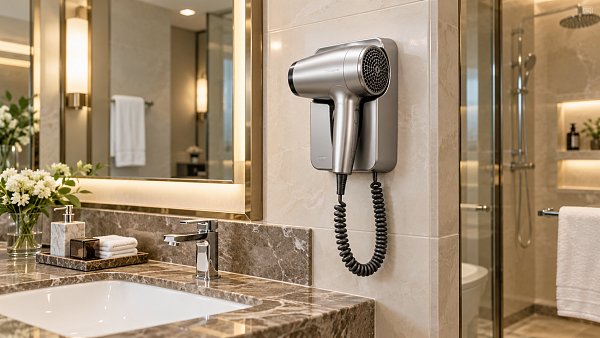
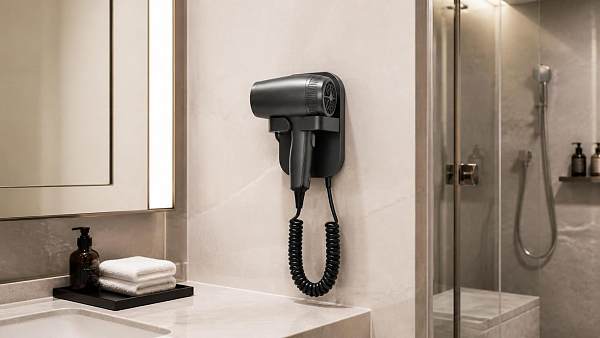
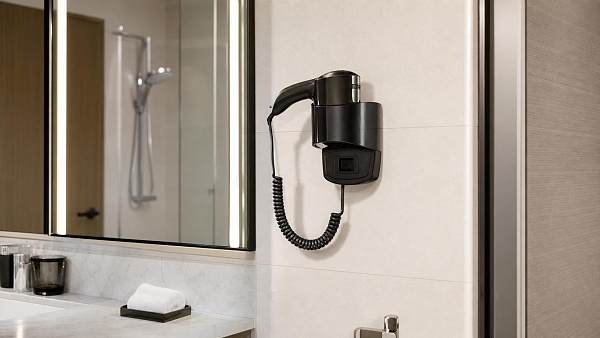
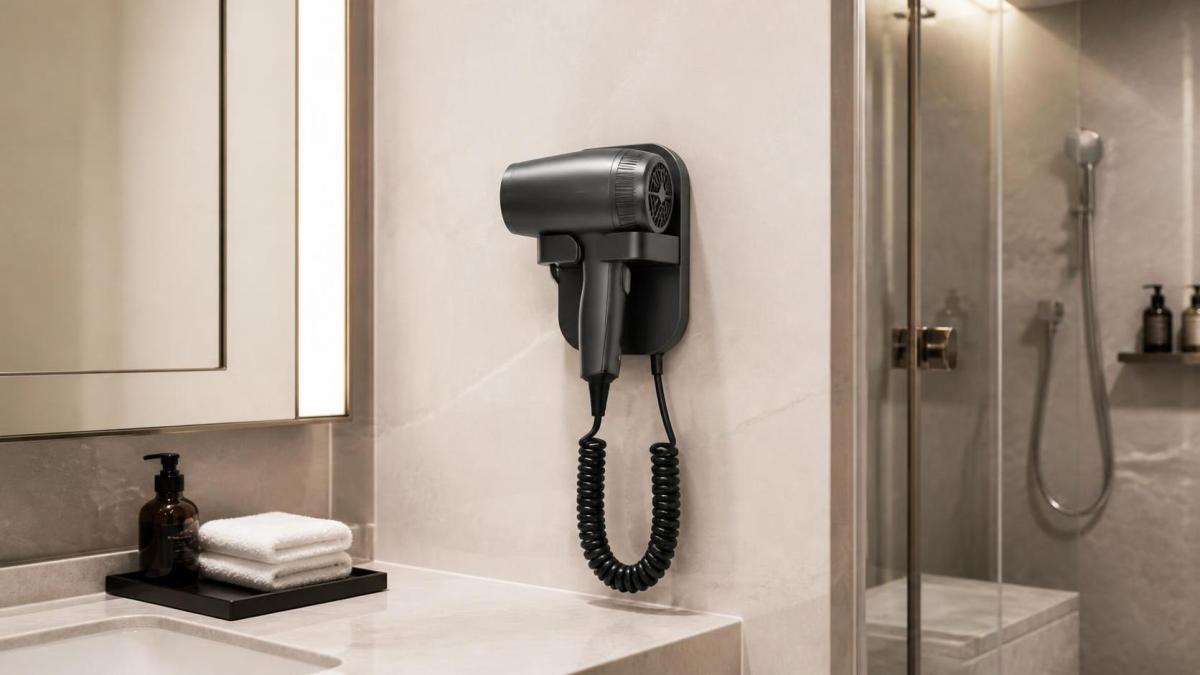
Wall-mounted units reduce disappearance and simplify room presentation, especially where the dryer remains permanently attached to a base. Their weak point is usually the bracket-to-wall connection, not the dryer motor. Fixing screws need to match the substrate behind the finished wall. Tile, plasterboard, stone, wood backing, and composite panels each require an appropriate fastening method. A screw anchored only into a weak surface layer can loosen, crack the finish, or leave the unit hanging at an angle.
Handheld dryers stored loose in a drawer or bag provide more flexibility and may better suit certain room designs. They also experience drops, cable pinching, and routine relocation during housekeeping. If loose placement is selected, confirm that the storage cavity allows air to circulate after use and that the dryer can cool before being enclosed. Repeatedly storing a warm appliance against plastic liners, towels, or tightly packed amenities increases avoidable wear.
Noise, Guest Perception, and Room Layout
Noise is produced by the motor, fan turbulence, vibration through the housing, and reflected sound from hard bathroom surfaces. A dryer that seems acceptable in an open sample room can sound much louder inside a tiled bathroom. Motor pitch also matters. High-frequency whine tends to be more noticeable than a lower, steadier airflow sound, even when a simple sound reading appears similar.
Where quiet rooms are part of the intended experience, evaluate samples in a comparable space. Listen with the dryer held normally, placed back on its mount, and operated near a mirror or vanity. A loose wall bracket can transmit vibration into panels. The sound of a rattling holder is often interpreted as poor maintenance, regardless of the dryer’s actual motor quality.
Visual integration should not compromise access. The mounting position should permit a clear grip, allow the cord to hang without pressing against sharp fittings, and keep the appliance away from splash-prone zones. Placement needs to align with the vanity mirror, outlet location, cable reach, and cleaning routine. A holder hidden behind a door may protect the visual scheme but can be awkward to access and easy to strike when the door opens.
Compare Samples Through Repeated, Relevant Tests
A sample review is strongest when it reproduces the room conditions that will affect performance. Record the model number, voltage, plug type, cable length, supplied accessories, mount dimensions, and stated service terms for every unit under review. Small configuration changes can occur between samples and production orders, so photographs and retained reference samples are useful when the final specification is confirmed.
Run each unit through repeated switching and several continuous operating periods, allowing appropriate cooling intervals. Observe whether the housing becomes excessively hot at the handle, whether the airflow weakens, and whether hot-plastic odor appears after warm-up. Inspect the inlet afterwards for lint accumulation and assess whether it can be cleaned without opening the appliance. A removable rear filter may simplify maintenance, but only if it stays securely attached and is not difficult to refit.
Drop resistance should be considered carefully rather than improvised recklessly. The relevant concern is whether the housing, rear grille, control switch, and cord entry withstand the minor impacts likely during normal room turnover. The goal is not to turn a room dryer into an industrial tool; it is to identify brittle parts, rattling internal components, and covers that detach too easily.
Serviceability changes the long-term cost profile. In some installations, a replaceable wall base, cord assembly, filter, or mounting plate can limit disruption after minor damage. In others, sealed construction is preferable because it reduces tampering and preserves electrical integrity. Either approach can be appropriate, provided replacement parts, assembly drawings, and warranty handling are clear before deployment.
Specification Details Often Missed Before Installation
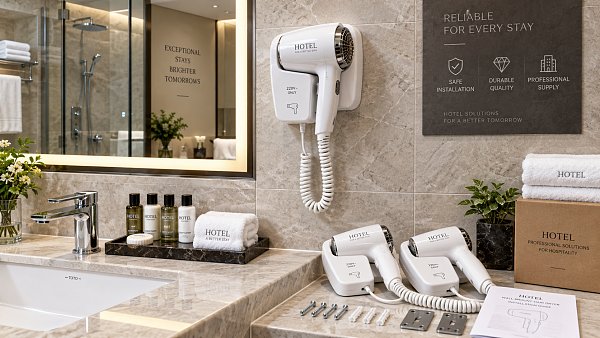
Carton dimensions, gross weight, and inner-pack quantity affect receiving, room-by-room distribution, and spare stock storage. Wall-mounted versions should include a drilling template, fasteners, clear installation instructions, and confirmation of whether the holder is supplied separately or integrated with the dryer. Missing brackets and incompatible fasteners can stall room readiness even when the appliance itself has arrived on site.
Finish consistency matters when dryers are visible. Confirm the approved color reference, logo treatment if any, surface gloss, and material texture against the bathroom palette. If a branded mark is required, its placement should not interfere with safety labels, ventilation openings, or cleaning. Decorative metallic coatings should also be evaluated for resistance to common bathroom cleaning agents; some finishes can dull or peel when exposed to unsuitable chemicals.
Set an acceptance process that separates cosmetic inspection from electrical verification. Incoming checks can confirm correct model, plug, color, cable condition, accessory count, packaging integrity, and mounting hardware. Functional sampling should include switch operation, airflow, abnormal noise, and protective-device behavior where applicable. Units with damaged cords, loose housings, cracked holders, or inconsistent labels should be isolated before room distribution rather than repaired informally on site.
A balanced dryer specification leaves room for the property’s actual operating conditions. Fast drying has value, but only when heat control, acoustic comfort, electrical compatibility, cleaning access, and mechanical life support it. The better choice is usually the model whose documented configuration can be installed correctly, inspected consistently, and kept presentable through repeated room turnover.
Search News
Hot Articles
- Outdoor RidesEnergylandia Announces Rokan, Set to Be Europe’s Tallest and Longest B&M Wing CoasterOct 20, 2026
- Musical InstrumentsChoosing a Classical Guitar Manufacturer in China: Quality Checks Before OrderingOct 20, 2026
- Stationery & UniformsChoosing a Wholesale Chef Coat Supplier: MOQs, Samples, and Lead TimesOct 19, 2026
Popular Tags
Need ExpertConsultation?
Connect with our specialized leisureengineering team for procurementstrategies.
Recommended News
 Oct 05, 2026How to Select Hotel Hair Dryers That Balance Guest Safety, Durability, and CostHair dryer for hotels: learn how to select safe, durable, cost-efficient models with the right certifications, performance, maintenance, and supplier support.● Hospitality Sourcing Dir
 Oct 01, 2026How Hotels Can Choose Amenity Bottles That Balance Brand Image and Refill CostsHotel amenity bottles: learn how to balance premium brand presentation, refill costs, hygiene, durability, and efficient housekeeping workflows.● Hospitality Sourcing Dir
 Sep 25, 2026How to Evaluate a Wall-Mounted Hotel Hair Dryer Manufacturer for Bulk ProjectsHotel hair dryers wall mounted manufacturer evaluation guide: compare safety, durability, installation fit, OEM options, total cost, and reliable bulk-project support.● Hospitality Sourcing Dir
 Sep 03, 2026What Lead Times Should Buyers Expect for Custom Luxury Fixtures?What delivery lead times should I expect for custom luxury fixtures? Discover realistic 12–24 week timelines, approval milestones, freight factors, and ways to avoid costly delays.● Hospitality Sourcing Dir
 Sep 05, 2026Hotel Hair Dryers Compared: Wattage, Safety Features, and Guest-Room DurabilityHair dryer for hotels: compare wattage, thermal safety, noise, mounting, and durability to select reliable guest-room dryers that elevate comfort and reduce maintenance costs.● Hospitality Sourcing Dir
 Aug 04, 2026What to Check Before Buying Space Saving Ironing Boards Wholesale for HotelsSpace saving ironing boards wholesale for hotels: learn what to check before buying, from room fit and mounting to durability, compliance, and total installed cost.● Hospitality Sourcing Dir
 Jul 12, 2026Saudi e-SABER Label Rule Hits Hotel Amenities ExportsSaudi e-SABER label rule will reshape hotel amenities exports from August 1, 2026. Learn how SASO compliance, port clearance risks, and supplier readiness may impact shipments.● Hospitality Sourcing Dir
 Jul 11, 2026SASO Requires e-SABER Labels for Hotel AmenitiesSASO requires e-SABER labels for hotel amenities from August 1, 2026. Learn how QR code, SABER, and GCC compliance rules may impact Saudi shipments and port clearance.● Hospitality Sourcing Dir
 Jul 10, 2026Saudi SABER Update Adds GCC and Arabic Manual RuleSaudi SABER Update Adds GCC and Arabic Manual Rule: learn how the new SABER requirements affect hotel amenities certification, timelines, costs, and Saudi market access planning.● Hospitality Sourcing Dir
 Jul 03, 2026Wet and Dry Vacuum Cleaners Quiet Enough for Hotels: What Noise Level and Features Matter?Wet and dry vacuum cleaners quiet enough for hotels: compare ideal dB ranges, filtration, maneuverability, and lifecycle cost to choose cleaner, quieter machines with confidence.● Hospitality Sourcing Dir
 Jul 01, 2026How to Choose Hotel Hospitality Supplies for Different Property TypesHotel hospitality supplies buying guide for resorts, boutique, business, and economy hotels. Learn how to match supplies to property type, durability, brand image, and lifecycle value.● Hospitality Sourcing Dir
 Jun 27, 2026Memory Foam Hotel Mattresses vs Hybrid Beds: Which Option Fits Your Property?Memory foam hotel mattresses or hybrid beds? Compare comfort, durability, cooling, and lifecycle cost to find the best fit for your property and guest experience.● Hospitality Sourcing Dir
 Jun 26, 2026Hotel Desks: Types, Materials, and Layout Tips for Modern Guest RoomsHotel desks guide covering desk types, durable materials, and smart layout tips for modern guest rooms. Discover practical ideas to improve comfort, style, and space efficiency.● Hospitality Sourcing Dir
 Jun 23, 2026How to Choose Hotel Wardrobes: Materials, Storage Layout, and Durability StandardsHotel wardrobes guide: learn how to compare materials, storage layout, and durability standards to choose wardrobes that improve guest experience and reduce long-term maintenance costs.● Hospitality Sourcing Dir
 Jun 20, 2026Artificial Plants for Hotels: How to Compare Fire Ratings, Materials, and Maintenance NeedsArtificial plants for hotels: compare fire ratings, materials, and maintenance needs to choose safer, longer-lasting greenery that protects design quality and lifecycle cost.● Hospitality Sourcing Dir
 Jun 17, 2026How to Choose Hotel Hair Dryers Wall Mounted for Safety, Power, and Room TypeHotel hair dryers wall mounted buying guide: learn how to compare safety features, power levels, noise, and room-fit options to choose reliable models for every hotel segment.● Hospitality Sourcing Dir
 Jun 04, 2026Wholesale Hotel Safes Buying Guide: Lock Types, Size Options, and Installation PointsWholesale hotel safes buying guide covering lock types, size options, and installation points. Compare models, reduce procurement risk, and choose the right safe for your hotel project.● Hospitality Sourcing Dir
 May 30, 2026Is glamping furniture worth the higher project cost?Glamping furniture can justify higher project costs when it boosts bookings, durability, guest reviews, and long-term ROI. Learn where premium upgrades truly pay off.● Hospitality Sourcing Dir
 May 29, 2026Do blackout curtains for hotels Cut Energy Costs?Blackout curtains for hotels can lower HVAC costs, improve guest comfort, and boost room performance. Learn when they save energy and how to specify the right system.● Hospitality Sourcing Dir
 May 09, 2026Glamping furniture mistakes that make premium stays feel cheapGlamping furniture mistakes can make premium stays feel cheap. Learn how to choose durable, comfortable, brand-aligned pieces that elevate guest experience and protect long-term value.● Hospitality Sourcing Dir
 May 04, 2026Commercial Carpet Tiles for Hotels: What Wears Out First?Commercial carpet tiles hotel buyers: discover what wears out first in entrances, corridors, and transition zones, and learn how to specify longer-lasting, guest-ready flooring.● Hospitality Sourcing Dir
 May 04, 2026Custom Hotel Signage That Looks Premium and Stays ReadableCustom hotel signage that balances premium aesthetics with readability, durability, and compliance. Discover a practical checklist to improve guest experience and streamline hotel projects.● Hospitality Sourcing Dir
 May 04, 2026Luxury Vinyl Tile Commercial Flooring in High-Traffic AreasLuxury vinyl tile commercial flooring for high-traffic spaces: discover how to compare durability, maintenance, installation risks, and lifecycle value before you specify.● Hospitality Sourcing Dir
 May 03, 2026AC Milan’s Smart Locker Room Procurement Triggers UNI 11743 Compliance ReviewAC Milan’s smart locker room procurement triggers UNI 11743:2025 compliance review — critical for sports infrastructure suppliers, EU exporters & integrators.● Hospitality Sourcing Dir