B2B Office Supplies Procurement: Building a Cost-Controlled Replenishment Program
B2B Office Supplies Procurement: Building a Cost-Controlled Replenishment Program
Effective B2B office supplies procurement is no longer about chasing the lowest unit price. Procurement teams need a replenishment program that protects service levels while controlling total cost.
The strongest programs combine demand forecasting, standardized specifications, supplier performance management, and location-level inventory visibility. Together, these controls reduce emergency purchases, excess stock, administrative effort, and avoidable waste.
For multi-site businesses, office supplies can appear insignificant beside major categories. Yet frequent, fragmented purchases often create material budget leakage and frustration for employees and finance teams.
A cost-controlled program does not mean restricting access to necessary items. It means establishing clear rules for what employees buy, when they buy it, from whom, and at what service level.
This guide helps procurement professionals build a practical B2B office supplies framework that supports daily operations without allowing low-value transactions to become an unmanaged cost center.
Start With Total Cost, Not the Catalog Price
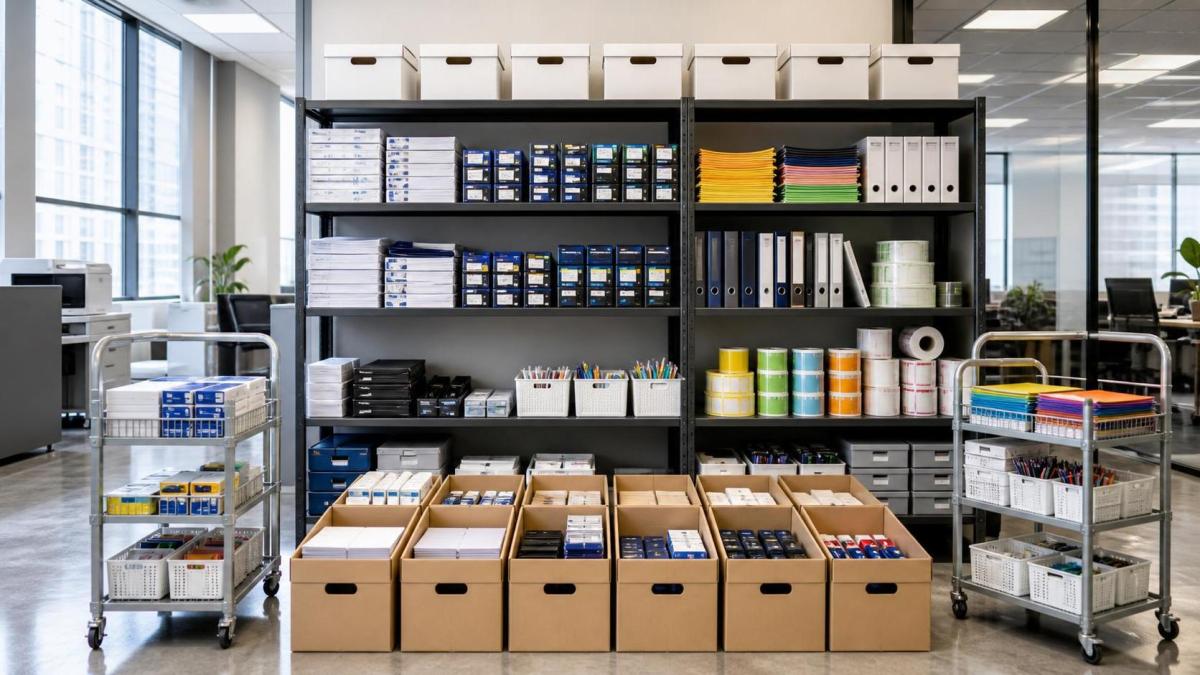
The visible price of paper, toner, pens, labels, and desk accessories is only one part of the cost. Procurement teams should measure the full cost of obtaining and managing each item.
Total cost includes purchase price, freight, delivery frequency, invoice processing, employee time, storage, stockouts, returns, and disposal. A low-priced product can become expensive when these factors are ignored.
For example, a cheaper toner cartridge may create higher costs if failure rates interrupt printing, replacements arrive slowly, or staff must repeatedly submit exception requests. Reliability has measurable operational value.
Begin by reviewing twelve months of spend data. Group purchases by item type, supplier, buyer, location, order value, delivery charge, and purchase channel to identify where costs actually accumulate.
Look especially for purchases below an internal order threshold. Small orders often carry disproportionately high transaction costs because approvals, receiving, invoicing, and payment processing remain largely unchanged.
Also identify non-contract spending. When departments buy common products from retail websites, local stores, or unauthorized vendors, negotiated pricing and procurement controls become difficult to enforce.
Do not assume all variation is wasteful. Different offices may have genuine operational needs, such as secure document handling, presentation materials, archival storage, accessibility requirements, or specialized educational equipment.
The objective is to distinguish justified demand from unmanaged preference. That distinction allows procurement to standardize routine items while preserving an approval path for legitimate exceptions.
Create a category baseline with four measures: annual spend, number of orders, active stock-keeping units, and supplier count. These metrics reveal whether complexity, rather than volume, is driving cost.
A practical baseline also records service outcomes. Track stockout incidents, emergency deliveries, order cycle time, return rates, and internal complaints before introducing changes to the replenishment process.
Design a Demand Model That Reflects How Offices Actually Consume Supplies
Forecasting office supplies demand does not require perfect prediction. It requires a repeatable method for estimating normal consumption, recognizing seasonal changes, and responding before shortages disrupt work.
Start with high-frequency and high-value items. Typical priorities include copier paper, printer consumables, envelopes, cleaning-related desk supplies, shipping labels, notebooks, writing instruments, and packaging materials.
Calculate average monthly usage by location, but avoid relying only on a company-wide average. A sales office, training center, administrative headquarters, and hybrid workplace can consume products very differently.
Adjust historic consumption for known changes. Office openings, relocations, headcount shifts, major training events, procurement policy changes, and reduced print volumes can quickly make past data misleading.
Separate stable demand from event-driven demand. Stable items can be replenished through fixed cycles, while event materials should be purchased against approved project plans or scheduled operational calendars.
For regularly consumed items, define a reorder point. This should reflect expected demand during supplier lead time, plus a sensible safety-stock allowance for delivery delays or usage variation.
A simple formula is useful: reorder point equals average weekly demand multiplied by lead time, plus safety stock. The calculation is basic, but its assumptions should be reviewed quarterly.
Safety stock should not be a universal percentage. Products with reliable local supply may need little buffer, while mission-critical or long-lead items may justify a larger inventory position.
For multi-location B2B office supplies programs, classify sites by consumption profile. Large sites may receive bulk deliveries, while smaller offices may benefit from consolidated scheduled replenishment or managed inventory services.
Forecasting must also account for substitution. If approved alternatives exist for noncritical items, procurement can reduce the amount of safety stock required without exposing employees to unnecessary shortages.
Demand data becomes more reliable when consumption is captured at the point of issue. Cabinet logs, vending systems, stockroom scans, and digital requisition records are more useful than annual purchase totals alone.
Standardize the Core Basket Without Creating User Resistance
Standardization is one of the most effective ways to control cost, but an oversized mandated catalog can encourage users to bypass procurement channels. The core basket must remain practical.
Build the core basket around items that represent frequent demand, predictable specifications, and low differentiation. These usually include common paper formats, basic writing tools, folders, labels, and desk organization products.
For each standard item, establish a clear specification. Define dimensions, color, recycled-content requirements, performance expectations, compatible equipment models, packaging format, and any necessary safety or compliance standards.
Specifications should describe functional outcomes rather than brand names whenever possible. This expands sourcing options, improves negotiation leverage, and reduces supply risk when a preferred item becomes unavailable.
However, avoid false standardization. Printer cartridges, ergonomic accessories, archival products, and security-sensitive materials may require tightly controlled product selection because compatibility or compliance failures are costly.
Use a tiered catalog structure. Tier one contains mandatory standard items, tier two contains approved alternatives, and tier three contains restricted products that require documented business justification.
This structure gives employees reasonable choice while making cost-conscious decisions easy. A well-designed catalog should guide users toward preferred products rather than relying only on policy enforcement.
Rationalize duplicate stock-keeping units carefully. If five similar notebooks meet the same need, reducing the range may improve pricing, simplify replenishment, and lower obsolete inventory without affecting usability.
Before removing products, consult representative users. Facilities teams, office managers, IT, finance, and frequent requesters can identify requirements that spend data alone may not reveal.
Communicate changes in operational terms. Explain which products are replacing legacy items, where they can be ordered, and how exceptions are reviewed. Users respond better to clarity than blanket restrictions.
Choose Suppliers for Service Reliability and Control
Supplier selection for B2B office supplies should evaluate more than quoted discounts. The appropriate supplier must support consistent availability, accurate billing, useful reporting, and reliable delivery across required locations.
Define the service model before issuing a request for quotation. Specify delivery areas, delivery days, cut-off times, minimum order values, emergency service expectations, returns procedures, and account-management responsibilities.
For organizations with multiple sites, decide whether a national distributor, regional network, or hybrid model provides the best balance of coverage, pricing, and local responsiveness.
A single supplier can simplify administration and improve spend visibility. However, sole sourcing may increase exposure when the supplier has stock constraints, logistics disruption, or weak capability in specialized categories.
Dual sourcing can reduce risk for critical products, particularly printer consumables, packaging supplies, and high-volume paper. It should be managed deliberately rather than allowing uncontrolled supplier proliferation.
Assess suppliers against a weighted scorecard. Core criteria should include price competitiveness, fill rate, on-time delivery, product quality, catalog integration, sustainability evidence, customer support, and geographic reach.
Ask suppliers for performance data from comparable business accounts. Generic claims about stock availability are less meaningful than documented order-fill rates, substitution practices, and delivery performance during disruptions.
Contract terms should define what happens when products are unavailable. Agree in advance whether substitutions require approval, what quality standards alternatives must meet, and how price differences are handled.
Include transparent pricing rules. Suppliers should identify catalog price lists, discount structures, freight thresholds, fuel surcharges, rebate conditions, and the notice period required for price changes.
For international or cross-border programs, confirm product labeling, import documentation, local tax treatment, safety requirements, and shipment lead times. A favorable quote is not useful if compliance creates delays.
Set Inventory Rules That Prevent Both Stockouts and Overbuying
Inventory control works best when each item has an assigned ownership model. Some products belong in central storage, some at local sites, and others should be delivered directly when requested.
Central inventory is appropriate for high-value, slow-moving, or easily controlled products. It provides purchasing leverage and limits duplicate stock, but requires disciplined receiving and internal distribution processes.
Local inventory supports convenience and continuity for frequently used essentials. It should be limited to products with predictable demand, sufficient usage volume, and manageable storage conditions.
Direct delivery is often preferable for bulky, infrequent, or project-specific products. This approach avoids tying up storage space and reduces the chance that temporary purchases become forgotten inventory.
Set minimum and maximum levels for local stockrooms. The minimum triggers replenishment, while the maximum prevents employees from treating the storage room as unlimited purchasing capacity.
Cycle counting is more useful than an annual inventory exercise alone. Count high-value and fast-moving items frequently, investigate material variances, and adjust records before discrepancies become routine.
Stockouts should be treated as data, not merely emergencies. Record the unavailable item, requested quantity, site, root cause, lost productivity risk, and action taken to prevent recurrence.
Excess inventory should receive the same attention. Aging stock may indicate incorrect forecasts, poor catalog design, supplier minimums, office closures, or users ordering outside the established program.
When possible, redeploy usable surplus between locations before writing it off. A simple transfer process can reduce waste, especially for unopened paper, stationery, labels, and standard storage products.
Make Buying Channels Easy Enough to Govern
Even the best sourcing strategy fails when employees find approved purchasing channels slow or confusing. Adoption depends on an ordering experience that matches the urgency of everyday office needs.
Use an approved digital catalog or procurement portal that displays contracted products, current pricing, availability, delivery terms, and any product restrictions. Visibility reduces accidental off-contract purchasing.
Configure approval workflows according to risk. Routine core-basket purchases should require minimal intervention, while restricted items, unusual quantities, and non-catalog requests should trigger appropriate review.
Do not impose identical approval rules on every location. Smaller sites may need office-manager authorization, while large offices may use department budgets, cost centers, or automated replenishment thresholds.
Purchase orders should carry enough data for analysis. Capture requester, department, location, cost center, item category, quantity, supplier, delivery date, and whether the purchase was planned or exceptional.
Invoice automation can materially reduce administrative cost. Match invoices against purchase orders and receipts where appropriate, and flag exceptions such as unexpected freight, unapproved substitutions, or pricing discrepancies.
Supplier punchout catalogs can simplify buying, but they require governance. Procurement should regularly validate catalog content, contracted prices, product availability, and whether users are selecting preferred alternatives.
For recurring site demand, consider scheduled replenishment. A supplier may deliver a predefined basket weekly or monthly, with a controlled adjustment mechanism for changes in occupancy or operations.
Use Performance Metrics to Keep Savings From Eroding
A replenishment program should be managed as an operating system, not a one-time sourcing event. Savings can disappear quickly when demand changes, suppliers drift, or users return to informal buying.
Track financial performance through spend per employee, spend per location, order value, price variance, freight cost, invoice-processing cost, and off-contract spend. Use trends rather than isolated monthly figures.
Track service performance through on-time delivery, order-fill rate, backorder duration, substitution rate, return rate, and stockout frequency. These measures show whether lower spend is harming operations.
Track compliance performance through catalog adoption, approval-cycle time, exception volume, unauthorized supplier use, and percentage of purchases made under negotiated terms. These metrics reveal process weaknesses.
Review the data with suppliers at defined intervals. Monthly operational reviews can address service failures, while quarterly business reviews should examine pricing, demand shifts, product rationalization, and contract commitments.
Set corrective actions with named owners and deadlines. A supplier scorecard has limited value unless poor fill rates, recurring invoice errors, or uncontrolled substitutions lead to practical improvements.
Benchmark product pricing periodically, but do not reopen every product line unnecessarily. Focus on categories with significant spend, volatile commodity inputs, poor service outcomes, or credible alternative sources.
Sustainability metrics may also matter to institutional buyers. Measure recycled-content adoption, packaging reduction, consolidated delivery performance, and product end-of-life options when these align with organizational commitments.
Build the Program in Phases and Protect Business Continuity
A phased implementation reduces disruption and gives procurement teams time to correct assumptions. Start with a pilot group of locations that represents common demand patterns and operational constraints.
During the pilot, test catalog usability, delivery accuracy, approval routing, stockroom practices, reporting quality, and supplier responsiveness. Collect feedback from users, not only senior stakeholders.
Use pilot results to refine reorder points, product specifications, delivery schedules, and training materials. Early adjustments are less costly than correcting widespread adoption problems after a full rollout.
Before expanding, establish a clear operating model. Identify who owns supplier management, catalog maintenance, local inventory checks, demand planning, exception approval, and performance reporting.
Prepare contingency plans for supply disruption. Critical products may require backup suppliers, approved substitutes, temporary inventory buffers, or regional transfer arrangements to preserve operational continuity.
Training should be concise and role-specific. Requesters need to understand the catalog and exceptions process, while local coordinators need practical guidance on receiving, storage, and inventory records.
Successful B2B office supplies procurement creates controlled flexibility. Employees receive dependable access to suitable products, while procurement gains the data and authority needed to manage cost responsibly.
Conclusion: Treat Replenishment as a Managed Procurement Capability
A cost-controlled replenishment program is built on better decisions, not simply tighter purchasing restrictions. It connects demand planning, standardization, supplier performance, inventory rules, and user-friendly buying channels.
Procurement teams should first establish a reliable spend and service baseline, then focus on the products and processes responsible for the greatest leakage, disruption, or administrative effort.
The right program reduces emergency buying, improves visibility, limits unnecessary stock, and creates predictable service across office locations. It also gives suppliers clear expectations and measurable accountability.
For procurement professionals, the key judgment is straightforward: select solutions that lower total operating cost while keeping essential supplies available when employees need them.
Search News
Hot Articles
- Stationery & UniformsChoosing a Wholesale Chef Coat Supplier: MOQs, Samples, and Lead TimesOct 19, 2026
- Indoor PlaygroundTurnkey Playground Installation: What's Included and What Costs Extra?Oct 18, 2026
- Musical InstrumentsProfessional String Instruments: How to Evaluate Tone, Response, and ProjectionOct 17, 2026
Popular Tags
Need ExpertConsultation?
Connect with our specialized leisureengineering team for procurementstrategies.
Recommended News
 Oct 13, 2026Choosing Commercial Air Conditioners for Offices: Capacity, Zoning, and NoiseChoosing commercial air conditioners for offices? Compare capacity, zoning, and noise to improve comfort, avoid costly mistakes, and find the right system for your workplace.● Institutional Buyer
 Sep 02, 2026How to Choose a Glass Acoustic Office Pod for Open-Plan Workplace PrivacyGlass acoustic pod office buying guide: compare privacy, ventilation, safety glass, power, site fit, and supplier support to choose a productive open-plan workspace solution.● Institutional Buyer
 Sep 01, 2026Is CE Marking Enough for Commercial Products Sold in the US?Is CE marking enough for commercial products sold in the US? Learn the key US safety, FCC, listing, and inspection requirements before you buy.● Institutional Buyer
 Sep 04, 2026B2B Office Supplies Procurement: Building a Cost-Controlled Replenishment ProgramB2B office supplies procurement made smarter: build a cost-controlled replenishment program that reduces spend, prevents stockouts, and improves supplier performance.● Institutional Buyer
 Aug 26, 2026How to Choose Automatic Office Coffee Machines for Team Size, Usage, and MaintenanceAutomatic office coffee machines: learn how to choose the right model for team size, daily demand, drink preferences, and maintenance needs to reduce downtime and improve workplace satisfaction.● Institutional Buyer
 Aug 13, 2026What to Look for When Choosing a Wood Executive Office Desk for Daily UseWood executive office desks should do more than look premium. Learn how to compare durability, ergonomics, cable management, and finish quality before you buy.● Institutional Buyer
 Jul 31, 2026How to Choose Institutional Storage Furniture for Schools, Offices, and Public FacilitiesInstitutional storage furniture buying guide for schools, offices, and public facilities—learn how to assess safety, durability, cleaning, locks, and lifecycle cost before you buy.● Institutional Buyer
 Jul 14, 2026Commercial Carpet Tile Price Guide: Cost Factors, Wear Ratings, and Installation ScopeCommercial carpet tile price explained: compare cost factors, wear ratings, and installation scope to choose durable, budget-smart flooring for offices, schools, hotels, and retail.● Institutional Buyer
 Jul 11, 2026How to Compare Motorized, Fixed Frame, and Portable Wholesale Projector ScreensWholesale projector screens compared: discover how motorized, fixed frame, and portable options differ in image quality, flexibility, and sourcing value for commercial projects.● Institutional Buyer
 Jul 10, 2026Desktop Hole Punches Wholesale: What Buyers Should Check Before Placing a Bulk OrderDesktop hole punches wholesale buyers should check quality, accuracy, compliance, total cost, and supplier reliability before placing a bulk order. Read the key checkpoints now.● Institutional Buyer
 Jul 09, 2026Library Bookshelves Wholesale Buying Guide: Materials, Load Capacity, and Layout CostsLibrary bookshelves wholesale guide covering materials, load capacity, and layout costs. Compare options, reduce procurement risk, and choose durable shelving for long-term value.● Institutional Buyer
 Jul 08, 2026Height Adjustable Desks Bulk: Key Specs to Compare for Office Fit-Out ProjectsHeight adjustable desks bulk: compare load, range, stability, noise, compliance, and rollout factors to choose reliable desks for office fit-out projects with less risk.● Institutional Buyer
 Jul 06, 2026FBX Drops 18% as Asia-Europe Furniture Rates FallFBX drops 18% as Asia-Europe furniture rates fall to $1,186/FEU, reshaping office furniture import margins, restocking timing, and shipping plans. See what buyers and exporters should do next.● Institutional Buyer
 Jul 06, 2026Training Chairs With Writing Tablet: What to Check for Classroom Layout and DurabilityTraining chairs with writing tablet: learn how to compare classroom layout, tablet size, frame durability, and maintenance needs to choose smarter, longer-lasting seating.● Institutional Buyer
 Jul 05, 2026Indonesia Tightens Wood Proof for Office Furniture ImportsIndonesia tightens wood proof for office furniture imports from July 3, 2026. Learn FLEGT, certification, customs risks, and how exporters can avoid delays and extra fees.● Institutional Buyer
 Jul 04, 2026How to Choose Educational Furniture for Schools by Age Group, Layout, and DurabilityEducational furniture for schools should match age groups, room layouts, and durability needs. Discover practical buying tips to improve safety, flexibility, and long-term value.● Institutional Buyer
 Jul 03, 2026Europe 40HQ Rates Climb to $6,920 for Large Furniture ShipmentsEurope 40HQ rates climb to $6,920, reshaping large furniture shipments with 9–12 week delays and higher consolidation costs. See what exporters and buyers should do now.● Institutional Buyer
 Jul 03, 2026Adjustable Library Shelves: Load Capacity, Material, and Layout Tips for Smarter Space PlanningAdjustable library shelves: learn how to compare load capacity, materials, and layout options to create safer, more flexible spaces with lower long-term costs.● Institutional Buyer
 Jul 02, 2026Vietnam Tightens Proof Rules for Wood Office FurnitureVietnam tightens proof rules for wood office furniture from July 1, 2026. Learn how FSC-CoC, VPA-FLEGT, and customs delays could impact exporters, sourcing, and delivery plans.● Institutional Buyer
 Jun 29, 2026Workspace Furniture for Offices: What to Compare Before Planning a Hybrid LayoutWorkspace furniture for offices should be compared by flexibility, comfort, space efficiency, and procurement value before planning a hybrid layout. Learn what to review for smarter office decisions.● Institutional Buyer
 Jun 28, 2026How to Evaluate an Institutional Furniture Manufacturer for Schools, Hospitals, and Public SpacesInstitutional furniture manufacturer evaluation guide for schools, hospitals, and public spaces. Learn how to compare compliance, durability, customization, and supply reliability.● Institutional Buyer
 Jun 23, 2026Educational Furniture for Universities: What to Compare Before Buying for Labs and Lecture RoomsEducational furniture for universities: compare lab and lecture room safety, durability, flexibility, and lifecycle cost before buying. Make smarter campus sourcing decisions.● Institutional Buyer
 Jun 22, 2026How to Choose Educational Furniture for Libraries by Age Group, Layout, and UseEducational furniture for libraries should match age groups, layout, and daily use. Discover practical tips to choose safer, flexible, durable solutions that improve learning spaces.● Institutional Buyer
 Jun 18, 2026Wholesale Projector Screens: How to Choose Size, Gain, and Mounting for Each SpaceWholesale projector screens guide: learn how to choose the right size, gain, and mounting for classrooms, boardrooms, hotels, and event spaces for clearer images and smarter sourcing.● Institutional Buyer