Commercial Carpet Tile Price Guide: Cost Factors, Wear Ratings, and Installation Scope
Commercial Carpet Tile Price Guide: Cost Factors, Wear Ratings, and Installation Scope
Understanding commercial carpet tile price starts with more than a simple per-square-foot quote.
For offices, schools, hotels, and retail spaces, total cost depends on performance, material, layout, and labor.
A low upfront number can look attractive, yet it may increase replacement frequency, installation waste, or maintenance spend.
This guide explains how to compare commercial carpet tile price with greater clarity, especially when procurement decisions must balance durability, appearance, and lifecycle value.
What Commercial Carpet Tile Price Usually Includes
Most suppliers quote commercial carpet tile price by square foot or square meter.
That base figure often covers the tile only, not the full installed system.
In real projects, buyers should separate product cost from adhesive, floor preparation, freight, waste allowance, and installation labor.
A practical buying review normally checks these five layers:
- Tile face value and backing construction
- Performance rating and warranty scope
- Quantity, pattern repeat, and cutting waste
- Subfloor correction and moisture treatment
- Labor complexity by site condition
This is where commercial carpet tile price becomes a budgeting tool, not just a catalog number.
Typical Commercial Carpet Tile Price Ranges
Recent market ranges vary by fiber type, backing, brand positioning, and order volume.
For planning purposes, these benchmark ranges are widely used in commercial sourcing.
Installed cost is usually much higher than material cost alone.
Depending on region and site readiness, full installed commercial carpet tile price may land between $4.50 and $18.00 per square foot.
The Biggest Cost Factors Behind Commercial Carpet Tile Price
1. Fiber Type
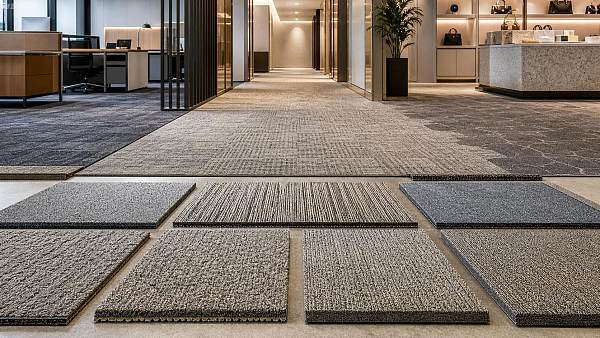
Fiber has a direct effect on commercial carpet tile price and long-term appearance retention.
Nylon usually costs more than polypropylene, but it often performs better in heavy circulation zones.
Solution-dyed fibers can also justify a premium when stain resistance and colorfastness matter.
2. Backing Construction
The backing does more than hold the tile together.
It affects dimensional stability, underfoot comfort, acoustics, and ease of replacement.
Cushion backing usually raises commercial carpet tile price, yet it may reduce noise and improve user comfort.
3. Face Weight and Density
Higher face weight does not always mean better value, but density matters.
A dense, well-constructed tile often resists crushing better in corridors, reception spaces, and circulation paths.
4. Design Complexity
Solid colors are usually more budget-friendly than custom patterns.
Plank formats, directional layouts, and branded graphics can increase waste and slow installation.
That means the real commercial carpet tile price should include design-related labor and ordering overage.
5. Order Volume and Supply Chain
Large projects often secure better factory pricing.
Still, freight, import duties, lead times, and regional stock availability can offset those savings.
From a sourcing perspective, commercial carpet tile price should be reviewed as delivered cost, not factory quote only.
Why Wear Ratings Matter More Than a Cheap Quote
A lower commercial carpet tile price can become expensive if the product wears out early.
Wear ratings help buyers compare suitability across traffic conditions and maintenance expectations.
Common evaluation points include:
- Traffic classification for light, medium, or heavy commercial use
- Appearance retention under rolling loads and foot traffic
- Stain resistance and cleanability
- Static control and slip considerations
- Fire performance and local compliance requirements
For hotels and education projects, the better question is not only price per square foot.
It is how long that commercial carpet tile price will support acceptable appearance before partial or full replacement.
Installation Scope Can Change the Budget Fast
Installation is where many budgets move off target.
Even when the commercial carpet tile price looks fixed, site conditions can add major cost.
The most common hidden items include:
- Removal of existing flooring and debris handling
- Moisture testing and mitigation before installation
- Subfloor leveling, crack repair, or patching
- Phased installation for occupied commercial spaces
- Furniture moving, edge detailing, and transition strips
In active offices or retail stores, night work can also increase labor rates.
This is why accurate commercial carpet tile price planning needs a detailed installation scope before approval.
How Different Spaces Affect Commercial Carpet Tile Price
Office Projects
Open-plan offices often favor modular replacement and acoustic performance.
Here, a slightly higher commercial carpet tile price may reduce future disruption when selective replacement is needed.
Schools and Campuses
Education environments need stain resistance, easy maintenance, and durable seams.
A mid-tier commercial carpet tile price often works best when balancing budget controls with daily wear.
Hotels
Hotels usually prioritize design identity, guest comfort, and zoning by traffic intensity.
Lobby and corridor areas often justify a premium commercial carpet tile price because appearance influences brand perception.
Retail Interiors
Retail spaces need flooring that handles traffic peaks and frequent visual merchandising changes.
In this setting, commercial carpet tile price should be weighed against speed of replacement and consistency across locations.
A Smarter Way to Compare Quotes
When comparing suppliers, request more than a product sheet and a unit price.
A useful quote comparison should include the same scope, specification level, and service assumptions.
Use this short checklist:
- Confirm fiber, backing, tile size, and construction details
- Match wear rating to the intended traffic zone
- Ask for waste percentage based on layout pattern
- Separate product, freight, prep, and labor costs
- Review warranty limits and replacement availability
This approach makes commercial carpet tile price easier to compare on a like-for-like basis.
It also reduces the risk of choosing a quote that looks cheaper only because important costs were excluded.
Final Buying Takeaway
The best commercial carpet tile price is rarely the lowest number on the page.
It is the price that fits the traffic level, design goal, installation condition, and replacement strategy.
For commercial buyers, the strongest decisions come from comparing lifecycle cost, not just purchase cost.
When commercial carpet tile price is evaluated alongside wear ratings and installation scope, budgeting becomes far more reliable.
A clear specification, realistic site review, and well-structured quote request will usually produce the best result.
Search News
Hot Articles
- Fashion & Gem JewelryHow to Choose Designer Eyewear That Fits Your Store’s Customer ProfileOct 12, 2026
- Musical InstrumentsA Practical Guide to Identifying Wooden Orchestral Instruments by Family and ToneOct 10, 2026
- Indoor PlaygroundHow to Choose Animatronic Haunted House Props for High-Throughput AttractionsOct 08, 2026
Popular Tags
Need ExpertConsultation?
Connect with our specialized leisureengineering team for procurementstrategies.
Recommended News
 Sep 02, 2026How to Choose a Glass Acoustic Office Pod for Open-Plan Workplace PrivacyGlass acoustic pod office buying guide: compare privacy, ventilation, safety glass, power, site fit, and supplier support to choose a productive open-plan workspace solution.● Institutional Buyer
 Sep 01, 2026Is CE Marking Enough for Commercial Products Sold in the US?Is CE marking enough for commercial products sold in the US? Learn the key US safety, FCC, listing, and inspection requirements before you buy.● Institutional Buyer
 Sep 04, 2026B2B Office Supplies Procurement: Building a Cost-Controlled Replenishment ProgramB2B office supplies procurement made smarter: build a cost-controlled replenishment program that reduces spend, prevents stockouts, and improves supplier performance.● Institutional Buyer
 Aug 26, 2026How to Choose Automatic Office Coffee Machines for Team Size, Usage, and MaintenanceAutomatic office coffee machines: learn how to choose the right model for team size, daily demand, drink preferences, and maintenance needs to reduce downtime and improve workplace satisfaction.● Institutional Buyer
 Aug 13, 2026What to Look for When Choosing a Wood Executive Office Desk for Daily UseWood executive office desks should do more than look premium. Learn how to compare durability, ergonomics, cable management, and finish quality before you buy.● Institutional Buyer
 Jul 31, 2026How to Choose Institutional Storage Furniture for Schools, Offices, and Public FacilitiesInstitutional storage furniture buying guide for schools, offices, and public facilities—learn how to assess safety, durability, cleaning, locks, and lifecycle cost before you buy.● Institutional Buyer
 Jul 14, 2026Commercial Carpet Tile Price Guide: Cost Factors, Wear Ratings, and Installation ScopeCommercial carpet tile price explained: compare cost factors, wear ratings, and installation scope to choose durable, budget-smart flooring for offices, schools, hotels, and retail.● Institutional Buyer
 Jul 11, 2026How to Compare Motorized, Fixed Frame, and Portable Wholesale Projector ScreensWholesale projector screens compared: discover how motorized, fixed frame, and portable options differ in image quality, flexibility, and sourcing value for commercial projects.● Institutional Buyer
 Jul 10, 2026Desktop Hole Punches Wholesale: What Buyers Should Check Before Placing a Bulk OrderDesktop hole punches wholesale buyers should check quality, accuracy, compliance, total cost, and supplier reliability before placing a bulk order. Read the key checkpoints now.● Institutional Buyer
 Jul 09, 2026Library Bookshelves Wholesale Buying Guide: Materials, Load Capacity, and Layout CostsLibrary bookshelves wholesale guide covering materials, load capacity, and layout costs. Compare options, reduce procurement risk, and choose durable shelving for long-term value.● Institutional Buyer
 Jul 08, 2026Height Adjustable Desks Bulk: Key Specs to Compare for Office Fit-Out ProjectsHeight adjustable desks bulk: compare load, range, stability, noise, compliance, and rollout factors to choose reliable desks for office fit-out projects with less risk.● Institutional Buyer
 Jul 06, 2026FBX Drops 18% as Asia-Europe Furniture Rates FallFBX drops 18% as Asia-Europe furniture rates fall to $1,186/FEU, reshaping office furniture import margins, restocking timing, and shipping plans. See what buyers and exporters should do next.● Institutional Buyer
 Jul 06, 2026Training Chairs With Writing Tablet: What to Check for Classroom Layout and DurabilityTraining chairs with writing tablet: learn how to compare classroom layout, tablet size, frame durability, and maintenance needs to choose smarter, longer-lasting seating.● Institutional Buyer
 Jul 05, 2026Indonesia Tightens Wood Proof for Office Furniture ImportsIndonesia tightens wood proof for office furniture imports from July 3, 2026. Learn FLEGT, certification, customs risks, and how exporters can avoid delays and extra fees.● Institutional Buyer
 Jul 04, 2026How to Choose Educational Furniture for Schools by Age Group, Layout, and DurabilityEducational furniture for schools should match age groups, room layouts, and durability needs. Discover practical buying tips to improve safety, flexibility, and long-term value.● Institutional Buyer
 Jul 03, 2026Europe 40HQ Rates Climb to $6,920 for Large Furniture ShipmentsEurope 40HQ rates climb to $6,920, reshaping large furniture shipments with 9–12 week delays and higher consolidation costs. See what exporters and buyers should do now.● Institutional Buyer
 Jul 03, 2026Adjustable Library Shelves: Load Capacity, Material, and Layout Tips for Smarter Space PlanningAdjustable library shelves: learn how to compare load capacity, materials, and layout options to create safer, more flexible spaces with lower long-term costs.● Institutional Buyer
 Jul 02, 2026Vietnam Tightens Proof Rules for Wood Office FurnitureVietnam tightens proof rules for wood office furniture from July 1, 2026. Learn how FSC-CoC, VPA-FLEGT, and customs delays could impact exporters, sourcing, and delivery plans.● Institutional Buyer
 Jun 29, 2026Workspace Furniture for Offices: What to Compare Before Planning a Hybrid LayoutWorkspace furniture for offices should be compared by flexibility, comfort, space efficiency, and procurement value before planning a hybrid layout. Learn what to review for smarter office decisions.● Institutional Buyer
 Jun 28, 2026How to Evaluate an Institutional Furniture Manufacturer for Schools, Hospitals, and Public SpacesInstitutional furniture manufacturer evaluation guide for schools, hospitals, and public spaces. Learn how to compare compliance, durability, customization, and supply reliability.● Institutional Buyer
 Jun 23, 2026Educational Furniture for Universities: What to Compare Before Buying for Labs and Lecture RoomsEducational furniture for universities: compare lab and lecture room safety, durability, flexibility, and lifecycle cost before buying. Make smarter campus sourcing decisions.● Institutional Buyer
 Jun 22, 2026How to Choose Educational Furniture for Libraries by Age Group, Layout, and UseEducational furniture for libraries should match age groups, layout, and daily use. Discover practical tips to choose safer, flexible, durable solutions that improve learning spaces.● Institutional Buyer
 Jun 18, 2026Wholesale Projector Screens: How to Choose Size, Gain, and Mounting for Each SpaceWholesale projector screens guide: learn how to choose the right size, gain, and mounting for classrooms, boardrooms, hotels, and event spaces for clearer images and smarter sourcing.● Institutional Buyer
 Jun 17, 2026Mobile Pedestals Wholesale Buying Guide: Locking Systems, Sizes, and Bulk PricingMobile pedestals wholesale guide covering locking systems, size options, durability, and bulk pricing to help buyers compare suppliers, cut risk, and secure better-value orders.● Institutional Buyer