Commercial Swimming Pool Filters: Sand, Cartridge, or DE?
Choosing the right commercial swimming pool filters can directly affect water clarity, operating costs, maintenance demands, and regulatory compliance. For technical evaluators comparing sand, cartridge, and DE systems, the best option depends on flow rate, filtration precision, labor efficiency, and lifecycle value. This guide outlines the key performance differences to support smarter commercial pool equipment decisions.
Why a checklist-based approach works better for technical evaluation
When reviewing commercial swimming pool filters, many teams compare media type first and miss the bigger picture. In commercial settings, filter choice is rarely just about water clarity. It affects hydraulic stability, pump sizing, backwash water use, staff workload, spare parts planning, and local health-code performance. A checklist-based evaluation helps technical buyers avoid a common mistake: choosing the finest nominal filtration rating without checking whether the system fits the facility’s operating profile.
For hotels, fitness clubs, water features, school facilities, therapy pools, and aquatic venues, the right decision usually comes from ranking practical factors in order. First confirm the duty conditions. Then compare separation performance, cleaning method, downtime, and whole-life cost. Only after that should you compare supplier claims. This structure makes commercial swimming pool filters easier to assess across different project types and procurement models.
Start here: the first items to confirm before comparing sand, cartridge, and DE
Before selecting a filter type, technical evaluators should collect a core set of design and operational inputs. Without these baseline figures, even a strong product comparison can lead to the wrong recommendation.
- Pool type and use pattern: lap pool, leisure pool, hotel pool, spa, training pool, therapy basin, or high-bather-load public facility.
- Required turnover rate and design flow: confirm normal operating flow, peak load flow, and whether the system serves one vessel or multiple bodies of water.
- Water quality target: define turbidity expectations, aesthetic standard, and sensitivity to fine particulate matter such as sunscreen, body oils, and makeup residues.
- Available maintenance labor: identify whether trained operators can perform frequent cleaning, media handling, and pressure-drop monitoring.
- Drainage and water availability: check whether regular backwash discharge is acceptable under site conditions, sustainability goals, or utility cost controls.
- Plant room space and access: include footprint, vessel height, access for cartridge removal or media replacement, and service clearances.
- Local code and compliance requirements: confirm if the facility must meet specific public health guidance, turnover limits, or discharge restrictions.
If this checklist is incomplete, the comparison between commercial swimming pool filters will stay too theoretical. Technical teams should treat these inputs as mandatory pre-screening data.
Core decision guide: how sand, cartridge, and DE filters differ
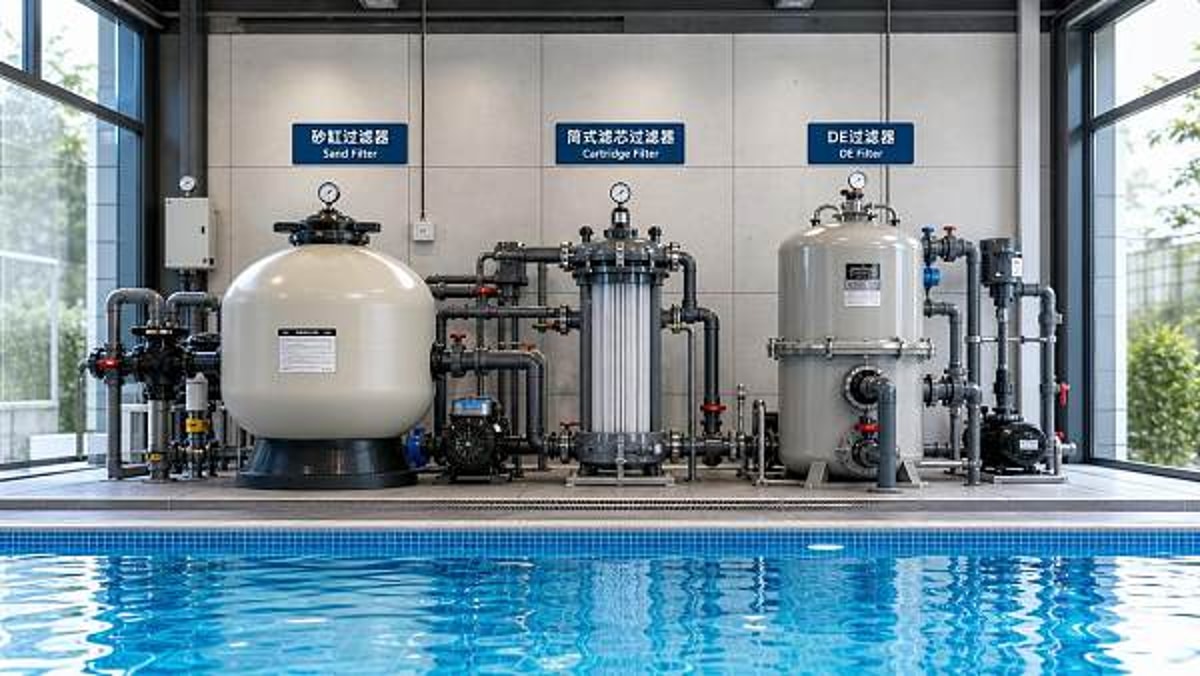
The three main commercial swimming pool filters solve the same problem in different ways. Sand systems emphasize robustness and simple operation. Cartridge systems reduce backwash demand and can provide solid clarity with lower water waste. DE systems typically deliver the finest filtration but require stricter maintenance discipline and media management.
When sand filters are the stronger choice
Sand-based commercial swimming pool filters are often preferred where reliability, simple operation, and durable throughput matter more than ultra-fine polishing. They are common in hotels, standard public pools, and facilities where maintenance teams need a predictable process. Backwashing is straightforward, media life can be long, and operators are usually familiar with the technology. The trade-off is that water use during cleaning can be significant, and clarity may not match DE in demanding aesthetic environments.
When cartridge filters deserve serious consideration
Cartridge commercial swimming pool filters are attractive where water conservation is a priority or where drain capacity for frequent backwash is limited. They can provide good filtration performance and reduce wasted heated water. However, technical evaluators must confirm labor expectations. Cartridge cleaning and replacement are hands-on tasks, and large commercial systems may require disciplined maintenance scheduling, spare element inventory, and adequate service access. In facilities with lean staffing, this can become a hidden cost.
When DE filters justify their complexity
DE commercial swimming pool filters are usually selected when superior clarity is a leading requirement, such as premium hospitality environments, visually critical leisure pools, or specialized aquatic applications. They capture finer particles and can improve water appearance noticeably. The caution is operational complexity. DE handling, recharge procedures, waste management, and health-and-safety controls should be reviewed carefully. A DE system is rarely the best answer if the operator team is undertrained or if site policies discourage media-intensive maintenance.
Priority checklist: the must-check technical criteria
- Flow compatibility: Verify that the selected filter can handle both nominal and peak circulation demand without excessive velocity or unstable pressure conditions.
- Pressure loss trend: Compare not only clean-filter pressure drop, but also how quickly differential pressure rises under actual bather load.
- Cleaning frequency: Estimate service interval based on debris type, oils, cosmetics, and suspended solids, not just manufacturer literature.
- Water and energy implications: Include backwash water, reheating losses, pump runtime, and any effect on chemical demand.
- Operator skill requirement: Match system complexity with the team that will run it daily, not the team that will commission it once.
- Lifecycle cost: Compare media replacement, cartridge replacement, labor hours, downtime, and disposal cost over multiple years.
- Compliance and documentation: Confirm pressure vessel certification, material suitability, and documentation needed for inspection, procurement, and warranty support.
Scenario-based guidance for different commercial facilities
Hotels and resorts
For hospitality projects, guest perception matters almost as much as treatment efficiency. If the pool is a visible brand asset, water sparkle and low disruption are critical. Sand may fit for standard pools with practical budgets, but DE may be justified for premium visual performance if the site has trained staff. Cartridge systems can be compelling where water conservation supports sustainability targets and utility costs are high.
Schools, campuses, and institutional facilities
Institutional buyers often prioritize reliability, straightforward training, and predictable maintenance budgets. Sand commercial swimming pool filters usually score well here because they are familiar and robust. Cartridge systems can work if maintenance teams can handle regular manual servicing. DE should be chosen only when there is a clear water-quality benefit and the facility has a disciplined operating program.
High-bather-load leisure or public venues
Where load swings are strong and contamination is frequent, technical evaluators should focus on dirt-holding behavior, cleaning downtime, and recovery speed. Sand systems often remain practical because of their scalability and easy backwash routine. DE can improve fine-particle removal but may create more operational burden. Cartridge filters should be assessed carefully if fouling is expected to be heavy or access for maintenance is limited.
Common oversights that can distort the filter decision
Several issues are repeatedly overlooked during commercial swimming pool filters evaluation:
- Assuming finer filtration always means better project value. In reality, labor, downtime, and consumables may erase the benefit.
- Ignoring service clearance. Cartridge removal space and media change access can become major plant room constraints.
- Using catalog ratings instead of real operating conditions. Oils, lotions, and peak usage change filter behavior significantly.
- Evaluating vessel cost without accounting for wastewater, heating loss, and operator time.
- Failing to align the filter with chemical treatment strategy, coagulation approach, and automation controls.
Practical execution steps for a smarter procurement process
To move from comparison to decision, technical teams should standardize the evaluation process. This is especially important for multi-site buyers, EPC coordination, hospitality developers, and institutional procurement groups that need repeatable results.
- Create a project data sheet with turnover, flow, pool volume, use case, and staffing assumptions.
- Request comparable supplier submissions for sand, cartridge, and DE options using the same operating basis.
- Ask for lifecycle assumptions in writing, including cleaning interval, media life, cartridge life, and estimated labor hours.
- Review plant room constraints and utility implications before shortlisting a filter type.
- Check reference projects that match your facility type, not just generic installations.
- Run a total-cost and operability review with both engineering and facility management input.
FAQ for technical evaluators reviewing commercial swimming pool filters
Which filter type is easiest to operate at scale?
In many commercial environments, sand filters are the easiest to operate consistently at scale because backwash procedures are familiar and less labor-intensive than cartridge cleaning or DE recharge routines.
Which option usually gives the best water clarity?
DE commercial swimming pool filters generally deliver the finest filtration and strongest visual clarity, but they are not automatically the best-value choice if staffing, waste handling, or maintenance discipline are weak.
Are cartridge systems always lower cost because they save water?
Not always. Cartridge systems can reduce backwash water loss, but manual cleaning time, replacement element cost, and downtime may offset savings depending on facility size and contamination load.
Final recommendation and next-step checklist
The best commercial swimming pool filters are the ones that balance clarity, hydraulic performance, labor realism, and lifecycle value for the exact facility profile. As a quick rule, sand suits many mainstream commercial applications, cartridge fits sites prioritizing water savings and manageable maintenance access, and DE is strongest where premium clarity justifies higher operational discipline.
If your team is moving toward specification or sourcing, prepare these items first: design flow rate, turnover requirement, pool use category, staffing model, water-discharge limits, space constraints, utility cost assumptions, and target maintenance interval. With that information, suppliers and sourcing partners can provide a much more accurate recommendation on commercial swimming pool filters, equipment compatibility, lead time, budget range, and long-term operating fit.
Search News
Hot Articles
Popular Tags
Need ExpertConsultation?
Connect with our specialized leisureengineering team for procurementstrategies.
Recommended News
 May 07, 2026Commercial Swimming Pool Filters: Sand, Cartridge, or DE?Commercial swimming pool filters compared: sand, cartridge, or DE? Discover the best option for water clarity, maintenance, operating costs, and smarter commercial pool decisions.● Hospitality Sourcing Dir
 May 07, 2026Synthetic Turf Wholesale: Which Specs Actually Change Lifespan?Synthetic turf wholesale buyers: learn which specs truly extend lifespan—fiber, stitch rate, backing, pile height, and UV resistance—to reduce replacement costs and source smarter.● Hospitality Sourcing Dir
 May 07, 2026Hotel and Catering Equipment Lists That Miss Critical Back-End ItemsHotel & Catering Equipment lists often miss critical back-end items like utilities, ventilation, and controls. Learn how to avoid delays, rework, and hidden project costs.● Hospitality Sourcing Dir
 May 07, 2026Why Pool Heat Pumps Perform Differently in Mild ClimatesPool heat pumps perform differently in mild climates due to part-load demand, humidity, and controls. Learn what drives real seasonal efficiency and smarter commercial selection.● Hospitality Sourcing Dir
 May 07, 2026Commercial Swimming Pool Filters: Sand, Cartridge, or DE?Commercial swimming pool filters compared: sand, cartridge, or DE? Discover the best option for water clarity, maintenance, operating costs, and smarter commercial pool decisions.● Hospitality Sourcing Dir
 May 07, 2026Synthetic Turf Wholesale: Which Specs Actually Change Lifespan?Synthetic turf wholesale buyers: learn which specs truly extend lifespan—fiber, stitch rate, backing, pile height, and UV resistance—to reduce replacement costs and source smarter.● Hospitality Sourcing Dir
 May 07, 2026Hotel and Catering Equipment Lists That Miss Critical Back-End ItemsHotel & Catering Equipment lists often miss critical back-end items like utilities, ventilation, and controls. Learn how to avoid delays, rework, and hidden project costs.● Hospitality Sourcing Dir
 May 07, 2026Why Pool Heat Pumps Perform Differently in Mild ClimatesPool heat pumps perform differently in mild climates due to part-load demand, humidity, and controls. Learn what drives real seasonal efficiency and smarter commercial selection.● Hospitality Sourcing Dir
 May 06, 2026Hotel & Catering Equipment upgrades that cut daily labor timeHotel & Catering Equipment upgrades that cut labor time fast—discover smart kitchen, warewashing, and service solutions that streamline workflows, reduce staffing strain, and boost hospitality efficiency.● Hospitality Sourcing Dir
 May 05, 2026Hotel & Catering Equipment costs that often get missed earlyHotel & Catering Equipment costs often go beyond the quote. Discover hidden expenses in utilities, compliance, logistics, and commissioning to protect budgets and avoid project delays.● Hospitality Sourcing Dir
 May 04, 2026Commercial Water Softeners: Sizing Mistakes That Raise CostsCommercial water softeners sizing mistakes can quietly raise salt, water, and maintenance costs. Learn the most common errors and smarter sizing tips for long-term commercial efficiency.● Hospitality Sourcing Dir
 May 04, 2026Hotel & Catering Equipment Lists Often Miss These BasicsHotel & Catering Equipment lists often miss critical basics like utilities, compliance, workflow, and maintenance access. Learn how to avoid delays, rework, and costly project risks.● Hospitality Sourcing Dir
 May 03, 2026Commercial pizza ovens that save labor may cost more to ventCommercial pizza ovens can cut labor, but venting, code compliance, and installation may raise total costs. See the key checks before you buy.● Hospitality Sourcing Dir
 May 03, 2026Commercial juicers: cold press or centrifugal for daily serviceCommercial juicers: compare cold press and centrifugal models for daily service. Discover the best fit for speed, juice quality, yield, cleaning, and operating costs.● Hospitality Sourcing Dir
 May 03, 2026Commercial water boilers: recovery time matters more than listed capacityCommercial water boilers perform best when recovery time matches peak demand. Learn why faster reheating beats listed capacity for reliable, efficient commercial hot water service.● Hospitality Sourcing Dir
 May 03, 2026Cotton candy machines wholesale: small details that affect cleaning timeCotton candy machines wholesale guide: discover the small design details that cut cleaning time, reduce labor costs, and improve hygiene for busy commercial operations.● Hospitality Sourcing Dir
 May 03, 2026Dough sheeters wholesale: thickness control is where quality showsDough sheeters wholesale buyers: see why thickness control defines real quality, repeatability, and long-term value. Compare key evaluation points for smarter sourcing.● Hospitality Sourcing Dir
 May 03, 2026Slushy machines wholesale: what causes flavor crossover problemsSlushy machines wholesale buyers should understand what causes flavor crossover, from poor sealing to weak cleaning design, to protect drink quality and choose more reliable equipment.● Hospitality Sourcing Dir
 May 03, 2026Commercial bread slicers: slice consistency affects more than looksCommercial bread slicers do more than improve appearance—they boost portion control, reduce waste, and support faster service. Learn what drives slice consistency before you buy.● Hospitality Sourcing Dir
 May 03, 2026Wood fired pizza ovens need more space than most plans allowWood fired pizza ovens often require more space than expected. Learn how to avoid redesigns, protect workflow, and plan compliant, high-performance hospitality projects.● Hospitality Sourcing Dir
 May 03, 2026Commercial pizza ovens: gas or electric for steady outputCommercial pizza ovens: compare gas vs. electric for steady output, faster recovery, precise control, and smarter installation choices across real kitchen scenarios.● Hospitality Sourcing Dir
 May 03, 2026Commercial popcorn machines: kettle size vs serving rush realityCommercial popcorn machines should be chosen by real rush-hour output, not kettle size alone. Learn how to match serving peaks, staffing, and workflow for smarter buying.● Hospitality Sourcing Dir
 May 03, 2026Commercial insect killers: indoor placement changes results fastCommercial insect killers perform very differently based on indoor placement. Discover how small positioning changes can boost control, reduce pest activity, and improve operational results fast.● Hospitality Sourcing Dir
 May 03, 2026Hotel & Catering Equipment lists often hide installation costsHotel & Catering Equipment lists often hide installation costs. Learn where budgets slip, what to verify early, and how to compare total installed value before approval.● Hospitality Sourcing Dir