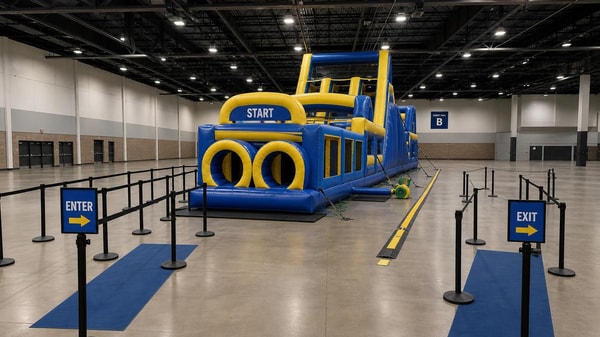
Inflatable Obstacle Courses: Setup Mistakes That Hurt Event Flow
Inflatable obstacle courses can energize an event, but poor setup decisions often create bottlenecks, safety risks, and frustrating delays. For project managers responsible for smooth execution, understanding the most common setup mistakes is essential to maintaining crowd flow, protecting participants, and maximizing operational efficiency. This guide highlights where planning often goes wrong and how to prevent disruptions before the event begins.
In commercial event environments such as leisure parks, school festivals, hospitality activations, sports promotions, and branded public experiences, inflatable obstacle courses are rarely standalone attractions. They affect queue design, staffing plans, power distribution, emergency access, insurance compliance, and visitor satisfaction at the same time. For project managers and engineering leads, setup quality is not just a technical issue; it is a flow-management decision with direct consequences for throughput, safety, and event ROI.
A course that looks impressive on paper can still underperform if the entry lane is too narrow, blower placement disrupts pathways, anchoring points are poorly matched to the surface, or turnover timing is underestimated. In many temporary event builds, avoidable mistakes happen during the final 24 hours before opening, when schedule pressure is highest. The result is often a chain reaction: delayed installation, slow participant cycling, uneven crowd density, and unnecessary downtime.
Why Setup Quality Directly Impacts Event Flow
For inflatable obstacle courses, event flow depends on three linked metrics: participant throughput, dwell time, and circulation efficiency around the attraction. If one cycle takes 90 seconds instead of the planned 45 to 60 seconds, hourly capacity can drop by 25% to 40%. That gap matters in commercial settings where site teams must balance visitor experience, staffing cost, and schedule reliability.
Flow problems usually begin before the first participant enters. A poor site layout can force crossing traffic between waiting guests, exiting users, supervising staff, and technical operators. Even a medium-sized inflatable obstacle course with a footprint of 20 to 35 meters may require an additional 2 to 3 meters of clearance on each side for safe access, blower equipment, cable routing, and emergency movement. When that buffer is ignored, congestion develops fast.
The Operational Cost of a “Minor” Setup Error
Project teams often treat setup errors as small adjustments that can be fixed on site. In reality, a misplaced entrance arch, insufficient queuing area, or unprotected power lead can trigger multiple operational issues at once. Staff are then forced to manage line disputes, reset participant spacing, and pause sessions for safety checks. A 10-minute interruption every 2 hours may not sound severe, but over an 8-hour activation it can remove 30 to 60 participant cycles.
- Reduced hourly capacity and longer queue times
- Higher staff intervention rates at entry and exit points
- Increased risk of trip hazards, collisions, or participant confusion
- Lower satisfaction for sponsors, venue operators, and visitors
For B2B buyers sourcing inflatable obstacle courses for repeat use, these issues also influence procurement decisions. A product that installs quickly, supports clean cable management, and provides clear loading and anchoring instructions can reduce labor pressure across multiple event cycles.
The Most Common Setup Mistakes That Disrupt Performance
Most event flow failures come from planning oversights rather than equipment failure. The inflatable may be structurally sound, but the operating environment is not. Below are the setup mistakes that most often slow down commercial events and create avoidable friction.
1. Underestimating Footprint and Clearance Requirements
One of the most frequent mistakes is measuring only the published product size. The actual working zone is larger. Beyond the inflatable body, operators need room for blower units, anchor points, queue barriers, entrance supervision, and exit recovery space. A course listed at 30m x 4m may need a practical operating area closer to 34m x 8m depending on orientation and site traffic.
Why this matters
If exit users step directly into a waiting line, or if the queue backs into a food service lane, the attraction starts affecting the whole event map. The mistake is especially costly in hotels, mixed-use venues, amusement pop-ups, and education campuses where pedestrian routes are already shared by multiple functions.
2. Poor Entry and Exit Orientation
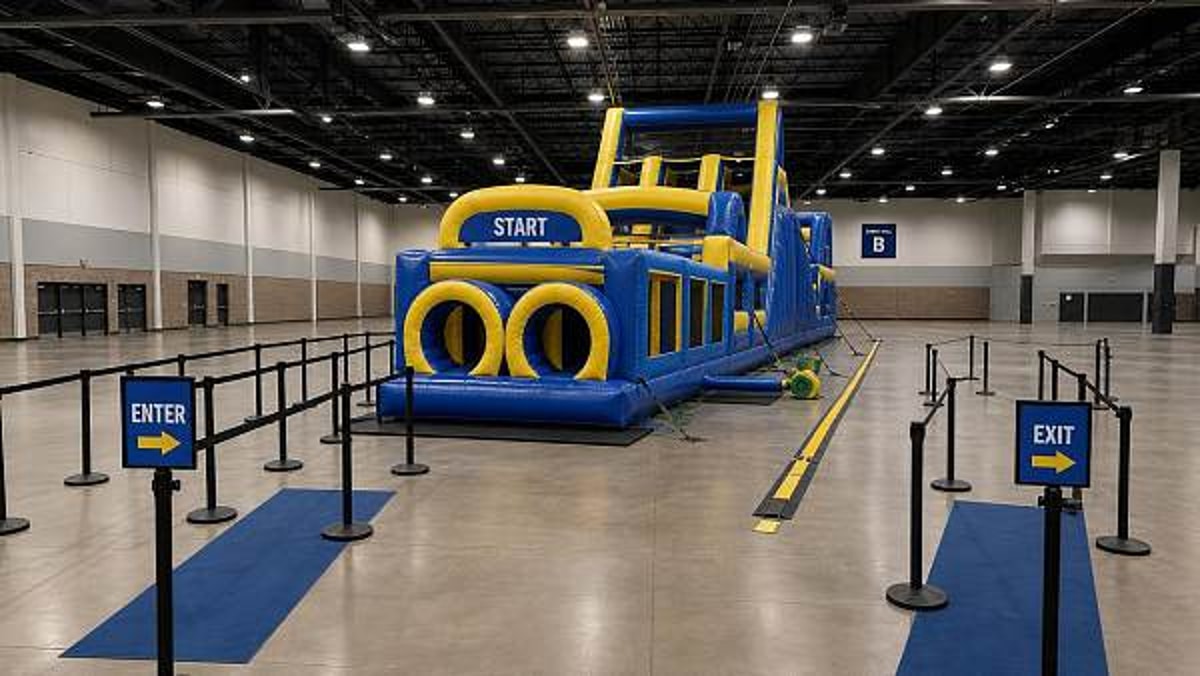
Inflatable obstacle courses work best when participant movement is one-directional and intuitive. When the entrance faces a high-traffic path or the exit opens into a narrow zone, staff must manually redirect people. That increases handling time per cycle and creates uncertainty for younger users or first-time participants.
A practical target is to maintain at least 1.5 to 2 meters of clear separation between the queue lane and the exit lane. For larger commercial courses, 3 meters is often safer if the audience includes children, family groups, or mixed-age users moving at different speeds.
3. Inadequate Ground Assessment and Anchoring
Surface type affects stability, drainage, anchoring method, and participant safety. Grass, asphalt, concrete, indoor flooring, and synthetic turf all require different planning. Anchoring a unit designed for stake systems onto a hard surface without approved ballast arrangements can compromise both compliance and performance. Wet ground, uneven paving, or hidden slopes can also change how the inflatable obstacle course sits under load.
Before installation, teams should inspect at least 6 points: levelness, slip risk, drainage path, anchor compatibility, underground service restrictions, and surrounding obstructions. Skipping this step often leads to rushed repositioning on event day.
The table below shows how site conditions influence setup decisions for inflatable obstacle courses in commercial event use.
The key takeaway is simple: surface choice changes more than stability. It also affects user recovery space, technical routing, and operator visibility. Project managers should confirm the full operating environment at least 7 to 14 days before load-in, not during the final installation window.
4. Mismanaging Power Supply and Cable Routing
Commercial inflatable obstacle courses rely on continuous airflow, so power planning is critical. Yet many event teams assign this task too late. Problems arise when blowers share overloaded circuits, extension runs are too long, or cables cross pedestrian routes without proper covers. A single power interruption can stop operations immediately and trigger a full participant evacuation from the unit.
At minimum, project teams should confirm blower quantity, voltage compatibility, cable path length, backup access, and distance to the nearest compliant power source. For larger temporary events, a dedicated electrical check 48 to 72 hours before opening can prevent last-minute rework.
5. Ignoring Queue Design and Throughput Planning
An inflatable obstacle course is only as efficient as the queue feeding it. Teams often focus on the attraction itself and forget that line design determines pace, fairness, and user readiness. If participants are not briefed before entry, cycle times stretch because each group needs instructions at the start line. If the waiting area is too short, lines spill into shared circulation zones.
- Estimate cycle time, including entry briefing and exit clearance.
- Convert that into hourly capacity for one lane or multiple lanes.
- Size the queue for peak intervals, not average attendance.
- Provide a visible rules board before the loading point.
- Use barriers to keep spectators separate from active participants.
If one operating cycle averages 60 seconds and the course releases 1 group per minute, the queue should be designed to absorb at least 10 to 15 minutes of demand without blocking adjacent vendor or venue functions. That is particularly important for sponsor activations, fairs, and mixed-use leisure events where dwell patterns shift every 30 to 45 minutes.
How Project Managers Can Build a Smoother Installation Process
The best way to prevent setup mistakes is to treat inflatable obstacle courses like managed infrastructure, not just temporary entertainment equipment. A stronger process begins with a documented pre-event checklist, a clear installation sequence, and a defined handover standard between supplier, site operations, and event management.
A 5-Step Pre-Event Control Framework
Project managers can reduce setup-related disruption by using a repeatable control framework. It does not need to be complex, but it should cover site readiness, technical readiness, operational readiness, and safety readiness before opening.
This type of framework improves communication across suppliers, venue managers, and technical contractors. It also helps buyers compare vendors more effectively, because the discussion moves beyond price and product size into execution reliability.
Supplier Questions That Prevent On-Site Surprises
When sourcing inflatable obstacle courses through global supply channels, project managers should request practical setup details early. This is especially important for buyers managing cross-border procurement, OEM customization, or multiple venue formats. Product visuals alone do not reveal how well the unit will perform in a live commercial environment.
Ask for these details before approval
- Installed operating footprint, not just packed or nominal size
- Blower count and power requirements per unit
- Recommended user age or size segmentation
- Typical setup time, such as 30 to 90 minutes depending on scale
- Anchoring guidance for grass, concrete, and indoor surfaces
- Inspection and maintenance points between event sessions
For commercial buyers, this level of detail reduces procurement risk. It also supports more accurate labor allocation, electrical planning, and site map design during pre-production.
Operational Best Practices During Live Event Use
Even a well-installed inflatable obstacle course can lose efficiency if live operations are weak. After opening, the focus shifts from setup to control. The operator team should monitor queue growth, participant spacing, exit speed, and equipment stability in regular intervals, often every 30 to 60 minutes depending on event intensity and weather conditions.
Staffing Ratios and Observation Zones
Many avoidable slowdowns happen because staffing is concentrated at the entrance only. In most commercial layouts, inflatable obstacle courses perform better with at least 2 active supervision points: one at entry and one at exit. On longer or multi-section units, a third roaming operator may be needed to monitor internal pace and participant behavior. This structure improves both safety and cycle consistency.
Positioning matters. Staff should be able to see loading, transition points, and landing zones without obstruction from banners, fencing, or sponsor elements. If a branded backdrop blocks sightlines, event flow will suffer no matter how strong the product design is.
Weather, Downtime, and Reset Planning
Outdoor events need clear thresholds for pause, inspection, and restart. Wind, rain, and surface moisture can all change operating conditions quickly. Project managers should define who can authorize a stop, what checklist applies before restart, and how participant lines will be held or redirected. A reset procedure that takes 5 minutes on paper may take 15 minutes in practice if communication roles are unclear.
For recurring commercial activations, maintaining a short post-event review is equally useful. Track 4 simple indicators: total operating hours, number of pauses, average queue length, and observed bottleneck location. After 2 to 3 deployments, these records usually reveal whether the issue is product layout, venue layout, or staffing design.
What Buyers Should Prioritize When Sourcing Inflatable Obstacle Courses
From a sourcing perspective, the right inflatable obstacle courses are those that fit the event model, installation conditions, and operational capacity of the buyer. For project managers in hospitality groups, institutional venues, leisure operators, and branded experience teams, procurement should evaluate installability as carefully as visual appeal.
Core Procurement Criteria
A strong purchasing decision usually combines 5 factors: suitable footprint, setup speed, maintenance practicality, safety documentation, and supplier responsiveness. If a unit requires complex site adaptation every time it is deployed, its long-term operating cost may be higher even if the purchase price is lower.
- Choose formats aligned with expected hourly traffic, not only visual scale.
- Prefer designs that separate queueing, participation, and exit recovery clearly.
- Confirm whether spare blowers, patch materials, and inspection guidance are available.
- Assess whether the supplier can support custom branding without compromising circulation or visibility.
- Review whether documentation is clear enough for multi-country venue teams to execute consistently.
For buyers using a global sourcing model, this is where a specialist B2B intelligence platform adds value. Access to reliable product guidance, supplier comparison logic, and sector-specific procurement insight helps reduce mismatch between product selection and real operational needs.
Inflatable obstacle courses succeed when setup discipline, site planning, and live operations work together. For project managers, the biggest risks are rarely dramatic failures; they are the small planning gaps that slow lines, increase interventions, and reduce commercial performance over an entire event day. By validating footprint, power, surface, anchoring, queue design, and staffing before opening, teams can protect both visitor experience and operational efficiency.
If you are evaluating inflatable obstacle courses for hospitality venues, amusement projects, school campuses, or branded commercial events, a sourcing strategy built around practical deployment details will deliver stronger results than a design-first approach alone. To discuss fit-for-purpose options, compare supplier capabilities, or get a tailored sourcing plan for your next project, contact GCT to learn more solutions and request a customized recommendation.
Search News
Hot Articles
Popular Tags
Need ExpertConsultation?
Connect with our specialized leisureengineering team for procurementstrategies.
Recommended News
 May 07, 2026CCTV5 Broadcasts Key Sports Events on May 7, 2026CCTV5 broadcasts WTT Finals, CBA playoffs & AFC U-17 Women’s qualifiers on May 7, 2026—boosting global demand for FIBA/AFC/ITTF-certified sports equipment.● Theme Park Strategist
 May 07, 2026Snooker World Championship Boosts Chinese Billiards Table ExportsSnooker World Championship boosts Chinese billiards table exports — CE+UKCA-certified slate tables see 37% surge in UK, Germany & Saudi demand.● Theme Park Strategist
 May 07, 2026CPSC Recalls 3 Chinese-Made Kids' Climbing FramesCPSC recalls 3 Chinese-made kids' climbing frames—47,000 units over ASTM F1487-23 failures & pinch hazards. Act now to protect your supply chain.● Theme Park Strategist
 May 07, 2026Inflatable Water Slides Wholesale: Which Features Cut Repair Rates?Inflatable water slides wholesale buyers: discover which features cut repair rates most—commercial PVC, reinforced seams, smart anchoring, matched blowers, and compliant design.● Theme Park Strategist
 May 07, 2026Mini Golf Course Equipment That Wears Out Faster OutdoorsMini golf course equipment wears out faster outdoors due to UV, moisture, and heavy traffic. Discover which parts fail first and how to choose longer-lasting solutions.● Theme Park Strategist
 May 07, 2026Bowling Alley Equipment Upgrades That Improve Lane ReliabilityBowling alley equipment upgrades that improve lane reliability: discover how smarter pinsetters, diagnostics, conditioning, and integration reduce downtime, cut costs, and boost player satisfaction.● Theme Park Strategist
 May 07, 2026Inflatable Obstacle Courses: Setup Mistakes That Hurt Event FlowInflatable obstacle courses can boost event energy, but setup mistakes can ruin flow. Discover the top errors to avoid and keep events safer, faster, and more efficient.● Theme Park Strategist
 May 07, 2026Coin Operated Kiddie Rides That Stop Paying Back Too SoonCoin operated kiddie rides can lose ROI fast when downtime, weak replay value, and poor sourcing add hidden costs. Learn how to choose models that earn longer.● Theme Park Strategist
 May 07, 2026Commercial Bouncy Castles: Why Material Weight Is Not EnoughCommercial bouncy castles are not defined by material weight alone. Learn the key buying checklist for safety, durability, compliance, and smarter commercial sourcing.● Theme Park Strategist
 May 07, 2026Inflatable Water Slides Wholesale: Which Features Cut Repair Rates?Inflatable water slides wholesale buyers: discover which features cut repair rates most—commercial PVC, reinforced seams, smart anchoring, matched blowers, and compliant design.● Theme Park Strategist
 May 07, 2026Mini Golf Course Equipment That Wears Out Faster OutdoorsMini golf course equipment wears out faster outdoors due to UV, moisture, and heavy traffic. Discover which parts fail first and how to choose longer-lasting solutions.● Theme Park Strategist
 May 07, 2026Bowling Alley Equipment Upgrades That Improve Lane ReliabilityBowling alley equipment upgrades that improve lane reliability: discover how smarter pinsetters, diagnostics, conditioning, and integration reduce downtime, cut costs, and boost player satisfaction.● Theme Park Strategist
 May 07, 2026Inflatable Obstacle Courses: Setup Mistakes That Hurt Event FlowInflatable obstacle courses can boost event energy, but setup mistakes can ruin flow. Discover the top errors to avoid and keep events safer, faster, and more efficient.● Theme Park Strategist
 May 07, 2026Coin Operated Kiddie Rides That Stop Paying Back Too SoonCoin operated kiddie rides can lose ROI fast when downtime, weak replay value, and poor sourcing add hidden costs. Learn how to choose models that earn longer.● Theme Park Strategist
 May 07, 2026Commercial Bouncy Castles: Why Material Weight Is Not EnoughCommercial bouncy castles are not defined by material weight alone. Learn the key buying checklist for safety, durability, compliance, and smarter commercial sourcing.● Theme Park Strategist
 May 06, 2026Basketball hoops for school: portable convenience vs fixed stabilityBasketball hoops for school: compare portable convenience and fixed stability to choose safer, smarter, and more cost-effective solutions for campus courts.● Theme Park Strategist
 May 06, 2026Montessori wooden toys and the question of long-term durabilityMontessori wooden toys: discover what really determines long-term durability, safety, and value, and learn how buyers can choose options built for repeated use.● Theme Park Strategist
 May 06, 2026Wholesale ping pong tables for schools: what wears out firstWholesale ping pong tables for schools: learn what wears out first, from casters to locks, and use this buyer-focused guide to cut replacement costs and choose safer, longer-lasting tables.● Theme Park Strategist
 May 06, 2026Gymnastic mats wholesale: thickness claims vs real shock absorptionGymnastic mats wholesale buyers: learn why thickness claims alone can mislead. Compare real shock absorption, foam density, rebound control, and sourcing checks before you buy.● Theme Park Strategist
 May 06, 2026Abacus learning toys still matter when math goes digitalAbacus learning toys still matter in digital math, helping children build number sense, focus, and hands-on problem-solving. See why educators, parents, and buyers still choose them.● Theme Park Strategist
 May 06, 2026Liaoning Tieren Appoints Shin Jeong-won; K-League Training Gear Sourcing Shift PossibleLiaoning Tieren appoints K-League coach Shin Jeong-won — sparking Korean demand for ISO 10993-certified smart athletic wear, especially heart-rate & GPS training vests.● Theme Park Strategist
 May 06, 2026NBA LED Interactive Court System Enters Mass ProductionNBA LED interactive court system enters mass production in Q3 2026 — a breakthrough for smart sports venues, AR fan engagement, and global LED display suppliers.● Theme Park Strategist
 May 06, 2026NBA Adopts New LED Interactive Court Floors in 2026–27 SeasonNBA LED interactive court floors launch in 2026–27: AR fan engagement, real-time stats & certified hardware — game-changing for global sports tech suppliers.● Theme Park Strategist
 May 06, 2026HuaiBA Youth Basketball Arena Adopts Domestic Smart Floor SystemHuaiBA Youth Basketball Arena's domestic smart floor system sets a new benchmark—featuring real-time pressure sensing & acoustic feedback for global sports infrastructure buyers.● Theme Park Strategist