Basketball hoops for school: portable convenience vs fixed stability
Choosing the right basketball hoops for school affects safety, budget control, site flexibility, and long-term maintenance. For project managers and facility planners, the decision between portable convenience and fixed stability is not just about sports equipment—it directly shapes installation efficiency, user experience, and lifecycle value. This guide explores how to match each option to campus needs, performance expectations, and procurement priorities.
Why a checklist approach works better for school basketball projects
When comparing basketball hoops for school, many buying teams start with price or appearance. That usually leads to poor fit. A school court is a shared-use environment with changing schedules, varied age groups, and strict safety expectations. Project managers need a faster and more reliable decision path: confirm usage, assess the site, define compliance needs, compare total cost, and only then shortlist models.
A checklist-based evaluation reduces procurement risk because it forces every stakeholder to review the same practical points. For new campus construction, gym renovation, or outdoor recreation upgrades, this method helps align physical education staff, maintenance teams, contractors, and finance departments before purchase orders are issued.
First decision: what must be confirmed before choosing portable or fixed systems
Before reviewing brands or technical drawings, confirm the following decision items. These checks create the foundation for selecting the right basketball hoops for school facilities.
- Primary use case: daily PE classes, competitive training, community use, or multi-sport scheduling.
- Installation location: indoor hardwood court, outdoor asphalt area, covered recreation zone, or temporary event space.
- User profile: elementary students, secondary students, mixed-age groups, or adult-height competitive play.
- Space flexibility needs: whether the court must be cleared for assemblies, exams, ceremonies, or other sports.
- Expected intensity: recreational shooting, institutional training, or repeated dunk-level impact.
- Budget structure: upfront capital expenditure only, or full lifecycle cost including repairs, anchoring, storage, and replacement parts.
- Compliance and safety: local school safety rules, stability requirements, edge protection, padding, and weather resistance.
If these points are unclear, the procurement process often becomes reactive. The result may be a portable unit that is easy to move but unstable for student competition, or a fixed system that performs well but limits future site use.
Portable convenience: where movable basketball hoops for school make sense
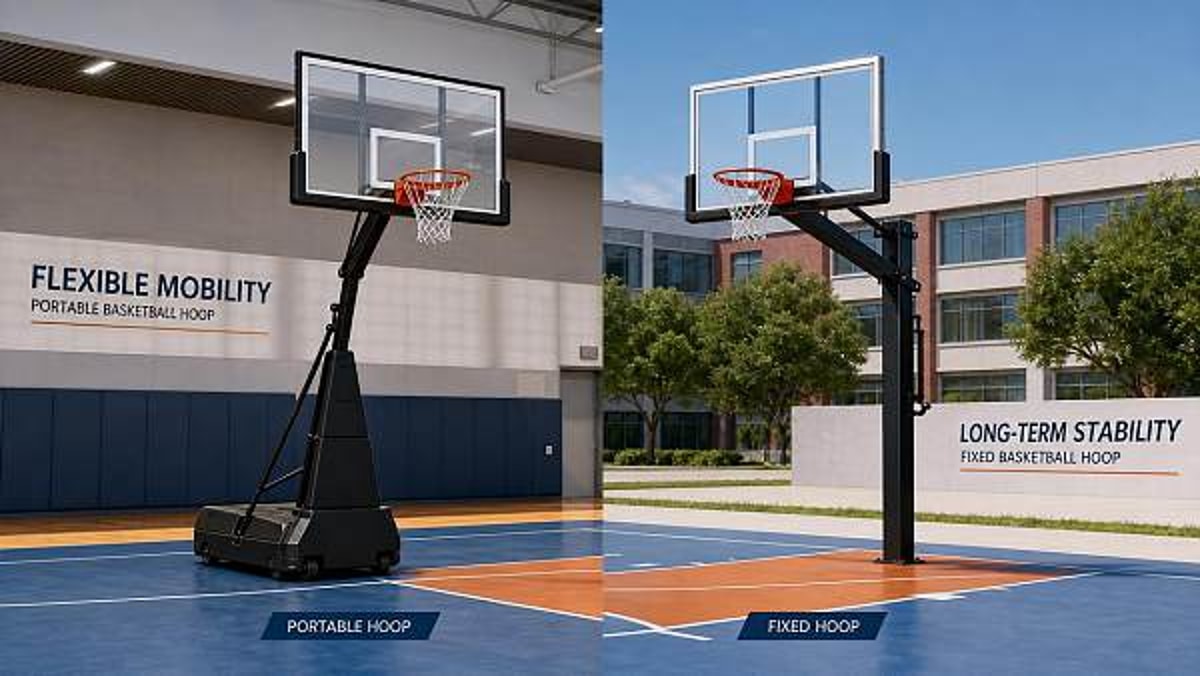
Portable basketball hoops for school projects are valuable when flexibility is a top operational priority. They are especially useful in campuses where one space must support multiple functions throughout the week. In smaller institutions, they also reduce the need for permanent civil works.
Best-fit situations for portable systems
- Schools that convert gym areas for exams, meetings, or performances.
- Temporary sports programs, leased facilities, or pilot campus upgrades.
- Outdoor areas where permanent excavation is restricted or delayed.
- Sites serving different age groups that may require adjustable height or repositioning.
Main advantages project teams should value
The biggest advantage is operational flexibility. Portable units can be relocated, stored, or repositioned to improve court layout and event scheduling. Installation is also simpler, which can shorten project timelines and reduce disruption to existing school operations. For phased procurement, portable basketball hoops for school can be introduced without waiting for major site preparation.
Checks that matter before buying portable models
- Base ballast requirements and whether water or sand filling is practical for maintenance staff.
- Wheel quality, locking systems, and how safely the unit moves across school flooring.
- Tip resistance during rebounds, aggressive play, and repeated daily use.
- Storage footprint when the hoops are not in active use.
- Backboard material, rim durability, and compatibility with institutional-level usage.
Portable does not automatically mean low-performance, but school buyers should avoid consumer-grade products marketed for light home use. In an educational environment, frame thickness, stability engineering, and replacement-part support are more important than convenience claims alone.
Fixed stability: when permanent basketball hoops for school deliver better value
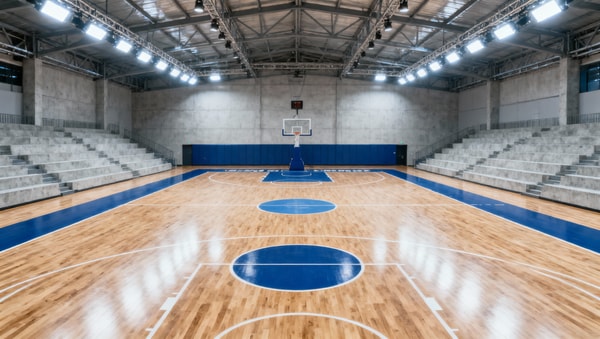
Fixed basketball hoops for school are typically the stronger choice where daily use, competitive play, and long-term durability matter more than layout flexibility. A properly anchored system offers more consistent performance and a better user experience, especially for middle school, high school, and advanced training environments.
Best-fit situations for fixed systems
- Dedicated indoor courts designed primarily for basketball programs.
- Outdoor school courts intended for year-round sports use.
- Campuses hosting tournaments, inter-school competition, or structured training.
- Facilities where long-term site planning supports permanent installation.
Main advantages project teams should value
The key advantage is structural stability. Fixed systems generally provide less vibration, more predictable rebound response, and better resistance to impact over time. They also reduce movement-related wear and simplify supervision because the equipment remains in a controlled position. For institutional buyers, this often means stronger lifecycle value despite higher initial installation cost.
Checks that matter before approving fixed models
- Foundation design and anchor specifications for indoor or outdoor conditions.
- Clearance zones around the pole, backboard extension, and safety padding needs.
- Corrosion resistance, especially for outdoor campuses in humid or coastal regions.
- Service access for future repairs, net replacement, and rim maintenance.
- Compatibility with official court markings and competitive play requirements.
Side-by-side judgment criteria for project managers
The table below helps compare portable and fixed basketball hoops for school from a project execution perspective, not just a product marketing perspective.
Scenario-based selection tips by school environment
For primary and lower-grade campuses
Adjustability, safety padding, and supervised use are top priorities. Portable basketball hoops for school may work well if younger students use shared play areas and if the school needs to clear space frequently. Still, stability should never be compromised for convenience.
For secondary schools and competitive programs
Fixed systems are often more suitable. They support repeated use, structured training, and a more professional court feel. If the school hosts events or league games, permanent hoops usually provide better long-term consistency.
For outdoor campus recreation zones
Weather exposure changes the equation. UV resistance, anti-rust treatment, drainage around foundations, and vandal resistance should be prioritized. Portable units may seem simpler, but in high-wind or unsupervised outdoor settings, fixed basketball hoops for school often present lower risk.
For shared gymnasiums and event halls
Portable systems can be the operationally smarter choice if basketball is only one of several functions. The key is to specify commercial-grade units with reliable locking, durable transport components, and clear storage procedures.
Commonly overlooked risk points in basketball hoops for school procurement
- Ignoring floor protection. Portable systems can damage gym flooring if wheel material and movement procedures are not matched to the surface.
- Focusing only on purchase price. Lower-cost units may generate higher replacement and repair costs within a short period.
- Underestimating assembly complexity. Even portable products may require careful setup, balancing, and routine inspection.
- Not defining user behavior. Student dunking, unsupervised after-hours access, and mixed-age use all affect equipment specification.
- Skipping spare-parts planning. Nets, rims, padding, and hardware availability should be confirmed before ordering.
- Overlooking local standards. School projects should verify applicable safety, structural, and institutional procurement requirements early.
Execution checklist: what to prepare before requesting quotations
To get useful supplier proposals for basketball hoops for school, project teams should prepare a clear specification package instead of asking only for a generic product catalog.
- State the court type, dimensions, and indoor or outdoor condition.
- Describe expected users, frequency of use, and whether competition-level play is required.
- Clarify whether portability, height adjustment, or storage is mandatory.
- Request material details for backboard, rim, frame, coating, and padding.
- Ask for installation requirements, anchoring drawings, and maintenance instructions.
- Confirm warranty scope, spare-parts availability, and after-sales response time.
- Request project references for schools, campuses, or institutional sports facilities.
Practical recommendation: how to make the final choice
Choose portable basketball hoops for school when the campus needs flexible space planning, phased deployment, and lower installation disruption. Choose fixed basketball hoops for school when court performance, impact stability, and long-term institutional durability are the leading priorities. If your project includes both a formal court and a shared-use area, a mixed strategy can also be efficient: install fixed systems on the main court and use portable units for overflow or multi-purpose spaces.
For project managers, the best decision is rarely about one product being universally better. It is about selecting the option that fits operational reality, site conditions, risk tolerance, and lifecycle expectations. That is where structured evaluation creates measurable value.
Next-step questions to raise with suppliers and internal stakeholders
If your team is moving forward with basketball hoops for school procurement, prioritize these questions in the next discussion: What level of play must the system support? What installation constraints exist on site? Which safety and compliance documents are required? How will maintenance be handled after handover? What is the realistic budget when transport, installation, spare parts, and service are included?
Answering those questions early will help your procurement team compare offers more accurately, avoid under-specification, and secure a solution that works not only on delivery day, but throughout the full life of the school sports facility.
Search News
Hot Articles
Popular Tags
Need ExpertConsultation?
Connect with our specialized leisureengineering team for procurementstrategies.
Recommended News
 May 06, 2026Basketball hoops for school: portable convenience vs fixed stabilityBasketball hoops for school: compare portable convenience and fixed stability to choose safer, smarter, and more cost-effective solutions for campus courts.● Theme Park Strategist
 May 06, 2026Montessori wooden toys and the question of long-term durabilityMontessori wooden toys: discover what really determines long-term durability, safety, and value, and learn how buyers can choose options built for repeated use.● Theme Park Strategist
 May 06, 2026Wholesale ping pong tables for schools: what wears out firstWholesale ping pong tables for schools: learn what wears out first, from casters to locks, and use this buyer-focused guide to cut replacement costs and choose safer, longer-lasting tables.● Theme Park Strategist
 May 06, 2026Gymnastic mats wholesale: thickness claims vs real shock absorptionGymnastic mats wholesale buyers: learn why thickness claims alone can mislead. Compare real shock absorption, foam density, rebound control, and sourcing checks before you buy.● Theme Park Strategist
 May 06, 2026Abacus learning toys still matter when math goes digitalAbacus learning toys still matter in digital math, helping children build number sense, focus, and hands-on problem-solving. See why educators, parents, and buyers still choose them.● Theme Park Strategist
 May 06, 2026Liaoning Tieren Appoints Shin Jeong-won; K-League Training Gear Sourcing Shift PossibleLiaoning Tieren appoints K-League coach Shin Jeong-won — sparking Korean demand for ISO 10993-certified smart athletic wear, especially heart-rate & GPS training vests.● Theme Park Strategist
 May 06, 2026NBA LED Interactive Court System Enters Mass ProductionNBA LED interactive court system enters mass production in Q3 2026 — a breakthrough for smart sports venues, AR fan engagement, and global LED display suppliers.● Theme Park Strategist
 May 06, 2026NBA Adopts New LED Interactive Court Floors in 2026–27 SeasonNBA LED interactive court floors launch in 2026–27: AR fan engagement, real-time stats & certified hardware — game-changing for global sports tech suppliers.● Theme Park Strategist
 May 06, 2026HuaiBA Youth Basketball Arena Adopts Domestic Smart Floor SystemHuaiBA Youth Basketball Arena's domestic smart floor system sets a new benchmark—featuring real-time pressure sensing & acoustic feedback for global sports infrastructure buyers.● Theme Park Strategist
 May 06, 2026Swedish Team’s Historic Win Spurs EU Demand for Chinese AI Ping-Pong MachinesAI ping-pong machines surge in EU demand after Sweden’s historic win over China—explore CE-compliant Chinese smart training tech now.● Theme Park Strategist
 May 06, 2026Snooker World Championship Boosts Billiards Table DemandSnooker World Championship drives global demand for billiards tables—especially smart-scoring & carbon-fiber models with FIBA-compatibility and multilingual UI.● Theme Park Strategist
 May 06, 2026FIBA 2026 Basketball Court Standards: LED Lighting & Acoustic Flooring Now MandatoryFIBA 2026 mandates LED lighting uniformity ≥0.8 & acoustic flooring ≥35 dB—key for exporters targeting CE, SASO, GOST markets. Act now to align.● Theme Park Strategist
 May 05, 2026FIBA 2026 Court Guidelines Enforce LED Uniformity & Floor AcousticsFIBA 2026 Court Guidelines mandate LED uniformity ≥0.8 & floor acoustics ≥35 dB @ 63 Hz—key for exporters targeting Qatar, Indonesia, Mexico tenders.● Theme Park Strategist
 May 05, 2026Sweden’s 26-Year Win Over China Spurs EU Demand for SpinMaster X9SpinMaster X9 AI table tennis robot surges in EU demand after Sweden’s historic 26-year win over China—CE & TÜV-certified units now priority for clubs and suppliers.● Theme Park Strategist
 May 05, 2026Wu Yize’s Snooker Final Surge Drives 37% Global Inquiry Spike for Regulation TablesRegulation snooker tables see 37% global B2B inquiry surge amid Wu Yize’s historic World Championship final — act now on WPBSA-compliant demand from UAE, KSA, Brazil & Thailand.● Theme Park Strategist
 May 05, 2026HuaiBA Basketball Arena Adopts Chinese Smart Flooring, Triggers SASO 5853 Acoustic TestingHuaiBA Basketball Arena adopts Chinese smart flooring—triggers SASO 5853 acoustic testing. Key insight for sports flooring exporters, GCC compliance, and ISO 10137 vibration analysis.● Theme Park Strategist
 May 04, 2026HuaiBA Basketball Court in Jinan Adopts Chinese Smart FlooringHuaiBA Basketball Court in Jinan adopts Chinese smart flooring — a breakthrough for ISO 20342 & SASO 5853-compliant sports surfaces in GCC markets.● Theme Park Strategist
 May 03, 2026CBA Game Triggers SASO 5853 Acoustic Certification Demand for Smart Basketball FloorsCBA game sparks SASO 5853 acoustic certification demand for smart basketball floors—key for GCC exporters, labs & specifiers. Act now.● Theme Park Strategist
 May 03, 2026Raptors G6 Barrett Buzzer-Beater Triggers FCC Part 15B Re-Testing for Commercial Rim-Vibration ModulesRaptors G6 Barrett buzzer-beater exposed FCC Part 15B compliance gaps for commercial rim-vibration modules—urgent re-testing now required across US, CA, MX markets.● Theme Park Strategist
 May 02, 20262026 Jiujiang Guokong Cup Tennis Open Spurs ASEAN Demand for AI Ball MachinesAI ball machines surge 165% amid 2026 Jiujiang Guokong Cup — urgent ASEAN MRA certification needed for Thailand/Vietnam exports.● Theme Park Strategist
 May 02, 2026China's Speed Relay Record Boosts EN 15613-Compliant Climbing Gear ExportsEN 15613-compliant climbing gear exports surge 140% after China’s Dubai speed relay record—key insights for manufacturers, labs & logistics providers.● Theme Park Strategist
 May 01, 2026Playground Borders That Reduce Mess and Keep Zones ClearPlayground borders reduce mess, define activity zones, and improve maintenance control. Discover durable, site-smart solutions for safer, cleaner, more organized play areas.● Theme Park Strategist
 May 01, 2026Inclusive Playground Features Families Notice Right AwayInclusive playground features families notice first: step-free access, stable surfacing, sensory balance, and shared play. Use this practical guide to evaluate safer, truly welcoming spaces.● Theme Park Strategist
 May 01, 2026Toddler Playground Layout Mistakes That Limit Safe PlayToddler playground layout mistakes can quietly increase risk. Learn how better zoning, circulation, and visibility create safer, compliant play spaces for every project.● Theme Park Strategist