Wholesale ping pong tables for schools: what wears out first
When schools invest in wholesale ping pong tables, the first failures rarely come from gameplay alone. High student traffic, frequent relocation, uneven storage, and inconsistent maintenance often wear out specific components faster than buyers expect. For procurement teams, understanding what breaks first helps reduce replacement costs, improve safety, and choose tables that deliver better long-term value across busy educational environments.
For buyers in education supply chains, a checklist approach works better than a brochure comparison. Most product sheets highlight tabletop thickness, brand image, or tournament language, but school use creates a different wear profile. A table used in a gym, cafeteria overflow area, student center, or dorm common room is exposed to rolling, folding, stacking, bumps, humidity, and supervision gaps. That means the smartest way to evaluate wholesale ping pong tables is to identify the parts that fail first, then use those weak points as procurement filters.
This guide is designed for procurement teams, institutional buyers, and distributors serving schools. It focuses on the parts most likely to wear out, the inspection points that matter before ordering, and the practical questions that improve long-term value. Instead of asking only which table looks best on day one, buyers should ask which table will still operate safely after repeated student use, seasonal storage moves, and limited maintenance support.
Why procurement teams should judge wear points before comparing price
In school settings, failure costs are rarely limited to replacement. A damaged caster can make transport difficult. A weak locking system can create a safety issue during setup. A chipped edge can shorten usable life even if the playing surface still works. For this reason, wholesale ping pong tables should be evaluated by total operating risk, not just unit cost or shipping convenience.
A lower-priced table may appear attractive in a large-volume bid, but if key components fail early, the hidden costs rise quickly. Schools then face spare part sourcing, labor time, student complaints, downtime, and inconsistent equipment standards across campuses. A structured wear checklist helps buyers reduce these long-term problems and supports more accurate lifecycle budgeting.
The first components that usually wear out on wholesale ping pong tables
The following order reflects common school-use conditions rather than elite club play. In educational environments, movement and handling often cause more damage than the ball itself.
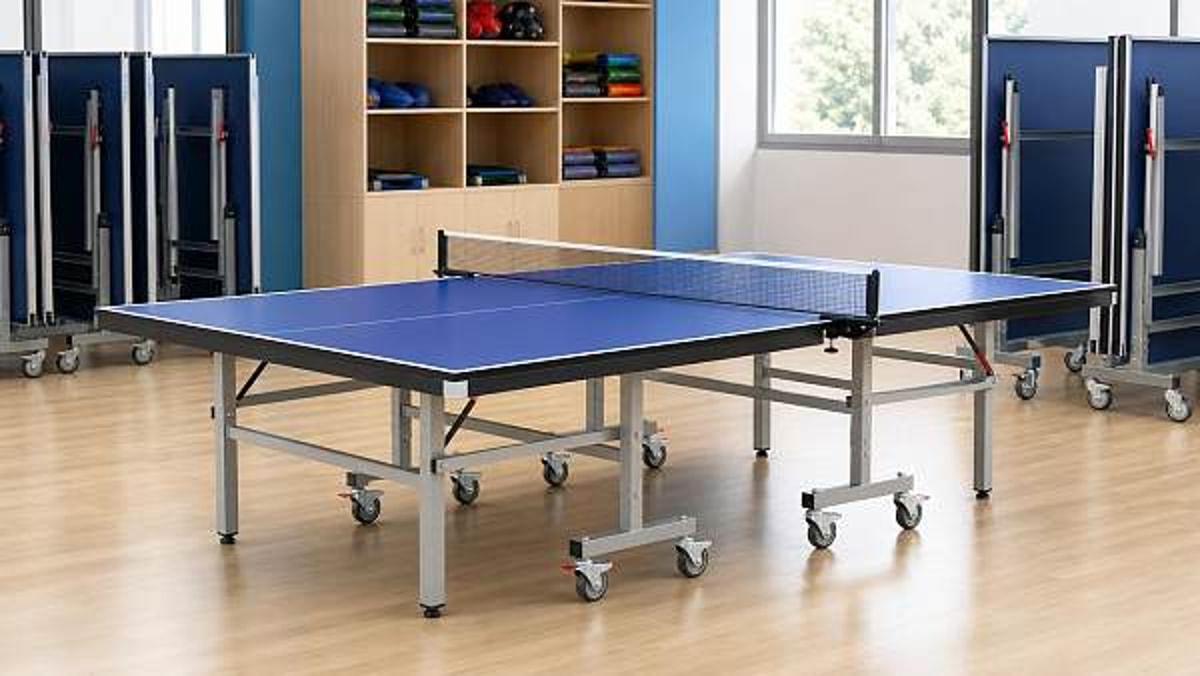
- Casters and wheels: These are often the first visible failure point. School staff and students move tables across tile, concrete, wood, and uneven thresholds. Low-grade wheels crack, wobble, flatten, or stop rolling smoothly. Once caster performance declines, users drag the table, which creates further frame damage.
- Wheel locks and brake mechanisms: Even when wheels remain intact, locking parts often loosen or fail. If a brake no longer holds properly, the table becomes unstable during play or storage.
- Folding hinges and pivot joints: Repeated opening and closing creates wear in the moving hardware. Weak hinges can become misaligned, noisy, stiff, or unsafe over time.
- Leg locking systems: Spring locks, release handles, and latch assemblies are critical in schools because multiple users may set up the same table. If these parts wear out early, the risk shifts from inconvenience to injury.
- Edge banding and corner protection: Table edges are highly vulnerable during transport and storage. Chipped corners, peeling edge strips, and impact damage are common in busy multipurpose rooms.
- Net posts and clamp systems: These smaller accessories are frequently misplaced, over-tightened, or bent. They are inexpensive compared with the full table, but repeated replacement disrupts operations.
- Surface coating: The tabletop itself usually lasts longer than moving parts, but poor coatings can scratch, bubble, fade, or absorb moisture. This is especially relevant where tables are stored in humid or semi-open facilities.
Core inspection checklist before ordering wholesale ping pong tables
Procurement teams should use a practical inspection list that goes beyond catalog photos. The goal is to verify whether the table is built for institutional handling, not just recreational use.
- Check caster specification, not just caster quantity. Confirm wheel diameter, material, axle strength, and whether replacement casters are standardized. Larger, durable wheels generally perform better on school floors and door transitions.
- Inspect the folding and locking system in action. Ask for a video demonstration or sample review showing opening, closing, locking, and nesting. Smooth operation matters as much as static stability.
- Review frame gauge and weld quality. Light frames reduce shipping weight but may twist under frequent movement. Buyers should request frame material details and photos of key joints.
- Verify corner and edge protection. If the table will be moved often, reinforced edge treatment can extend service life significantly.
- Ask about spare part availability. A supplier of wholesale ping pong tables should be able to support replacement wheels, locks, net sets, and hardware without forcing a full-table reorder.
- Confirm storage footprint and nesting behavior. Some tables look compact but create pressure points when grouped. Poor storage design increases impact damage.
- Check packaging protection for institutional delivery. Weak export packaging can lead to corner damage before the table ever reaches campus.
A simple decision table for high-wear school environments
How wear patterns change by school type and usage scenario
Not all educational buyers should prioritize the same features. The first wear point depends heavily on where and how the tables are used.
K-12 schools
In primary and secondary schools, rough handling and supervision gaps make safety hardware a top priority. Locks, anti-tip stability, and edge protection matter more than advanced play characteristics. Wholesale ping pong tables for this segment should be chosen for durability, simple operation, and low misuse risk.
Colleges and universities
In higher education, tables may be located in residence halls, student recreation areas, or mixed-use common spaces. Here, movement frequency increases. Casters, folding joints, and replacement parts become critical because equipment is often repositioned for events, cleaning, or room conversion.
Sports programs and dedicated activity rooms
Where gameplay quality matters more, the surface and frame flatness gain importance. However, even in these settings, institutional wear still begins with transport hardware if the tables are not permanently installed.
Commonly overlooked risks when sourcing wholesale ping pong tables
Many procurement issues come from details that are not obvious in quotations. These overlooked items often determine whether the purchase performs well after delivery.
- Replacement policy gaps: Some suppliers offer attractive pricing but weak after-sales support for hardware failures.
- Overemphasis on tabletop thickness: Thickness matters, but in schools the undercarriage often fails earlier than the top.
- Ignoring storage conditions: Tables stored near exterior walls, damp rooms, or non-climate-controlled facilities face faster surface degradation.
- Not checking assembly complexity: If setup is time-consuming or error-prone, institutional staff may stress hardware during installation.
- Assuming all “commercial” labels mean the same thing: Some tables are marketed for commercial use but designed mainly for light indoor recreation.
Execution tips for buyers building a durable school specification
If your organization is preparing a bid or comparing multiple suppliers of wholesale ping pong tables, create a specification sheet that reflects actual school wear conditions. This usually leads to better long-term results than selecting from general retail descriptions.
A practical school-oriented specification should include minimum caster performance, reinforced folding hardware, stable locking mechanisms, impact-resistant edge finishing, and documented spare part support. It should also define expected use frequency, storage method, floor type, and who will typically move the table. These operating details help suppliers recommend models that fit the real environment rather than a generic market segment.
It is also useful to request the following before confirming an order: product testing information, packaging details, warranty terms for moving parts, lead time for replacement components, and references from other education or institutional projects. For large-volume school procurement, a pre-shipment inspection standard can further reduce damage claims and installation issues.
FAQ for procurement teams evaluating wholesale ping pong tables
What usually wears out before the playing surface?
In most school environments, casters, locks, hinges, and edge protection fail before the tabletop itself. Movement and storage create more wear than normal rallies.
Should buyers prioritize thicker tops for schools?
Only if gameplay performance is a major requirement. For general campus use, hardware durability and safe folding design often matter more than increasing top thickness alone.
Are spare parts important for large orders?
Yes. For wholesale ping pong tables, access to wheels, locks, net assemblies, and basic hardware can extend useful life and improve total cost control.
How can schools reduce premature wear after delivery?
Train staff on correct folding, avoid dragging tables, store them on level surfaces, inspect wheels regularly, and keep tables away from moisture-prone areas.
Final checklist before moving forward with a supplier
Before placing a bulk order for wholesale ping pong tables, buyers should confirm five final points: which component is most likely to wear first in their campus setting, whether replacement parts are available locally or through the supplier, how the locking and wheel systems perform under repeated use, what storage conditions the table can tolerate, and whether the supplier has real institutional project experience. These questions help convert a simple product purchase into a lower-risk equipment decision.
If your team needs to confirm parameters, model suitability, project volume, delivery schedules, budget alignment, or OEM/ODM sourcing options, the best next step is to prepare a usage brief covering student age group, installation area, movement frequency, storage constraints, and maintenance capacity. With those details in hand, suppliers and sourcing partners can recommend wholesale ping pong tables that are better matched to real educational wear patterns and long-term procurement goals.
Search News
Hot Articles
Popular Tags
Need ExpertConsultation?
Connect with our specialized leisureengineering team for procurementstrategies.
Recommended News
 May 06, 2026Basketball hoops for school: portable convenience vs fixed stabilityBasketball hoops for school: compare portable convenience and fixed stability to choose safer, smarter, and more cost-effective solutions for campus courts.● Theme Park Strategist
 May 06, 2026Montessori wooden toys and the question of long-term durabilityMontessori wooden toys: discover what really determines long-term durability, safety, and value, and learn how buyers can choose options built for repeated use.● Theme Park Strategist
 May 06, 2026Wholesale ping pong tables for schools: what wears out firstWholesale ping pong tables for schools: learn what wears out first, from casters to locks, and use this buyer-focused guide to cut replacement costs and choose safer, longer-lasting tables.● Theme Park Strategist
 May 06, 2026Gymnastic mats wholesale: thickness claims vs real shock absorptionGymnastic mats wholesale buyers: learn why thickness claims alone can mislead. Compare real shock absorption, foam density, rebound control, and sourcing checks before you buy.● Theme Park Strategist
 May 06, 2026Abacus learning toys still matter when math goes digitalAbacus learning toys still matter in digital math, helping children build number sense, focus, and hands-on problem-solving. See why educators, parents, and buyers still choose them.● Theme Park Strategist
 May 06, 2026Liaoning Tieren Appoints Shin Jeong-won; K-League Training Gear Sourcing Shift PossibleLiaoning Tieren appoints K-League coach Shin Jeong-won — sparking Korean demand for ISO 10993-certified smart athletic wear, especially heart-rate & GPS training vests.● Theme Park Strategist
 May 06, 2026NBA LED Interactive Court System Enters Mass ProductionNBA LED interactive court system enters mass production in Q3 2026 — a breakthrough for smart sports venues, AR fan engagement, and global LED display suppliers.● Theme Park Strategist
 May 06, 2026NBA Adopts New LED Interactive Court Floors in 2026–27 SeasonNBA LED interactive court floors launch in 2026–27: AR fan engagement, real-time stats & certified hardware — game-changing for global sports tech suppliers.● Theme Park Strategist
 May 06, 2026HuaiBA Youth Basketball Arena Adopts Domestic Smart Floor SystemHuaiBA Youth Basketball Arena's domestic smart floor system sets a new benchmark—featuring real-time pressure sensing & acoustic feedback for global sports infrastructure buyers.● Theme Park Strategist
 May 06, 2026Swedish Team’s Historic Win Spurs EU Demand for Chinese AI Ping-Pong MachinesAI ping-pong machines surge in EU demand after Sweden’s historic win over China—explore CE-compliant Chinese smart training tech now.● Theme Park Strategist
 May 06, 2026Snooker World Championship Boosts Billiards Table DemandSnooker World Championship drives global demand for billiards tables—especially smart-scoring & carbon-fiber models with FIBA-compatibility and multilingual UI.● Theme Park Strategist
 May 06, 2026FIBA 2026 Basketball Court Standards: LED Lighting & Acoustic Flooring Now MandatoryFIBA 2026 mandates LED lighting uniformity ≥0.8 & acoustic flooring ≥35 dB—key for exporters targeting CE, SASO, GOST markets. Act now to align.● Theme Park Strategist
 May 05, 2026FIBA 2026 Court Guidelines Enforce LED Uniformity & Floor AcousticsFIBA 2026 Court Guidelines mandate LED uniformity ≥0.8 & floor acoustics ≥35 dB @ 63 Hz—key for exporters targeting Qatar, Indonesia, Mexico tenders.● Theme Park Strategist
 May 05, 2026Sweden’s 26-Year Win Over China Spurs EU Demand for SpinMaster X9SpinMaster X9 AI table tennis robot surges in EU demand after Sweden’s historic 26-year win over China—CE & TÜV-certified units now priority for clubs and suppliers.● Theme Park Strategist
 May 05, 2026Wu Yize’s Snooker Final Surge Drives 37% Global Inquiry Spike for Regulation TablesRegulation snooker tables see 37% global B2B inquiry surge amid Wu Yize’s historic World Championship final — act now on WPBSA-compliant demand from UAE, KSA, Brazil & Thailand.● Theme Park Strategist
 May 05, 2026HuaiBA Basketball Arena Adopts Chinese Smart Flooring, Triggers SASO 5853 Acoustic TestingHuaiBA Basketball Arena adopts Chinese smart flooring—triggers SASO 5853 acoustic testing. Key insight for sports flooring exporters, GCC compliance, and ISO 10137 vibration analysis.● Theme Park Strategist
 May 04, 2026HuaiBA Basketball Court in Jinan Adopts Chinese Smart FlooringHuaiBA Basketball Court in Jinan adopts Chinese smart flooring — a breakthrough for ISO 20342 & SASO 5853-compliant sports surfaces in GCC markets.● Theme Park Strategist
 May 03, 2026CBA Game Triggers SASO 5853 Acoustic Certification Demand for Smart Basketball FloorsCBA game sparks SASO 5853 acoustic certification demand for smart basketball floors—key for GCC exporters, labs & specifiers. Act now.● Theme Park Strategist
 May 03, 2026Raptors G6 Barrett Buzzer-Beater Triggers FCC Part 15B Re-Testing for Commercial Rim-Vibration ModulesRaptors G6 Barrett buzzer-beater exposed FCC Part 15B compliance gaps for commercial rim-vibration modules—urgent re-testing now required across US, CA, MX markets.● Theme Park Strategist
 May 02, 20262026 Jiujiang Guokong Cup Tennis Open Spurs ASEAN Demand for AI Ball MachinesAI ball machines surge 165% amid 2026 Jiujiang Guokong Cup — urgent ASEAN MRA certification needed for Thailand/Vietnam exports.● Theme Park Strategist
 May 02, 2026China's Speed Relay Record Boosts EN 15613-Compliant Climbing Gear ExportsEN 15613-compliant climbing gear exports surge 140% after China’s Dubai speed relay record—key insights for manufacturers, labs & logistics providers.● Theme Park Strategist
 May 01, 2026Playground Borders That Reduce Mess and Keep Zones ClearPlayground borders reduce mess, define activity zones, and improve maintenance control. Discover durable, site-smart solutions for safer, cleaner, more organized play areas.● Theme Park Strategist
 May 01, 2026Inclusive Playground Features Families Notice Right AwayInclusive playground features families notice first: step-free access, stable surfacing, sensory balance, and shared play. Use this practical guide to evaluate safer, truly welcoming spaces.● Theme Park Strategist
 May 01, 2026Toddler Playground Layout Mistakes That Limit Safe PlayToddler playground layout mistakes can quietly increase risk. Learn how better zoning, circulation, and visibility create safer, compliant play spaces for every project.● Theme Park Strategist