Why leather bracelets OEM fails on samples and lead time
When leather bracelets OEM projects fail, the first warnings usually appear in sample approval and lead time accuracy.
These early failures are not random. They often expose unstable leather grading, weak process discipline, unclear specifications, and poor production scheduling.
In global sourcing, leather bracelets OEM performance matters because accessories combine design sensitivity, small-part precision, and strict delivery expectations.
A supplier that misses samples or lead time on simple bracelet programs may also struggle with larger custom accessories, gifting lines, and branded retail collections.
This article explains why leather bracelets OEM breaks down, what signals deserve attention, and how to reduce sourcing risk before volume commitment.
Basic Overview of Leather Bracelets OEM
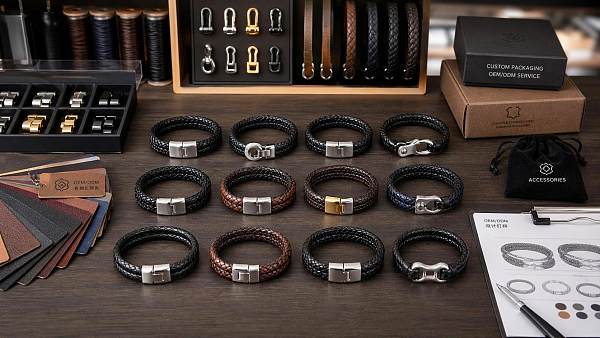
Leather bracelets OEM refers to custom production based on a buyer’s design, material standard, packaging requirement, and commercial target.
The process usually includes design review, raw material confirmation, sample development, cost validation, pilot production, and bulk manufacturing.
Compared with simple commodity items, leather bracelets OEM involves more variables in feel, color, hardware fit, edge finishing, and brand presentation.
That complexity makes sample quality a strong predictor of future consistency. Lead time, meanwhile, reveals how mature the factory’s planning system really is.
In many sourcing cases, a bracelet looks easy on paper but becomes difficult once multiple leather types, plating options, logo methods, and packaging details are combined.
Why samples and lead time matter first
Samples show technical capability under controlled conditions. Lead time shows whether that capability can survive under commercial pressure.
A factory may produce one acceptable sample by rework. That does not mean it can deliver 5,000 units on schedule with matching quality.
Industry Signals Behind Repeated Failure
Across global commercial trade, custom accessories face rising expectations for traceability, finish consistency, and fast product launch cycles.
Leather bracelets OEM is especially exposed because it sits between fashion aesthetics and industrial execution.
The table below shows common warning signals and what they often mean inside the supply chain.
These issues are common in leather bracelets OEM because many factories rely on manual craft without matching documentation discipline.
Why Leather Bracelets OEM Fails on Samples
Sample failure usually begins before cutting or stitching. It starts when technical data is incomplete or interpreted differently by each team.
Material inconsistency
Leather is a natural material. Thickness, grain, softness, stretch, and color absorbency can vary even within the same specification.
If the supplier lacks strict grading rules, sample results become unstable. One round feels premium, the next looks dry or uneven.
Weak prototype engineering
Many sample rooms focus on appearance only. They may ignore tolerance, stress points, snap force, glue behavior, or wear resistance.
That creates attractive first samples that cannot survive normal use or mass production conditions.
Incomplete technical pack
Leather bracelets OEM depends on exact details: width, edge paint layers, stitch density, logo depth, plating tone, and packing sequence.
If any requirement remains verbal, teams fill gaps with assumptions. Assumptions are one of the largest causes of sample rejection.
Hardware and leather mismatch
Bracelets combine soft and rigid components. A beautiful leather strap can still fail because the clasp is oversized or plating stains the material.
This mismatch often appears in custom gift programs and branded collections that require exact color harmony.
Uncontrolled rework
Some sample approvals are achieved through hand correction. Edges are repainted, hardware is replaced, and defects are selectively hidden.
Such samples misrepresent real factory capability. In leather bracelets OEM, rework-heavy samples often predict bulk inconsistency.
Why Leather Bracelets OEM Fails on Lead Time
Lead time failure usually comes from planning weakness, not only slow workmanship. The most visible delay often hides several small scheduling gaps.
Raw material dependency
Custom leather colors, special embossing, and branded hardware often require outside suppliers. One delayed component can stop final assembly.
Factories with poor supplier coordination tend to promise short timelines before these dependencies are confirmed.
Capacity overbooking
Some workshops accept too many small custom orders because bracelets look simple. In reality, customization creates many interruptions and line changes.
This reduces output speed and creates queue conflicts with other accessories, packaging jobs, or urgent repeat orders.
Approval loop delays
Leather bracelets OEM schedules often fail because revisions are not built into the calendar. One sample rejection can shift every downstream milestone.
If the factory has no parallel planning for materials and packaging, lost days multiply quickly.
Quality escapes during bulk production
When defects appear late, units need sorting, repair, or remanufacture. This is one of the fastest ways to destroy promised shipment dates.
Business Value of Early Failure Analysis
Investigating leather bracelets OEM failure at the sample stage saves more than product cost. It protects calendar commitments, retail launch timing, and brand credibility.
In broader commercial sourcing, this matters for corporate gifting, hospitality retail, event merchandise, museum stores, fashion accessories, and luxury packaging ecosystems.
A disciplined review process also creates a stronger benchmark for other custom categories that depend on mixed materials and finishing consistency.
- Lower rework and return exposure
- Better forecast accuracy for launch windows
- Stronger comparison across potential suppliers
- More reliable cost control during bulk production
Typical Scenarios Where Risk Increases
Not every leather bracelets OEM program carries the same difficulty. Risk rises when customization depth increases or deadlines become less flexible.
Practical Measures to Improve Leather Bracelets OEM Results
The best control method is not stricter follow-up alone. It is a clearer system that forces technical alignment before production starts.
- Lock a complete specification sheet with material, tolerance, finish, and packaging details.
- Request sample comments in written form, linked to photos and measurable points.
- Confirm leather source, hardware source, and replacement options before order release.
- Ask for a production timeline that includes procurement, assembly, inspection, and packing.
- Use a pilot run when design complexity or branding sensitivity is high.
- Check whether approved samples were made under normal process, not manual rescue rework.
For leather bracelets OEM, consistency matters more than a single beautiful prototype. Repeatability is the real indicator of production maturity.
Next-Step Evaluation Framework
Before moving forward with any leather bracelets OEM project, build a simple gate review based on evidence, not promises.
Compare sample stability, communication speed, bill of materials clarity, and timeline realism across the same approval criteria.
If failures already appear in early rounds, treat them as strategic signals. They often reveal how the supplier will behave under scale.
A stronger leather bracelets OEM decision starts with disciplined screening, documented standards, and realistic lead time verification before bulk commitment.
That approach reduces risk not only for bracelets, but for wider custom accessory sourcing across premium commercial and retail programs.
Search News
Hot Articles
- Indoor PlaygroundHow to Choose Animatronic Haunted House Props for High-Throughput AttractionsOct 08, 2026
- Fashion & Gem JewelryThermal Diamond Testers: How They Work and When They Can Misidentify StonesOct 07, 2026
- Commercial KitchenWhat Is Driving Demand for Commercial Hospitality Projects Across the GCC?Oct 06, 2026
Popular Tags
Need ExpertConsultation?
Connect with our specialized leisureengineering team for procurementstrategies.
Recommended News
 Oct 07, 2026Thermal Diamond Testers: How They Work and When They Can Misidentify StonesThermal diamond tester guide: learn how it works, spot false positives from moissanite, and choose reliable verification methods for jewelry trade and retail.● Luxury Retail Analyst
 Oct 02, 2026Diamond Tester Wholesale: How to Vet Accuracy, Calibration, and MOQ Before OrderingDiamond tester wholesale guide: verify accuracy, calibration records, supplier quality controls, and MOQ terms before ordering. Source reliable testers with confidence.● Luxury Retail Analyst
 Sep 09, 2026Wholesale Coral Earrings: How Buyers Can Assess Quality, Treatments, and Supply RiskCoral jewelry earrings wholesale guide for buyers: assess quality, treatments, secure settings, documentation, and supply risks before ordering.● Luxury Retail Analyst
 Sep 01, 2026How to Choose a Jewelry Laser Engraving Machine Manufacturer for Custom ProductionChoose a jewelry laser engraving machine manufacturer with proven sample testing, precision fixtures, workflow-ready software, and reliable support for custom production.● Luxury Retail Analyst
 Aug 27, 2026Evaluating Luxury Retail Accessories Suppliers: Quality, Lead Times, and Brand FitLuxury retail accessories supplier selection made clearer: assess quality, lead times, compliance, costs, and brand fit to protect premium launches and margins.● Luxury Retail Analyst
 Jul 29, 2026Fine Jewelry Price Guide: What Affects Cost and How to Judge Real ValueFine jewelry price guide for buyers: learn what drives cost in metals, gemstones, craftsmanship, certification, and branding so you can judge real value, reduce sourcing risk, and buy with confidence.● Luxury Retail Analyst
 Jul 14, 2026What to Ask an Enamel Jewelry Manufacturer Before Sampling and Mass ProductionEnamel jewelry manufacturer selection starts with the right questions. Learn what to ask about materials, color matching, MOQ, QC, compliance, and lead times before sampling and mass production.● Luxury Retail Analyst
 Jul 12, 2026Surgical Steel Belly Rings vs Titanium: Material Differences, Safety, and CostSurgical steel belly rings vs titanium: compare safety, nickel exposure, comfort, durability, and cost to choose the best option for sensitive skin or budget-friendly style.● Luxury Retail Analyst
 Jul 12, 2026Natural Coral Jewelry Guide: How to Identify Real Coral, Treatments, and QualityNatural coral jewelry guide covering how to identify real coral, spot treatments, assess quality, and buy with confidence. Learn the key signs before you choose.● Luxury Retail Analyst
 Jul 11, 2026Braided Leather Bracelets OEM: Material, Clasp, and MOQ Factors Before SamplingBraided leather bracelets OEM guide covering material grades, clasp options, and MOQ factors before sampling. Learn how to reduce sourcing risk, control cost, and choose the right supplier.● Luxury Retail Analyst
 Jul 09, 2026Jewelry Craftsmanship Gemstone Setting Methods Explained: Prong, Bezel, Pave, and MoreJewelry craftsmanship gemstone setting explained clearly: compare prong, bezel, pavé, channel, and more to choose secure, beautiful, and commercially smart jewelry designs.● Luxury Retail Analyst
 Jul 06, 2026Photo Locket Necklace Manufacturer Selection Guide: Materials, MOQ, and Custom OptionsPhoto locket necklace manufacturer selection guide covering materials, MOQ, custom options, compliance, and quality checks to help buyers source smarter and build stronger jewelry lines.● Luxury Retail Analyst
 Jul 05, 2026What to Check When Comparing a Sterling Silver Clasp ManufacturerChoosing a sterling silver clasp manufacturer? Learn what to check first: 925 silver claims, finish quality, testing, compliance, lead times, and hidden sourcing costs.● Luxury Retail Analyst
 Jul 02, 2026Jewelry Craftsmanship Techniques Explained: Casting, Stone Setting, Engraving, and PolishingJewelry craftsmanship techniques explained: discover how casting, stone setting, engraving, and polishing shape quality, durability, and sourcing confidence.● Luxury Retail Analyst
 Jul 01, 2026Lost Wax Casting Machines Explained: Types, Capacity, and Metal CompatibilityLost wax casting machines explained: compare types, real capacity, and metal compatibility to choose the right system for precision casting, higher quality, and smarter sourcing.● Luxury Retail Analyst
 Jun 29, 2026How to Evaluate a Luxury Accessories Online Store Before You BuyLuxury accessories online store buying guide: learn how to verify authenticity, compare policies, check reviews, and avoid costly mistakes before you place an order.● Luxury Retail Analyst
 Jun 22, 2026Matching Couple Rings: Popular Materials, Fit Differences, and How to ChooseMatching couple rings guide: compare popular materials, fit differences, comfort, durability, and resizing options to choose a stylish pair that truly lasts.● Luxury Retail Analyst
 Jun 19, 2026How to Build a Fashion Accessories Catalog That Improves Product Discovery and SalesFashion accessories catalog strategies that improve product discovery, filtering, and conversions. Learn how to structure pages, categories, and data to drive more qualified sales.● Luxury Retail Analyst
 Jun 19, 2026How to Choose Luxury Accessories for Women by Material, Style, and Price PointLuxury accessories for women: learn how to choose the right pieces by material, style, and price point for better value, timeless appeal, and smarter buying decisions.● Luxury Retail Analyst
 Jun 18, 2026Stainless Steel Rings Bulk: 304 vs 316L, Finishes, and Custom Order FactorsStainless steel rings bulk guide: compare 304 vs 316L, explore finish options, and learn key custom order factors to reduce sourcing risk and improve product value.● Luxury Retail Analyst
 Jun 18, 2026Body Piercing Jewelry Bulk Buying Guide: Materials, Sizes, and MOQ QuestionsBody piercing jewelry bulk buying guide covering safe materials, size checks, MOQ strategy, supplier screening, and compliance tips to reduce risk and source with confidence.● Luxury Retail Analyst
 Jun 18, 2026How to Evaluate a Luxury Jewelry Exporter for Quality, Compliance, and DeliveryLuxury jewelry exporter evaluation starts with more than design. Learn how to verify quality, compliance, and delivery control to source premium jewelry with less risk.● Luxury Retail Analyst
 Jun 17, 2026Iced Out Watches Wholesale: How to Compare MOQ, Stone Quality, and MarginsIced out watches wholesale guide: compare MOQ, stone quality, and real margins to choose reliable suppliers, reduce risk, and grow resale profits with smarter sourcing.● Luxury Retail Analyst
 Jun 15, 2026How to Evaluate an Amber Jewelry Manufacturer: Quality Grades, OEM Options, and Lead TimesAmber jewelry manufacturer selection starts with quality grades, OEM capability, and realistic lead times. Learn how to compare suppliers, reduce sourcing risk, and choose with confidence.● Luxury Retail Analyst