Banquet chairs wholesale: stacking height can change storage costs
For procurement teams, banquet chairs wholesale decisions go far beyond unit price. Stacking height directly affects storage density, labor efficiency, transport planning, and ultimately total operating cost. Understanding this often-overlooked factor helps buyers compare suppliers more accurately, reduce hidden expenses, and choose seating solutions that better support high-volume event operations and long-term commercial value.
Why storage scenarios matter more than many buyers expect
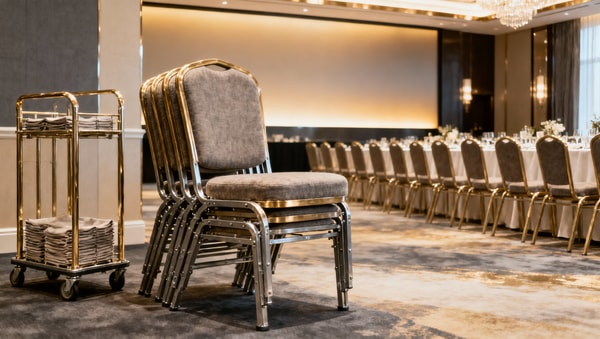
In banquet operations, the chair is not only a seating product; it is a moving asset. It is stacked, rolled, unloaded, stored, cleaned, and redeployed across changing room layouts. That is why banquet chairs wholesale evaluations should be based on real use scenarios rather than on appearance or quote sheets alone. A chair that looks cost-effective at purchase can create higher warehouse pressure, require more carts, increase handling time, and raise the risk of staff injury if the stacking profile is inefficient.
For procurement personnel in hotels, event venues, rental fleets, institutional dining spaces, and multi-site hospitality groups, stacking height is a practical metric with financial consequences. The difference between one supplier’s stack of 10 chairs and another supplier’s stack of 10 chairs may seem minor on paper, but across hundreds or thousands of units, vertical height changes aisle planning, truck loading logic, and the number of storage positions required.
This is where a smarter banquet chairs wholesale strategy creates value. Buyers who align chair design with operating conditions can lower total ownership cost, not just purchase cost. The right specification depends on where the chairs are used, how often layouts change, how much back-of-house space is available, and whether the organization values high stacking density over wider seating comfort or decorative form.
Typical business scenarios where stacking height changes the decision
Different commercial settings use banquet chairs in very different ways. Procurement teams should first classify their own operating model before comparing banquet chairs wholesale suppliers. The same chair may perform well in one environment and poorly in another.
Luxury hotels with frequent event turnover
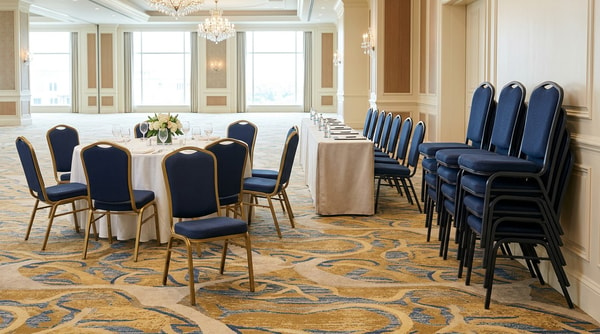
Five-star and upscale business hotels often run weddings, conferences, gala dinners, and corporate training sessions in the same ballroom within a short time period. In this scenario, staff move chairs repeatedly, often under tight reset schedules. Stacking height matters because every extra centimeter increases cart height and can slow movement through service corridors, elevators, and storage doors. Here, buyers should prioritize stable stacking, manageable stack weight, fabric durability, and scratch resistance in addition to design elegance.
Independent banquet halls and wedding venues
Standalone venues usually optimize for seasonal peaks and visual presentation. They may stock larger chair volumes for high-capacity events, but storage rooms are not always designed efficiently. In this case, banquet chairs wholesale selection should focus on how many chairs fit per cart, how many carts fit per room, and whether decorative back shapes reduce nesting efficiency. A beautiful frame can become expensive if it reduces the practical number of chairs that can be stored vertically.
Event rental companies and mobile service fleets
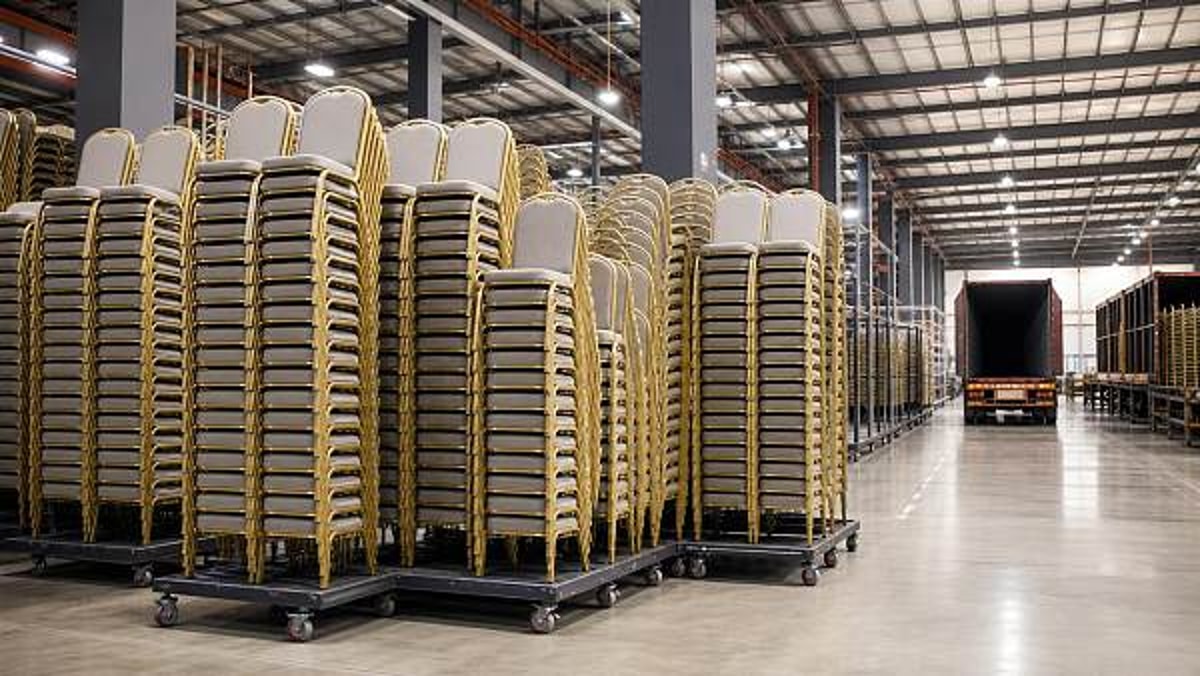
Rental operators are among the most storage-sensitive buyers in the banquet chairs wholesale market. Their assets spend significant time in trucks, depots, and temporary staging areas. Lower stacking height often means better cube utilization in vehicles and lower labor minutes per event. Since loading and unloading happen constantly, chair-to-chair abrasion, stack stability, and compatibility with transport dollies become critical. Rental fleets should test real loading patterns rather than relying on catalog measurements alone.
Convention centers and institutional spaces
Convention centers, campuses, and civic venues usually deal with scale. Their challenge is not only elegance but also deployment speed and storage discipline. If staff store 500 to 2,000 chairs after large assemblies, slight inefficiencies become major operational costs. Here, banquet chairs wholesale buyers should ask for stack height at defined quantities, cart compatibility, and recommended safe stacking limits by the manufacturer. Uniformity across batches is especially important because inconsistent dimensions reduce storage predictability.
A practical scenario comparison for procurement teams
The table below shows how stacking height should be judged differently across common commercial use cases. This helps buyers of banquet chairs wholesale products connect technical data to operating impact.
What procurement teams should check in each scenario
When comparing banquet chairs wholesale offers, stacking height should not be viewed as an isolated number. It must be assessed together with space, labor, mobility, and maintenance conditions. The same nominal stack height can perform differently depending on chair shape and cart system.
Back-of-house space availability
If storage rooms are shallow, vertical efficiency is more valuable than floor density alone. Buyers should calculate how many full stacks can be placed while still maintaining safe access aisles. In banquet chairs wholesale planning, a chair with a slightly higher unit price but lower stack height may reduce the need for overflow storage or external warehousing.
Labor model and handling frequency
Properties with lean staffing benefit from chairs that are easier to stack, roll, and separate quickly. If a venue resets rooms daily, labor savings can outweigh initial product cost. Procurement teams should ask suppliers how many chairs are recommended per stack for daily operations, not just maximum theoretical stacking limits. This is especially relevant in banquet chairs wholesale orders for hotel chains or high-throughput event sites.
Transport path constraints
Storage cost is not limited to the warehouse. It includes movement through loading bays, elevators, staging areas, and vehicle interiors. A stack that is too tall may require fewer chairs per move than expected because of route restrictions. That is why professional banquet chairs wholesale sourcing should include a route audit: door heights, elevator depth, truck dimensions, ramp angle, and cart turning radius.
Product protection during repeated stacking
Chairs with poor stack guidance or insufficient bumpers can suffer finish damage, fabric wear, and frame rubbing. This issue is common in high-cycle use environments such as rental fleets and conference hotels. A lower stack height advantage loses value if the chairs require frequent touch-up or upholstery replacement. Buyers should request test videos or samples to evaluate how the chair nests after repeated use.
How to estimate the real cost impact before placing a banquet chairs wholesale order
Procurement teams can convert stacking data into a business case by using a simple scenario-based model. This approach improves supplier comparison and supports internal approval discussions.
Start with five operating variables: total chair quantity, chairs per stack, stack height, storage room height, and number of daily or weekly handling cycles. Then add related cost factors such as cart count, labor minutes per room reset, truck capacity, and damage replacement rate. In banquet chairs wholesale evaluations, this analysis often reveals that a small design difference can alter annual cost more than expected.
- Calculate how many stacks are needed for your standard event inventory.
- Measure whether those stacks fit current storage without reducing aisle safety.
- Test how many chairs can be moved per labor hour with the proposed cart setup.
- Estimate truck loading efficiency for off-site or inter-venue transfer.
- Review whether stack pressure affects upholstery, frame finish, or seat shape over time.
A disciplined banquet chairs wholesale process treats the chair as part of an operating system. This mindset helps buyers defend quality-focused sourcing decisions to finance, operations, and facility management teams.
Common scenario mistakes that increase hidden storage costs
Many organizations evaluate banquet chairs wholesale products using showroom impressions or basic specifications only. That creates avoidable mistakes, especially when the purchase will support years of high-frequency commercial use.
Choosing by style without testing full stacks
A chair may look compact individually but stack inefficiently because of its back profile or seat spacing. Buyers should always request stack measurements at realistic quantities, such as 5, 8, or 10 chairs, depending on use conditions.
Ignoring the cart and trolley system
The chair and the cart must work as one solution. In banquet chairs wholesale projects, incompatible dollies can reduce the real number of movable chairs and create tipping risk. Procurement should assess whether carts are included, standardized, or custom-built for the exact frame.
Using supplier claims without route-based validation
A stack may fit in a warehouse but fail in service corridors or truck interiors. This is especially costly for multi-site groups that standardize one chair across properties with different layouts. Validation should happen at the property level whenever practical.
Focusing only on storage room cost
Hidden costs also appear in event setup speed, staff fatigue, product damage, and delayed room turnover. For banquet chairs wholesale buyers, total cost of use is a better metric than invoice cost alone.
FAQ for buyers evaluating banquet chairs wholesale options
How much difference in stacking height is financially meaningful?
Even a modest reduction can matter when inventory is large or handling is frequent. The impact becomes more meaningful in venues with limited storage height, high labor cost, or transport-dependent operations.
Should buyers always choose the lowest possible stack height?
Not always. The best banquet chairs wholesale choice balances compact stacking with comfort, aesthetics, structural stability, and finish protection. Extremely tight stacking can sometimes increase wear if the chair is poorly engineered.
What sample test is most useful before bulk purchase?
Ask for a live or recorded demonstration showing repeated stacking, cart loading, doorway passage, and unpacking speed. If possible, test the chair in your actual venue with your own operations team.
Making the right decision for your own operating scenario
The strongest banquet chairs wholesale decisions come from matching chair specification to business reality. A hotel with premium branding and fast ballroom turnover needs a different answer than a rental fleet focused on truck utilization, or a wedding venue managing seasonal peaks in limited storage space. In every case, stacking height is not a minor technical detail. It is a cost driver that affects storage planning, labor productivity, transport efficiency, and asset longevity.
Before finalizing a supplier, procurement teams should compare real stack measurements, storage layouts, cart systems, and handling workflows across their priority scenarios. That process leads to better supplier negotiations, more accurate total-cost analysis, and more resilient sourcing decisions. If your organization is reviewing banquet chairs wholesale opportunities, start by defining where and how the chairs will actually move, store, and cycle every week. That is where the smartest savings are usually found.
Search News
Hot Articles
- Commercial KitchenStainless steel GN pans with reinforced corners last longer in busy kitchensMay 02, 2026
- Hotel Room AmenitiesMemory foam hotel mattresses: when soft comfort leads to faster saggingMay 02, 2026
- Hotel Room AmenitiesElectronic hotel door locks: battery alerts are often less simple than they seemMay 02, 2026
Popular Tags
Need ExpertConsultation?
Connect with our specialized leisureengineering team for procurementstrategies.
Recommended News
 May 02, 2026Folding event tables that stay stable on uneven banquet floorsFolding event tables that stay stable on uneven banquet floors help reduce wobble, speed setup, and improve guest experience. Discover key features buyers should compare.● Hospitality Sourcing Dir
 May 02, 2026Banquet chairs wholesale: stacking height can change storage costsBanquet chairs wholesale decisions should consider stacking height, because smarter storage, faster handling, and lower transport costs can significantly improve long-term venue profitability.● Hospitality Sourcing Dir
 May 02, 2026When wholesale melamine plates look premium and when they do notWholesale melamine plates can look refined or cheap. Learn how finish, weight, design, and supplier quality affect premium appeal before you source for hospitality or retail.● Hospitality Sourcing Dir
 May 01, 2026Restaurant Booth Seating That Saves Space Without Feeling TightRestaurant booth seating that saves space without feeling cramped—discover smart dimensions, durable specs, and layout tips to boost comfort, traffic flow, and revenue.● Hospitality Sourcing Dir
 May 01, 2026How to Choose Commercial Bar Stools for High-Traffic VenuesCommercial bar stools for high-traffic venues: learn how to compare durability, safety, comfort, maintenance, and supplier reliability to choose seating that lasts and performs.● Hospitality Sourcing Dir
 Apr 28, 2026Why Hotel Tables Often Fail at Edges, Bases, and Surface FinishHotel tables often fail at edges, bases, and surface finish. Compare hotel furniture, custom furniture, luxury furniture, hotel chairs, hotel beds, and hotel equipment before you buy.● Hospitality Sourcing Dir
 Apr 28, 2026Hotel Tables With Stone Tops or Wood Tops: Which Performs Better?Hotel tables with stone tops or wood tops? Compare ROI, durability, and style across hotel furniture, custom furniture, hotel chairs, and hotel beds to choose smarter.● Hospitality Sourcing Dir
 Apr 28, 2026The Best Hotel Chairs Balance Comfort, Stackability, and DurabilityHotel chairs that balance comfort, stackability, and durability. Explore hotel furniture, custom furniture, hotel tables, hotel beds, and luxury furniture solutions for hospitality buyers.● Hospitality Sourcing Dir
 Apr 28, 2026Hotel Chairs: What Causes Wobbling, Cracks, and Early Wear?Hotel chairs buying guide: learn what causes wobbling, cracks, and early wear, and how to compare hotel furniture, custom furniture, hotel tables, hotel beds, and luxury furniture for lasting value.● Hospitality Sourcing Dir
 Apr 21, 2026Hotel tables that stay stable on uneven flooringHotel tables that stay stable on uneven flooring: a practical guide for hospitality procurement covering hotel furniture, commercial furniture, luxury furniture, and specs that reduce wobble, risk, and maintenance.● Hospitality Sourcing Dir
 Apr 21, 2026Round or rectangular hotel tables for tighter layouts?Hotel tables for tight layouts: compare round vs rectangular hotel furniture for better flow, seating, and hospitality procurement decisions. Find the best fit for compact hotel room furniture.● Hospitality Sourcing Dir
 Apr 21, 2026Why hotel chairs fail early in banquet spacesHotel chairs in banquet spaces fail early due to stacking, impact, and weak specs. Learn how hotel furniture and commercial furniture choices cut costs and improve hospitality procurement.● Hospitality Sourcing Dir
 Apr 21, 2026Hotel chairs that look elegant and still hold upHotel chairs that blend luxury furniture appeal with commercial furniture durability. Discover how hotel furniture works with hotel tables, hotel desks, and hotel room furniture for smarter hospitality procurement.● Hospitality Sourcing Dir
 Apr 23, 2026How to Choose Commercial Furniture That LastsCommercial furniture buying guide for hotels, schools, and leisure venues—covering hotel tables, playground safety, sensory playgrounds, and durable amusement equipment.● Hospitality Sourcing Dir
 Apr 23, 2026When Commercial Furniture Fails in High-Traffic VenuesLearn why commercial furniture fails in busy venues and how to choose safer hotel tables, playground borders, sensory playground solutions, amusement equipment, and hotel equipment that last.● Hospitality Sourcing Dir
 Apr 20, 2026Hotel tables with edge seams that trap moisture and moldHotel tables, park benches & commercial furniture with mold-trapping edge seams? Discover seamless, moisture-resistant hotel furniture solutions—luxury, custom, and compliant.● Hospitality Sourcing Dir
 Apr 20, 2026Hotel chairs rated for 100,000 cycles—but tested how?Discover how top hotel chairs, park benches & commercial furniture are truly tested for 100,000 cycles—backed by BIFMA, EN & GB/T standards. Get verified luxury furniture insights.● Hospitality Sourcing Dir
 Apr 19, 2026Hotel tables that warp under daily cleaning chemicalsHotel tables, hotel chairs, hotel beds & park benches—discover why chemical warping fails luxury furniture & commercial furniture specs. Get expert OEM insights on durable hotel furniture & equipment.● Hospitality Sourcing Dir
 Apr 19, 2026Hotel chairs with hidden wear patterns no one tests forHotel chairs, luxury furniture & commercial furniture buyers: uncover hidden wear patterns in hotel chairs, hotel beds, and custom furniture—before failure hits ROI.● Hospitality Sourcing Dir
 Apr 18, 2026Custom furniture quoting errors—how small measurement gaps become big cost overrunsAvoid costly overruns: Fix custom furniture quoting errors before they derail hotel beds, theme park rides, playground structures & soundproofing materials.● Hospitality Sourcing Dir
 Apr 17, 2026Restaurant furniture that handles spills, scratches, and constant turnoverCommercial furniture built for spills, scratches & turnover—ideal for playground borders, sensory playgrounds, hotel tables, amusement equipment & more.● Hospitality Sourcing Dir
 Apr 16, 2026Custom fabrication for restaurant furniture: When ‘made-to-order’ becomes ‘wait-for-3-months’Custom fabrication for hotel furniture, designer eyewear & jewelry—solve supply chain delays with OEM manufacturing expertise. Get on-time, cross-sector solutions.● Hospitality Sourcing Dir
 Apr 15, 2026Restaurant furniture durability tests don’t match real dining room stressCommercial furniture, playground safety & amusement equipment tested for real-world stress—not just labs. Discover field-validated durability for hotel tables, sensory playgrounds, climbers & more.● Hospitality Sourcing Dir
 Apr 12, 2026Custom furniture for play spaces: When 'bespoke' means higher liability, not better fitOutdoor playground & inclusive playground design demands caution: custom furniture, playground swings, and theme park rides raise liability—discover safer, certified alternatives.● Hospitality Sourcing Dir