What makes custom name necklaces oem orders go wrong?
Custom name necklaces OEM projects usually go wrong for predictable technical reasons, not because buyers lack market vision. Most failures start with incomplete specifications, weak artwork control, vague material standards, and poor validation between sample approval and mass production.
For technical evaluators, the real task is not simply comparing price or checking whether a supplier can make personalized jewelry. It is determining whether the supplier can repeatedly manufacture compliant, consistent, and brand-safe products at commercial scale.
When buyers search for guidance on custom name necklaces OEM, they are often trying to prevent rework, shipment disputes, plating failures, engraving defects, or unacceptable variation in chain strength, finish, and personalization accuracy.
The practical conclusion is clear: custom name necklaces OEM orders fail when engineering detail is treated as a sales discussion. They succeed when artwork, metallurgy, surface treatment, tolerances, packaging, testing, and change control are locked before production begins.
Why do custom name necklaces OEM orders fail so often?
The failure rate is high because personalized jewelry combines aesthetic expectations with manufacturing complexity. Every customized name, font, connector point, and finish creates a new technical variable, even when the base product concept seems simple.
Unlike standardized jewelry SKUs, custom name necklaces OEM programs involve frequent design changes, low tolerance for visual defects, and high sensitivity to surface quality. Small errors become highly visible because the product is worn close to the face and carries emotional value.
In B2B sourcing, failure rarely comes from one major mistake. It usually develops through a chain of smaller gaps: unclear CAD files, weak pre-production review, inconsistent alloy selection, unstable plating thickness, and missing inspection criteria.
Technical evaluators should therefore treat these projects as controlled manufacturing programs, not creative customization requests. The more premium the intended market positioning, the less room there is for ambiguity anywhere in the OEM process.
What is the first technical mistake buyers make?
The first and most common mistake is issuing incomplete product specifications. Many buyers provide a design image and a target finish, then assume the manufacturer will infer the rest. That assumption creates risk immediately.
A workable specification for custom name necklaces OEM should define metal type, target weight range, chain length, letter thickness, joint structure, surface finish, plating color, plating thickness, clasp type, logo placement, and packaging requirements.
It should also define whether the necklace is cast, laser-cut, stamped, or assembled from multiple components. Different manufacturing methods affect edge quality, production speed, tooling cost, durability, and achievable detail.
If the product is intended for retail or gifting, the specification should include acceptable visual standards under normal viewing conditions. If it is intended for luxury channels, the standard must be tighter and documented with greater precision.
Without this foundation, suppliers quote against assumptions rather than facts. That usually leads to sample inconsistency, unexpected cost adjustments, and disputes over whether the delivered product actually matches the approved concept.
How do artwork and file errors create downstream production problems?
Personalized jewelry is unusually sensitive to file accuracy. A minor issue in vector artwork, font conversion, spacing, or connector placement can produce major structural or aesthetic defects once the design enters casting or cutting.
Many OEM issues begin when the buyer submits a low-resolution visual reference instead of production-ready files. The supplier then redraws the design internally, which introduces interpretation risk and makes later accountability difficult.
Technical reviewers should verify minimum stroke widths, unsupported letter spans, chain attachment points, and stress concentration around narrow script characters. Attractive typography can still be mechanically weak if not adapted for jewelry manufacturing.
It is also important to confirm whether all names in a personalization program will use one standard engineering rule set. Some names are short and compact, while others create long spans that sag, twist, or snap during wear.
For this reason, suppliers should validate worst-case name formats, not only the sample shown during development. A sample for “Anna” may perform well, while a longer name with thin script elements fails in production or consumer use.
Why do material and compliance assumptions become expensive later?
Material misunderstanding is one of the most expensive problems in custom name necklaces OEM sourcing. Buyers often request “stainless steel,” “brass,” or “silver tone” without defining composition, coating system, or compliance expectations.
For technical evaluation, material selection is not only a cost issue. It affects engraving clarity, casting detail, polish response, solder reliability, plating adhesion, corrosion resistance, and skin-contact safety.
If the target market includes the EU, the United States, or other regulated regions, the evaluator should verify compliance with applicable limits on nickel release, lead, cadmium, and other restricted substances where relevant.
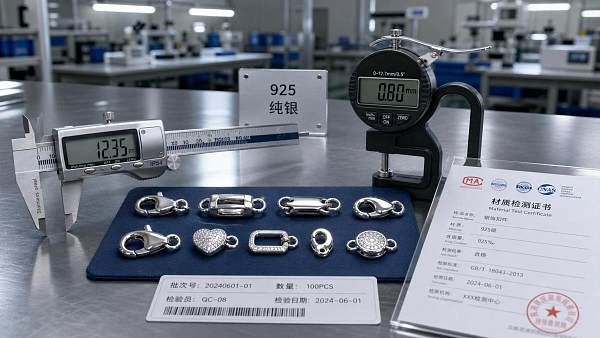
In addition, the supplier should be able to explain how material certificates connect to actual production lots. Generic assurances are not enough. Commercial buyers need traceability, especially when the jewelry supports a branded retail program.
Another common gap is confusion between base metal quality and finished appearance. A necklace may look acceptable in a short-term sample but degrade quickly if the substrate is porous, contaminated, or unsuitable for stable electroplating.
How does plating quality become the hidden source of complaints?
Surface finish is one of the most visible and most misunderstood parts of custom name necklaces OEM production. Many complaints described as “color inconsistency” are actually caused by weak substrate preparation or unstable plating control.
Technical evaluators should ask how the factory manages polishing, cleaning, activation, undercoating, final plating, and post-treatment. If these steps are inconsistent, the final finish may vary from batch to batch.
Plating thickness matters, but thickness alone is not enough. Adhesion, porosity, bath stability, and process cleanliness all influence durability. A necklace that passes visual inspection may still fade or peel after routine wear.
Color matching is another common issue. “Gold,” “rose gold,” and “silver” can vary significantly depending on chemistry, lighting, and comparison standards. Approved master samples or color references should be used whenever possible.
For premium programs, evaluators should also define how the finish will be tested. Salt spray, sweat resistance, tape adhesion, and wear simulation may be relevant depending on market positioning and customer expectations.
Why does sample approval often fail to protect mass production?
Many buyers assume sample approval secures production quality. In reality, the sample only reduces risk if the sample is made using the same materials, process route, and quality controls planned for bulk orders.
If the development sample is hand-polished by a senior technician, plated in a special batch, or assembled with exceptional care, it may not represent what the production line can repeat economically at volume.
That is why technical evaluators should distinguish clearly between concept samples, pre-production samples, and golden samples. Each serves a different purpose, and each should be reviewed against specific acceptance criteria.
A proper golden sample for custom name necklaces OEM should be linked to approved specifications, measurement standards, finish expectations, packaging format, and defect classification. It should not simply be “the sample everyone liked.”
Mass production should also begin only after line validation confirms that the approved quality level is achievable across normal output conditions, not only on a few selected pieces prepared for presentation.
What production control weaknesses usually cause inconsistency?
Once an order moves into volume manufacturing, inconsistency often comes from weak process discipline rather than deliberate negligence. Personalized jewelry requires organized data handling and stable execution at every step.
Typical failure points include mixed personalization files, unclear work orders, wrong chain pairing, inconsistent welding strength, excessive polishing that alters letter shape, and inadequate segregation of different finishes.
Factories that handle custom name necklaces OEM well usually have batch coding, workstation controls, in-process inspection points, and a clear digital-to-physical matching system for personalization content.
Evaluators should ask whether the supplier can prevent name mix-ups during cutting, casting, finishing, assembly, and packing. This is especially important in multi-style or multi-language orders with high SKU complexity.
Another overlooked area is rework management. If defective pieces are repaired without documented controls, color mismatch, weld weakness, or dimensional variation can increase, even when final output appears visually acceptable.
How do tolerances and defect standards affect commercial acceptance?
Many disputes in custom name necklaces OEM programs happen because buyers and suppliers use different definitions of “acceptable.” A factory may judge a piece sellable, while a brand views the same piece as commercially unusable.
Technical evaluators should define measurable tolerances for dimensions, weight range, alignment, chain length, clasp function, engraving position, and plating appearance. Visual standards should also address scratches, pits, and polish marks.
Defect criteria should distinguish critical, major, and minor issues. For example, a misspelled name is critical, a weak joint may be major, and a faint polishing swirl might be minor depending on the quality level agreed.
These definitions must be documented before production, not after a dispute appears. If quality language remains subjective, inspections become inconsistent and supplier performance becomes difficult to improve fairly.
Commercial acceptance is strongest when inspection standards are linked to sampling plans, reference samples, and clear escalation procedures for borderline results.
Why do packaging and logistics details matter more than expected?
Even when the jewelry itself is well made, projects can still fail at the packaging and fulfillment stage. Personalized necklaces are especially vulnerable to tangling, scratching, and order mismatches during final handling.
Technical evaluators should confirm whether each necklace requires individual bagging, card mounting, barcode labeling, anti-tarnish materials, or retail-ready gift boxes. Packaging must support both protection and operational accuracy.
For commercial buyers, logistics accuracy is just as important as product quality. A perfect necklace shipped with the wrong name card, wrong finish label, or wrong chain length still creates a customer-facing failure.
Bulk export conditions also matter. Humidity exposure, carton compression, and inadequate internal separation can damage plated surfaces or deform delicate name structures during international transit.
Because of this, packaging specifications should be treated as part of the technical file, not as a last-minute administrative detail.
How should technical evaluators assess an OEM supplier before placing the order?
A strong assessment should test whether the supplier can convert design intent into repeatable production performance. Capability claims are useful, but evidence from process control is more valuable than catalog images.
Start by reviewing engineering support. Can the supplier optimize fonts, structural weak points, and attachment locations before sampling? A capable factory should identify manufacturability risks early, not after defects appear.
Next, examine process transparency. Ask for the actual route from file intake to final inspection, including casting or cutting method, polishing stages, plating sequence, and personalization tracking controls.
Then review quality records. Reliable suppliers should be able to show inspection standards, defect histories, corrective action practices, and consistency across previous customized jewelry programs.
Compliance documentation, subcontractor control, sample traceability, and packaging validation should also be checked. In custom name necklaces OEM sourcing, a supplier that hides detail usually creates more risk later.
What practical checklist reduces failure in custom name necklaces OEM projects?
A practical approach begins with complete specifications. Define material, dimensions, finish, plating standard, personalization rules, packaging, testing expectations, and acceptable defects before requesting final quotation approval.
Require production-ready artwork and confirm engineering adaptation for long or structurally difficult names. Validate the most challenging design conditions, not only the easiest sample layout.
Approve a golden sample that reflects real production methods. Record color, weight, chain configuration, attachment strength, packaging format, and inspection criteria in a controlled reference file.
Before mass production, verify compliance documents, process route, lot traceability, and in-line quality checkpoints. During production, use sampling plans and order matching controls to prevent personalization errors.
Finally, review packaging protection and shipment labeling as part of the technical release. This checklist does not eliminate all risk, but it prevents the most common and expensive causes of OEM failure.
Conclusion: what actually makes these orders go wrong?
Custom name necklaces OEM orders go wrong when personalization complexity is underestimated and technical control is too weak to support commercial scale. The root cause is usually not creativity, but unmanaged specification risk.
For technical evaluators, the most effective mindset is to treat every necklace program as a controlled product system. Design files, materials, plating, tolerances, compliance, packaging, and traceability must all connect clearly.
When those controls are in place, buyers reduce rejection rates, protect brand reputation, and build stronger supplier relationships. When they are missing, even attractive samples can turn into expensive production problems.
In short, successful custom name necklaces OEM sourcing depends on disciplined validation. The buyers who define details early are the ones most likely to receive consistent, compliant, and commercially reliable results.
Search News
Hot Articles
- Fashion & Gem JewelryThermal Diamond Testers: How They Work and When They Can Misidentify StonesOct 07, 2026
- Commercial KitchenWhat Is Driving Demand for Commercial Hospitality Projects Across the GCC?Oct 06, 2026
- Hotel Room AmenitiesHow to Select Hotel Hair Dryers That Balance Guest Safety, Durability, and CostOct 05, 2026
Popular Tags
Need ExpertConsultation?
Connect with our specialized leisureengineering team for procurementstrategies.
Recommended News
 Oct 07, 2026Thermal Diamond Testers: How They Work and When They Can Misidentify StonesThermal diamond tester guide: learn how it works, spot false positives from moissanite, and choose reliable verification methods for jewelry trade and retail.● Luxury Retail Analyst
 Oct 02, 2026Diamond Tester Wholesale: How to Vet Accuracy, Calibration, and MOQ Before OrderingDiamond tester wholesale guide: verify accuracy, calibration records, supplier quality controls, and MOQ terms before ordering. Source reliable testers with confidence.● Luxury Retail Analyst
 Sep 09, 2026Wholesale Coral Earrings: How Buyers Can Assess Quality, Treatments, and Supply RiskCoral jewelry earrings wholesale guide for buyers: assess quality, treatments, secure settings, documentation, and supply risks before ordering.● Luxury Retail Analyst
 Sep 01, 2026How to Choose a Jewelry Laser Engraving Machine Manufacturer for Custom ProductionChoose a jewelry laser engraving machine manufacturer with proven sample testing, precision fixtures, workflow-ready software, and reliable support for custom production.● Luxury Retail Analyst
 Aug 27, 2026Evaluating Luxury Retail Accessories Suppliers: Quality, Lead Times, and Brand FitLuxury retail accessories supplier selection made clearer: assess quality, lead times, compliance, costs, and brand fit to protect premium launches and margins.● Luxury Retail Analyst
 Jul 29, 2026Fine Jewelry Price Guide: What Affects Cost and How to Judge Real ValueFine jewelry price guide for buyers: learn what drives cost in metals, gemstones, craftsmanship, certification, and branding so you can judge real value, reduce sourcing risk, and buy with confidence.● Luxury Retail Analyst
 Jul 14, 2026What to Ask an Enamel Jewelry Manufacturer Before Sampling and Mass ProductionEnamel jewelry manufacturer selection starts with the right questions. Learn what to ask about materials, color matching, MOQ, QC, compliance, and lead times before sampling and mass production.● Luxury Retail Analyst
 Jul 12, 2026Surgical Steel Belly Rings vs Titanium: Material Differences, Safety, and CostSurgical steel belly rings vs titanium: compare safety, nickel exposure, comfort, durability, and cost to choose the best option for sensitive skin or budget-friendly style.● Luxury Retail Analyst
 Jul 12, 2026Natural Coral Jewelry Guide: How to Identify Real Coral, Treatments, and QualityNatural coral jewelry guide covering how to identify real coral, spot treatments, assess quality, and buy with confidence. Learn the key signs before you choose.● Luxury Retail Analyst
 Jul 11, 2026Braided Leather Bracelets OEM: Material, Clasp, and MOQ Factors Before SamplingBraided leather bracelets OEM guide covering material grades, clasp options, and MOQ factors before sampling. Learn how to reduce sourcing risk, control cost, and choose the right supplier.● Luxury Retail Analyst
 Jul 09, 2026Jewelry Craftsmanship Gemstone Setting Methods Explained: Prong, Bezel, Pave, and MoreJewelry craftsmanship gemstone setting explained clearly: compare prong, bezel, pavé, channel, and more to choose secure, beautiful, and commercially smart jewelry designs.● Luxury Retail Analyst
 Jul 06, 2026Photo Locket Necklace Manufacturer Selection Guide: Materials, MOQ, and Custom OptionsPhoto locket necklace manufacturer selection guide covering materials, MOQ, custom options, compliance, and quality checks to help buyers source smarter and build stronger jewelry lines.● Luxury Retail Analyst
 Jul 05, 2026What to Check When Comparing a Sterling Silver Clasp ManufacturerChoosing a sterling silver clasp manufacturer? Learn what to check first: 925 silver claims, finish quality, testing, compliance, lead times, and hidden sourcing costs.● Luxury Retail Analyst
 Jul 02, 2026Jewelry Craftsmanship Techniques Explained: Casting, Stone Setting, Engraving, and PolishingJewelry craftsmanship techniques explained: discover how casting, stone setting, engraving, and polishing shape quality, durability, and sourcing confidence.● Luxury Retail Analyst
 Jul 01, 2026Lost Wax Casting Machines Explained: Types, Capacity, and Metal CompatibilityLost wax casting machines explained: compare types, real capacity, and metal compatibility to choose the right system for precision casting, higher quality, and smarter sourcing.● Luxury Retail Analyst
 Jun 29, 2026How to Evaluate a Luxury Accessories Online Store Before You BuyLuxury accessories online store buying guide: learn how to verify authenticity, compare policies, check reviews, and avoid costly mistakes before you place an order.● Luxury Retail Analyst
 Jun 22, 2026Matching Couple Rings: Popular Materials, Fit Differences, and How to ChooseMatching couple rings guide: compare popular materials, fit differences, comfort, durability, and resizing options to choose a stylish pair that truly lasts.● Luxury Retail Analyst
 Jun 19, 2026How to Build a Fashion Accessories Catalog That Improves Product Discovery and SalesFashion accessories catalog strategies that improve product discovery, filtering, and conversions. Learn how to structure pages, categories, and data to drive more qualified sales.● Luxury Retail Analyst
 Jun 19, 2026How to Choose Luxury Accessories for Women by Material, Style, and Price PointLuxury accessories for women: learn how to choose the right pieces by material, style, and price point for better value, timeless appeal, and smarter buying decisions.● Luxury Retail Analyst
 Jun 18, 2026Stainless Steel Rings Bulk: 304 vs 316L, Finishes, and Custom Order FactorsStainless steel rings bulk guide: compare 304 vs 316L, explore finish options, and learn key custom order factors to reduce sourcing risk and improve product value.● Luxury Retail Analyst
 Jun 18, 2026Body Piercing Jewelry Bulk Buying Guide: Materials, Sizes, and MOQ QuestionsBody piercing jewelry bulk buying guide covering safe materials, size checks, MOQ strategy, supplier screening, and compliance tips to reduce risk and source with confidence.● Luxury Retail Analyst
 Jun 18, 2026How to Evaluate a Luxury Jewelry Exporter for Quality, Compliance, and DeliveryLuxury jewelry exporter evaluation starts with more than design. Learn how to verify quality, compliance, and delivery control to source premium jewelry with less risk.● Luxury Retail Analyst
 Jun 17, 2026Iced Out Watches Wholesale: How to Compare MOQ, Stone Quality, and MarginsIced out watches wholesale guide: compare MOQ, stone quality, and real margins to choose reliable suppliers, reduce risk, and grow resale profits with smarter sourcing.● Luxury Retail Analyst
 Jun 15, 2026How to Evaluate an Amber Jewelry Manufacturer: Quality Grades, OEM Options, and Lead TimesAmber jewelry manufacturer selection starts with quality grades, OEM capability, and realistic lead times. Learn how to compare suppliers, reduce sourcing risk, and choose with confidence.● Luxury Retail Analyst