Instrument cables that reduce noise without overspending
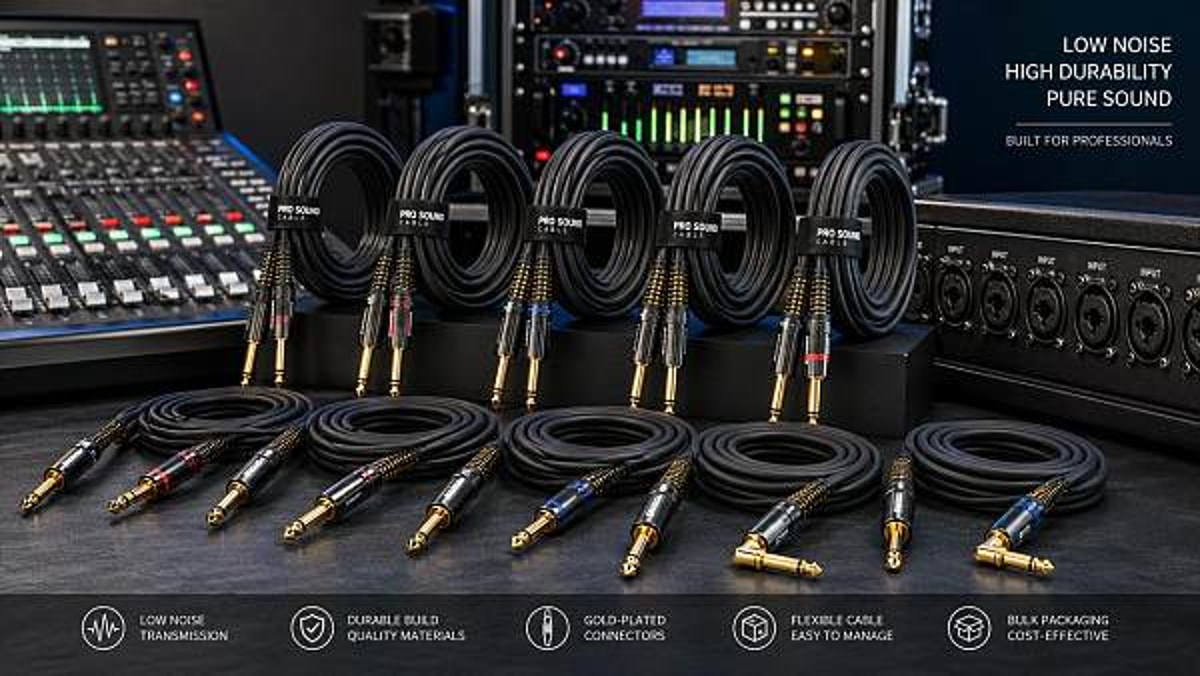
For procurement teams seeking reliable audio performance without inflating budgets, choosing the right instrument cables is a practical advantage. Low-noise options can improve signal clarity, reduce maintenance issues, and support consistent performance across commercial environments. This guide outlines how to identify cost-effective instrument cables that balance shielding, durability, and sourcing value for professional buyers.
Why scenario-based cable selection matters in commercial buying
Not all instrument cables serve the same business purpose, even when the connector format looks identical. A cable used in a hotel lounge for nightly background performances faces different pressure than one installed in a music classroom, a rental inventory, or a fixed entertainment venue. For buyers managing 20, 50, or even 500 cable units across multiple sites, noise control is not just a technical issue; it affects service continuity, technician workload, and replacement budgets.
In practical sourcing, low-noise performance usually depends on a combination of conductor quality, shielding design, connector integrity, cable capacitance, and physical durability. Overspending often happens when procurement teams pay for studio-grade specifications that exceed the actual use case. Underspending happens when low-cost cables fail within 3 to 12 months in high-handling environments, creating hidden costs through downtime and repeat orders.
For commercial buyers, the better question is not simply which instrument cables are cheapest. It is which cables match the signal path, movement frequency, maintenance cycle, and expected equipment value in each scenario. A venue with short 3 m to 6 m runs may prioritize flexibility and connector strain relief, while a teaching facility with 10 to 30 student stations may focus on bulk consistency and easy replacement.
Core factors that influence noise without forcing premium spend
- Shielding type: spiral and braided shielding are common choices, with braided options often offering better long-term coverage in demanding use.
- Cable capacitance: lower capacitance generally helps preserve high-frequency detail, especially over runs above 6 m to 9 m.
- Connector build: poor soldering or weak strain relief can introduce intermittent noise faster than the cable itself fails.
- Outer jacket and flexibility: a cable that is too stiff may survive warehouse storage but perform poorly in daily stage handling.
- Application fit: a mid-range cable can outperform an expensive one when its specifications better match the real environment.
This scenario-based approach is especially relevant in integrated commercial sourcing, where procurement decisions are tied to hospitality experience, educational reliability, entertainment uptime, and multi-site supply planning. Choosing instrument cables by application reduces noise risk more effectively than buying only by brand reputation or headline price.
Typical application scenarios for instrument cables
Commercial demand for instrument cables usually falls into several recurring scenarios. Each one has a different balance of signal quality, handling stress, replacement frequency, and budget sensitivity. For procurement teams, this is where selection criteria should become more specific.
The comparison below helps buyers quickly align cable grade with environment. Instead of chasing the most expensive low-noise product, the goal is to select the cable type that gives stable performance over the expected service cycle.
The table shows that “best” instrument cables change with the environment. In hotel and education projects, the target is often a predictable 12- to 24-month service window at controlled cost. In rental and event work, buyers may justify a slightly higher unit price if it cuts field failures and emergency replacements during busy seasons.
Scenario 1: hospitality venues and premium guest-facing spaces
In hospitality settings, audio quality contributes directly to guest perception. A solo guitar setup in a restaurant, a jazz duo in a rooftop bar, or background performance equipment in a hotel lounge often uses short instrument cable runs, but these spaces also contain dense power distribution, decorative lighting, and compact equipment placement. That combination can raise hum and handling noise if cable shielding is weak.
For this scenario, instrument cables with dependable shielding and moderate capacitance are usually sufficient. Buyers do not always need premium touring-grade stock. A practical target is a cable that performs cleanly over 3 m to 6 m, remains visually tidy, and tolerates nightly setup over 4 to 6 days per week. Connector finish and grip also matter because staff may not be specialist technicians.
The main purchasing mistake in hospitality is prioritizing appearance alone. A cable that blends into upscale interiors but fails under repeated coiling creates service interruptions during peak operating hours. Procurement teams should request samples, test near dimmers or power supplies, and confirm whether the supplier can maintain consistent batches for future reorder cycles.
Hospitality buying checklist
- Confirm standard run lengths needed for lounge, banquet, and small-stage layouts.
- Check flexibility for daily rolling, storage, and discreet routing around furniture or stage risers.
- Test for hum susceptibility near lighting and power distribution within 1 m to 2 m proximity.
- Ask for batch consistency if the project requires repeat orders across multiple properties.
Scenario 2: schools, academies, and training facilities
Educational buyers often need more units at a lower average cost, but the usage pattern is rougher than many assume. Student handling, frequent unplugging, and improper storage can damage connectors faster than signal conductors. In this environment, low-noise performance is still important, yet the larger issue is balancing acceptable audio quality with survivability over a semester or full academic year.
For music labs with 10, 20, or 30 stations, uniformity matters more than premium tonal nuance. Procurement should look for instrument cables with predictable build quality, clear length coding, and sturdy strain relief. A cable that is slightly heavier but lasts two teaching terms may cost less overall than a cheaper cable that needs replacement every 8 to 12 weeks.
Another useful tactic is split-tier sourcing. Core teaching rooms may use mid-range instrument cables, while faculty demo rooms or recording practice suites can justify lower capacitance options. This prevents overbuying across the entire facility while still supporting better signal performance where it genuinely matters.
Scenario 3: event production, rental, and mobile performance
Rental and event teams face the highest handling stress. Cables are packed, transported, deployed, pulled, and re-coiled repeatedly, sometimes several times within 24 hours. In these operations, low-noise performance must coexist with mechanical endurance. A cable with excellent bench performance but weak jacket or connector construction becomes expensive once failure rates rise in the field.
For mobile use, buyers should focus on shielding stability, tensile tolerance, and serviceability. Instrument cables in this category often justify a stronger connector housing and better strain management, especially for fleets above 50 units. The right choice can reduce incident tickets, save technician time during line checks, and limit emergency local purchases at inflated event-season prices.
A common sourcing error is buying consumer-grade cables for professional rental inventory because initial unit pricing looks attractive. Once the cables pass through repeated transport cycles, hidden costs appear in labor, troubleshooting, and replacement frequency. For this scenario, durability often has a greater impact on total cost than shaving a small amount off initial purchase price.
How different scenarios change the specification priorities
After identifying the use case, procurement teams should convert application needs into technical buying criteria. This is where many projects improve outcomes without increasing spend. The same keyword, instrument cables, can point to very different specification targets depending on route length, surrounding electronics, and expected movement frequency.
The table below summarizes how common requirements shift from one scenario to another. It can be used when discussing samples, quotations, and equivalent alternatives with suppliers.
This comparison helps avoid over-specifying every line item. For example, a 2 m pedalboard patch path and a 9 m live stage connection should not automatically receive the same cable strategy. Separating needs by function can lower average procurement cost while still reducing noise where signal integrity is most exposed.
What to ask suppliers before placing a volume order
When evaluating instrument cables, buyers should ask for more than a unit price. Useful questions include conductor and shielding construction, available lengths, connector type consistency, sample lead time, and packaging format for inventory control. If the order supports multi-site deployment, ask whether the same specification can be maintained over 2 to 3 reorder cycles.
It is also reasonable to request a small pilot batch for field testing. A 5-unit or 10-unit trial can reveal handling noise, connector looseness, or storage issues that a data sheet will not show. This is particularly valuable in schools, hospitality chains, and entertainment operators that standardize equipment across locations.
Where applicable, buyers may also discuss common compliance expectations for commercial supply chains, such as material transparency, general electrical safety expectations, and packaging suitability for export or warehouse distribution. These do not replace technical evaluation, but they support smoother sourcing management.
Common misjudgments that increase noise or total cost
The most expensive cable is not always the lowest-risk decision, and the cheapest cable is rarely the most economical over time. In commercial environments, several recurring mistakes lead directly to noise complaints, avoidable replacements, or inconsistent system performance. Recognizing these errors early can improve both procurement efficiency and end-user satisfaction.
Mistake 1: buying by price only
A cable that saves 10% to 15% at purchase may create a much higher cost if it fails after a few months of regular use. This is especially true when service calls, venue disruption, or technician hours are involved. Procurement should compare cost per service cycle, not just cost per unit.
Mistake 2: ignoring cable length strategy
Standardizing on one length for every application may look simple in the warehouse, but it often adds clutter, excess coiling, or avoidable signal loss. Using 3 m, 6 m, and 9 m bands for different tasks can improve both operational neatness and audio consistency. Longer lengths should be justified by real routing needs.
Mistake 3: treating all commercial spaces the same
A music school, a resort lounge, and a themed attraction may all use instrument cables, but their usage patterns are not interchangeable. Applying one specification blindly across all sites can result in overbuying in low-stress areas and underbuying where handling is intense. Segmenting orders by scenario often delivers a better result within the same total budget.
Practical risk control steps
- Map each purchase to a real use environment before approving the quotation.
- Set a target replacement window, such as 12 months, 18 months, or 24 months, by scenario.
- Pilot-test sample units near actual power, lighting, and stage conditions.
- Maintain at least one approved alternative source for continuity in repeat purchasing.
These steps are especially useful for procurement teams overseeing mixed portfolios across hospitality, education, entertainment, and specialty retail environments. They keep the decision focused on business use rather than generic marketing claims.
A practical sourcing framework for low-noise, cost-aware instrument cables
A structured buying process helps commercial teams reduce noise issues without paying for unnecessary premium specifications. The best results usually come from combining scenario mapping, pilot testing, and supplier communication into one repeatable sourcing workflow. This makes future replenishment easier and supports standardization across projects.
Recommended procurement workflow
Start by categorizing the order into at least three groups: fixed or low-movement use, moderate daily use, and high-cycle handling. Then define the typical cable lengths, connector format, and required delivery quantities for each group. Even this basic step can expose where overspending is happening.
Next, shortlist instrument cables in two or three price bands and request samples. Field-test them under realistic conditions for 7 to 14 days where possible. Compare not only signal noise, but also coiling behavior, connector confidence, and post-use wear. The winning option is the one that matches performance needs with reliable replenishment, not necessarily the lowest quoted number.
Finally, document the approved specification with reorder notes. Include preferred lengths, acceptable substitutions, packaging preferences, and any site-specific observations. This reduces confusion during future purchase cycles and supports more stable cross-border or multi-site sourcing.
Decision points to confirm before order release
- Which scenarios require the quietest signal path, and which mainly require durability?
- What are the standard lengths and quantities by site type or room type?
- Is a sample test needed before a 50-unit, 100-unit, or larger deployment?
- Can the supplier support repeat orders, export packing, and consistent specifications?
For procurement professionals, this approach creates a clearer path to sourcing instrument cables that reduce noise, support operational reliability, and stay aligned with budget controls. It is particularly relevant in commercial projects where equipment quality must match customer experience and maintenance realities.
Why work with us for instrument cable sourcing
Global Commercial Trade supports professional buyers who need more than a product list. We help procurement teams evaluate instrument cables in the context of hospitality venues, education systems, entertainment operations, and broader commercial sourcing goals. That means conversations can focus on application fit, quantity planning, and supply practicality rather than generic claims.
If you are comparing low-noise instrument cables for a hotel project, music classroom rollout, event inventory, or multi-site commercial program, we can help you narrow the specification and sourcing path. You can consult us on parameter confirmation, scenario-based product selection, delivery cycles, custom length options, packaging needs, and sample support for evaluation.
Contact us to discuss your required lengths, expected usage frequency, target budget range, and any certification or export considerations relevant to your market. We can also support quotation communication, replacement planning, and supplier comparison so your instrument cables are selected for the environments where they will actually perform.
Search News
Hot Articles
Popular Tags
Need ExpertConsultation?
Connect with our specialized leisureengineering team for procurementstrategies.
Recommended News
 Apr 30, 2026How to vet a musical instruments exporter before first ordersmusical instruments exporter vetting guide: learn how to assess quality control, compliance, lead times, and supplier reliability before first orders.● Pro Audio Engineer
 Apr 30, 2026Instrument cables that reduce noise without overspendingInstrument cables that cut noise without inflating costs. Discover how buyers can choose durable, low-noise options for hospitality, schools, events, and commercial venues.● Pro Audio Engineer
 Apr 30, 2026Music accessories people replace too often and whyMusic accessories are often replaced too soon. Learn which items truly wear out, how to spot real failure signs, and how smarter buying can cut costs and improve reliability.● Pro Audio Engineer
 Apr 30, 2026Music production tools that actually speed up a home studioMusic production tools that truly speed up a home studio: compare workflow-saving gear, avoid costly mistakes, and build a faster, smarter setup with confidence.● Pro Audio Engineer
 Apr 29, 2026String Instruments Compared: What Really Affects Tone and DurabilityString instruments compared for tone and durability: learn how materials, construction, hardware, and setup affect long-term performance for schools, venues, rentals, and sourcing teams.● Pro Audio Engineer
 Apr 29, 2026Wind Instruments Maintenance Tips That Prevent Costly RepairsWind instruments maintenance tips that help teams prevent leaks, corrosion, and pad failure. Learn practical care steps to reduce repair costs and keep instruments performance-ready.● Pro Audio Engineer
 Apr 29, 2026Percussion Instruments Buying Guide: Sound, Build, and ValuePercussion instruments buying guide for schools, venues, and studios—compare sound, build quality, durability, and total value to source smarter and avoid costly mistakes.● Pro Audio Engineer
 Apr 29, 2026How to Find Reliable Musical Instruments WholesaleMusical instruments wholesale made safer: learn how to vet a musical instruments manufacturer, compare suppliers, and source reliable musical instruments for schools and bands with confidence.● Pro Audio Engineer
 Apr 29, 2026Musical Instruments for Schools on BudgetMusical instruments for schools on a budget: compare musical instruments for bands, wholesale options, and how to choose a reliable musical instruments manufacturer for lasting value.● Pro Audio Engineer
 Apr 29, 2026OEM or ODM Musical Instruments ManufacturerFind the right musical instruments manufacturer for bands, schools, and wholesale buyers. Compare OEM vs ODM options, customization, quality control, and sourcing strategies.● Pro Audio Engineer
 Apr 29, 2026Which Musical Instruments Fit Small BandsMusical instruments for bands: explore smart lineups for schools, venues, and buyers comparing musical instruments wholesale and a trusted musical instruments manufacturer.● Pro Audio Engineer
 Apr 29, 2026Musical Instruments Wholesale Buying GuideMusical instruments wholesale guide for bands, schools, and distributors: compare musical instruments manufacturers, MOQ, quality, compliance, and sourcing strategies for smarter bulk buying.● Pro Audio Engineer
 Apr 29, 2026How to Source Musical Instruments for SchoolsMusical instruments for schools: learn how to compare musical instruments wholesale options, choose a trusted musical instruments manufacturer, and source durable musical instruments for bands with confidence.● Pro Audio Engineer
 Apr 29, 2026How to Choose a Musical Instruments ManufacturerFind the right musical instruments manufacturer for bands, schools, and wholesale buyers. Compare quality, OEM/ODM options, compliance, and lead times to source with confidence.● Pro Audio Engineer
 Apr 29, 2026How to Choose Musical Instruments for BandsMusical instruments for bands guide: compare musical instruments manufacturer options, wholesale terms, and musical instruments for schools to source durable, high-value solutions.● Pro Audio Engineer
 Apr 26, 2026Musical instruments manufacturer compliance: EU RoHS vs. US CPSIA documentation gapsMusical instruments manufacturer? Close EU RoHS vs. US CPSIA documentation gaps—critical for bands, schools & trampoline park suppliers. Avoid disqualification.● Pro Audio Engineer
 Apr 26, 2026High-quality musical instruments: why serial number verification matters for resale valueHigh-quality musical instruments for bands and schools rely on serial number verification to protect resale value, authenticity, and compliance—trusted by top suppliers worldwide.● Pro Audio Engineer
 Apr 26, 2026Musical instruments supplier lead times: why 8-week delivery now means ‘in stock’Musical instruments supplier lead times hit 8 weeks—now meaning 'in stock.' Compare trampoline park supplier, indoor playground manufacturer & more for assured readiness.● Pro Audio Engineer
 Apr 26, 2026Musical instruments for schools: what happens when warranty service requires shipping overseasMusical instruments for schools & bands: Avoid costly overseas warranty shipping. Discover high-quality, service-backed instruments from trusted manufacturers and suppliers.● Pro Audio Engineer
 Apr 26, 2026Musical instruments manufacturer transparency: where are your components really made?Discover how top musical instruments manufacturer & trampoline park supplier ensure component transparency—boost safety, compliance, and ROI for bands, schools, and indoor playground installations.● Pro Audio Engineer
 Apr 26, 2026Musical instruments for bands: why matching wood grain matters for live soundDiscover why matching wood grain in musical instruments for bands ensures superior live sound—key insight for schools, venues & suppliers seeking high quality musical instruments.● Pro Audio Engineer
 Apr 26, 2026Musical instruments supplier red flags—delayed shipping isn’t the worst signSpot red flags in musical instruments supplier, trampoline park supplier & indoor playground manufacturer—beyond delayed shipping. Ensure safety, compliance & quality.● Pro Audio Engineer
 Apr 26, 2026Musical instruments manufacturer vs. supplier: who handles warranty claims?Musical instruments manufacturer vs. supplier: who handles warranty claims? Discover how warranty authority impacts trampoline park safety, indoor playground installation & more.● Pro Audio Engineer
 Apr 26, 2026High-quality musical instruments: how to spot factory-refurbished units sold as newSpot high-quality musical instruments for bands & schools—avoid factory-refurbished units sold as new. Trusted insights on musical instruments manufacturer transparency, supplier accountability, and procurement safety.● Pro Audio Engineer