How to vet a musical instruments exporter before first orders
Choosing a musical instruments exporter for your first order can affect product quality, compliance, lead times, and long-term sourcing stability. For procurement teams, proper vetting goes beyond price lists and catalogs. This guide explains how to assess manufacturing capability, export experience, certifications, communication standards, and risk controls before committing to a supplier.
Why first-order vetting matters more in musical instruments sourcing
A musical instruments exporter is not just a trading contact. For procurement teams serving retail chains, education projects, hospitality venues, entertainment operators, or branded distribution programs, the exporter becomes the bridge between product development, factory execution, export compliance, and after-sales coordination. A weak first selection often creates problems that only appear after deposit payment or shipment booking.
In the musical instruments category, quality is harder to verify than in many commodity sectors. A guitar, keyboard stand, digital piano, drum accessory, or orchestral instrument may look acceptable in photos, yet fail on tuning stability, finish consistency, packaging protection, or component durability after 30–90 days of use. That is why procurement teams should evaluate capability across at least 5 dimensions before placing trial orders.
For commercial buyers, risk is amplified when the order supports a launch deadline, a school opening, a venue fit-out, or a regional distribution contract. In these scenarios, a delay of 2–4 weeks can affect installation schedules, promotions, and cash flow. GCT supports sourcing decisions by helping buyers compare supplier signals beyond price, especially in categories where quality perception and user experience directly shape brand reputation.
The first order should be treated as a structured qualification stage, not a simple purchase. Buyers need evidence of export readiness, batch consistency, and practical communication discipline. This is particularly important when the musical instruments exporter offers OEM or ODM services, because specifications, packaging, labeling, and safety responsibilities become more complex.
What makes this category different from standard consumer goods
- Acoustic and performance-sensitive products require checks that go beyond dimensions and color matching.
- Mixed-material construction such as wood, metal, felt, rubber, and electronics creates more failure points in transit and use.
- Many commercial orders include accessories, spare parts, branding, manuals, and retail packaging, increasing execution complexity.
- Products may face destination-market compliance checks for electronics, labeling, packaging declarations, or material restrictions.
How to evaluate a musical instruments exporter before requesting final quotations
Before negotiating unit prices, procurement teams should establish whether the musical instruments exporter fits the intended business model. A supplier suitable for small online retail replenishment may not be suitable for private-label distribution or institutional supply. The first screening phase should usually take 7–10 business days and focus on capability, not discounts.
Start by mapping your order profile. Clarify whether you need stock models, semi-custom products, or full OEM. Define expected annual volume bands such as pilot order, repeat small batch, or container-level program. Then compare the exporter’s response speed, technical accuracy, and willingness to discuss defects, tolerances, and packaging details. Serious suppliers answer these points directly rather than sending generic catalogs.
Ask for export history by destination region, not only total years in business. An exporter that regularly serves the EU, North America, Southeast Asia, or the Middle East is more likely to understand documentation, marking requirements, and freight expectations for those markets. For first orders, practical export familiarity often matters more than broad product range.
The table below gives a practical pre-quotation checklist for screening any musical instruments exporter in a B2B setting.
If a musical instruments exporter cannot answer these points with operational detail, the risk level is already visible. Procurement teams should move such suppliers to a lower priority tier, even if quoted prices appear competitive at first glance.
Three early warning signs during supplier screening
First, be cautious if samples, technical details, and shipping terms are all handled by one person with vague answers. Second, watch for inconsistent lead times, such as promising 15 days for one order and 45 days for a nearly identical one without explanation. Third, question suppliers that avoid discussing defect handling, spare parts, or packaging drop resistance.
These signals do not always mean the supplier is unreliable, but they usually indicate immature process control. For a first order, immature process control is often a bigger risk than moderate price differences.
What to verify in manufacturing capability, quality control, and product consistency
When evaluating a musical instruments exporter, procurement should separate exporter competence from manufacturing competence. Some exporters coordinate multiple factories, which can work well, but only if they can prove stable supplier management. Ask whether the key product line is factory-owned, exclusively partnered, or open-market sourced. This distinction directly affects consistency, MOQ flexibility, and quality accountability.
For acoustic instruments, request details on material grading, moisture control practices where relevant, hardware sourcing, finish process, and tuning or playability inspection. For electronic or electro-acoustic products, ask about functional testing, adaptor compatibility, cable quality, battery or power safety labeling, and carton protection. Quality cannot be validated by appearance alone.
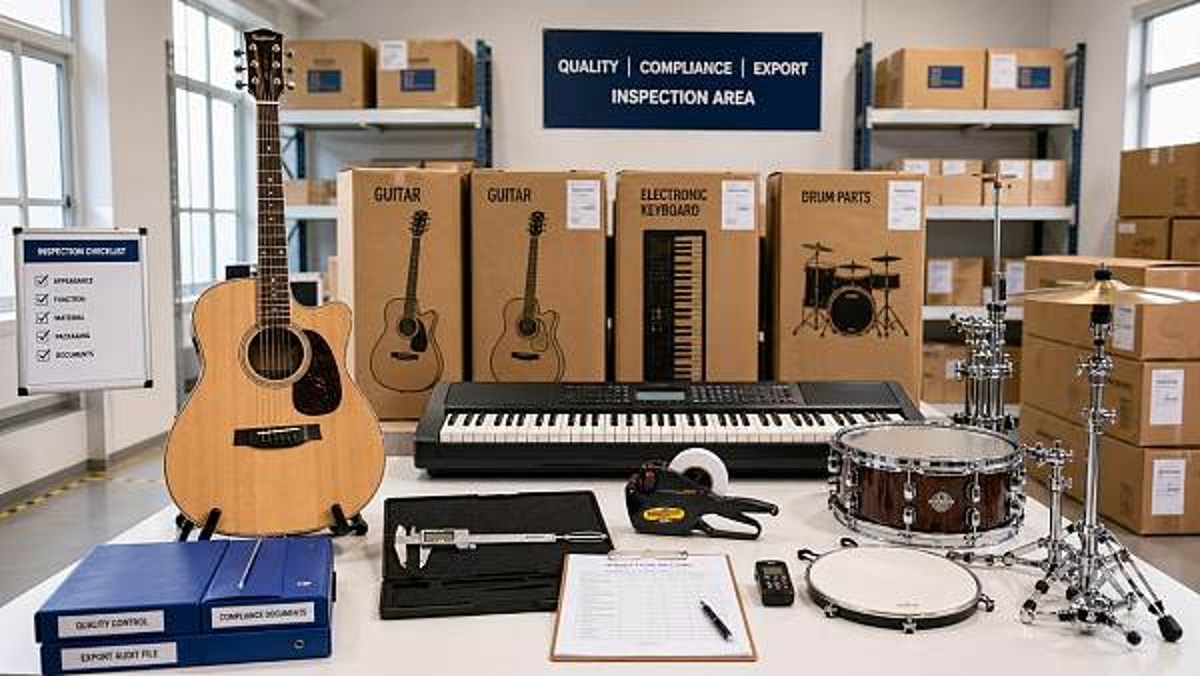
A practical first-order approach is to request 1 pre-production sample, 1 golden sample confirmation, and a final inspection report before balance payment. On larger initial programs, buyers may add random checks at three points: pre-production, in-line production, and pre-shipment. This 3-stage process reduces surprises more effectively than relying on a final photo set.
The next table helps buyers judge whether a musical instruments exporter has process depth or only surface-level sales capability.
For procurement teams, the key is not whether every answer is perfect. The key is whether the exporter has a repeatable system. In musical instruments sourcing, repeatability is often the best predictor of acceptable first-order performance.
A practical inspection checklist for first orders
Core checks before production release
- Confirm final specifications, accessory list, logo file, packaging artwork, barcode placement, and carton marks in one approved file set.
- Lock the golden sample and define acceptable variation for finish, dimensions, and function where applicable.
- Agree on inspection quantity, defect classification, and reporting format before mass production starts.
- Verify whether spare parts, touch-up parts, or extra accessories should be included at a ratio suitable for commercial use.
Which certifications, documents, and export controls should procurement check?
Certification requirements vary by product type and destination market, so buyers should avoid asking for generic compliance claims. A musical instruments exporter handling electronic products such as keyboards, amplifiers, interfaces, or powered accessories may need to support electrical safety, EMC-related documentation, labeling, and import paperwork depending on the market. Acoustic products may place more emphasis on material declarations, packaging compliance, and accurate HS classification.
Procurement teams should request a document matrix early, ideally before sample approval. This matrix should list product category, destination market, required labels, test reports if applicable, manual language needs, carton marks, and shipping documentation. Waiting until production is complete can create relabeling costs or customs delays of 1–3 weeks.
Also check whether the exporter understands restricted materials, wood-related declarations where relevant, battery transport rules if the product uses battery components, and country-of-origin consistency across packaging and documents. Errors here do not always stop shipment, but they can increase inspection frequency and importer liability.
The table below shows a practical compliance review framework for a first order from a musical instruments exporter.
A capable musical instruments exporter will not treat documentation as a last-minute paperwork task. They will connect compliance, packaging, and shipment planning from the start. For buyers managing multiple categories across commercial projects, this disciplined approach reduces hidden cost and internal approval friction.
Questions to ask about compliance readiness
- Have you shipped this exact or similar product type to my target market within the last 12 months?
- Which product markings are printed on the unit, inner box, and outer carton?
- If labeling changes are needed after sample approval, what is the impact on cost and lead time?
- Can you provide a pre-shipment document review 3–5 days before cargo handover?
How to compare price, MOQ, lead time, and service without choosing the wrong exporter
The lowest quotation from a musical instruments exporter may reflect lighter packaging, fewer inspections, substituted materials, excluded accessories, or weak after-sales terms. Procurement should always normalize quotations before making any comparison. Use one RFQ sheet with the same specification version, packaging details, Incoterm basis, spare parts expectation, and document requirements for every supplier.
Pay close attention to MOQ logic. Some exporters quote attractively at 300 units but rely on mixed factory sourcing that may not support repeat consistency. Others quote slightly higher at 100–200 units because they manage tighter process control and can support branded packaging or better pre-shipment checks. First-order value should be measured against risk-adjusted cost, not only unit cost.
Lead time is another area where buyers should compare structure rather than headline numbers. Ask for sample lead time, production lead time, packaging approval time, and booking readiness separately. A quote showing 30 days total may actually hide 7 days for artwork, 20 days production, and uncertain shipment space allocation. Breaking the schedule into 4 nodes gives better visibility.
For procurement teams handling commercial rollouts, the best musical instruments exporter is often the one that balances controllable MOQ, stable documentation, and predictable communication. This is where GCT adds value by helping buyers read supplier capability through a commercial sourcing lens rather than a catalog lens.
A simple decision framework for first-order comparison
- Eliminate suppliers that cannot confirm specifications, compliance support, or lead-time structure within 3–5 working days.
- Shortlist 2–3 suppliers based on risk profile, not more than 5, to keep testing manageable.
- Run sample evaluation with the same checklist across sound, finish, function, accessories, packaging, and document accuracy.
- Award the first order to the supplier with the strongest total execution score, then monitor repeat-order stability over the next 1–2 cycles.
Common mistakes buyers make when vetting a musical instruments exporter
One common mistake is overvaluing product photos and underestimating packaging engineering. Musical instruments are vulnerable to transit vibration, corner impact, humidity variation, and accessory loss. If the first order arrives with damaged tuners, scratched finishes, cracked plastic parts, or missing cables, the apparent savings from a lower quote disappear quickly.
Another mistake is approving samples without documenting the approved standard. Buyers often receive a good sample, but the mass production version changes in foam density, hardware source, finish gloss, or carton construction. Without a signed sample reference and inspection criteria, it becomes difficult to manage claims fairly.
A third mistake is assuming a musical instruments exporter can manage compliance simply because they export regularly. Export frequency does not always equal product-specific compliance understanding. A supplier strong in accessories may be weak in powered products, and a supplier experienced in one region may still miss labeling nuances in another.
Finally, many teams evaluate only the supplier, not the internal procurement process. If your RFQ, approval chain, specification lock, or claim protocol is unclear, even a good exporter may struggle to perform well. Strong sourcing outcomes require discipline on both sides.
FAQ for first-time buyers
How many suppliers should I test before placing a first order?
For most B2B procurement teams, testing 2–3 suppliers is practical. Fewer than 2 limits comparison. More than 4 often slows evaluation and creates inconsistent feedback. Use the same sample checklist and decision criteria to keep the comparison fair.
What is a reasonable first-order lead time?
It depends on product complexity, customization depth, and seasonality. A common range for first orders is 3–8 weeks after sample and artwork approval, excluding ocean transit. Custom packaging, branded accessories, or mixed-SKU orders may add 1–2 weeks. Always request a stage-by-stage schedule.
Should I prioritize a factory or an exporter?
Either can work. A factory may offer direct process visibility, while a strong exporter may provide better cross-factory coordination, documentation support, and communication. The decision should depend on category complexity, compliance needs, MOQ flexibility, and your internal sourcing capacity.
What if my first order is small?
Small first orders are common and can still be effective if used as a qualification batch. Focus on 1–2 core SKUs, define packaging clearly, and test the supplier’s response across sample accuracy, paperwork, and shipment execution. A small order should generate evidence for future scaling.
Why work with GCT when shortlisting a musical instruments exporter
GCT supports procurement teams that need more than a supplier directory. In commercial sourcing, especially across experience-led sectors such as hospitality, education, leisure, and specialty retail, buyers need structured intelligence on capability, consistency, compliance readiness, and sourcing fit. That is particularly valuable when evaluating a musical instruments exporter for a first order where visibility is limited.
Our industry focus helps buyers interpret supplier claims in context. Instead of relying on broad catalog language, we help clarify which questions matter for OEM potential, documentation discipline, commercial packaging, and repeat-order reliability. This reduces screening time and supports better internal decision-making for procurement, operations, and brand teams.
If you are comparing exporters for pro audio and musical instruments programs, GCT can help you review product scope, sample strategy, compliance checkpoints, quotation structure, and practical risk controls. This is useful whether you are sourcing for retail distribution, institutional supply, venue projects, or branded commercial programs across multiple regions.
Contact GCT to discuss supplier shortlisting, specification review, sample planning, delivery timing, packaging confirmation, compliance questions, or quotation comparison. If your team is preparing a first order, we can help you define the right vetting checklist before deposits are committed and timelines become harder to change.
Search News
Hot Articles
Popular Tags
Need ExpertConsultation?
Connect with our specialized leisureengineering team for procurementstrategies.
Recommended News
 Apr 30, 2026How to vet a musical instruments exporter before first ordersmusical instruments exporter vetting guide: learn how to assess quality control, compliance, lead times, and supplier reliability before first orders.● Pro Audio Engineer
 Apr 30, 2026Instrument cables that reduce noise without overspendingInstrument cables that cut noise without inflating costs. Discover how buyers can choose durable, low-noise options for hospitality, schools, events, and commercial venues.● Pro Audio Engineer
 Apr 30, 2026Music accessories people replace too often and whyMusic accessories are often replaced too soon. Learn which items truly wear out, how to spot real failure signs, and how smarter buying can cut costs and improve reliability.● Pro Audio Engineer
 Apr 30, 2026Music production tools that actually speed up a home studioMusic production tools that truly speed up a home studio: compare workflow-saving gear, avoid costly mistakes, and build a faster, smarter setup with confidence.● Pro Audio Engineer
 Apr 29, 2026String Instruments Compared: What Really Affects Tone and DurabilityString instruments compared for tone and durability: learn how materials, construction, hardware, and setup affect long-term performance for schools, venues, rentals, and sourcing teams.● Pro Audio Engineer
 Apr 29, 2026Wind Instruments Maintenance Tips That Prevent Costly RepairsWind instruments maintenance tips that help teams prevent leaks, corrosion, and pad failure. Learn practical care steps to reduce repair costs and keep instruments performance-ready.● Pro Audio Engineer
 Apr 29, 2026Percussion Instruments Buying Guide: Sound, Build, and ValuePercussion instruments buying guide for schools, venues, and studios—compare sound, build quality, durability, and total value to source smarter and avoid costly mistakes.● Pro Audio Engineer
 Apr 29, 2026How to Find Reliable Musical Instruments WholesaleMusical instruments wholesale made safer: learn how to vet a musical instruments manufacturer, compare suppliers, and source reliable musical instruments for schools and bands with confidence.● Pro Audio Engineer
 Apr 29, 2026Musical Instruments for Schools on BudgetMusical instruments for schools on a budget: compare musical instruments for bands, wholesale options, and how to choose a reliable musical instruments manufacturer for lasting value.● Pro Audio Engineer
 Apr 29, 2026OEM or ODM Musical Instruments ManufacturerFind the right musical instruments manufacturer for bands, schools, and wholesale buyers. Compare OEM vs ODM options, customization, quality control, and sourcing strategies.● Pro Audio Engineer
 Apr 29, 2026Which Musical Instruments Fit Small BandsMusical instruments for bands: explore smart lineups for schools, venues, and buyers comparing musical instruments wholesale and a trusted musical instruments manufacturer.● Pro Audio Engineer
 Apr 29, 2026Musical Instruments Wholesale Buying GuideMusical instruments wholesale guide for bands, schools, and distributors: compare musical instruments manufacturers, MOQ, quality, compliance, and sourcing strategies for smarter bulk buying.● Pro Audio Engineer
 Apr 29, 2026How to Source Musical Instruments for SchoolsMusical instruments for schools: learn how to compare musical instruments wholesale options, choose a trusted musical instruments manufacturer, and source durable musical instruments for bands with confidence.● Pro Audio Engineer
 Apr 29, 2026How to Choose a Musical Instruments ManufacturerFind the right musical instruments manufacturer for bands, schools, and wholesale buyers. Compare quality, OEM/ODM options, compliance, and lead times to source with confidence.● Pro Audio Engineer
 Apr 29, 2026How to Choose Musical Instruments for BandsMusical instruments for bands guide: compare musical instruments manufacturer options, wholesale terms, and musical instruments for schools to source durable, high-value solutions.● Pro Audio Engineer
 Apr 26, 2026Musical instruments manufacturer compliance: EU RoHS vs. US CPSIA documentation gapsMusical instruments manufacturer? Close EU RoHS vs. US CPSIA documentation gaps—critical for bands, schools & trampoline park suppliers. Avoid disqualification.● Pro Audio Engineer
 Apr 26, 2026High-quality musical instruments: why serial number verification matters for resale valueHigh-quality musical instruments for bands and schools rely on serial number verification to protect resale value, authenticity, and compliance—trusted by top suppliers worldwide.● Pro Audio Engineer
 Apr 26, 2026Musical instruments supplier lead times: why 8-week delivery now means ‘in stock’Musical instruments supplier lead times hit 8 weeks—now meaning 'in stock.' Compare trampoline park supplier, indoor playground manufacturer & more for assured readiness.● Pro Audio Engineer
 Apr 26, 2026Musical instruments for schools: what happens when warranty service requires shipping overseasMusical instruments for schools & bands: Avoid costly overseas warranty shipping. Discover high-quality, service-backed instruments from trusted manufacturers and suppliers.● Pro Audio Engineer
 Apr 26, 2026Musical instruments manufacturer transparency: where are your components really made?Discover how top musical instruments manufacturer & trampoline park supplier ensure component transparency—boost safety, compliance, and ROI for bands, schools, and indoor playground installations.● Pro Audio Engineer
 Apr 26, 2026Musical instruments for bands: why matching wood grain matters for live soundDiscover why matching wood grain in musical instruments for bands ensures superior live sound—key insight for schools, venues & suppliers seeking high quality musical instruments.● Pro Audio Engineer
 Apr 26, 2026Musical instruments supplier red flags—delayed shipping isn’t the worst signSpot red flags in musical instruments supplier, trampoline park supplier & indoor playground manufacturer—beyond delayed shipping. Ensure safety, compliance & quality.● Pro Audio Engineer
 Apr 26, 2026Musical instruments manufacturer vs. supplier: who handles warranty claims?Musical instruments manufacturer vs. supplier: who handles warranty claims? Discover how warranty authority impacts trampoline park safety, indoor playground installation & more.● Pro Audio Engineer
 Apr 26, 2026High-quality musical instruments: how to spot factory-refurbished units sold as newSpot high-quality musical instruments for bands & schools—avoid factory-refurbished units sold as new. Trusted insights on musical instruments manufacturer transparency, supplier accountability, and procurement safety.● Pro Audio Engineer