How to compare microphone systems for different room sizes
Choosing the right microphone systems for different room sizes is essential for clear speech, consistent coverage, and cost-effective performance. For technical evaluators, the comparison goes beyond basic specifications to include pickup patterns, signal stability, installation complexity, and acoustic compatibility. This guide helps you assess microphone systems with a practical framework tailored to small, medium, and large commercial spaces.
How should technical evaluators compare microphone systems by room size?
When comparing microphone systems, room size is the starting point, but it should never be the only variable. In commercial environments such as hotel meeting rooms, training centers, lecture halls, showrooms, and entertainment venues, a microphone solution must support intelligibility, user control, and predictable performance under real operating conditions. A system that sounds acceptable in a 20 m² boardroom may fail in a 200 m² divisible hall.
For technical evaluators, the most practical approach is to organize the decision around 5 core factors: room dimensions, speaking distance, acoustic behavior, infrastructure constraints, and operational workflow. These five factors usually determine whether wired gooseneck units, wireless handhelds, boundary microphones, ceiling arrays, lapel systems, or hybrid microphone systems will produce the best result.
A useful first-pass segmentation is small rooms under roughly 40 m², medium rooms around 40–150 m², and large rooms above 150 m². These are not hard limits, but they provide a practical framework for estimating coverage density, channel count, DSP requirements, and installation scope. In many B2B projects, the technical risk rises sharply once a room exceeds 2 sound zones or requires more than 4 simultaneous microphones.
Global Commercial Trade supports buyers who need more than catalog comparisons. Across hospitality, education, leisure, and pro audio sourcing, the real challenge is matching microphone systems to procurement goals: speech clarity, reliable delivery, standards alignment, serviceability, and consistent performance across multiple sites. That is especially relevant for evaluators handling mixed portfolios such as campuses, hotels, and event-ready commercial interiors.
- Define the room by actual use, not only by floor area. A 60 m² boardroom and a 60 m² classroom can require very different microphone systems.
- Estimate concurrent speakers. Systems for 1–2 active talkers differ significantly from systems supporting 6–12 participants.
- Check environmental constraints such as reflective glass, low ceilings, HVAC noise, RF congestion, and furniture layout.
- Review lifecycle factors including battery logistics, spare parts, firmware support, and integration with DSP, conferencing, or AV control platforms.
The 3 questions that prevent mis-specification
Before comparing brands or form factors, ask 3 questions. First, how many voices must be captured at the same time? Second, how far is each talker from the microphone capsule during normal use? Third, is the room primarily for speech reinforcement, recording, conferencing, or a combination of all three? These questions quickly eliminate poor-fit microphone systems and shorten the evaluation cycle by 1–2 rounds.
This method also improves procurement conversations. Instead of requesting a “better microphone,” technical teams can specify measurable needs such as stable pickup within 1–2 meters, support for 8 delegates, low visual impact, or compatibility with installed DSP and echo cancellation. That creates cleaner quotations and fewer post-installation disputes.
Which microphone systems fit small, medium, and large rooms best?
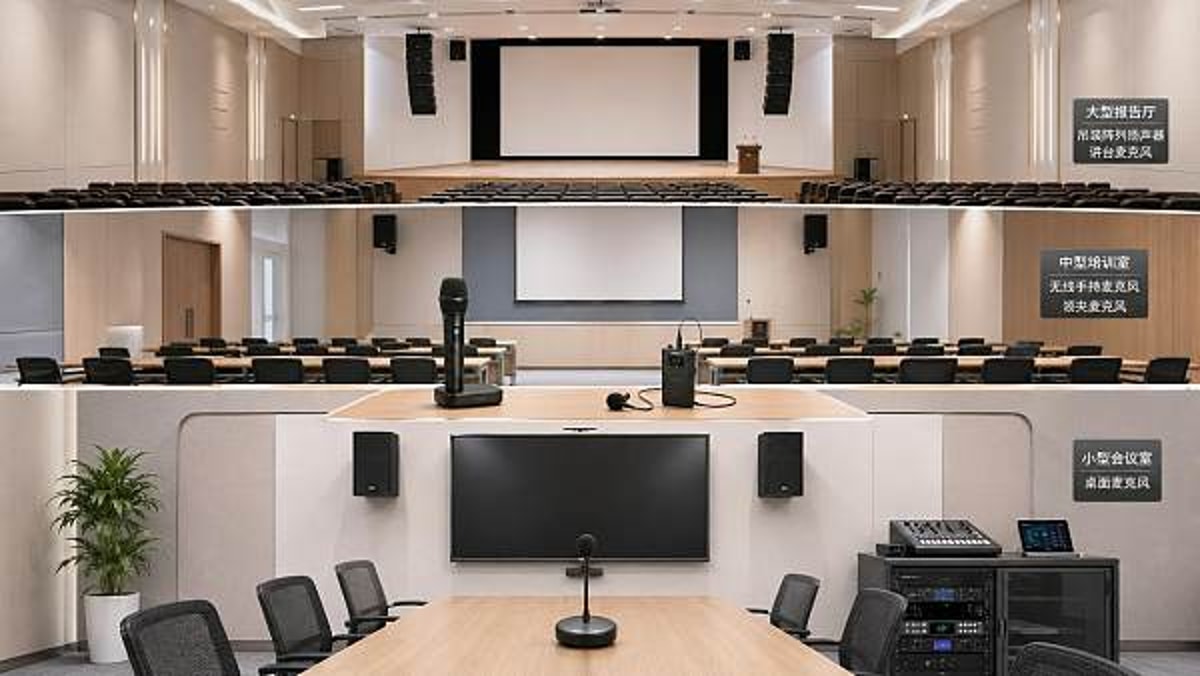
Different room sizes favor different microphone architectures. Small rooms often reward simplicity and close pickup. Medium rooms require a balance between flexibility and control. Large rooms demand coverage planning, zone management, and stronger integration between microphones, DSP, loudspeakers, and control systems. Technical evaluators should compare microphone systems by use case rather than by price alone.
In small spaces, the goal is usually high speech clarity with minimal setup. Wired tabletop, boundary, or short gooseneck microphone systems often perform well because talkers remain close to the source and installation is straightforward. In medium spaces, wireless handheld, lavalier, or ceiling-assisted systems become more attractive, especially when furniture layouts change or presenters move around.
In large rooms, a single microphone type rarely solves the entire requirement. Evaluators may need a hybrid approach combining podium microphones, wireless bodypack transmitters, handheld backups, and ceiling or audience capture devices. Once coverage spans a stage, audience area, and overflow zone, planning usually shifts from single-room thinking to multi-zone system design.
The table below summarizes how common microphone systems compare across typical commercial room categories. These ranges are practical evaluation bands rather than universal technical limits, and they should always be validated against room acoustics and operating workflow.
This comparison shows why room size alone cannot determine the right microphone systems. A medium classroom with active discussion may need more channels than a large ceremonial hall used mainly for one-way speech. For evaluators, the stronger method is to map the room to user behavior, then validate technology choices against pickup distance, interference risk, and service demands.
What usually works in commercial spaces?
Hotels often need flexible microphone systems because one ballroom may be divided into 2–4 sections in a single day. Educational facilities usually prioritize intelligibility, ease of operation, and repeatability across many rooms. Leisure and event venues often need wireless freedom, rapid changeover, and backup channels. These use profiles matter more than the label on a product brochure.
In sourcing terms, the best fit is the system that preserves speech quality while reducing operational friction. That means fewer dead spots, predictable battery management, sensible installation time, and simpler support for local integrators or in-house technicians.
Which technical parameters matter most when comparing microphone systems?
Technical evaluators often receive long specification sheets, but only a smaller set of parameters usually drives real-world outcomes. When comparing microphone systems for room size, focus on pickup pattern, usable speaking distance, gain-before-feedback, wireless stability, channel density, and integration readiness. These factors are more actionable than isolated lab figures viewed without room context.
Pickup pattern is critical. Cardioid and supercardioid microphones typically help in controlled speech applications by rejecting more ambient sound from the rear or sides. Omnidirectional microphones can work well in small meeting tables or when talker position varies, but in reverberant rooms they may capture too much room sound. Ceiling arrays add flexibility, yet performance depends heavily on ceiling height, surface reflectivity, and DSP tuning.
Wireless performance must be evaluated beyond advertised range. In a dense commercial environment, stable RF operation depends on local spectrum conditions, antenna placement, receiver coordination, and the number of simultaneous channels. A system that supports 4 channels reliably in one site may not scale cleanly to 12 channels in another without more careful frequency planning.
The following table provides a practical checklist for comparing microphone systems using parameters that influence installation success, maintenance load, and user satisfaction across different room sizes.
A clear takeaway is that technical parameters should be interpreted as part of a system, not as isolated advantages. For example, a sensitive capsule is not automatically better if it also increases background pickup in a reflective room. Likewise, a higher channel count adds value only if the receiver architecture, antenna design, and spectrum planning can support it under site conditions.
A practical 4-step technical review
- Measure room use and geometry, including ceiling height, seating density, and loudspeaker locations.
- Define the minimum acceptable speech outcome, such as lecture capture, voice lift, conferencing, or event reinforcement.
- Compare microphone systems using 3–5 critical parameters only, instead of reviewing every published metric equally.
- Confirm support requirements such as battery runtime, spare units, firmware policy, and service response expectations.
This review process is especially useful when a buyer must standardize across several room types within 2–4 weeks. It reduces overbuying in small rooms and under-specification in event-capable spaces.
What should procurement teams check before selecting microphone systems?
Procurement decisions for microphone systems often fail because teams focus on unit price before checking implementation risk. In commercial projects, the true cost includes accessories, installation labor, DSP programming, training, maintenance, and replacement planning. A lower-cost microphone may become more expensive if it requires more channels, more troubleshooting, or more frequent battery handling.
Technical evaluators should document at least 6 purchasing checkpoints: application fit, compatibility, acoustic suitability, power or battery strategy, compliance requirements, and lead time. In many regional projects, delivery windows of 2–8 weeks can change the shortlist, especially where imported wireless products face regulatory review or limited stock availability.
For buyers in hospitality, education, and experience-led commercial environments, aesthetics and operational simplicity also matter. Ceiling or low-visibility microphone systems may justify a higher initial cost in premium interiors, while robust handheld or gooseneck solutions may be preferred where staff turnover is high and systems must remain easy to operate with minimal training.
The procurement table below helps translate technical comparison into sourcing decisions. It is especially relevant for teams balancing budget control with performance assurance across multiple room sizes.
This framework is valuable because it links sourcing with deployment reality. In multi-site projects, standardizing 2–3 approved microphone systems for different room sizes often delivers better long-term value than choosing a different product for every room. It simplifies training, maintenance, and future expansion while keeping performance expectations consistent.
Common cost drivers that change the final decision
- Wireless systems may require chargers, battery packs, antenna distribution, and frequency planning, all of which affect the total project budget.
- Ceiling-based microphone systems can reduce table clutter, but installation labor and DSP tuning may be higher in reflective rooms.
- Wired tabletop solutions often lower complexity in small rooms, yet they may reduce flexibility in spaces that change layout every week.
- Hybrid systems can improve resilience in large rooms by keeping 1–2 backup channels available for high-priority events.
What mistakes do buyers make when evaluating microphone systems?
One common mistake is choosing microphone systems based on brand familiarity without confirming room acoustics. Reverberation, reflective finishes, and open architectural layouts can undermine even premium equipment. Another mistake is overestimating pickup distance. If users expect clear speech at 1.5–2 meters from a microphone designed for close placement, dissatisfaction is almost guaranteed.
A second issue is underestimating operational complexity. Wireless microphone systems can look simple during demonstration, yet daily charging, channel management, and coordination become serious concerns in facilities with frequent turnover, shared rooms, or non-technical operators. In such cases, a less glamorous but more controlled wired or semi-fixed system may perform better over 12–24 months.
Buyers also often compare only hardware and forget commissioning. Proper setup may involve automixing logic, equalization, acoustic echo cancellation, loudspeaker tuning, and user interface programming. For medium and large rooms, the commissioning stage can determine more of the final speech result than the raw microphone specification itself.
The final mistake is ignoring future change. A room that supports 6 users today may need 10 users next year. A hotel ballroom may shift from banquet speech to hybrid presentation. A campus room may require lecture capture within one procurement cycle. Flexible microphone systems do not always mean “more features”; they mean a better path to scale without replacing the full signal chain.
FAQ for technical evaluators
How many microphone channels are usually needed for a medium room?
A medium room often starts with 2–4 active channels for presentation use, but discussion-heavy environments may need 6–12 channels depending on seating and workflow. The key is to distinguish between total microphones installed and simultaneous channels required. That difference has a direct impact on RF planning, mixer capacity, and system cost.
Are ceiling microphone systems always better for clean interior design?
Not always. Ceiling microphone systems can preserve aesthetics and reduce table clutter, which is attractive in premium hotels and executive spaces. However, they depend heavily on ceiling height, room treatment, and DSP quality. In acoustically hard rooms, close microphone placement may still provide more consistent intelligibility.
What is the typical evaluation timeline before purchase?
For straightforward small-room projects, comparison and approval may take 7–15 days. Medium and large commercial spaces often need 2–4 weeks, especially if demonstrations, integration reviews, or regional compliance checks are required. Multi-site standardization can take longer because technical teams must validate repeatability across room types.
What compliance issues matter for wireless microphone systems?
The main concerns are regional spectrum legality, electrical safety, and charging or battery handling procedures. Requirements vary by market, so technical evaluators should confirm whether the proposed wireless bands are permitted locally and whether the product documentation supports the intended country of deployment.
Why work with GCT when sourcing microphone systems for commercial projects?
Sourcing microphone systems for different room sizes is rarely a simple product decision. Technical evaluators need aligned guidance on performance, deployment risk, room suitability, and supply chain reliability. GCT helps bridge those factors by connecting commercial buyers with specialized sourcing intelligence across hospitality, education, leisure, and pro audio applications.
That matters when your project includes mixed room categories, tight implementation windows, or premium user expectations. Instead of reviewing isolated products without context, buyers can assess microphone systems against project realities: installation conditions, support needs, customization scope, and delivery planning. This is especially valuable for organizations standardizing solutions across several sites or planning phased rollouts over 3 stages.
If you are comparing microphone systems for boardrooms, lecture spaces, hotel function rooms, show venues, or multi-purpose commercial interiors, GCT can support the next step with more targeted sourcing inputs. These may include parameter confirmation, room-size matching, product shortlist refinement, estimated delivery cycles, sample coordination, customization feasibility, and compliance-oriented documentation review.
Contact GCT if you need a structured comparison for small, medium, and large room microphone systems, a second opinion on technical selection, or supplier-facing guidance before RFQ issuance. Clear requests produce better outcomes, so prepare 5 basic inputs: room size, expected user count, speaking format, preferred installation style, and project timeline. With that information, sourcing discussions become faster, more precise, and easier to convert into deployable commercial solutions.
Search News
Hot Articles
Popular Tags
Need ExpertConsultation?
Connect with our specialized leisureengineering team for procurementstrategies.
Recommended News
 Apr 30, 2026Soundproofing materials that work better than thicker wallsSoundproofing materials that outperform thicker walls: compare damping, absorption, and decoupling options to cut noise, save space, and improve commercial acoustic results.● Pro Audio Engineer
 Apr 30, 2026How to compare microphone systems for different room sizesMicrophone systems compared by room size: learn how to evaluate pickup, coverage, DSP, and RF stability for small, medium, and large spaces to choose smarter, lower-risk solutions.● Pro Audio Engineer
 Apr 30, 2026Live sound equipment failures that usually start at setupLive sound equipment failures often begin at setup. Learn the early warning signs, key risk points, and smart sourcing tips to prevent costly audio issues.● Pro Audio Engineer
 Apr 30, 2026Recording studio gear upgrades that matter more than price tagsRecording studio gear upgrades that matter most aren’t always expensive. Learn how acoustics, monitoring, interfaces, and workflow tools deliver better sound, efficiency, and ROI.● Pro Audio Engineer
 Apr 30, 2026Commercial sound systems and the hidden cost of poor coverageCommercial sound systems with poor coverage can raise hidden costs, hurt clarity, and damage customer experience. Learn how to evaluate smarter solutions before buying.● Pro Audio Engineer
 Apr 29, 2026Kenya Marathon Record Break Sparks Demand for Racing Sensor ChipsRacing sensor chips surge in demand after Kenya's marathon record—RFID+UWB fusion modules with IP68, –20°C–60°C & ISO/IEC 18000-63 compliance now sought globally.● Pro Audio Engineer
 Apr 28, 2026Kenyan Marathon WR Break Drives Demand for Timing Chips & Track SensorsTiming chips & track sensors surge after Kenyan marathon WR—discover how UWB+BLE timing tech, EN compliance, and −20°C sensor resilience drive global demand.● Pro Audio Engineer
 Apr 27, 2026BWF Adopts 15-Point Scoring System from Jan 2027BWF 15-point scoring system (2027) drives urgent firmware, UI & AI replay upgrades for LED displays, broadcast tech & venue integrators—act now.● Pro Audio Engineer
 Apr 26, 2026BYD Confirms F1 Entry Talks: China’s Racing Electronics & Carbon Fiber Export Window OpensBYD’s F1 entry talks open China’s racing electronics & carbon fiber export window—FIA-certified sensors, composites & data systems in demand.● Pro Audio Engineer
 Apr 25, 2026Fan Zhendong Promotes Chinese AI Ping-Pong Table in Silicon ValleyAI ping-pong table by Fan Zhendong & MLTT debuts in Silicon Valley—smart sports hardware meets edge AI, radar tracking & coaching analytics. Discover the future of table tennis tech.● Pro Audio Engineer
 Apr 24, 2026FIFA Adopts Chinese Mini-LED Displays for 2026 World Cup VAR SystemFIFA adopts Chinese Mini-LED displays for 2026 World Cup VAR—ultra-low latency (≤3ms), 1500+ nits, FIFA TMS 4.2 certified. Game-changing for sports tech suppliers.● Pro Audio Engineer
 Apr 24, 2026Fan Zhendong Visits Silicon Valley as MLTT Investor, AI Ping-Pong Tech Draws US InterestAI ping-pong tech: Fan Zhendong’s MLTT-backed smart table & coaching system draws US youth training interest—edge AI, radar sensing, pilot orders inbound.● Pro Audio Engineer
 Apr 24, 2026FIBA Women's World Cup 2026 Draw: China in 'Group of Death', Lighting & Timing Systems Export Window OpensFIBA Women's World Cup 2026 draw sparks global demand for FIBA Level 3–certified LED lighting & timing systems—act now to qualify.● Pro Audio Engineer
 Apr 23, 2026China Upgrades Security Compliance for International Sports EventsChina mandates ISO 22301 business continuity planning for venues hosting international sports events—key for stadium tech, ops, and compliance providers.● Pro Audio Engineer
 Apr 22, 2026China's UWB Timing System Gains ITU Certification at Haiwan EventChina's UWB timing system wins ITU-T Y.3506 certification—key for sports tech exporters targeting GCC & SADC stadium tenders.● Pro Audio Engineer
 Apr 24, 2026Music Production Tools That Save Setup TimeMusic production tools that save setup time help venues and studios deploy faster. Learn smart sourcing for hospitality procurement, hotel sofas, and playground planning.● Pro Audio Engineer
 Apr 24, 2026Best Music Production Tools for Small StudiosMusic production tools for small studios: compare scalable setups, sourcing tips, and smart procurement for hospitality procurement, hotel room furniture, and playground planning projects.● Pro Audio Engineer
 Apr 24, 2026How to Choose Music Production Tools in 2026Music production tools in 2026: learn how to compare workflow, scalability, and supplier reliability for venues, hospitality procurement, and entertainment projects with confidence.● Pro Audio Engineer
 Apr 23, 2026Best Soundproofing Materials for VenuesBest soundproofing materials for venues: compare solutions for hotel beds, custom furniture, catering equipment, instrument cables, playground structures, and theme park rides to improve comfort, compliance, and sourcing efficiency.● Pro Audio Engineer
 Apr 22, 2026Do Soundproofing Materials Really WorkSoundproofing materials really work when matched to hotels, leisure park venues, and pro audio needs. Explore practical solutions for hotel beds, custom furniture, catering equipment, theme park rides, and inclusive playground projects.● Pro Audio Engineer
 Apr 20, 2026Snooker World Championship: Xiao Guodong Secures Third Chinese SpotSnooker World Championship: Xiao Guodong secures third Chinese spot amid AI officiating & 4K HDR broadcast — tech and talent converge in elite cue sports.● Pro Audio Engineer
 Apr 20, 2026FDA Proposes Chinese Label Translation Requirements for Sports SupplementsFDA proposes Chinese label translation requirements for sports supplements—key for importers, manufacturers & global brands. Act now to ensure compliance by Jan 2027.● Pro Audio Engineer
 Apr 19, 20262026 Shanghai Sailing Open Adopts ITU-Certified Chinese Timing System2026 Shanghai Sailing Open adopts ITU-certified Chinese timing system — a breakthrough for precision sports tech exporters, certifiers & event organizers.● Pro Audio Engineer
 Apr 17, 2026FDA Drafts New Labeling Rule for Chinese-Labeled Sports SupplementsFDA's new draft rule for Chinese-labeled sports supplements mandates certified English translations—key for brands, CMOs & importers navigating U.S. market entry.● Pro Audio Engineer