Best Soundproofing Materials for Venues
Choosing the right soundproofing materials is essential for venues that demand clear acoustics, guest comfort, and long-term value. From hotels and leisure park facilities to live entertainment spaces, buyers evaluating custom furniture, catering equipment, hotel beds, instrument cables, and even adjacent solutions for playground structures or theme park rides need practical guidance. This guide helps procurement teams and commercial decision-makers compare options that balance performance, compliance, and sourcing efficiency.
In sports and entertainment environments, soundproofing is rarely a single-product decision. A karaoke room, indoor attraction, rehearsal studio, event hall, family entertainment center, or multipurpose leisure venue all face different noise profiles, operating hours, and construction limits. For B2B buyers, the real question is not simply which material is “best,” but which combination of materials delivers the right level of noise control, safety, installation speed, and lifecycle value.
This article examines the best soundproofing materials for venues through a procurement lens. It focuses on practical performance indicators, common venue use cases, budget-sensitive comparisons, and sourcing criteria relevant to distributors, project evaluators, and facility buyers working across hospitality, amusement, and live entertainment projects.
Understanding What Venues Need from Soundproofing
Venue soundproofing serves two distinct goals: blocking sound transmission between spaces and managing sound behavior inside the room. Many buyers confuse soundproofing with acoustic treatment. A wall panel that reduces echo may improve speech clarity, but it may do little to stop bass leakage from a nightclub, gaming zone, or music stage into adjacent guest rooms or retail corridors.
For sports and entertainment facilities, the noise source often changes by time of day. A family entertainment center may run at 65–75 dB during regular traffic, then exceed 85 dB around redemption zones, bowling lanes, or immersive attractions. Live performance venues and rehearsal rooms can generate strong low-frequency energy below 125 Hz, which is harder to contain than speech or midrange sound.
Procurement teams should define at least 4 decision variables before selecting materials: target noise reduction, structural limitations, fire performance, and maintenance expectations. If a venue operates 12–16 hours daily, durable finishes and replaceable components matter more than laboratory data alone. Materials that perform well on paper but fail under repeated cleaning, impact, or humidity can quickly increase total cost of ownership.
Another common issue is flanking noise. Even when walls are upgraded, sound can still pass through doors, ceilings, duct penetrations, cable routes, or shared structural frames. That is why venue projects often require a layered assembly rather than one standalone soundproofing material. A successful design may include insulation, resilient mounting, sealants, dense barriers, and door upgrades working together.
Key Performance Terms Buyers Should Know
When comparing soundproofing materials for venues, three metrics appear frequently: STC, NRC, and impact resistance. STC, or Sound Transmission Class, is commonly used for walls and partitions and often falls in the 35–60 range for commercial applications. NRC, or Noise Reduction Coefficient, measures absorption and is often used for ceiling tiles, baffles, and wall panels. These values describe different behaviors, so they should not be treated as interchangeable.
- STC 35–40: Suitable for basic separation in non-critical public zones.
- STC 45–50: Common target for private rooms, small studios, and function spaces.
- STC 55+: More appropriate for music rooms, premium hospitality zones, and high-noise entertainment areas.
- NRC 0.70–1.00: Typical range for materials designed to reduce reverberation and improve clarity.
Buyers should also review moisture tolerance, cleaning compatibility, and installation sequencing. For example, an indoor water-adjacent leisure facility may prioritize mold resistance and washable surfaces, while a theater or esports room may prioritize low-frequency control and cable-access flexibility.
Best Soundproofing Materials for Different Venue Conditions
The best soundproofing materials for venues are usually selected as part of a system. Dense materials help block airborne noise, fibrous materials help absorb sound, and decoupling elements reduce vibration transfer. The right choice depends on whether the priority is a party room, cinema lounge, hotel event floor, arcade zone, music practice room, or backstage technical area.
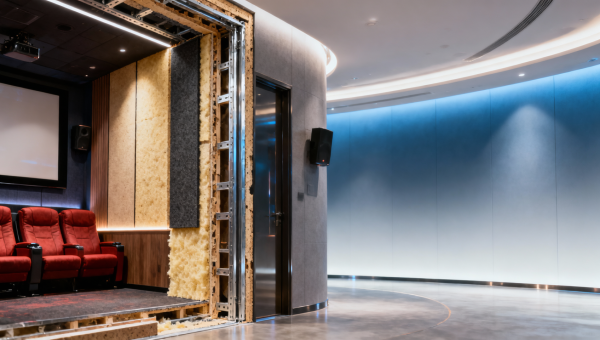
Mineral wool is one of the most widely specified materials in commercial assemblies. It is commonly placed inside partitions and ceilings in thicknesses such as 50 mm, 75 mm, or 100 mm. It is valued for sound absorption, dimensional stability, and fire performance. However, on its own, mineral wool is not a complete soundproofing solution; it performs best when paired with multiple gypsum board layers and resilient channels.
Mass-loaded vinyl, or MLV, is a dense barrier used when space is limited. In retrofit projects where wall buildup must stay compact, MLV can add mass without the thickness of masonry. It is especially useful behind wall finishes, inside partitions, or around equipment enclosures. For venue owners working with premium interior aesthetics, MLV often fits hidden applications where visible acoustic products are undesirable.
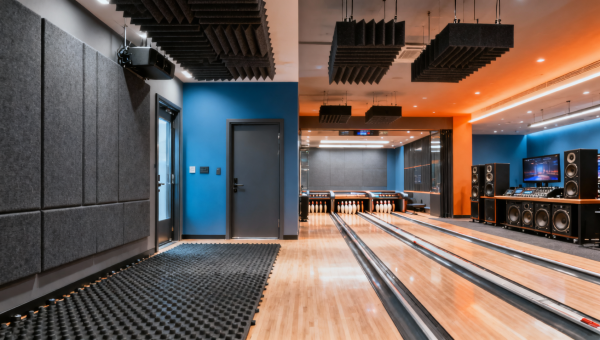
Acoustic foam and fabric-wrapped panels are often chosen for internal echo control rather than true isolation. They can improve music clarity, reduce flutter echo, and create a more comfortable sound environment in lounges, simulator rooms, and VIP entertainment suites. But they should not be oversold as substitutes for properly isolated walls or doors when leakage to neighboring spaces is the core issue.
Material Comparison for Commercial Venues
The table below compares several common soundproofing materials used in sports and entertainment venues. It highlights how each option performs in terms of use, installation, and procurement suitability.
For many venue projects, the strongest performing specification combines 3 elements: cavity insulation, a decoupled frame or resilient system, and multiple dense board layers with acoustic sealant. That layered approach is more reliable than relying on foam panels alone, particularly where neighboring guest rooms, food service areas, or premium retail spaces are involved.
Where Each Material Performs Best
- Use mineral wool when building new partitions or ceiling cavities in medium to high-noise venues.
- Use MLV when retrofit space is tight and added wall depth must stay below roughly 25–35 mm.
- Use acoustic panels when speech clarity, music detail, or user comfort is more urgent than transmission loss.
- Use resilient clips and channels when structural vibration or bass transfer is a recurring complaint.
How to Match Materials to Venue Type and Noise Source
Different venues produce different acoustic challenges. A bowling alley creates impact and rolling noise, a family karaoke suite produces high vocal energy and bass, while an indoor amusement zone may combine mechanical sound, crowd noise, and announcements. Buyers who map the dominant noise source first usually make better material choices and avoid overspending on products that solve the wrong problem.
In hospitality-linked entertainment spaces, soundproofing must also protect brand perception. Guests who hear late-night events through corridor walls or hotel floors often associate that disturbance with poor overall facility quality. For mixed-use commercial properties, sound leakage can also affect leasing value, especially when entertainment venues operate next to dining, retail, or wellness areas.
A practical method is to divide the project into 3 acoustic zones: high-noise source rooms, transition zones, and sensitive adjacent spaces. High-noise rooms may require STC 55+ wall assemblies and upgraded doors. Transition zones may need ceiling absorption and controlled HVAC penetrations. Sensitive spaces, such as guest rooms or private lounges, often benefit from both isolation and soft-finish acoustic treatment.
For procurement teams handling regional rollouts, standardization helps. Instead of specifying one universal build-up for every site, define 2–4 repeatable acoustic packages based on venue function. This supports more predictable sourcing, clearer contractor instructions, and faster review of supplier alternatives.
Recommended Material Priorities by Venue Scenario
The following matrix helps commercial buyers align soundproofing materials with typical venue types found across sports, leisure, and entertainment projects.
The table shows that no single product solves every venue problem. Buyers should expect to combine 2–5 material types depending on noise frequency, room adjacency, and interior design requirements. Projects that ignore door sealing, ceiling penetrations, or floor vibration details often underperform even when high-grade wall materials are used.
A Simple 5-Step Evaluation Process
- Identify the loudest source and estimate operational noise range.
- Review the adjacent room type, such as hotel room, dining area, retail zone, or office.
- Set a target assembly level, often STC 45, 50, or 55 depending on use.
- Check material restrictions for fire rating, moisture, hygiene, and installation depth.
- Validate the full assembly, including doors, ceilings, joints, and service penetrations.
Procurement Factors: Compliance, Cost Control, and Supplier Screening
For distributors, developers, and procurement managers, soundproofing materials should be evaluated beyond acoustic claims. Commercial venues operate under practical constraints: phased openings, coordination with MEP trades, brand-standard finishes, and regional code requirements. That makes supplier reliability as important as product composition.
Lead time is a frequent challenge in venue projects. Standard insulation and gypsum-based systems may fit a 2–4 week sourcing cycle in many markets, while custom acoustic panels, doors, or decorative absorbers may require 4–8 weeks or longer depending on finish approval and production load. Buyers should align material selection with the construction sequence rather than approve specialty items too late.
Another critical factor is testing documentation. Buyers should request clear performance data for the intended application, not vague marketing language. For example, a panel with a strong NRC result may still be unsuitable if the venue’s main problem is transmission into neighboring spaces. Installation guidelines, edge details, and compatibility with local contractors also deserve early review.
From a cost standpoint, material price per square meter is only one part of the equation. Projects should also compare labor hours, accessory requirements, replacement intervals, and operational downtime during installation. In retrofit entertainment sites, reducing closure time by even 2–3 days can materially affect revenue continuity.
Supplier and Material Screening Checklist
The checklist below can help B2B buyers compare vendor offers more effectively and reduce approval risk before placing larger commercial orders.
In many cases, the most competitive offer is not the lowest unit price. Buyers often gain better commercial results from suppliers that can package acoustic materials with adjacent venue components, coordinate finish approvals quickly, and support OEM or project-specific customization where needed.
Common Procurement Mistakes
- Selecting decorative acoustic products when the real issue is sound leakage through walls or doors.
- Ignoring floor, ceiling, and service penetrations while investing heavily in partition upgrades.
- Comparing products by unit price only, without estimating labor, downtime, and replacement cycle.
- Approving materials without confirming finish durability for high-traffic entertainment use.
Installation Planning, Maintenance, and FAQ for Commercial Buyers
Even the best soundproofing materials for venues can underperform if installation quality is inconsistent. Small gaps around electrical boxes, doors, ducts, or framing junctions can materially reduce overall performance. For commercial sites, a 3-stage control process often works best: pre-installation review, in-progress inspection, and post-installation verification before finish handover.
Maintenance expectations vary by product type. Hidden materials such as cavity insulation or MLV may require minimal intervention once enclosed, while exposed wall panels, ceiling baffles, and decorative absorbers should be reviewed every 6–12 months for staining, impact damage, loose fixings, or edge wear. In children’s entertainment zones or high-turnover venues, maintenance-friendly surface finishes can significantly reduce replacement frequency.
Commercial buyers should also plan for future service access. Venue operators frequently add cabling, lighting controls, AV upgrades, or surveillance devices after opening. If penetrations are made without acoustic resealing, the original soundproofing strategy weakens over time. A coordinated service protocol helps preserve isolation performance after fit-out modifications.
For project teams sourcing through a global trade network, bundled procurement can improve consistency. Aligning soundproofing materials with related venue packages such as pro audio infrastructure, specialty furnishings, or entertainment fit-out components often simplifies scheduling and reduces coordination risk across multiple suppliers.
FAQ: What Buyers Ask Most Often
How do I choose between acoustic panels and true soundproofing materials?
If the complaint is echo, harshness, or poor speech intelligibility inside the room, acoustic panels may be enough. If the complaint is noise escaping into neighboring rooms, corridors, or guest areas, you need soundproofing materials such as insulated partitions, dense barriers, resilient supports, and sealed door systems. Many venues need both functions in one assembly.
What is a practical target for entertainment venue wall performance?
A practical commercial target is often STC 45–50 for moderate separation and STC 55 or above for louder music-based rooms. However, doors, glazing, and ceiling paths must be designed to a similar standard. A high-rated wall paired with a weak door set will not deliver balanced results.
How long does a typical procurement and installation cycle take?
For standard materials, sourcing may fit within 2–4 weeks, while custom-finished acoustic products often require 4–8 weeks. Installation duration depends on area size, access hours, and whether the venue remains operational. Small room upgrades may take several days, while larger phased projects can extend across multiple weeks.
What should distributors and agents look for when building a product line?
A strong portfolio usually includes at least 3 categories: isolation materials, internal acoustic treatment, and accessory items such as sealants, gaskets, or suspension hardware. This creates a more complete venue solution and makes specification selling easier for project-based customers.
Selecting the best soundproofing materials for venues requires a system mindset, not a single-product shortcut. The right solution depends on venue type, noise frequency, adjacency risk, installation constraints, and supplier execution. For sports and entertainment projects, buyers who combine performance data with practical fit-out planning usually achieve stronger acoustic control and better long-term value.
Global Commercial Trade supports commercial buyers, evaluators, and channel partners with sourcing intelligence across hospitality, leisure, and pro audio environments. If you are comparing venue soundproofing materials, planning a new entertainment fit-out, or reviewing supplier options for multi-site rollout, contact us to get a tailored sourcing strategy, discuss project requirements, and explore more commercial solutions.
Search News
Hot Articles
Popular Tags
Need ExpertConsultation?
Connect with our specialized leisureengineering team for procurementstrategies.
Recommended News
 Apr 22, 2026China's UWB Timing System Gains ITU Certification at Haiwan EventChina's UWB timing system wins ITU-T Y.3506 certification—key for sports tech exporters targeting GCC & SADC stadium tenders.● Pro Audio Engineer
 Apr 20, 2026Snooker World Championship: Xiao Guodong Secures Third Chinese SpotSnooker World Championship: Xiao Guodong secures third Chinese spot amid AI officiating & 4K HDR broadcast — tech and talent converge in elite cue sports.● Pro Audio Engineer
 Apr 20, 2026FDA Proposes Chinese Label Translation Requirements for Sports SupplementsFDA proposes Chinese label translation requirements for sports supplements—key for importers, manufacturers & global brands. Act now to ensure compliance by Jan 2027.● Pro Audio Engineer
 Apr 17, 2026FDA Drafts New Labeling Rule for Chinese-Labeled Sports SupplementsFDA's new draft rule for Chinese-labeled sports supplements mandates certified English translations—key for brands, CMOs & importers navigating U.S. market entry.● Pro Audio Engineer
 Apr 16, 20262026 Yangtze River Delta Triathlon Uses Certified Chinese Timing System2026 Yangtze River Delta Triathlon uses certified Chinese timing system — ChronoLink Pro, ITU-approved RFID+GPS dual-mode solution for global race organizers.● Pro Audio Engineer
 Apr 13, 2026Asian University Basketball League Secures Funding, Launches Smart Venue ProgramThe Asian University Basketball League (AUBL) secures Series A funding and launches its Smart Venue Program, partnering with tech firms for sustainable sports infrastructure. A key opportunity for sports tech exporters with ISO 50001 certification.● Pro Audio Engineer
 Apr 23, 2026Best Soundproofing Materials for VenuesBest soundproofing materials for venues: compare solutions for hotel beds, custom furniture, catering equipment, instrument cables, playground structures, and theme park rides to improve comfort, compliance, and sourcing efficiency.● Pro Audio Engineer
 Apr 22, 2026Do Soundproofing Materials Really WorkSoundproofing materials really work when matched to hotels, leisure park venues, and pro audio needs. Explore practical solutions for hotel beds, custom furniture, catering equipment, theme park rides, and inclusive playground projects.● Pro Audio Engineer
 Apr 19, 20262026 Shanghai Sailing Open Adopts ITU-Certified Chinese Timing System2026 Shanghai Sailing Open adopts ITU-certified Chinese timing system — a breakthrough for precision sports tech exporters, certifiers & event organizers.● Pro Audio Engineer
 Apr 20, 2026What Causes Early Failure in Pro Audio Equipment?Pro audio equipment fails early due to heat, dust, unstable power, and weak components. Learn how musical instruments, instrument cables, music accessories, and sourcing choices affect reliability.● Pro Audio Engineer
 Apr 20, 2026Instrument Cables: Shielding, Durability, and the Price Gap ExplainedInstrument cables guide for buyers of pro audio equipment and music accessories across musical instruments, string instruments, keyboard instruments, percussion instruments, wind instruments, and orchestral instruments.● Pro Audio Engineer
 Apr 20, 2026Pro Audio Equipment Upgrades That Improve Sound Without OverspendingPro audio equipment upgrades for musical instruments: improve sound with instrument cables, music stands, and music accessories for keyboard, percussion, wind, string, and orchestral instruments—without overspending.● Pro Audio Engineer
 Apr 20, 2026Instrument Cables: Why Cheap Options Often Fail During Live UseInstrument cables for musical instruments often fail live when cheap builds meet pro audio equipment demands. Compare smarter options for string, wind, percussion, and keyboard instruments.● Pro Audio Engineer
 Apr 18, 2026Instrument cables with gold-plated connectors: Do they improve tone—or just resale value?Instrument cables with gold-plated connectors boost reliability & resale value in theme parks, leisure parks, and hotels—proven for soundproofing, playground structures, and catering equipment.● Pro Audio Engineer
 Apr 18, 2026Instrument cables that degrade mid-show—what causes sudden signal drop?Instrument cables failing mid-show? Discover why—bending fatigue, EMI, corrosion & thermal stress—in theme parks, hotels, playgrounds & leisure venues.● Pro Audio Engineer
 Apr 17, 2026Pro stage audio setups where music accessories become acoustic liabilitiesDiscover how commercial furniture, playground borders, sensory playground gear & music accessories impact acoustic safety—avoid liability in pro audio environments.● Pro Audio Engineer
 Apr 16, 2026Pro stage audio gear warranties: What ‘lifetime’ really covers when used in hospitality venuesPro audio equipment & designer eyewear warranties decoded for hotels. See what ‘lifetime’ really covers—OEM manufacturing, custom fabrication, supply chain solutions & more.● Pro Audio Engineer
 Apr 16, 2026Recording studio gear sourcing: Why local compliance often overrides ‘best-in-class’ specsRecording studio gear sourcing for luxury spaces: compliance-first pro audio equipment, designer eyewear integration, and OEM manufacturing solutions—avoid costly delays.● Pro Audio Engineer
 Apr 16, 2026Pro audio equipment for boutique hotels: Why studio-grade gear doesn’t always translate to lobby soundPro audio equipment for boutique hotels must integrate with hotel furniture, designer eyewear & jewelry displays—discover why studio gear fails and how custom fabrication + supply chain solutions deliver sonic & material harmony.● Pro Audio Engineer
 Apr 16, 2026DJ equipment brands prioritizing repairability over replacementDJ equipment brands leading in repairability—trusted alongside luxury furniture, orchestral instruments, music stands & park benches for sustainable, high-ROI commercial procurement.● Pro Audio Engineer
 Apr 15, 2026DJ equipment setups that scale from club nights to festivalsDiscover scalable DJ equipment for clubs & festivals—engineered like luxury furniture, orchestral instruments & music stands. Premium, certified, ready to grow with your venue.● Pro Audio Engineer
 Apr 15, 2026Pro stage audio cabinets tested for 90dB+ continuous playback — not just peaksCommercial furniture & amusement equipment: Pro audio cabinets tested for 90dB+ continuous playback—ideal for sensory playgrounds, hotels, and educational supplies.● Pro Audio Engineer
 Apr 13, 2026Microphone systems for multi-room venues: why one-size-fits-all doesn’t workMicrophone systems for multi-room venues—optimized for hotel desks, commercial playgrounds, trampoline park manufacturer needs & hospitality furniture integration.● Pro Audio Engineer
 Apr 13, 2026Microphone systems for outdoor stages: wind noise reduction that actually worksMicrophone systems engineered for outdoor stages—wind noise reduction that works. Trusted by trampoline park manufacturers, commercial playground & hospitality venues.● Pro Audio Engineer