FIFA Adopts Chinese Mini-LED Displays for 2026 World Cup VAR System
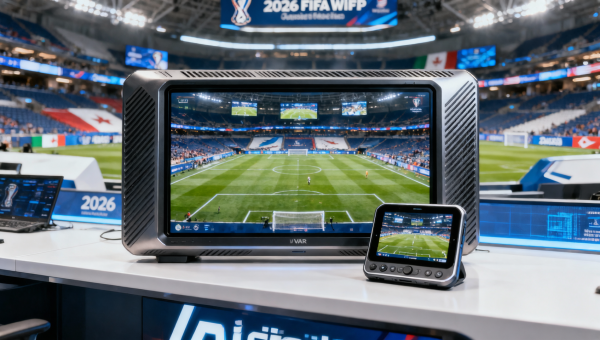
On April 22, 2026, FIFA announced that the Video Assistant Referee (VAR) system for the upcoming United States–Canada–Mexico FIFA World Cup will deploy Mini-LED display modules supplied by Chinese manufacturers for both main control monitors and assistant referees’ handheld terminals. With sub-3ms response time and peak brightness ≥1500 nits—and certified under FIFA TMS 4.2—the deployment marks the first integration of Chinese commercial display technology into the core operational chain of a top-tier global sports event. This development is particularly relevant for display module exporters, broadcast integration firms, stadium infrastructure suppliers, and sports technology service providers, as it signals a shift in technical specification benchmarks and procurement pathways for high-stakes live-sports environments.
Event Overview
On April 22, 2026, FIFA officially confirmed that the VAR system for the FIFA World Cup hosted jointly by the United States, Canada, and Mexico will utilize Mini-LED ultra-low-latency display modules manufactured in China. These modules are specified for use in main control screens and handheld terminals operated by assistant referees. Technical parameters include a response time of ≤3 ms and brightness of ≥1500 nits. The modules have passed FIFA’s Technical Monitoring Standard (TMS) version 4.2 certification. No further details regarding vendor names, supply volume, or contractual scope were disclosed in the official announcement.
Industries Affected
Display Module Exporters
Exporters specializing in professional-grade display modules—particularly those targeting broadcast, sports venue, or live-event applications—may face recalibrated client expectations. The FIFA TMS 4.2 certification now serves as a de facto reference standard for latency, brightness, and reliability in mission-critical sports displays. As a result, export-oriented manufacturers may need to prioritize TMS-aligned testing protocols ahead of market entry in North America and Europe.
Broadcast Integration Firms
Firms integrating VAR systems, stadium video walls, or real-time officiating toolkits into broadcast workflows may encounter revised hardware compatibility requirements. Since FIFA has validated specific Mini-LED performance thresholds, integrators may need to verify display interoperability with existing signal processing hardware (e.g., SMPTE ST 2110-compatible encoders, low-latency IP routing layers) before tender submissions for future sports venue projects.
Sports Venue Infrastructure Suppliers
Suppliers involved in end-to-end stadium AV infrastructure—including control room design, referee terminal deployment, and sideline display networks—may see tighter technical specifications in upcoming RFPs. The adoption indicates growing demand for certified, low-latency display solutions not only for VAR but potentially for other on-field decision support tools. This could affect procurement timelines and validation cycles for new installations.
Sports Technology Service Providers
Providers offering VAR system maintenance, calibration, or real-time monitoring services may need to expand technical documentation and field-service training to cover Mini-LED-specific failure modes (e.g., localized dimming inconsistencies under high ambient light, thermal management during extended operation). Certification alignment (e.g., TMS 4.2 compliance verification) may become a prerequisite for service accreditation.
What Enterprises and Practitioners Should Monitor and Act On
Track official FIFA TMS documentation updates
Current TMS 4.2 certification criteria were referenced in the announcement—but full public documentation remains limited. Organizations should monitor FIFA’s official technical publications portal for updated test methodologies, especially around display latency measurement under variable frame rates (e.g., 50/60 Hz vs. 100/120 Hz HDR workflows).
Assess exposure to North American and Latin American stadium upgrade cycles
The 2026 World Cup spans 16 host cities across three countries, many undergoing concurrent AV infrastructure modernization. Companies with display-related offerings should map their current certifications against known venue upgrade timelines—noting that VAR-compliant displays may serve as anchor products for broader control-room refresh programs.
Distinguish between policy signal and immediate procurement impact
This announcement reflects a technical validation milestone—not a blanket procurement directive. It does not imply automatic adoption across all FIFA-sanctioned competitions or national federation venues. Stakeholders should avoid assuming broad rollout; instead, treat this as a benchmark-setting precedent requiring selective, evidence-based engagement with certification bodies and venue operators.
Prepare for tighter integration validation windows
Given the tight operational tolerances (≤3 ms response), pre-deployment testing cycles for display modules in integrated VAR environments may shorten. Suppliers and integrators should review internal QA workflows—especially around end-to-end signal path validation (camera → encoder → switcher → display)—and consider allocating additional buffer time for TMS-aligned verification prior to delivery deadlines.
Editorial Perspective / Industry Observation
From an industry perspective, this announcement is best understood not as a market entry announcement, but as a technical recognition milestone: Chinese display module suppliers have met a globally acknowledged, application-specific performance threshold for elite sports operations. Analysis来看, it confirms that latency and brightness—long dominated by legacy Japanese and Korean panel technologies—are now competitively addressable via domestic Mini-LED supply chains. Observation来看, the emphasis on TMS 4.2 certification suggests FIFA is consolidating technical governance around measurable, repeatable benchmarks—potentially reducing reliance on proprietary vendor claims. Current更值得关注的是 how regional sports federations and major league broadcasters (e.g., MLS, Liga MX, Premier League partners) interpret and adopt these same criteria beyond the 2026 tournament. It is more accurately read as a signal of evolving specification rigor than as an immediate demand driver—yet one with clear implications for product development roadmaps and certification investment priorities.
This development underscores a structural shift: display technology is no longer treated as a generic component in sports broadcasting infrastructure, but as a deterministic element of officiating integrity. For the industry, the key takeaway is not that Chinese displays ‘won’ a contract—but that verifiable, application-tailored performance metrics are now non-negotiable in high-stakes live sports environments. The event represents a validation point, not a tipping point—yet it redefines what ‘certified readiness’ means for display suppliers serving global sports markets.
Source: FIFA official announcement dated April 22, 2026. No additional vendor, technical, or contractual details were released. Ongoing observation is warranted for subsequent TMS documentation updates and regional federation implementation guidance.
Search News
Hot Articles
- Pro Stage AudioFIFA Adopts Chinese Mini-LED Displays for 2026 World Cup VAR SystemApr 24, 2026
- Outdoor RidesChina FA Warns Nanjing City Over Fan Conduct; ISO 20785 Compliance AcceleratesApr 24, 2026
- Pro Stage AudioFan Zhendong Visits Silicon Valley as MLTT Investor, AI Ping-Pong Tech Draws US InterestApr 24, 2026
Popular Tags
Need ExpertConsultation?
Connect with our specialized leisureengineering team for procurementstrategies.
Recommended News
 Apr 24, 2026FIFA Adopts Chinese Mini-LED Displays for 2026 World Cup VAR SystemFIFA adopts Chinese Mini-LED displays for 2026 World Cup VAR—ultra-low latency (≤3ms), 1500+ nits, FIFA TMS 4.2 certified. Game-changing for sports tech suppliers.● Pro Audio Engineer
 Apr 24, 2026Fan Zhendong Visits Silicon Valley as MLTT Investor, AI Ping-Pong Tech Draws US InterestAI ping-pong tech: Fan Zhendong’s MLTT-backed smart table & coaching system draws US youth training interest—edge AI, radar sensing, pilot orders inbound.● Pro Audio Engineer
 Apr 24, 2026FIBA Women's World Cup 2026 Draw: China in 'Group of Death', Lighting & Timing Systems Export Window OpensFIBA Women's World Cup 2026 draw sparks global demand for FIBA Level 3–certified LED lighting & timing systems—act now to qualify.● Pro Audio Engineer
 Apr 23, 2026China Upgrades Security Compliance for International Sports EventsChina mandates ISO 22301 business continuity planning for venues hosting international sports events—key for stadium tech, ops, and compliance providers.● Pro Audio Engineer
 Apr 22, 2026China's UWB Timing System Gains ITU Certification at Haiwan EventChina's UWB timing system wins ITU-T Y.3506 certification—key for sports tech exporters targeting GCC & SADC stadium tenders.● Pro Audio Engineer
 Apr 20, 2026Snooker World Championship: Xiao Guodong Secures Third Chinese SpotSnooker World Championship: Xiao Guodong secures third Chinese spot amid AI officiating & 4K HDR broadcast — tech and talent converge in elite cue sports.● Pro Audio Engineer
 Apr 20, 2026FDA Proposes Chinese Label Translation Requirements for Sports SupplementsFDA proposes Chinese label translation requirements for sports supplements—key for importers, manufacturers & global brands. Act now to ensure compliance by Jan 2027.● Pro Audio Engineer
 Apr 17, 2026FDA Drafts New Labeling Rule for Chinese-Labeled Sports SupplementsFDA's new draft rule for Chinese-labeled sports supplements mandates certified English translations—key for brands, CMOs & importers navigating U.S. market entry.● Pro Audio Engineer
 Apr 16, 20262026 Yangtze River Delta Triathlon Uses Certified Chinese Timing System2026 Yangtze River Delta Triathlon uses certified Chinese timing system — ChronoLink Pro, ITU-approved RFID+GPS dual-mode solution for global race organizers.● Pro Audio Engineer
 Apr 13, 2026Asian University Basketball League Secures Funding, Launches Smart Venue ProgramThe Asian University Basketball League (AUBL) secures Series A funding and launches its Smart Venue Program, partnering with tech firms for sustainable sports infrastructure. A key opportunity for sports tech exporters with ISO 50001 certification.● Pro Audio Engineer
 Apr 24, 2026Best Music Production Tools for Small StudiosMusic production tools for small studios: compare scalable setups, sourcing tips, and smart procurement for hospitality procurement, hotel room furniture, and playground planning projects.● Pro Audio Engineer
 Apr 24, 2026How to Choose Music Production Tools in 2026Music production tools in 2026: learn how to compare workflow, scalability, and supplier reliability for venues, hospitality procurement, and entertainment projects with confidence.● Pro Audio Engineer
 Apr 23, 2026Best Soundproofing Materials for VenuesBest soundproofing materials for venues: compare solutions for hotel beds, custom furniture, catering equipment, instrument cables, playground structures, and theme park rides to improve comfort, compliance, and sourcing efficiency.● Pro Audio Engineer
 Apr 22, 2026Do Soundproofing Materials Really WorkSoundproofing materials really work when matched to hotels, leisure park venues, and pro audio needs. Explore practical solutions for hotel beds, custom furniture, catering equipment, theme park rides, and inclusive playground projects.● Pro Audio Engineer
 Apr 19, 20262026 Shanghai Sailing Open Adopts ITU-Certified Chinese Timing System2026 Shanghai Sailing Open adopts ITU-certified Chinese timing system — a breakthrough for precision sports tech exporters, certifiers & event organizers.● Pro Audio Engineer
 Apr 20, 2026What Causes Early Failure in Pro Audio Equipment?Pro audio equipment fails early due to heat, dust, unstable power, and weak components. Learn how musical instruments, instrument cables, music accessories, and sourcing choices affect reliability.● Pro Audio Engineer
 Apr 20, 2026Instrument Cables: Shielding, Durability, and the Price Gap ExplainedInstrument cables guide for buyers of pro audio equipment and music accessories across musical instruments, string instruments, keyboard instruments, percussion instruments, wind instruments, and orchestral instruments.● Pro Audio Engineer
 Apr 20, 2026Pro Audio Equipment Upgrades That Improve Sound Without OverspendingPro audio equipment upgrades for musical instruments: improve sound with instrument cables, music stands, and music accessories for keyboard, percussion, wind, string, and orchestral instruments—without overspending.● Pro Audio Engineer
 Apr 20, 2026Instrument Cables: Why Cheap Options Often Fail During Live UseInstrument cables for musical instruments often fail live when cheap builds meet pro audio equipment demands. Compare smarter options for string, wind, percussion, and keyboard instruments.● Pro Audio Engineer
 Apr 18, 2026Instrument cables with gold-plated connectors: Do they improve tone—or just resale value?Instrument cables with gold-plated connectors boost reliability & resale value in theme parks, leisure parks, and hotels—proven for soundproofing, playground structures, and catering equipment.● Pro Audio Engineer
 Apr 18, 2026Instrument cables that degrade mid-show—what causes sudden signal drop?Instrument cables failing mid-show? Discover why—bending fatigue, EMI, corrosion & thermal stress—in theme parks, hotels, playgrounds & leisure venues.● Pro Audio Engineer
 Apr 17, 2026Pro stage audio setups where music accessories become acoustic liabilitiesDiscover how commercial furniture, playground borders, sensory playground gear & music accessories impact acoustic safety—avoid liability in pro audio environments.● Pro Audio Engineer
 Apr 16, 2026Pro stage audio gear warranties: What ‘lifetime’ really covers when used in hospitality venuesPro audio equipment & designer eyewear warranties decoded for hotels. See what ‘lifetime’ really covers—OEM manufacturing, custom fabrication, supply chain solutions & more.● Pro Audio Engineer
 Apr 16, 2026Recording studio gear sourcing: Why local compliance often overrides ‘best-in-class’ specsRecording studio gear sourcing for luxury spaces: compliance-first pro audio equipment, designer eyewear integration, and OEM manufacturing solutions—avoid costly delays.● Pro Audio Engineer