Luxury Jewelry Wholesale for New Distributors
Entering the luxury jewelry wholesale market requires more than trend awareness—it demands trusted sourcing, premium design, and scalable manufacturing. For new distributors, understanding how a custom jewelry manufacturer supports custom jewelry design, high-end luxury jewelry, and luxury accessories wholesale is essential to building a competitive portfolio. This guide explores how to evaluate luxury jewelry B2B opportunities and source custom luxury jewelry for modern retail, hospitality, and brand-driven markets.
Why luxury jewelry wholesale is attractive for new distributors
For new distributors, luxury jewelry wholesale offers a practical entry point into premium retail because the category combines emotional value, repeat seasonal demand, and flexible product architecture. Unlike highly standardized goods, high-end jewelry can be positioned for boutique stores, hotel retail corners, resort gift programs, concept stores, and brand collaborations. That gives distributors more than 1 route to market and more than 1 pricing strategy.
The opportunity is strongest when sourcing is built around 3 pillars: dependable manufacturing, differentiated design, and manageable minimum order quantities. New distributors often face a narrow margin for error in their first 2–4 buying cycles, so the right wholesale partner matters as much as the product itself. A supplier that can support sampling, material transparency, and custom development reduces risk before larger commitments are made.
In the jewelry and luxury accessories segment, the market is not only about precious materials. It also includes plated collections, branded fashion-luxury crossover pieces, and capsule assortments designed for faster replenishment. This matters because new distributors rarely begin with a broad inventory. They succeed faster by building a focused assortment of 20–50 SKUs that fits a clear buyer profile.
Global Commercial Trade supports this evaluation process by connecting sourcing intelligence with commercial reality. For buyers serving hospitality groups, specialty retailers, and premium distribution channels, the challenge is not simply finding a factory. It is identifying suppliers that can align design language, production consistency, packaging expectations, and cross-border trade requirements in one workable supply plan.
What new distributors should validate first
- Whether the supplier specializes in luxury jewelry wholesale or mainly serves low-cost fashion jewelry, because this affects finishing quality, plating durability, and packaging standards.
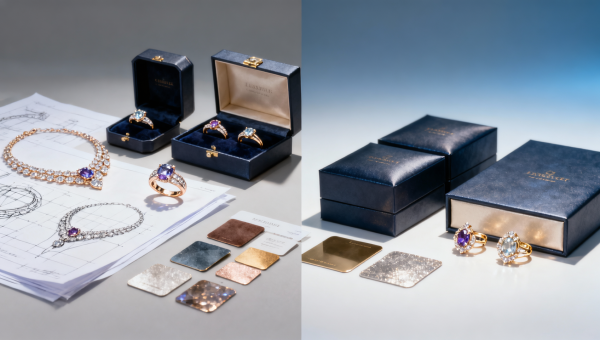
- Whether custom jewelry design support is available at the concept stage, CAD stage, and sample revision stage, ideally within a 7–15 day sample window depending on complexity.
- Whether the manufacturer can handle small-batch launches, mid-volume replenishment, and OEM or ODM programs without changing quality benchmarks between orders.
- Whether export documentation, material declarations, and labeling support are available for the destination market and retail format.
How to assess a custom jewelry manufacturer beyond catalog appearance
A polished catalog is useful, but it does not reveal how a custom jewelry manufacturer performs under commercial pressure. Distributors need to evaluate development depth, communication speed, and production discipline. In practice, many sourcing problems appear after the first attractive quotation: inconsistent stone setting, unstable plating color, delayed packaging approval, or unclear lead times for revised samples.
A stronger assessment method is to review the supplier across 4 stages: inquiry response, design interpretation, sample execution, and bulk delivery readiness. If a manufacturer struggles to clarify alloy options, plating thickness expectations, or packaging tolerances early, those problems often multiply during mass production. For high-end luxury jewelry, detail management is not a premium extra; it is the operating baseline.
For distributors entering B2B luxury accessories wholesale, supplier flexibility is often as important as capacity. A factory may handle large output, but if it cannot support mixed-SKU launches, logo customization, and packaging adaptation, it may not suit distributor-led growth. New distributors usually need 3 commercial options: standard collection, semi-custom adaptation, and fully custom luxury jewelry development.
GCT’s value in this process lies in structured supplier evaluation. Rather than looking only at product photos, buyers can frame sourcing decisions around use case, sales channel, risk level, and replenishment logic. This is especially important in jewelry and luxury accessories, where a distributor’s reputation can be damaged by one visibly weak batch.
Core evaluation dimensions for luxury jewelry B2B sourcing
The table below helps new distributors compare supplier capabilities using criteria that directly affect market launch, reorder stability, and premium positioning.
This comparison shows why luxury jewelry wholesale should be assessed as a system, not a product list. A distributor who buys from a supplier with only visual appeal may save time initially, but often loses margin through slower revisions, inconsistent quality, and packaging mismatches once the business moves into regular reordering.
Questions to ask during supplier screening
- What is the typical sample lead time for a custom jewelry design using plated brass, sterling silver, or stainless steel?
- How many sample revision rounds are commercially practical before bulk production planning starts?
- Can the supplier maintain the same finishing standard across small batch orders and repeat orders placed every quarter?
- What packaging formats are supported for retail stores, hospitality boutiques, and gifting programs?
Which product strategy works best: ready collection, semi-custom, or fully custom luxury jewelry?
Not every new distributor should begin with fully custom luxury jewelry. The right model depends on capital, speed-to-market, target channel, and brand ambition. In many cases, the smartest launch is a hybrid model: start with a curated ready collection, then add semi-custom branded pieces after the first reorder cycle. This lowers design risk while still creating commercial differentiation.
Ready collections work well when distributors need quick market testing in 2–6 weeks. Semi-custom programs suit distributors that want exclusive finishes, logo tags, custom packaging, or altered stone colors without funding a completely new mold or structure. Fully custom jewelry design is more appropriate when the distributor serves a defined niche such as luxury resort retail, wedding-focused boutiques, or branded concept stores.
The choice also depends on the audience expectation. A premium independent retailer may value exclusivity first, while a hospitality buyer may prioritize visual harmony with the property concept, giftability, and replenishment reliability. This is why luxury accessories wholesale should be planned around channel fit, not only product taste.
Below is a practical comparison for distributors evaluating how to enter luxury jewelry B2B sourcing with manageable risk and credible premium positioning.
The most effective strategy for many new distributors is staged progression. Begin with 1 ready collection and 1 semi-custom capsule, then use sales feedback to decide whether a fully custom line is justified. This protects cash flow while giving buyers a stronger value proposition than generic wholesale alone.
Application scenarios where each model performs well
In specialty retail, ready collections help distributors react to trend-led demand quickly. In hospitality retail, semi-custom lines are often better because packaging, logo placement, and destination storytelling matter. In luxury gifting, fully custom jewelry can create stronger emotional value for limited editions, VIP events, or brand collaborations with a clear narrative.
For buyers serving resorts, hotels, and premium leisure destinations, jewelry often functions as part of a broader commercial experience. The product must work with in-store display, gift presentation, and guest profile. That is one reason GCT focuses on sourcing intelligence tied to real commercial environments rather than isolated product listings.
For distributors handling multi-channel sales, assortment discipline is critical. A launch built around 3 price tiers, 2 material stories, and 1 clear packaging concept is usually easier to scale than a broad but inconsistent catalog. Premium perception grows from cohesion as much as from cost.
Procurement guide: what to check before placing a first wholesale jewelry order
The first order is where many distribution plans either stabilize or become difficult to repair. Buyers should move from visual approval to operational verification. At minimum, review 5 areas before confirming production: material specification, finish consistency, closure function, packaging execution, and shipment readiness. In jewelry, small details create large downstream cost if overlooked.
Material alignment is the first checkpoint. A distributor should confirm whether the line uses brass, sterling silver, stainless steel, or other common base materials, then verify plating color expectations and stone descriptions. This is especially important when building a luxury jewelry wholesale program for premium stores, because retail claims must match product reality and market regulations.
Packaging should be approved as carefully as the jewelry itself. A necklace with acceptable craftsmanship can still fail commercially if the box size, insert stability, barcode placement, or logo finish is inconsistent. For many new distributors, packaging errors create avoidable delays of 7–10 days because rework starts after bulk goods are already packed.
The final checkpoint is reorder logic. Ask the supplier how repeat orders are handled, what lead time applies to replenishment, and whether color or component matching is controlled between batches. If your business plan relies on monthly or quarterly restocking, production repeatability should be discussed before the first PO, not after sales begin.
A practical first-order checklist
- Confirm product specification sheet for each SKU, including dimensions, base material, plating tone, stone type, and closure type.
- Approve physical or high-detail reference samples for at least the top 5–10 priority styles in the launch assortment.
- Validate packaging structure, print details, and barcode position before bulk packing begins.
- Define production timeline with milestone dates for sample signoff, bulk start, packing, and shipment booking.
- Clarify after-sales handling for finish inconsistency, missing components, or transit-related claims.
Compliance and quality points distributors should not ignore
Depending on the destination market, buyers may need material declarations, product labeling support, or documentation related to metal content and general product safety expectations. While requirements vary by region, the key procurement lesson is simple: clarify compliance during sourcing, not after goods are ready to ship. Luxury positioning does not reduce compliance risk; it often raises customer scrutiny.
For watches, jewelry, and accessories sold in premium environments, consistency also includes tactile experience. Clasps should close cleanly, stones should be securely set, and finishing should feel even across the line. In commercial terms, buyers are not only purchasing a product. They are purchasing reliability across every customer touchpoint.
This is where a sourcing platform with category knowledge adds value. GCT helps buyers connect product decisions to retail application, hospitality expectations, and commercial execution, which is often more useful than a simple vendor directory for new market entrants.
Common risks, misconceptions, and FAQ for luxury jewelry B2B buyers
New distributors often assume that premium appearance equals premium supply capability. In reality, the most common problems are not design failures but operational gaps: incomplete specifications, unclear finishing references, inconsistent packaging, and reorder delays. A good-looking sample is valuable, but it is only 1 part of the wholesale decision.
Another frequent misconception is that lower MOQ always means lower risk. Sometimes the opposite is true. Extremely small runs can carry higher unit cost, weaker process control, or limited component consistency. Distributors should compare the full commercial equation: launch quantity, target margin, reorder timing, and expected sell-through over the first 60–90 days.
The final risk is over-customization too early. A first-time distributor may want custom molds, exclusive packaging, and a wide assortment immediately. That approach increases complexity before market demand is proven. In many cases, controlled customization delivers a stronger return than full complexity at launch.
How long does custom luxury jewelry development usually take?
For a semi-custom project, development often takes 2–5 weeks including design confirmation and sample review. A fully custom jewelry design can take 3–8 weeks or longer when structural development, mold creation, or multiple revisions are involved. Bulk production timing then depends on order size, component availability, and packaging complexity.
What MOQ is reasonable for a new distributor?
There is no single ideal MOQ. The right starting point depends on sales channel, price point, and assortment depth. A practical launch often balances 20–50 SKUs with modest quantities per style, allowing testing without excessive stock pressure. Buyers should focus less on the lowest MOQ and more on whether the supplier can support healthy reorder economics.
How should distributors compare suppliers if both look premium online?
Compare them on response quality, sample discipline, packaging execution, and bulk planning clarity. Ask for a structured explanation of sample timing, revision process, production checkpoints, and shipment preparation. A supplier that answers clearly across these 4 areas usually performs more reliably than one that only presents attractive images.
Is luxury accessories wholesale relevant outside jewelry boutiques?
Yes. Luxury accessories wholesale increasingly supports hotel retail, destination stores, museum boutiques, branded gifting, and premium concept retail. In these environments, jewelry must fit the venue story, packaging requirements, and guest profile. That creates room for distributors who can source not just product, but commercially aligned collections.
Why work with GCT when building your jewelry distribution portfolio
New distributors need more than supplier names. They need sourcing intelligence that matches commercial reality across jewelry, luxury accessories, and adjacent premium retail channels. GCT is built for that purpose. Its focus on commercial environments, institutional buying logic, and premium category sourcing helps buyers assess whether a supplier can support long-term distribution, not just a first transaction.
This matters especially when the target market includes specialty retail, hospitality groups, branded experiences, or project-driven luxury programs. A custom jewelry manufacturer may be technically capable, but the distributor still needs clarity on assortment architecture, lead time planning, packaging fit, and compliance readiness. GCT helps connect these decision points so buyers can move from research to negotiation with better structure.
If you are evaluating luxury jewelry wholesale for a new distribution business, the most productive next step is a focused sourcing discussion. That conversation should cover 6 practical topics: target market, preferred material range, desired price band, MOQ expectations, sample timeline, and packaging or branding requirements. Clear inputs lead to faster and more accurate supplier matching.
Contact GCT to discuss custom jewelry design options, product selection strategy, delivery timelines, compliance expectations, sample support, and quotation planning for your first wholesale launch. Whether you need a ready collection, a semi-custom capsule, or fully custom luxury jewelry, a structured sourcing approach will help you enter the market with stronger control and better commercial confidence.
Search News
Hot Articles
- Stage Lighting & Truss2026 FIBA Women's World Cup Draw Sets LED Timing Screen RequirementsApr 27, 2026
- Hotel Room AmenitiesIranian Delegation’s Ritual Gesture at Sanya ASG Sparks Mideast Hospitality Procurement ShiftApr 27, 2026
- Arcade & VR MachinesSnooker World Championship 'China Derby' Drives VR Viewing DemandApr 27, 2026
Popular Tags
Need ExpertConsultation?
Connect with our specialized leisureengineering team for procurementstrategies.
Recommended News
 Apr 25, 2026Luxury Jewelry B2B in 2026: What Changes?Luxury jewelry B2B in 2026: explore custom jewelry design, custom jewelry manufacturer trends, luxury jewelry wholesale shifts, and how custom luxury jewelry drives faster, safer growth.● Luxury Retail Analyst
 Apr 25, 2026How to Grow a Luxury Accessories Online StoreLearn how to grow a luxury accessories online store with custom jewelry design, a trusted custom jewelry manufacturer, luxury accessories wholesale strategy, and high-end luxury jewelry that converts.● Luxury Retail Analyst
 Apr 25, 2026Custom Jewelry for Corporate Gifts That LastCustom jewelry for corporate gifts from a trusted custom jewelry manufacturer—discover custom jewelry design, high-end luxury jewelry, and scalable luxury jewelry B2B solutions.● Luxury Retail Analyst
 Apr 25, 2026What a Good Luxury Accessories Catalog IncludesLuxury accessories catalog guide covering custom jewelry design, high-end luxury jewelry, luxury accessories for men and women, and trusted luxury jewelry B2B sourcing insights.● Luxury Retail Analyst
 Apr 27, 2026Custom Jewelry with Diamonds: Lab or Natural?Custom jewelry with diamonds: compare lab-grown and natural options for custom jewelry design, pricing, sourcing, and brand fit. A smart guide for luxury jewelry B2B buyers.● Luxury Retail Analyst
 Apr 27, 2026Luxury Accessories Wholesale: How to Start SmallLuxury accessories wholesale made simple: learn custom jewelry design, choose a reliable custom jewelry manufacturer, and build profitable luxury accessories for men and women with low-risk B2B sourcing.● Luxury Retail Analyst
 Apr 27, 2026Luxury Jewelry Manufacturer: Red Flags to KnowLuxury jewelry manufacturer warning signs every B2B buyer should know. Learn how to evaluate custom jewelry design, custom luxury jewelry, and luxury jewelry wholesale partners before costly mistakes.● Luxury Retail Analyst
 Apr 27, 2026Custom Jewelry for Weddings: Timeline GuideCustom jewelry for weddings made simple: learn timelines for custom jewelry design, choosing a custom jewelry manufacturer, and planning custom luxury jewelry with diamonds.● Luxury Retail Analyst
 Apr 27, 2026Luxury Jewelry Wholesale for New DistributorsLuxury jewelry wholesale guide for new distributors: compare custom jewelry manufacturer options, custom jewelry design support, and luxury jewelry B2B strategies to launch faster.● Luxury Retail Analyst
 Apr 27, 2026Custom Luxury Jewelry: OEM or Small Batch?Custom luxury jewelry sourcing guide: compare OEM vs small-batch with a custom jewelry manufacturer for custom jewelry design, cost control, quality, and scalable luxury jewelry B2B growth.● Luxury Retail Analyst
 Apr 27, 2026How to Price High-End Luxury Jewelry RightCustom jewelry design and high-end luxury jewelry pricing guide for B2B buyers—learn how a custom jewelry manufacturer sets value, margins, and wholesale strategy.● Luxury Retail Analyst
 Apr 27, 2026Luxury Accessories for Women by Price TierLuxury accessories for women by price tier: compare high-end luxury jewelry, luxury jewelry wholesale, and custom luxury jewelry from a trusted custom jewelry manufacturer for smarter B2B sourcing.● Luxury Retail Analyst
 Apr 27, 2026Luxury Accessories for Men: Classic or Trendy?Luxury accessories for men: classic or trendy? Explore custom jewelry design, high-end luxury jewelry, and how a luxury jewelry manufacturer helps buyers source smarter for growth.● Luxury Retail Analyst
 Apr 27, 2026How to Compare Custom Jewelry ManufacturersCompare every custom jewelry manufacturer with confidence. Learn how custom jewelry design, compliance, craftsmanship, MOQ, and luxury jewelry wholesale capabilities impact quality and growth.● Luxury Retail Analyst
 Apr 27, 20262026 Custom Jewelry Design Trends to WatchExplore 2026 custom jewelry design trends shaping B2B buying, from custom luxury jewelry and diamonds to luxury accessories for men and women with smarter sourcing insights.● Luxury Retail Analyst
 Apr 27, 2026Luxury Jewelry B2B: What Buyers Need FirstLuxury jewelry B2B starts with trust. Learn how a custom jewelry manufacturer supports custom jewelry design, luxury jewelry wholesale, and scalable high-end luxury jewelry sourcing.● Luxury Retail Analyst
 Apr 27, 2026How Luxury Brands Source Jewelry CollectionsCustom jewelry design and custom jewelry manufacturer insights for luxury brands: learn how high-end luxury jewelry, wholesale sourcing, and compliant supply chains drive profitable collections.● Luxury Retail Analyst
 Apr 27, 2026Luxury Accessories Online Store: What Converts?Luxury accessories online store insights for B2B buyers: explore custom jewelry design, luxury jewelry manufacturer strengths, wholesale strategy, and what truly drives high-end conversions.● Luxury Retail Analyst
 Apr 27, 2026Custom Jewelry for Corporate Gifts: Good Fit?Custom jewelry for corporate gifts: learn when custom jewelry design and a trusted custom jewelry manufacturer create high-end luxury jewelry that elevates VIP gifting and luxury jewelry B2B value.● Luxury Retail Analyst
 Apr 27, 2026How to Build a Luxury Accessories CatalogLuxury accessories catalog guide covering custom jewelry design, custom jewelry manufacturer insights, high-end luxury jewelry sourcing, and luxury accessories wholesale strategies for B2B buyers.● Luxury Retail Analyst
 Apr 27, 2026Custom Jewelry with Diamonds: Key Quality ChecksCustom jewelry with diamonds: learn the key quality checks in custom jewelry design, from grading and metal purity to craftsmanship and supplier review for confident B2B sourcing.● Luxury Retail Analyst
 Apr 27, 2026Luxury Accessories Wholesale: Common Buying RisksLuxury accessories wholesale guide: avoid common sourcing risks, verify a custom jewelry manufacturer, and secure high-end luxury jewelry quality, compliance, and reliable B2B supply.● Luxury Retail Analyst
 Apr 27, 2026How to Vet a Luxury Jewelry ManufacturerCustom jewelry manufacturer vetting guide: learn how to assess custom jewelry design, high-end luxury jewelry quality, lead times, and luxury jewelry B2B fit before you buy.● Luxury Retail Analyst
 Apr 26, 2026Custom Jewelry for Weddings: Where to Start?Custom jewelry for weddings starts with strategy. Explore custom jewelry design, choosing a custom jewelry manufacturer, and sourcing high-end luxury jewelry that balances quality, scalability, and profit.● Luxury Retail Analyst