How Luxury Brands Source Jewelry Collections
Behind every standout collection, luxury brands rely on strategic sourcing that blends custom jewelry design, trusted custom jewelry manufacturer partnerships, and strict quality control. From high-end luxury jewelry and custom luxury jewelry to luxury jewelry wholesale programs for hotels, retailers, and commercial spaces, the right supply chain shapes both brand prestige and profitability. This guide explores how leading buyers evaluate sourcing models, craftsmanship, and global production capabilities.
Why luxury jewelry sourcing is a strategic business function
For luxury brands, sourcing is not a back-office purchasing task. It directly affects design consistency, margin control, launch timing, and long-term brand perception. In the jewelry and luxury accessories segment, a sourcing error can delay a collection by 4–8 weeks, create visible quality variation between batches, or introduce compliance risks that disrupt cross-border sales. That is why serious buyers evaluate sourcing partners with the same rigor they apply to product design and retail positioning.
This is especially true in commercial environments where jewelry is not sold only through boutiques. Hotels, resort retail, cruise programs, airport shops, museum stores, and premium department stores often require curated luxury jewelry wholesale assortments, custom packaging, and replenishment support. A supplier must therefore support both aesthetic standards and commercial execution across small-batch launches, seasonal updates, and repeat orders.
Global Commercial Trade (GCT) serves buyers who need more than a vendor list. In practice, procurement teams need sourcing intelligence that connects design feasibility, factory capability, material control, lead time stability, and commercial deployment. For information researchers, this means clearer market mapping. For procurement managers, it means faster supplier screening. For distributors and agents, it means identifying collections that can scale across different channels without eroding brand value.
Across watches, jewelry, and eyewear-adjacent luxury accessories, three decision pressures appear repeatedly: how to protect product identity, how to ensure reliable delivery, and how to maintain acceptable landed cost. Buyers who understand these three pressures early usually make better sourcing decisions within the first 2–3 evaluation rounds, instead of restarting after failed samples or inconsistent production output.
What luxury buyers usually expect from a sourcing model
- A clear path from concept drawing to approved sample, usually through 3 stages: design review, prototype validation, and production sign-off.
- Material transparency for metals, plating, stones, coatings, and packaging components, especially when multiple countries are involved.
- Stable production planning that supports low MOQ trial orders and scaled commercial replenishment without major finish variation.
- Documentation and compliance alignment for labeling, metal content claims, and destination-market import requirements.
How leading brands choose between sourcing models
Luxury brands do not all source the same way. Some build collections through direct factory relationships, while others work through specialized sourcing hubs that coordinate design translation, vendor qualification, compliance review, and commercial rollout. The right model depends on annual volume, customization depth, regional distribution strategy, and how much internal technical expertise the brand already has.
A direct custom jewelry manufacturer relationship may suit brands with in-house product developers who can manage CAD revisions, metallurgy questions, packaging specs, and inspection standards. In contrast, a sourcing intelligence partner is often more efficient for hospitality buyers, multi-market distributors, and luxury retail groups that need cross-supplier comparison before committing to tooling or launch schedules.
Commercial buyers should also distinguish between OEM and ODM structures. OEM is stronger when the brand already owns a precise concept and needs manufacturing discipline. ODM can accelerate launches when the buyer needs market-ready silhouettes that can be customized through plating color, stone selection, logo detailing, or packaging. Typical prototype cycles range from 2–4 weeks for simpler items and longer for complex sets with custom components.
The table below helps procurement teams compare common luxury jewelry sourcing models using practical B2B criteria rather than generic descriptions.
For many buyers, the hybrid approach creates the best commercial balance. Signature necklaces, rings, or branded sets can be developed as custom luxury jewelry, while complementary giftable items can come from luxury jewelry wholesale programs. This approach is particularly useful when a buyer needs one hero collection plus 15–30 supporting SKUs for multi-location retail deployment.
Questions to ask before selecting a model
Internal readiness
Do you have an internal team able to approve technical drawings, review samples, and define acceptance tolerances? If not, external sourcing support becomes more valuable because it reduces the risk of attractive but unmanufacturable designs entering the pipeline.
Channel complexity
Will the collection be sold in boutiques only, or also through hotels, premium retail corners, and distributors? The broader the channel mix, the more important packaging durability, barcode labeling, replenishment planning, and destination-specific documentation become.
What procurement teams should verify in a custom jewelry manufacturer
A luxury collection can succeed creatively and still fail commercially if manufacturing control is weak. Procurement teams should therefore review a supplier through five checkpoints: design translation, material integrity, finish consistency, production capacity, and inspection discipline. These checkpoints apply whether the project involves high-end luxury jewelry for brand boutiques or custom jewelry programs for hotel retail and premium gifting.
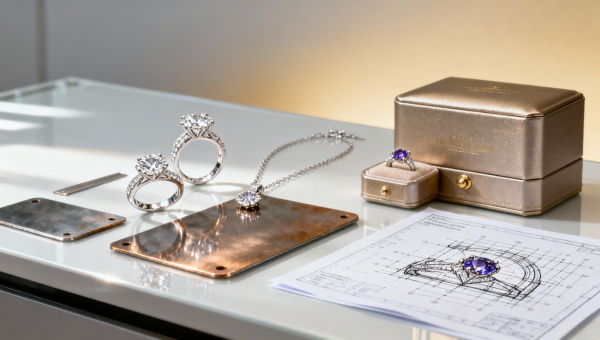
Design translation starts with technical interpretation. A capable custom jewelry manufacturer should move from sketch or reference image to CAD, sample, and production notes without losing proportion, wearability, or fastening reliability. In practical terms, buyers should confirm revision rounds, sample policy, and whether stone setting, clasp construction, and logo application are documented before bulk production begins.
Material control matters just as much as craftsmanship. For plated fashion-luxury items, procurement should ask about base metal options, coating sequence, anti-tarnish treatment, and storage recommendations. For fine jewelry or premium mixed-material pieces, questions may include metal composition, stone grading communication, and whether the supplier can maintain batch consistency over repeat orders placed every quarter or every season.
The following table can be used as a practical supplier evaluation tool during RFQ or qualification review.
A strong evaluation process helps distributors and commercial buyers compare suppliers on operational evidence rather than presentation quality alone. It also shortens negotiation because pricing, quality expectations, and delivery windows become easier to align when requirements are documented from the start.
A practical 5-point qualification checklist
- Request at least one comparable sample that reflects similar stone setting, plating tone, and complexity level.
- Confirm whether the supplier can support small-batch pilots before committing to a larger seasonal order.
- Review packaging specifications, especially for retail gift sets, travel retail, and hospitality environments where display condition matters.
- Clarify inspection checkpoints for clasps, stone security, plating finish, and logo legibility before production begins.
- Discuss replenishment ability for the next 6–12 months, not only the first order.
How cost, compliance, and delivery shape sourcing decisions
Luxury buyers rarely choose a jewelry sourcing partner on unit price alone. Total commercial value comes from the relationship between cost, consistency, lead time, and compliance readiness. A lower quote may become more expensive if finish variation causes returns, if packaging fails during transport, or if rework pushes launch dates into the next retail window. Procurement teams should therefore compare landed cost, not just ex-factory price.
Cost is influenced by more than precious inputs. Tooling, sampling rounds, plating thickness targets, stone sorting, manual setting time, packaging format, and inspection intensity all contribute. For example, a custom jewelry design with multiple articulated parts and premium presentation boxes may involve longer assembly and packing time than a simpler ready-to-sell wholesale line. The right question is not “Which is cheapest?” but “Which model protects both margin and positioning?”
Compliance should be addressed early, especially for brands selling across multiple regions. Depending on destination market and product composition, buyers may need to review metal content claims, labeling language, packaging regulations, and substance restrictions. In watches, jewelry, and eyewear-adjacent accessories, ignoring such requirements can create customs delays or relabeling costs that disrupt launch plans by 1–3 weeks.
The table below summarizes how commercial buyers often compare cost-related sourcing choices in luxury jewelry programs.
A disciplined sourcing plan often combines these options. Buyers may reserve full customization for 20% of a collection that defines brand identity, then use semi-custom or wholesale options for the remaining assortment to manage budget and lead time. This is one of the most practical ways to protect launch impact while avoiding overinvestment in slow-moving SKUs.
Delivery planning points many teams overlook
- Sample approval timing should include internal sign-off, not only factory completion. Many delays happen between receipt and decision.
- Packaging production may run on a separate timeline from jewelry production, adding 7–15 days if artwork or inserts change.
- Peak selling seasons require earlier booking of factory capacity and freight planning, especially for gift-focused luxury jewelry wholesale programs.
Which sourcing approach works best by application scenario
The most effective sourcing strategy depends on where and how the jewelry will be sold. A boutique capsule collection, a hotel retail program, and a distributor-led regional launch each require different priorities. Application-based sourcing reduces mismatch between product concept and operational reality, which is why sophisticated buyers segment sourcing plans instead of using one approach for every channel.
In luxury hospitality, collections often need elegant visual impact, compact packaging, and reliable replenishment in lower but recurring volumes. In department store or specialty retail channels, assortment breadth and visual consistency across multiple counters become more important. For distributors and agents, margin structure, reorder speed, and manageable SKU complexity can matter even more than full exclusivity in the first buying cycle.
GCT is particularly relevant in these cross-channel decisions because buyers need intelligence that links commercial environment, audience expectations, and sourcing feasibility. A collection that works in a flagship setting may not perform in travel retail if packaging is oversized or replenishment is too slow. A range that looks attractive in a catalog may fail in hospitality gifting if the perceived finish does not match the guest experience.
The table below maps common sourcing priorities to practical application scenarios in the watches, jewelry, and luxury accessories trade.
Scenario-based sourcing helps buyers avoid a common mistake: over-specifying every item. Not every SKU in a commercial assortment needs the same development cost or exclusivity level. Matching sourcing depth to channel value is often the difference between a collection that is beautiful and one that is both beautiful and profitable.
Common misconceptions that create sourcing risk
“Custom always means better”
Not necessarily. Full customization is powerful when product identity matters most, but it can slow launch speed and increase development cost. For supporting SKUs, a semi-custom route may create stronger commercial results.
“One approved sample guarantees stable production”
A single approved sample is only the start. Buyers still need batch comparison, packing review, and pre-shipment inspection to maintain finish consistency across larger runs.
“Wholesale programs are too generic for luxury channels”
That depends on curation. Well-selected luxury jewelry wholesale programs with custom packaging, SKU editing, and channel alignment can perform very well in hospitality, travel retail, and distributor-led environments.
FAQ and next steps for buyers evaluating luxury jewelry sourcing
How long does a custom luxury jewelry project usually take?
A practical timeline often includes 2–4 weeks for development and sampling, followed by additional production time depending on complexity, quantity, and packaging. Projects involving multiple sample revisions, custom boxes, or multi-market compliance checks can take longer. Buyers should confirm not only factory lead time but also their own approval schedule.
What should distributors focus on when selecting a luxury jewelry manufacturer?
Distributors should look beyond appearance and check reorder stability, documentation support, assortment logic, and packaging resilience. The best supplier for a distributor is often one that can support a manageable first assortment, then scale into repeat orders without major variation in plating tone, clasp function, or retail presentation.
Is luxury jewelry wholesale suitable for premium hotels and commercial spaces?
Yes, when the assortment is curated to fit the guest profile and retail environment. Hotels and commercial spaces often benefit from compact collections with gift-ready packaging, clear replenishment planning, and selective customization such as branded sleeves, display cards, or destination-themed product edits.
What are the first documents a buyer should prepare before requesting quotations?
At minimum, prepare a product brief covering target market, materials or finish expectations, approximate quantity range, packaging needs, delivery window, and destination market. If custom jewelry design is involved, include sketches, reference images, and any non-negotiable brand elements. This reduces quotation gaps and speeds up supplier comparison.
Why work with GCT when evaluating sourcing options?
Because many buyers do not need more noise; they need usable sourcing intelligence. GCT helps bridge the gap between creative ambition and commercial execution by focusing on supplier capability logic, market-fit scenarios, quality risk points, and procurement decision structure across jewelry and luxury accessories applications.
Why choose us for luxury jewelry sourcing support
If you are comparing custom jewelry manufacturers, reviewing luxury jewelry wholesale options, or planning a channel-specific collection, GCT can help you clarify the right sourcing route before costly mistakes occur. Our value is practical: we help buyers narrow evaluation criteria, compare sourcing models, and align design goals with manufacturing and delivery realities.
You can contact us to discuss sample strategy, product selection, target price structure, delivery cycle expectations, packaging configuration, destination-market requirements, and whether a custom, semi-custom, or wholesale approach makes the most sense for your business. This is especially useful for procurement teams, business evaluators, and distributors managing multiple commercial channels at once.
If you already have sketches, an assortment plan, or an upcoming launch calendar, we can help organize the next steps into a workable sourcing brief. If you are still at the research stage, we can support supplier screening criteria, application scenario matching, and risk review points so your RFQ process starts from a stronger position.
Reach out with your target collection type, estimated quantity, launch timeline, preferred materials, and required market destinations. With the right sourcing structure, luxury jewelry becomes not only a design statement but a disciplined commercial asset.
Search News
Hot Articles
- Pro Stage AudioFIFA Adopts Chinese Mini-LED Displays for 2026 World Cup VAR SystemApr 24, 2026
- Outdoor RidesChina FA Warns Nanjing City Over Fan Conduct; ISO 20785 Compliance AcceleratesApr 24, 2026
- Pro Stage AudioFan Zhendong Visits Silicon Valley as MLTT Investor, AI Ping-Pong Tech Draws US InterestApr 24, 2026
Popular Tags
Need ExpertConsultation?
Connect with our specialized leisureengineering team for procurementstrategies.
Recommended News
 Apr 23, 2026Texas Launches PFAS Probe Against Lululemon, Export Compliance Risks RisePFAS probe against Lululemon in Texas escalates export compliance risks for sportswear ODMs, testing labs & chemical suppliers — act now.● Luxury Retail Analyst
 Apr 21, 2026FDA Proposes Chinese Label Translation Requirement for Sports SupplementsFDA proposes Chinese label translation requirements for sports supplements—learn how protein powders, BCAAs & creatine brands can prepare for Q3 2026 compliance.● Luxury Retail Analyst
 Apr 21, 2026CPSC Urgent Alert: PFAS in Fitness Apparel Risks US Import DelaysPFAS in fitness apparel triggers CPSC alerts—avoid US import delays! Get CPSC-recognized PFAS testing, compliance tips & port detention prevention now.● Luxury Retail Analyst
 Apr 20, 2026US CPSC Alert: PFAS in Fitness Apparel May Delay US Import ClearancePFAS in fitness apparel may delay US import clearance—learn how the Texas AG probe & CPSC alert impact compliance, testing, and supply chains now.● Luxury Retail Analyst
 Apr 15, 2026FDA Updates Guidelines for Sports Nutrition Supplement Labels: Chinese Translations Must Be FDA-CertifiedFDA now requires Chinese translations on sports nutrition supplement labels to be FDA-certified. Learn how this impacts manufacturers, importers, and compliance timelines for US market access.● Luxury Retail Analyst
 Apr 14, 2026Japan Updates Jewelry Labeling Rules: Mandatory China Factory Codes from April 2026Japan's new jewelry labeling rules mandate 'Country of Origin + China Factory Code' (CN-FAC-XXXXX) from April 2026. Learn how this impacts Chinese exporters and Japanese importers in the $2.1B precious metals market.● Luxury Retail Analyst
 Apr 14, 2026RCEP Tariff Cuts Boost China's Optical Lens Exports to ASEANRCEP tariff cuts boost China's optical lens exports to ASEAN with 0% duties on CR-39 & polycarbonate lenses. Learn how this + faster logistics create new trade opportunities.● Luxury Retail Analyst
 Apr 14, 2026US CPSC Proposes Stricter Lead Limits in Children's Jewelry, Impacting Chinese ExportersUS CPSC proposes stricter lead limits (40ppm) in children's jewelry, impacting Chinese exporters with new compliance challenges. Learn how this 2026 regulation affects manufacturers & supply chains.● Luxury Retail Analyst
 Apr 14, 2026EU's Revised EN 14138:2026 Eyewear Nickel Standard Takes Effect, Impacting Chinese ExportersEU's EN 14138:2026 eyewear standard tightens nickel limits to 0.2μg/cm²/week, impacting Chinese exporters. Learn compliance strategies for EU market access.● Luxury Retail Analyst
 Apr 25, 2026Luxury Jewelry B2B in 2026: What Changes?Luxury jewelry B2B in 2026: explore custom jewelry design, custom jewelry manufacturer trends, luxury jewelry wholesale shifts, and how custom luxury jewelry drives faster, safer growth.● Luxury Retail Analyst
 Apr 25, 2026How to Grow a Luxury Accessories Online StoreLearn how to grow a luxury accessories online store with custom jewelry design, a trusted custom jewelry manufacturer, luxury accessories wholesale strategy, and high-end luxury jewelry that converts.● Luxury Retail Analyst
 Apr 25, 2026Custom Jewelry for Corporate Gifts That LastCustom jewelry for corporate gifts from a trusted custom jewelry manufacturer—discover custom jewelry design, high-end luxury jewelry, and scalable luxury jewelry B2B solutions.● Luxury Retail Analyst
 Apr 25, 2026What a Good Luxury Accessories Catalog IncludesLuxury accessories catalog guide covering custom jewelry design, high-end luxury jewelry, luxury accessories for men and women, and trusted luxury jewelry B2B sourcing insights.● Luxury Retail Analyst
 Apr 27, 2026Luxury Jewelry Manufacturer: Red Flags to KnowLuxury jewelry manufacturer warning signs every B2B buyer should know. Learn how to evaluate custom jewelry design, custom luxury jewelry, and luxury jewelry wholesale partners before costly mistakes.● Luxury Retail Analyst
 Apr 27, 2026Custom Jewelry for Weddings: Timeline GuideCustom jewelry for weddings made simple: learn timelines for custom jewelry design, choosing a custom jewelry manufacturer, and planning custom luxury jewelry with diamonds.● Luxury Retail Analyst
 Apr 27, 2026Luxury Jewelry Wholesale for New DistributorsLuxury jewelry wholesale guide for new distributors: compare custom jewelry manufacturer options, custom jewelry design support, and luxury jewelry B2B strategies to launch faster.● Luxury Retail Analyst
 Apr 27, 2026Custom Luxury Jewelry: OEM or Small Batch?Custom luxury jewelry sourcing guide: compare OEM vs small-batch with a custom jewelry manufacturer for custom jewelry design, cost control, quality, and scalable luxury jewelry B2B growth.● Luxury Retail Analyst
 Apr 27, 2026How to Price High-End Luxury Jewelry RightCustom jewelry design and high-end luxury jewelry pricing guide for B2B buyers—learn how a custom jewelry manufacturer sets value, margins, and wholesale strategy.● Luxury Retail Analyst
 Apr 27, 2026Luxury Accessories for Women by Price TierLuxury accessories for women by price tier: compare high-end luxury jewelry, luxury jewelry wholesale, and custom luxury jewelry from a trusted custom jewelry manufacturer for smarter B2B sourcing.● Luxury Retail Analyst
 Apr 27, 2026Luxury Accessories for Men: Classic or Trendy?Luxury accessories for men: classic or trendy? Explore custom jewelry design, high-end luxury jewelry, and how a luxury jewelry manufacturer helps buyers source smarter for growth.● Luxury Retail Analyst
 Apr 27, 2026How to Compare Custom Jewelry ManufacturersCompare every custom jewelry manufacturer with confidence. Learn how custom jewelry design, compliance, craftsmanship, MOQ, and luxury jewelry wholesale capabilities impact quality and growth.● Luxury Retail Analyst
 Apr 27, 20262026 Custom Jewelry Design Trends to WatchExplore 2026 custom jewelry design trends shaping B2B buying, from custom luxury jewelry and diamonds to luxury accessories for men and women with smarter sourcing insights.● Luxury Retail Analyst
 Apr 27, 2026Luxury Jewelry B2B: What Buyers Need FirstLuxury jewelry B2B starts with trust. Learn how a custom jewelry manufacturer supports custom jewelry design, luxury jewelry wholesale, and scalable high-end luxury jewelry sourcing.● Luxury Retail Analyst
 Apr 27, 2026How Luxury Brands Source Jewelry CollectionsCustom jewelry design and custom jewelry manufacturer insights for luxury brands: learn how high-end luxury jewelry, wholesale sourcing, and compliant supply chains drive profitable collections.● Luxury Retail Analyst