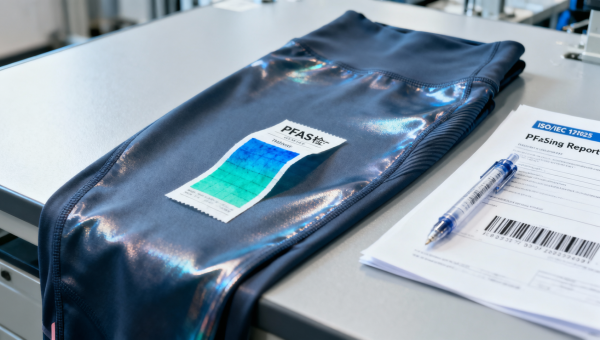
US CPSC Alert: PFAS in Fitness Apparel May Delay US Import Clearance
On April 13, 2026, the Texas Attorney General launched a civil investigation into Lululemon concerning potential PFAS overages in its athletic pants — triggering immediate attention from U.S.-bound textile importers, brand compliance teams, and global sportswear supply chain stakeholders. This development signals heightened regulatory scrutiny of per- and polyfluoroalkyl substances in performance apparel, with implications for customs clearance, labeling, and product testing protocols across key export markets.
Event Overview
On April 13, 2026, the Office of the Texas Attorney General initiated a civil investigation into Lululemon, focusing on possible elevated levels of PFAS (per- and polyfluoroalkyl substances) in its athletic pants and related fitness apparel. The U.S. Consumer Product Safety Commission (CPSC) issued an accompanying advisory highlighting risks associated with PFAS exposure, particularly their classification as reproductive toxicants under multiple international frameworks. Regulatory actions are underway in both the EU (under REACH) and the U.S. (via CPSC), with formal limit-setting legislation in active development.
Industries Affected by This Development
Direct Trading Enterprises
U.S.-based importers and distributors of fitness apparel face increased risk of port detention, mandatory retesting, and documentation review upon entry. PFAS presence may now trigger CBP holds even without final regulatory limits, as enforcement agencies act on existing health advisories and state-level investigations.
Raw Material Sourcing Firms
Suppliers of water-repellent finishes, durable-press treatments, or stain-resistant coatings used in activewear fabrics must verify whether their chemistries contain regulated PFAS compounds. Absence of supplier declarations or third-party test reports may delay purchase orders or trigger contractual non-compliance clauses.
Apparel Manufacturing Contractors
Contract manufacturers producing yoga pants, sports bras, or high-performance leggings for U.S.-bound brands may be asked to provide full substance declarations, mill test reports, or updated SDS documentation — especially if finishing steps involve fluorinated treatments.
Distribution & Logistics Providers
Third-party logistics firms handling cross-border shipments of fitness apparel may encounter new pre-clearance verification requests from importers or customs brokers, including proof of PFAS-free processing or certified lab results dated within 90 days of shipment.
Supply Chain Compliance Services
Firms offering chemical compliance audits, restricted substance list (RSL) management, or test coordination services are seeing rising inquiry volume — particularly around PFAS screening in finished garments and intermediate textiles. Demand is concentrated among exporters targeting U.S. retail channels with fast-turnover athletic wear lines.
What Relevant Enterprises or Practitioners Should Monitor and Do Now
Track official updates from CPSC and state AG offices
The Texas AG investigation remains ongoing; no findings or enforcement orders have been published as of April 13, 2026. CPSC has not yet issued binding PFAS limits for apparel, but its advisory carries weight in customs interpretation. Stakeholders should monitor CPSC’s public docket and state attorney general press releases for any expansion beyond Lululemon-specific scope.
Prioritize testing and documentation for high-risk categories
Fitness apparel with water-repellent, anti-odor, or wrinkle-resistant properties — especially items marketed for high-sweat use (e.g., running tights, compression tops) — are most likely to undergo targeted screening. Companies should proactively obtain accredited lab reports (e.g., ISO/IEC 17025) for PFAS using EPA Method 537.1 or equivalent, covering C4–C14 perfluoroalkyl carboxylic acids and sulfonic acids.
Distinguish policy signals from enforceable requirements
Analysis来看, this event reflects an emerging enforcement trend rather than an implemented regulation. While REACH Annex XVII restrictions on certain PFAS apply broadly to consumer goods, U.S. federal rules remain proposal-stage. Current actions rely on state authority and CPSC’s general safety mandate — meaning outcomes will vary by port, broker, and importer risk tolerance.
Update internal procurement and communication protocols
Brands and importers should revise purchase order terms to require PFAS declarations from suppliers, specify acceptable test methods and detection limits (e.g., <10 ppb total PFAS), and define liability for failed clearances. Internal compliance teams should align with quality assurance and sourcing departments to ensure consistent terminology (e.g., “intentionally added PFAS” vs. trace contamination) across documentation.
Editorial Perspective / Industry Observation
From industry angle, this incident functions primarily as a regulatory signal — not yet a compliance milestone. It illustrates how state-level enforcement can accelerate federal action and reshape importer expectations ahead of formal rulemaking. Observationally, it underscores a shift toward proactive chemical stewardship in performance textiles: buyers are increasingly treating PFAS not as a future compliance item, but as a current due diligence checkpoint. The timing — coinciding with CPSC’s broader focus on youth and athletic products — suggests fitness apparel may be among the first textile categories subjected to systematic PFAS oversight in the U.S.
Conclusion
This development does not represent an immediate ban or mandatory recall, but rather a material escalation in regulatory visibility for PFAS in functional sportswear. It signals growing alignment between environmental health concerns and trade enforcement mechanisms — particularly where state attorneys general and federal safety agencies converge on shared chemical priorities. For affected businesses, the current posture is best understood as a preparatory phase: one requiring documentation rigor, supply chain transparency, and responsiveness to evolving interpretations — not yet a finalized standard.
Information Sources
Main source: Public statement issued by the Office of the Texas Attorney General on April 13, 2026; supplementary advisory notice from the U.S. CPSC dated same day. Ongoing legislative proposals under CPSC jurisdiction and EU REACH amendment processes remain under observation and are not yet finalized.
Search News
Hot Articles
Popular Tags
Need ExpertConsultation?
Connect with our specialized leisureengineering team for procurementstrategies.
Recommended News
 Apr 20, 2026US CPSC Alert: PFAS in Fitness Apparel May Delay US Import ClearancePFAS in fitness apparel may delay US import clearance—learn how the Texas AG probe & CPSC alert impact compliance, testing, and supply chains now.● Luxury Retail Analyst
 Apr 15, 2026FDA Updates Guidelines for Sports Nutrition Supplement Labels: Chinese Translations Must Be FDA-CertifiedFDA now requires Chinese translations on sports nutrition supplement labels to be FDA-certified. Learn how this impacts manufacturers, importers, and compliance timelines for US market access.● Luxury Retail Analyst
 Apr 14, 2026Japan Updates Jewelry Labeling Rules: Mandatory China Factory Codes from April 2026Japan's new jewelry labeling rules mandate 'Country of Origin + China Factory Code' (CN-FAC-XXXXX) from April 2026. Learn how this impacts Chinese exporters and Japanese importers in the $2.1B precious metals market.● Luxury Retail Analyst
 Apr 14, 2026RCEP Tariff Cuts Boost China's Optical Lens Exports to ASEANRCEP tariff cuts boost China's optical lens exports to ASEAN with 0% duties on CR-39 & polycarbonate lenses. Learn how this + faster logistics create new trade opportunities.● Luxury Retail Analyst
 Apr 14, 2026US CPSC Proposes Stricter Lead Limits in Children's Jewelry, Impacting Chinese ExportersUS CPSC proposes stricter lead limits (40ppm) in children's jewelry, impacting Chinese exporters with new compliance challenges. Learn how this 2026 regulation affects manufacturers & supply chains.● Luxury Retail Analyst
 Apr 14, 2026EU's Revised EN 14138:2026 Eyewear Nickel Standard Takes Effect, Impacting Chinese ExportersEU's EN 14138:2026 eyewear standard tightens nickel limits to 0.2μg/cm²/week, impacting Chinese exporters. Learn compliance strategies for EU market access.● Luxury Retail Analyst
 Apr 18, 2026Luxury jewelry authenticity verification: Can UV light spot fake gemstones?Trampoline park, luxury jewelry & adventure playground buyers: Discover how UV light detects fake gemstones—fast, non-destructive, field-proven verification for experiential retail and entertainment environments.● Luxury Retail Analyst
 Apr 16, 2026Designer eyewear MOQs that quietly exclude small-batch collectionsDesigner eyewear MOQs stifle creativity—discover agile OEM manufacturing, supply chain solutions & custom fabrication for small-batch luxury collections.● Luxury Retail Analyst
 Apr 16, 2026Designer eyewear supply chain risks no one talks about—beyond MOQ and color matchingDiscover hidden designer eyewear supply chain risks—from lens certification delays to acetate traceability gaps—and get actionable OEM manufacturing & supply chain solutions.● Luxury Retail Analyst
 Apr 16, 2026Luxury accessories with traceable material sourcingLuxury accessories, custom jewelry & luxury timepieces with fully traceable material sourcing—verified for park benches, music stands, orchestral instruments, DJ equipment and more.● Luxury Retail Analyst
 Apr 15, 2026Luxury accessories that actually hold value over timeDiscover luxury accessories that hold value—custom jewelry, orchestral instruments, keyboard instruments, luxury timepieces, park benches & more. Built to last, appreciate, and elevate your procurement strategy.● Luxury Retail Analyst
 Apr 15, 2026Why custom jewelry orders take longer than expected in 2026Discover why custom jewelry, luxury accessories & timepieces face delays in 2026—linked to park benches, music stands, DJ equipment & office supply bottlenecks. Optimize timelines now.● Luxury Retail Analyst
 Apr 13, 2026Designer eyewear materials that age gracefully—or fail silentlyDesigner eyewear materials impact hotel furniture, indoor playground equipment & pro audio gear longevity. Discover which age gracefully—or fail silently.● Luxury Retail Analyst
 Apr 13, 2026OEM manufacturing for eyewear: How small-batch runs affect hinge consistencyOEM manufacturing for eyewear demands precision hinge consistency—especially for designer eyewear, indoor playground equipment & pro audio equipment. Discover how small-batch runs impact durability, brand trust & supply chain solutions.● Luxury Retail Analyst
 Apr 14, 2026Designer eyewear OEM: How lens compatibility affects frame durability over timeDesigner eyewear OEM durability hinges on precise lens compatibility—critical for hotel furniture, indoor playground equipment & pro audio gear. Discover how smart supply chain solutions prevent frame failure.● Luxury Retail Analyst
 Apr 10, 2026OEM jewelry casting defects appear identical across factories — until you check mold maintenance logsUnlock supply chain solutions with OEM manufacturing transparency—spot hidden jewelry, watch & eyewear defects through mold maintenance logs.● Luxury Retail Analyst
 Apr 10, 2026Commercial procurement of premium accessories reveals unexpected inventory biasDiscover how supply chain solutions for premium accessories—ODM watches, OEM jewelry & designer eyewear—are shifting. Optimize commercial procurement today.● Luxury Retail Analyst
 Apr 11, 2026Premium accessories buyers notice subtle finish inconsistencies long before QC reports flag themPremium accessories buyers spot finish flaws before QC—discover vetted OEM manufacturing, ODM watches, designer eyewear & supply chain solutions.● Luxury Retail Analyst
 Apr 11, 2026Supply chain solutions for accessories rarely include real-time material traceabilitySupply chain solutions for premium accessories—ODM watches, OEM jewelry & designer eyewear—with real-time material traceability. Boost compliance, trust & speed-to-market.● Luxury Retail Analyst
 Apr 11, 2026Why OEM jewelry manufacturers still struggle with lead time consistency in 2026Discover why OEM jewelry and ODM watches still face lead time chaos in 2026—and how supply chain solutions, designer eyewear partners, and premium accessories manufacturers are raising the bar.● Luxury Retail Analyst
 Apr 09, 2026Designer eyewear frames with non-replaceable hinges — a durability trade-off worth making?Designer eyewear frames with non-replaceable hinges: sleek aesthetics vs. real-world durability. Explore trade-offs for hotel furniture, inclusive playgrounds, soundproofing materials & more.● Luxury Retail Analyst
 Apr 09, 2026Designer eyewear with UV400 lenses but no polarization — is glare reduction really optional?Designer eyewear with UV400 lenses—essential for outdoor playgrounds, theme park rides & luxury retail. Is non-polarized truly strategic? Discover when glare reduction is optional—and why it matters for safety, branding & compliance.● Luxury Retail Analyst
 Apr 07, 2026Middle East Tensions Raise Air Freight Costs for Jewelry, EyewearMiddle East tensions drive 12% air freight cost surge for jewelry & eyewear exports. Learn how luxury goods shippers adapt to rising logistics challenges and extended delivery times.● Luxury Retail Analyst
 Apr 07, 2026Lao Miao, Chow Sang Sang Gold Jewelry Prices Drop, Easing Cost PressuresLao Miao & Chow Sang Sang gold jewelry prices drop 5-11 yuan/gram, easing cost pressures for manufacturers. Boost your jewelry business with lower production costs & enhanced overseas order competitiveness.● Luxury Retail Analyst