Office Phone Booths: How to Evaluate Speech Privacy Before You Buy
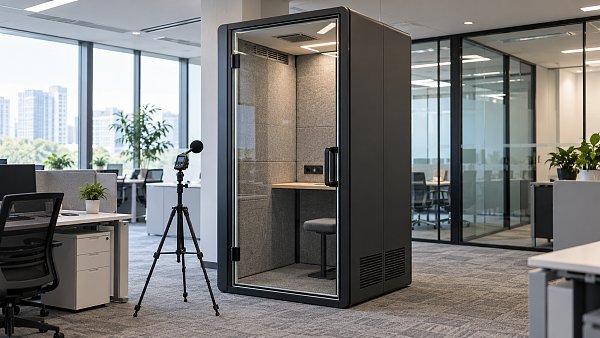
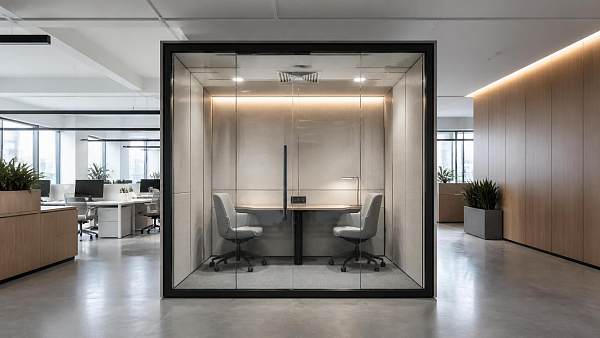
Select an office phone booth by establishing whether speech remains intelligible outside it under the quietest conditions expected in the workplace. A strong laboratory result supports the shortlist, but the purchase decision also needs evidence from the proposed location, with the door closed, ventilation operating, and realistic conversations inside. A booth that conceals ordinary calls beside a busy circulation route may expose recognizable phrases beside a quiet workstation.
Before comparing specifications, define the required outcome: reduced distraction, conversations that are audible but unintelligible, or a stricter requirement for sensitive discussions. These are different acceptance conditions. “Soundproof” does not define any of them, and no single decibel figure establishes that confidential speech will remain private.
Read the speech reduction result in context
ISO 23351-1 describes laboratory measurement of speech level reduction for furniture ensembles and enclosures, including office booths. The reported speech level reduction, commonly written as DS,A, indicates how much the enclosure reduces a standardized speech signal under the specified test conditions. A higher result indicates greater measured reduction within that method.
This provides a useful basis for comparison when the products were tested using the same method and comparable configurations. It does not directly state the probability that someone outside will understand a conversation. Intelligibility also depends on the speaker’s vocal effort, the background sound at the listener’s position, distance, and the acoustic character of the surrounding room.
Request the underlying test report rather than relying on a product-page badge. The report should identify the tested model, configuration, method, laboratory, and result. Confirm whether the offered booth matches the specimen, particularly its door, glazing, ventilation arrangement, and cable openings. An upgraded door or alternative ventilation package creates a configuration question that the original result may not resolve.
Do not subtract the published reduction from a casually measured interior sound level to predict the level at a nearby desk. The laboratory metric is derived through a defined measurement procedure; it is not a universal correction for every microphone position, room, or speaking condition.
Define what counts as a privacy failure
An audible voice is not necessarily intelligible speech. A listener might detect that a call is taking place without recognizing words. Conversely, a conversation that sounds faint can still reveal names, numbers, or short phrases during pauses in office activity. Acceptance criteria should distinguish these outcomes.
For routine calls, the requirement might allow detectable speech while rejecting repeatable understanding of sentences at adjacent workstations. For discussions involving sensitive information, recognition of isolated meaningful details may already be unacceptable. A booth intended for that use needs evaluation against the stricter condition from the start.
Document the receiving positions that matter: the nearest occupied desk, a waiting area, a corridor where someone could pause, and any workspace behind the booth. Include seated ear height where appropriate. A demonstration taken only from the front of the enclosure can miss a ventilation outlet facing another occupied area.
Set the vocal conditions as well. Ordinary conversation, an animated video call, and raised speech produce different demands. Include the loudest speaking style reasonably expected during normal use, without treating shouting as representative unless the application actually requires it.
The installation can change the result
The surrounding sound environment often explains why an impressive showroom demonstration fails to transfer to an office. Busy showrooms provide masking from conversations, equipment, and movement. After installation, the same booth may stand beside desks where background sound falls sharply between calls or after normal working hours.
Assess the quietest occupied operating period, not simply the average daytime condition. If the building ventilation switches to a quieter mode while the booth remains available, that condition belongs in the assessment. Where sound masking is part of the office design, record its operating state and assess privacy with the intended settings.
Distance and layout matter because escaped speech changes level as it travels, while reflections redistribute it. Hard nearby surfaces can redirect sound toward a desk. An outlet placed close to a wall can behave differently from the same outlet in an open display area. Avoid assuming that moving the booth a short distance will produce a predictable improvement without retesting.
Installation quality creates another source of variation. An uneven base can affect door alignment; missing cable closures create openings; a poorly seated panel joint can form a leakage path. These details should be inspected before interpreting a disappointing result as a limitation of the entire design.
Doors and air paths deserve close attention
A closed door must seal consistently
The door is a moving acoustic boundary. Its performance depends on continuous seals, correct alignment, and a closure mechanism that reliably brings the leaf into its intended position. A door that appears closed while leaving part of the perimeter uncompressed creates a repeatable privacy problem.
Inspect the threshold, corners, hinge side, and latch side. Look for interrupted gaskets, damage, debris, or uneven contact. Where a drop seal is fitted, verify that it engages across the intended width when the door closes. Repeat the closure several times using normal hand pressure; performance that requires careful adjustment after each entry is unlikely to persist in daily use.
Glass thickness alone is an inadequate selection criterion. The door assembly includes its frame, seals, hardware, and interfaces. A heavier panel does little to resolve an open perimeter path.
Ventilation must work during the privacy assessment
Air must pass through the enclosure, making ventilation a necessary acoustic design challenge. Attenuated passages use geometry and absorptive treatment to reduce sound transmission while allowing airflow. Their effectiveness depends on the complete path, including openings and connections.
Run the booth in its intended occupied mode during testing. A demonstration with fans switched off may misrepresent normal operation. Fan sound inside can also make a speaker raise their voice, increasing the speech level presented to the enclosure.
Listen near both supply and exhaust openings, then at the nearest relevant occupied position. A concentrated leak near a grille calls for a different remedy from transmission spread across a panel. Any ventilation modification intended to improve privacy also needs its airflow performance verified; obstructing a grille is not an acceptable acoustic fix.
Run a listening trial that produces usable evidence
An on-site trial should make differences repeatable enough to support a purchase decision. Casual conversation through a demonstration booth rarely does this: the speaker changes level, listeners already know the topic, and surrounding activity fluctuates.
- Prepare unfamiliar speech material. Use several passages containing ordinary sentences and some meaningful details, such as fictional names or reference numbers. Keep the text hidden from listeners so prior knowledge does not inflate recognition.
- Fix the speaking position and delivery. Place the speaker where calls will normally occur, including the expected orientation toward a laptop. Repeat the assessment with a more projected voice if that reflects actual use. A calibrated speech source provides better repeatability when specialist measurement is available.
- Record conditions before each run. Note the door state, ventilation mode, surrounding activity, and any masking system. Background measurements are useful only when their location, instrument, and measurement settings are documented.
- Collect independent observations. At each receiving position, record whether speech is detectable, whether isolated words are recognized, and whether phrases or complete meanings are understood. Write down recognized content before revealing the source text.
- Repeat the demanding conditions. Include a quiet occupied period and repeat normal door closures. Retest after any seal adjustment, relocation, or other corrective work.
Use both the nearest likely listener position and other locations where speech appears strongest. Testing only at an arbitrary fixed distance can overlook the actual exposure created by the office layout.
A listening trial supports a practical acceptance decision, but it is not a substitute for a standardized acoustic test. Where the privacy requirement is stringent or the result is disputed, an acoustics specialist can select suitable measurements and interpret speech intelligibility alongside background sound.
Diagnose a weak result before changing the specification
If words become clearer beside the door edge, investigate seal contact and alignment first. A marked concentration near an air opening points toward the ventilation path. Broadly distributed sound warrants examination of panels, glazing, joints, and multiple simultaneous paths. Listening observations help locate the problem, but controlled measurements are preferable when the source remains uncertain.
Different corrective measures address different causes. Additional interior absorption reduces reflected sound within the booth, but it does not close a gap. Better seals address leakage without necessarily improving transmission through a large panel. Relocation increases separation from listeners, while masking changes the receiving environment. Treating these measures as interchangeable encourages unsuccessful modifications.
A particularly revealing result occurs when the booth passes during busy periods and fails during quiet ones. That pattern shows that privacy relies partly on environmental masking. The decision then turns on whether that masking is available throughout the intended hours of use and whether the organization accepts that operating dependency.
Make the accepted configuration part of the purchase
The purchase documentation should connect the laboratory evidence, delivered configuration, and installed acceptance conditions. Identify the enclosure version, door assembly, ventilation package, and permitted service penetrations. Record the receiving positions, speech conditions, operating modes, and intelligibility outcome used for acceptance.
If a sample booth is evaluated before a larger order, establish how delivered units will be inspected for assembly consistency. The sample’s success does not resolve misaligned doors or incomplete seals elsewhere. Agree on the corrective process and retesting conditions before delivery, particularly when final acceptance depends on the completed office environment.
Privacy performance also needs to survive ordinary maintenance. Specify replacement seals and adjustment instructions, and require an acoustic reassessment after changes to doors, ventilation paths, or cable openings. A booth accepted with intact seals and a properly aligned door should return to those same conditions after service.
Search News
Hot Articles
- Office Furniture & EquipOffice Phone Booths: How to Evaluate Speech Privacy Before You BuyOct 24, 2026
- Outdoor RidesComcast Q3 Earnings: Universal Theme Park Revenue Falls 4.4% to $2.6 BillionOct 23, 2026
- Restaurant FurnitureHotel Bar Furniture Prices: What to Budget for Stools, Tables, and DeliveryOct 23, 2026
Popular Tags
Need ExpertConsultation?
Connect with our specialized leisureengineering team for procurementstrategies.
Recommended News
 Oct 24, 2026Office Phone Booths: How to Evaluate Speech Privacy Before You BuyChoose a privacy phone booth office teams can trust. Learn how to assess speech privacy, verify acoustic test reports, and check seals and ventilation before you buy.● Institutional Buyer
 Oct 13, 2026Choosing Commercial Air Conditioners for Offices: Capacity, Zoning, and NoiseChoosing commercial air conditioners for offices? Compare capacity, zoning, and noise to improve comfort, avoid costly mistakes, and find the right system for your workplace.● Institutional Buyer
 Sep 02, 2026How to Choose a Glass Acoustic Office Pod for Open-Plan Workplace PrivacyGlass acoustic pod office buying guide: compare privacy, ventilation, safety glass, power, site fit, and supplier support to choose a productive open-plan workspace solution.● Institutional Buyer
 Sep 01, 2026Is CE Marking Enough for Commercial Products Sold in the US?Is CE marking enough for commercial products sold in the US? Learn the key US safety, FCC, listing, and inspection requirements before you buy.● Institutional Buyer
 Sep 04, 2026B2B Office Supplies Procurement: Building a Cost-Controlled Replenishment ProgramB2B office supplies procurement made smarter: build a cost-controlled replenishment program that reduces spend, prevents stockouts, and improves supplier performance.● Institutional Buyer
 Aug 26, 2026How to Choose Automatic Office Coffee Machines for Team Size, Usage, and MaintenanceAutomatic office coffee machines: learn how to choose the right model for team size, daily demand, drink preferences, and maintenance needs to reduce downtime and improve workplace satisfaction.● Institutional Buyer
 Aug 13, 2026What to Look for When Choosing a Wood Executive Office Desk for Daily UseWood executive office desks should do more than look premium. Learn how to compare durability, ergonomics, cable management, and finish quality before you buy.● Institutional Buyer
 Jul 31, 2026How to Choose Institutional Storage Furniture for Schools, Offices, and Public FacilitiesInstitutional storage furniture buying guide for schools, offices, and public facilities—learn how to assess safety, durability, cleaning, locks, and lifecycle cost before you buy.● Institutional Buyer
 Jul 14, 2026Commercial Carpet Tile Price Guide: Cost Factors, Wear Ratings, and Installation ScopeCommercial carpet tile price explained: compare cost factors, wear ratings, and installation scope to choose durable, budget-smart flooring for offices, schools, hotels, and retail.● Institutional Buyer
 Jul 11, 2026How to Compare Motorized, Fixed Frame, and Portable Wholesale Projector ScreensWholesale projector screens compared: discover how motorized, fixed frame, and portable options differ in image quality, flexibility, and sourcing value for commercial projects.● Institutional Buyer
 Jul 10, 2026Desktop Hole Punches Wholesale: What Buyers Should Check Before Placing a Bulk OrderDesktop hole punches wholesale buyers should check quality, accuracy, compliance, total cost, and supplier reliability before placing a bulk order. Read the key checkpoints now.● Institutional Buyer
 Jul 09, 2026Library Bookshelves Wholesale Buying Guide: Materials, Load Capacity, and Layout CostsLibrary bookshelves wholesale guide covering materials, load capacity, and layout costs. Compare options, reduce procurement risk, and choose durable shelving for long-term value.● Institutional Buyer
 Jul 08, 2026Height Adjustable Desks Bulk: Key Specs to Compare for Office Fit-Out ProjectsHeight adjustable desks bulk: compare load, range, stability, noise, compliance, and rollout factors to choose reliable desks for office fit-out projects with less risk.● Institutional Buyer
 Jul 06, 2026FBX Drops 18% as Asia-Europe Furniture Rates FallFBX drops 18% as Asia-Europe furniture rates fall to $1,186/FEU, reshaping office furniture import margins, restocking timing, and shipping plans. See what buyers and exporters should do next.● Institutional Buyer
 Jul 06, 2026Training Chairs With Writing Tablet: What to Check for Classroom Layout and DurabilityTraining chairs with writing tablet: learn how to compare classroom layout, tablet size, frame durability, and maintenance needs to choose smarter, longer-lasting seating.● Institutional Buyer
 Jul 05, 2026Indonesia Tightens Wood Proof for Office Furniture ImportsIndonesia tightens wood proof for office furniture imports from July 3, 2026. Learn FLEGT, certification, customs risks, and how exporters can avoid delays and extra fees.● Institutional Buyer
 Jul 04, 2026How to Choose Educational Furniture for Schools by Age Group, Layout, and DurabilityEducational furniture for schools should match age groups, room layouts, and durability needs. Discover practical buying tips to improve safety, flexibility, and long-term value.● Institutional Buyer
 Jul 03, 2026Europe 40HQ Rates Climb to $6,920 for Large Furniture ShipmentsEurope 40HQ rates climb to $6,920, reshaping large furniture shipments with 9–12 week delays and higher consolidation costs. See what exporters and buyers should do now.● Institutional Buyer
 Jul 03, 2026Adjustable Library Shelves: Load Capacity, Material, and Layout Tips for Smarter Space PlanningAdjustable library shelves: learn how to compare load capacity, materials, and layout options to create safer, more flexible spaces with lower long-term costs.● Institutional Buyer
 Jul 02, 2026Vietnam Tightens Proof Rules for Wood Office FurnitureVietnam tightens proof rules for wood office furniture from July 1, 2026. Learn how FSC-CoC, VPA-FLEGT, and customs delays could impact exporters, sourcing, and delivery plans.● Institutional Buyer
 Jun 29, 2026Workspace Furniture for Offices: What to Compare Before Planning a Hybrid LayoutWorkspace furniture for offices should be compared by flexibility, comfort, space efficiency, and procurement value before planning a hybrid layout. Learn what to review for smarter office decisions.● Institutional Buyer
 Jun 28, 2026How to Evaluate an Institutional Furniture Manufacturer for Schools, Hospitals, and Public SpacesInstitutional furniture manufacturer evaluation guide for schools, hospitals, and public spaces. Learn how to compare compliance, durability, customization, and supply reliability.● Institutional Buyer
 Jun 23, 2026Educational Furniture for Universities: What to Compare Before Buying for Labs and Lecture RoomsEducational furniture for universities: compare lab and lecture room safety, durability, flexibility, and lifecycle cost before buying. Make smarter campus sourcing decisions.● Institutional Buyer
 Jun 22, 2026How to Choose Educational Furniture for Libraries by Age Group, Layout, and UseEducational furniture for libraries should match age groups, layout, and daily use. Discover practical tips to choose safer, flexible, durable solutions that improve learning spaces.● Institutional Buyer