Why playground swings fail early at busy public sites
At busy public sites, playground swings often wear out faster than expected due to heavy traffic, poor material choices, weather exposure, and inconsistent maintenance. For buyers comparing outdoor playground and indoor playground equipment, or planning broader leisure venues such as a trampoline park, understanding these failure points is essential for safer sourcing, longer service life, and better commercial value.
For procurement teams, distributors, and project evaluators in the sports and entertainment sector, early swing failure is not a minor maintenance issue. It directly affects site uptime, user safety, replacement budgets, and brand reputation. A swing set at a municipal park, school campus, family entertainment center, resort, or mixed-use leisure venue may face hundreds of use cycles per day, far beyond the assumptions made for low-traffic installations.
This article explains why playground swings fail early at high-volume public sites, what technical and operational warning signs buyers should watch, and how sourcing teams can reduce lifecycle cost through better specification, inspection, and maintenance planning. The focus is practical: failure mechanisms, material decisions, installation variables, and procurement criteria that matter in commercial environments.
High Traffic Changes the Real Load Profile
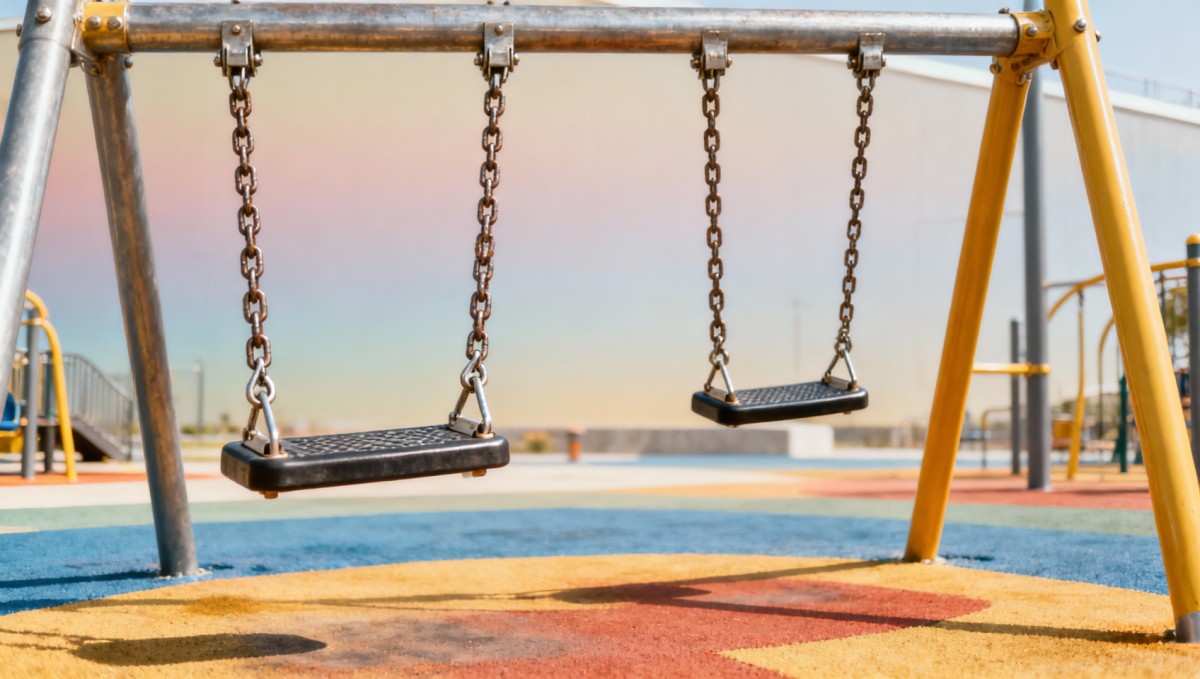
At busy public playgrounds, the actual stress on swings is rarely limited to simple forward-and-back motion. Users twist chains, stand on seats, apply side loads, and create repeated impact at the top beam, hanger, and seat connection points. A swing designed for moderate use may degrade quickly when daily traffic reaches 200 to 500 play cycles, especially during weekends, school breaks, or event periods.
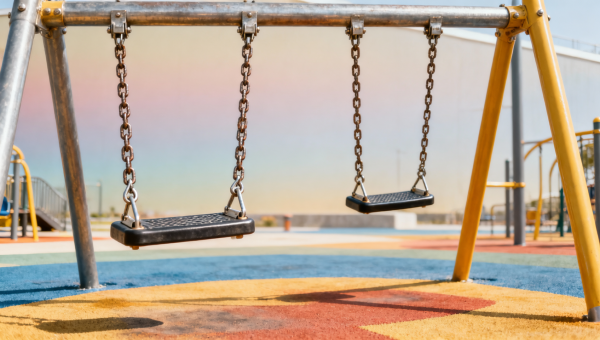
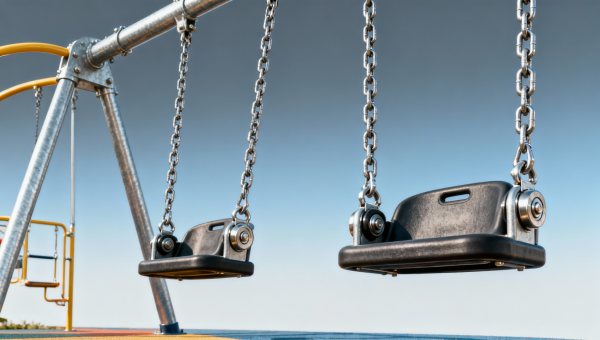
The most common early failures begin at wear interfaces rather than at the largest visible components. Hangers, bearings, chain links, shackles, and seat inserts often show damage first. In many public installations, small components fail 6 to 18 months before the main frame shows obvious deterioration. For buyers, this means lifecycle performance should be judged at the assembly level, not only by frame thickness or visual appearance.
Why usage intensity matters more than nominal capacity
A swing may be advertised with a static load rating, but public-site durability depends more on dynamic loading. Repeated swinging, abrupt stopping, jumping onto seats, and multi-user misuse create peak forces far above resting weight. In practical terms, a seat supporting a child of 35 kg can still experience much higher momentary stress when impact and side movement are involved.
This is why procurement teams should ask suppliers about fatigue resistance, test cycles, and component replacement intervals rather than relying only on basic weight capacity. A frame with a 10-year structural claim may still require hanger replacement every 12 to 24 months if installed in a heavy-use urban location.
Common high-traffic stress factors
- Continuous use for 6 to 10 hours per day in parks, schools, and tourism sites.
- Peak loading during weekends where traffic may be 1.5 to 2 times weekday levels.
- Unintended side-swinging and twisting that accelerate hanger and chain wear.
- Multi-age use, including older children using equipment sized for younger users.
The table below summarizes how different usage patterns influence swing failure risk in commercial leisure environments.
The key procurement takeaway is simple: a swing that performs acceptably in a residential or low-use setting may be under-specified for a public site. Buyers should match the product to real traffic intensity, not just to the playground footprint or target age label.
Material Selection Often Determines Service Life
Many early failures come from material mismatch rather than obvious manufacturing defects. Commercial buyers often compare steel thickness, but long-term performance also depends on coating quality, chain grade, seat compound, UV stability, corrosion resistance, and the quality of moving hardware. A swing exposed to sun, rain, and dust 365 days a year needs a much higher material baseline than equipment installed indoors.
For outdoor playground equipment, galvanized steel or properly protected stainless steel components are usually more reliable than untreated carbon steel. Powder coating can improve appearance and surface protection, but if pretreatment is weak or edges are poorly covered, corrosion may begin within 12 months in humid or coastal climates. Once rust starts around welds or bolt holes, the damage often accelerates.
Seats and suspension parts fail differently
Swing seats made from low-grade plastic may crack under UV exposure and temperature cycling, especially in climates ranging from below 0°C in winter to above 35°C in summer. Rubber seats can offer better impact comfort, but their reinforcement structure and insert bonding quality are critical. If the insert-to-seat connection degrades, the seat may fail before the surface material appears badly worn.
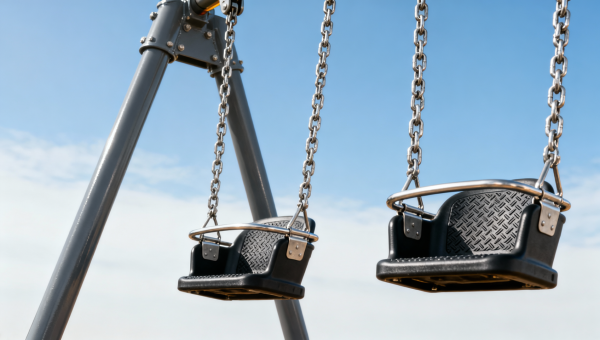
Suspension chains also deserve close attention. Buyers should review link finish, weld consistency, finger-safe design, and resistance to abrasion. Poor chain quality increases not only breakage risk but also noise, pinch hazards, and maintenance frequency. In high-traffic sites, even small chain deformation can become a recurring service issue within one operating season.
Material choices buyers should compare
The following comparison helps procurement teams evaluate which materials are better suited to intensive public use.
A lower purchase price can look attractive during tender review, but replacement cycles often erase that advantage. If one swing assembly needs major parts replacement after 18 months instead of 36 months, the total cost of ownership changes quickly once labor, downtime, and site management are included.
This issue becomes even more important when buyers compare outdoor playground equipment with indoor playground equipment or hybrid leisure concepts. Indoor equipment is protected from rain and UV, while outdoor swings need stronger resistance to moisture, thermal expansion, and contamination from sand or dust. Material specification should therefore be environment-specific, not copied across project types.
Installation Quality and Site Conditions Can Shorten Lifespan
Even a well-made swing can fail early if installation quality is inconsistent. Public projects often involve multiple contractors, compressed schedules, and varying ground conditions. Misalignment at the top beam, poor anchoring, uneven surfacing, or incorrect clearances can increase vibration and transfer extra stress into joints and moving parts from day one.
Anchoring deserves particular attention. If a frame shifts slightly under repeated motion, the swing assembly experiences cumulative fatigue that is not obvious during initial inspection. On some busy sites, micro-movement in the support structure leads to fastener loosening within 3 to 6 months. This is especially common where installation occurs on poorly compacted ground or where drainage problems soften the base after heavy rain.
Environmental exposure is rarely neutral
Public swings are exposed to more than weather. Airborne pollutants, chlorides near coastal zones, standing water, sand abrasion, and vandalism all affect service life. In coastal or high-humidity areas, corrosion can progress significantly faster than in dry inland regions. In hot climates, UV and heat can stiffen plastics and degrade flexible seat materials over 2 to 3 summer seasons.
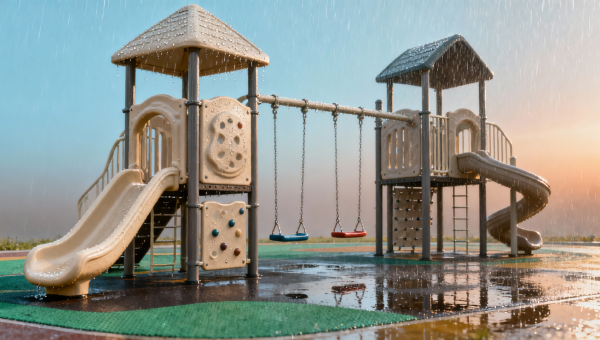
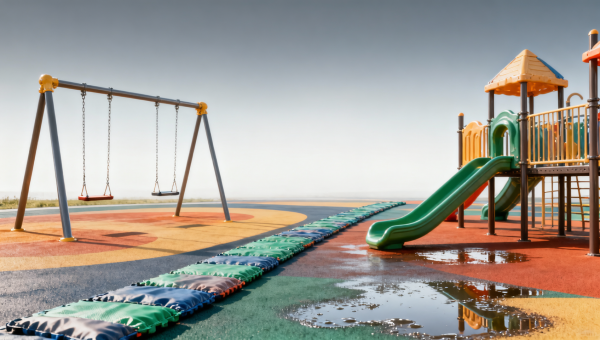
Drainage and surfacing also matter. If water collects near foundations or around the wear zone under the swing, mud and debris can increase contamination of moving parts. That raises friction, accelerates hanger wear, and complicates inspection. A site that looks acceptable at handover may perform poorly after one rainy season if drainage design was under-prioritized.
Site inspection checklist before acceptance
- Verify anchor stability after initial loading and again after the first 30 days of use.
- Check beam alignment, seat height consistency, and swing spacing against the approved layout.
- Confirm drainage performance after rainfall or controlled water testing.
- Inspect all fasteners, hanger movement, and connection points for noise or abnormal friction.
- Review protective surfacing depth and wear pattern in the primary impact zone.
The table below outlines several site factors that frequently reduce swing lifespan in public leisure projects.
For procurement managers, installation quality should be written into the delivery scope, acceptance checklist, and post-install review. A swing is not a finished product at factory dispatch; it becomes a reliable commercial asset only after correct site integration.
Maintenance Gaps Turn Normal Wear Into Early Failure
A large share of premature swing failure is maintenance-related. Public operators often assume swings need only occasional visual checks, but high-use equipment requires planned inspection intervals. When lubrication, tightening, wear measurement, and part replacement are delayed, minor issues rapidly escalate into service interruptions or safety incidents.
For busy public sites, a practical maintenance rhythm often includes quick visual checks daily or weekly, operational checks every 1 to 4 weeks, and more detailed inspections every 3 months. The exact interval depends on traffic, climate, and site management resources, but the principle is consistent: the busier the site, the shorter the inspection cycle should be.
What buyers should ask before ordering
Commercial buyers should not only ask about product price and delivery time. They should request spare part availability, recommended maintenance intervals, wear part lists, and typical replacement lead times. If a supplier cannot provide a clear maintenance matrix, the equipment may become expensive to operate after the warranty window closes.
This is particularly important for distributors and agents serving institutional clients. A product line that looks competitive on paper may create after-sales pressure if replacement chains, hangers, seats, or bushings are difficult to source within 7 to 21 days. Delayed parts supply means longer downtime and weaker end-user satisfaction.
Typical maintenance priorities for public swings
- Check hanger and bearing movement for friction, noise, or irregular play.
- Inspect chains for deformation, coating loss, and pinch-point risk.
- Review seat integrity, insert retention, and cracking around connection holes.
- Retighten structural fasteners according to service schedule.
- Clean debris and moisture-prone zones to limit corrosion and abrasive wear.
A common mistake is replacing only the visibly damaged part. In reality, wear often spreads across paired components. If a worn hanger is replaced but the chain link interface remains damaged, the new part may deteriorate faster than expected. Maintenance decisions should therefore be assembly-based, not purely part-based.
For operators planning broader entertainment projects, including a trampoline park or mixed indoor-outdoor recreation site, maintenance planning should be centralized. Cross-site spare parts strategy, inspection documentation, and technician training can reduce service costs over 12 to 24 months while improving uptime across different equipment categories.
A Better Sourcing Framework for Public-Site Buyers
Preventing early swing failure starts before the purchase order. Buyers in the sports and entertainment sector should evaluate swings as long-life commercial assets, not as interchangeable catalog items. That means balancing acquisition cost with traffic suitability, environmental resistance, maintainability, spare parts support, and compatibility with the wider venue concept.
For municipal projects, educational spaces, resorts, and family entertainment venues, specification should be usage-led. A low-traffic courtyard swing and a destination-park swing may look similar in product images, yet require different frame protection, hardware durability, and inspection planning. Procurement documents should therefore define expected user intensity, climate conditions, and maintenance capability from the outset.
Five sourcing criteria that improve lifecycle value
- Match specification to traffic level, including expected daily cycles and misuse risk.
- Confirm material suitability for outdoor exposure, humidity, UV, and pollution.
- Request replacement-part lists and realistic post-sale support timelines.
- Include installation verification and early-use inspection in the contract scope.
- Compare total cost over 24 to 60 months, not just initial purchase price.
The table below can be used by procurement teams, commercial evaluators, and distributors when screening suppliers or comparing project bids.
A disciplined sourcing process protects both safety and commercial performance. For B2B buyers, the best result is not the cheapest swing set on the tender sheet, but the one that delivers stable use, predictable maintenance, and lower replacement pressure over its operating life.
Practical fit across leisure project types
The same procurement logic can support a wide range of projects, from outdoor playground equipment at public parks to indoor playground equipment in shopping centers and complementary attractions near a trampoline park. When buyers use lifecycle criteria instead of one-time price comparison, they gain better commercial control, clearer vendor evaluation, and more resilient venue performance.
FAQ for Buyers, Evaluators, and Distributors
How often should public-site swings be inspected?
At busy sites, a visual check should be frequent, often daily or several times per week depending on usage. Functional checks are commonly scheduled every 1 to 4 weeks, while a more detailed technical inspection is often performed every 3 months. If traffic exceeds 300 cycles per day or the site is exposed to heavy weather, shorter intervals are usually justified.
Which parts usually fail first?
In many public installations, hangers, bearings, chain connections, and seat attachment points wear out before the main frame. These are moving or friction-exposed parts, so they accumulate damage faster than static structural members. Buyers should prioritize serviceability of these parts during sourcing.
Are indoor and outdoor swings sourced the same way?
No. Indoor playground equipment is less exposed to UV, rain, and corrosion, so material priorities are different. Outdoor playground equipment requires stronger environmental protection, better drainage planning, and more robust anti-corrosion measures. A specification copied from an indoor project may underperform outdoors within 12 to 24 months.
What is the most common procurement mistake?
The most common mistake is buying on appearance and initial price alone. Busy public sites need evaluation of traffic intensity, wear parts, spare parts access, installation quality, and maintenance demands. Ignoring these factors often leads to earlier replacement, higher labor cost, and weaker long-term value.
Playground swings fail early at busy public sites when demand, environment, and maintenance reality exceed the product’s true operating tolerance. Heavy traffic, weak materials, poor site conditions, and inconsistent upkeep are the main causes, but each of them can be addressed through better specification and smarter sourcing.
For procurement teams, commercial evaluators, and channel partners in sports and entertainment, the most effective strategy is to assess swings by lifecycle value: component durability, environmental fit, installation quality, and spare parts support. If you are sourcing outdoor playground equipment, indoor playground equipment, or planning a broader leisure venue portfolio, contact GCT to discuss product details, compare sourcing options, and get a project-focused solution built for long-term commercial performance.
Search News
Hot Articles
Popular Tags
Need ExpertConsultation?
Connect with our specialized leisureengineering team for procurementstrategies.
Recommended News
 Apr 17, 2026Popular Badminton AI Protocol Launched in ChengduPopular Badminton AI protocol launched in Chengdu — a game-changer for smart sports hardware, VR simulators & outdoor ride manufacturers targeting Asian youth academies.● Theme Park Strategist
 Apr 17, 2026EN 1176-7:2026 Enforced: AI Behavior Recognition Required for EU Outdoor Interactive Play EquipmentEN 1176-7:2026 is now enforced — AI behavior recognition is mandatory for EU outdoor interactive play equipment. Ensure CE compliance now.● Theme Park Strategist
 Apr 16, 2026EN 1176-7:2026 Enforces AI Safety Rules for EU Outdoor Interactive Play EquipmentEN 1176-7:2026 enforces AI safety rules for EU outdoor interactive play equipment — mandatory false-trigger ≤0.3% & local-only data processing. Act now to comply.● Theme Park Strategist
 Apr 13, 20262026 CKC China Karting Championship in Macau Sparks Export Interest for Domestic Racing GearThe 2026 CKC China Karting Championship in Macau showcased FIA-compliant racing gear, sparking export interest for domestic timing systems, carbon fiber kits & sustainable tires. Discover how this event opens global opportunities.● Theme Park Strategist
 Apr 13, 2026Japan Revises Sports Equipment Safety Standards: Mandatory Multilingual E-Manuals for Imported Fitness Gear from April 2026Japan's new Sports Equipment Safety Standards mandate multilingual e-manuals for imported fitness gear from 2026. Learn how this impacts global exporters and key compliance strategies for smooth market entry.● Theme Park Strategist
 Apr 10, 2026Middle East Tensions Raise Shipping Risks in Hormuz Strait, Air Freight Costs for Sports Equipment Surge 12%Middle East tensions escalate shipping risks in Hormuz Strait, causing a 12% surge in air freight costs for sports equipment. Learn how this impacts supply chains and strategies to mitigate delays.● Theme Park Strategist
 Apr 18, 20262026 Shanghai Sailing Open Adopts Domestic Smart Timing System2026 Shanghai Sailing Open adopts China's first ITU-R M.2412–certified smart timing system — a game-changer for marine sports exporters, integrators & event organizers worldwide.● Theme Park Strategist
 Apr 18, 2026EN 1176-7:2026 Enforced: AI Behavior Recognition Mandatory for EU Outdoor Play EquipmentEN 1176-7:2026 is now mandatory — AI behavior recognition required for EU outdoor play equipment. Ensure CE compliance, low-latency certification & market access before shipment.● Theme Park Strategist
 Apr 19, 2026Park benches built for coastal climates—what actually worksDiscover coastal-proof park benches, luxury furniture & custom hotel furniture built to last 25+ years in salt, sun & humidity—engineered for resorts, hotels & commercial spaces.● Theme Park Strategist
 Apr 19, 2026Why park benches fail after two seasons of outdoor usePark benches failing in 2 seasons? Discover why luxury furniture, hotel furniture, and commercial furniture specs matter—and how to choose resilient park benches, hotel chairs, and hotel tables.● Theme Park Strategist
 Apr 19, 2026Outdoor playground shade planning affects more than comfortOutdoor playground shade planning improves safety, durability, and visitor flow for outdoor playground, indoor playground, and trampoline park projects—explore smarter sourcing for swings and more.● Theme Park Strategist
 Apr 19, 2026Why playground swings fail early at busy public sitesPlayground swings at busy public sites fail early due to heavy traffic, weak materials, and poor maintenance. Compare outdoor playground, indoor playground, and trampoline park solutions for safer, longer-lasting performance.● Theme Park Strategist
 Apr 19, 2026Playground swings with fewer maintenance calls over timePlayground swings built for fewer maintenance calls: compare durable options for outdoor playground, indoor playground, and trampoline park projects with smarter lifecycle value.● Theme Park Strategist
 Apr 19, 2026How weather exposure changes outdoor playground safety plansOutdoor playground safety starts with weather planning. Learn how trampoline park, indoor playground, and playground swings buyers reduce risk, protect value, and choose climate-smart equipment.● Theme Park Strategist
 Apr 19, 2026Outdoor playground surfaces that hide higher lifetime costsOutdoor playground surface choices can raise hidden lifetime costs for trampoline park and indoor playground projects. Compare safer, longer-lasting options around playground swings.● Theme Park Strategist
 Apr 18, 2026Playground structures with integrated solar lighting: Is battery life consistent across seasons?Playground structures with integrated solar lighting: Discover seasonal battery performance data for leisure parks, theme park rides & inclusive playgrounds—backed by real-world climate testing and OEM validation.● Theme Park Strategist
 Apr 18, 2026Theme park rides using recycled steel: How does material origin affect fatigue testing?Theme park rides, playground swings & inclusive playground structures using recycled steel demand origin-aware fatigue testing—discover how material provenance impacts safety, durability & compliance.● Theme Park Strategist
 Apr 18, 2026Leisure park shade structures that fade unevenly—UV resistance vs. pigment qualityLeisure park shade structures fading unevenly? Discover why pigment quality—not just UV resistance—dictates longevity, brand integrity & ROI for playground structures, theme park rides & inclusive playgrounds.● Theme Park Strategist
 Apr 18, 2026Playground swings rated for 300kg: Does weight capacity include dynamic load?Playground swings rated for 300kg—do they handle real dynamic loads? Discover certified, inclusive playground structures for leisure parks, theme park rides & more.● Theme Park Strategist
 Apr 18, 2026Playground structures built for coastal climates—do salt-spray tests matter?Playground structures, inclusive playgrounds & theme park rides built for coastal climates—discover why ASTM B117 salt-spray testing matters for safety, compliance & TCO.● Theme Park Strategist
 Apr 18, 2026Theme park rides and service intervals: Why ‘5-year maintenance’ rarely holds upTheme park rides, playground swings & inclusive playground systems demand real-world maintenance—not '5-year' myths. Discover evidence-based service intervals, compliance benchmarks, and smarter sourcing strategies.● Theme Park Strategist
 Apr 18, 2026Leisure park flooring that wears faster than expected—here’s whyLeisure park flooring failing early? Discover why—linked to playground structures, inclusive playground specs, theme park rides & material science. Get data-backed solutions.● Theme Park Strategist
 Apr 18, 2026Playground swings with rust-resistant hardware—what’s actually tested?Playground swings with verified rust-resistant hardware—tested to ASTM F1487 & 2,000h salt spray. Also sourcing hotel beds, custom furniture, catering equipment, soundproofing materials, and instrument cables.● Theme Park Strategist
 Apr 18, 2026Custom furniture for leisure parks: When 'bespoke' means longer lead timesCustom furniture for leisure parks—covering playground swings, inclusive playgrounds, theme park rides & soundproofing materials. Discover how to balance bespoke quality with realistic lead times.● Theme Park Strategist