How weather exposure changes outdoor playground safety plans
From sun exposure and heavy rain to seasonal temperature swings, weather can significantly reshape how an outdoor playground is designed, inspected, and maintained. For buyers comparing outdoor playground systems, playground swings, indoor playground extensions, or even trampoline park solutions, understanding climate-related safety planning is essential for long-term performance, compliance, and commercial value.
For procurement teams, distributors, and commercial project evaluators, weather is not a secondary maintenance issue. It directly affects material life cycle, surface temperature, slip resistance, corrosion risk, anchoring stability, inspection frequency, and replacement costs. In sports and entertainment environments, poor climate planning can shorten service life by several seasons and raise the total cost of ownership far beyond the initial equipment price.
A weather-responsive playground safety plan helps buyers match product specifications to local operating conditions. Whether the project is for a school, hotel, municipal park, family entertainment center, campground, or mixed-use leisure venue, selecting the right outdoor playground equipment means balancing child safety, regulatory alignment, maintenance resources, and long-term asset value.
Why weather exposure should shape safety planning from the start
In many commercial playground projects, safety planning starts with age range, site capacity, and budget. Those are important, but weather exposure should be treated as a design input at the same stage. UV intensity, rainfall frequency, freeze-thaw cycles, coastal salt air, and wind loads all influence how a playground system performs after 12, 24, and 60 months of use.
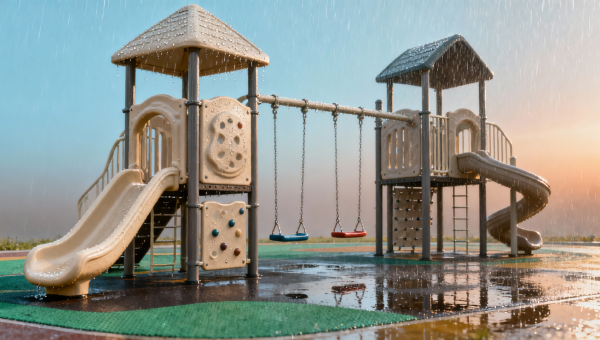
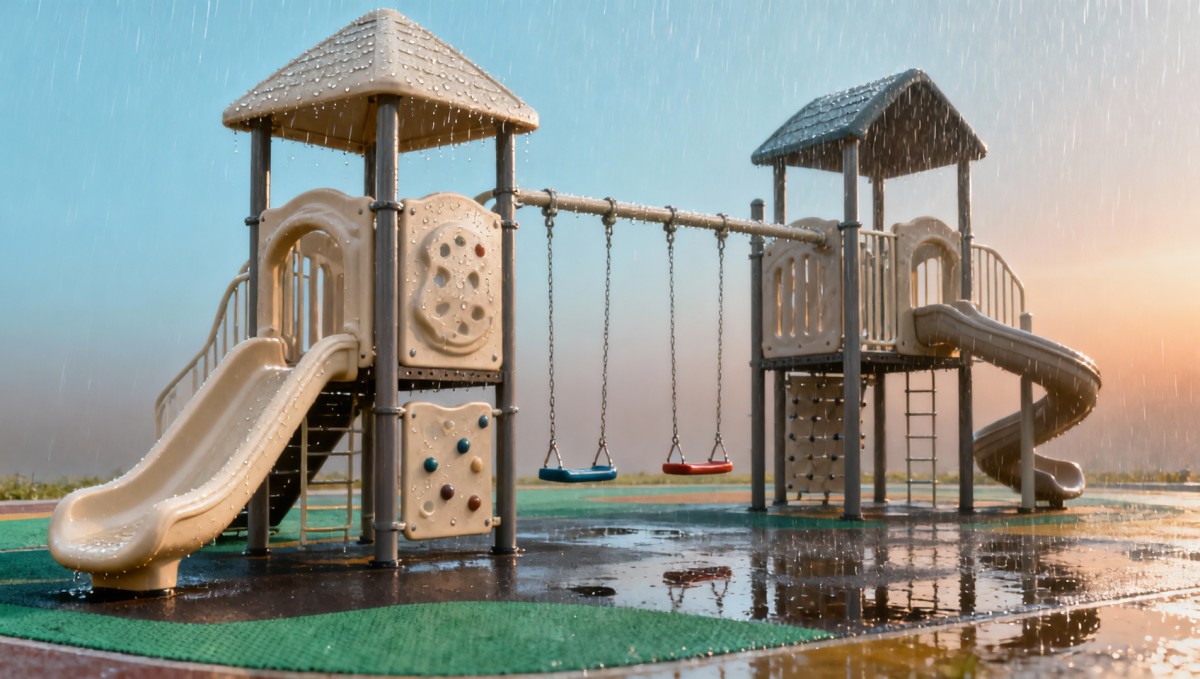
For example, dark plastic panels or rubber seats can become significantly hotter under direct summer sun, especially during midday exposure of 3 to 5 hours. In rainy climates, standing water around surfacing and posts can accelerate wear, weaken sub-base stability, and increase slip incidents. In colder regions, repeated freezing and thawing may loosen fittings, create cracks in surfacing, and affect the shock-absorbing performance required for safe falls.
Buyers assessing outdoor playground systems often focus on visible features such as slides, climbing nets, and playground swings. However, the weather-related variables behind those features are what determine whether a product remains safe and commercially reliable. A swing frame in a dry inland climate may perform very differently from the same frame installed in a humid coastal city.
A practical safety plan should evaluate at least four climate dimensions before procurement: heat and UV exposure, precipitation and drainage, seasonal temperature variation, and wind or airborne contaminants. This approach is especially useful for distributors serving multiple territories, because it prevents one-size-fits-all product recommendations that may underperform in specific local markets.
Key weather variables that affect playground risk
The table below highlights how common weather conditions translate into operational safety concerns and specification decisions for outdoor playground equipment.
The main takeaway is simple: climate exposure changes both risk profile and maintenance workload. A buyer choosing solely on appearance or unit price may overlook hidden service costs that emerge within 6 to 18 months. For commercial installations, those overlooked costs can affect warranty claims, downtime, and user satisfaction.
How weather changes material selection, surfacing, and structural specifications
Material choice is one of the most important links between weather exposure and playground safety. Metal, plastic, coated steel, aluminum, timber, rope systems, and rubber surfacing each react differently to heat, moisture, and seasonal movement. A high-traffic sports and entertainment venue should assess not only initial durability but also how quickly each material loses performance under local climate stress.
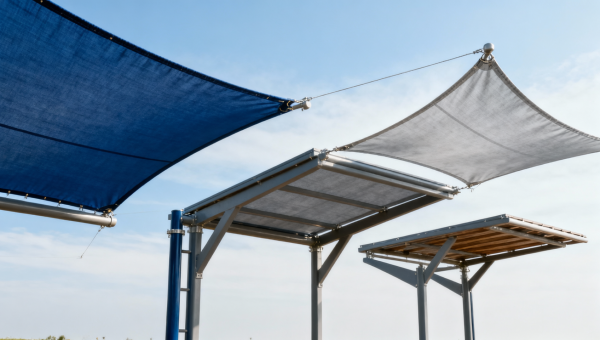
For hot and high-UV regions, buyers often prefer lighter color palettes, UV-stabilized polymers, and coated metal components that reduce heat absorption. In rainy or humid environments, sealed bearings, non-porous panels, stainless or treated fasteners, and elevated drainage-friendly deck designs can reduce water retention. In mountain or northern climates, structural allowances for contraction and expansion become more important, particularly for connections and impact-attenuating surfacing.
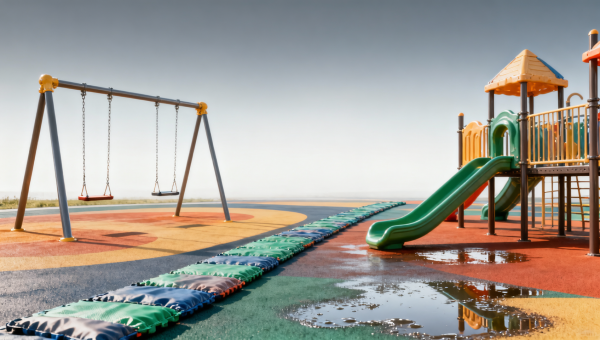
Surfacing also deserves closer attention. Wet-pour rubber, rubber tiles, engineered wood fiber, synthetic turf over pad systems, and sand each have different responses to moisture and temperature. Some systems perform well in dry zones but require more frequent leveling or drainage intervention after heavy rain. Others offer more consistent impact performance but need tighter installation control and scheduled inspections every 30 to 90 days.
For procurement teams comparing outdoor playground equipment with indoor playground extensions or adjacent trampoline park areas, consistency of safety planning matters. An outdoor site exposed to rain or heat may need transition zones, covered waiting areas, and surface changes at entrances so users do not carry water, grit, or mud into connected recreation spaces.
Typical specification priorities by climate condition
The following comparison can help buyers and resellers align product configuration with weather-related operating conditions.
The best commercial specification is not the most expensive one. It is the one that aligns with site exposure, usage frequency, and operator capacity. For a distributor or sourcing manager, that means asking suppliers for weather-specific recommendations rather than relying on a generic catalog sheet.
Material review checklist for buyers
- Confirm whether exposed plastics and coatings are intended for prolonged UV use and color retention.
- Review hardware and frame protection for humidity, salt air, or frequent wash-down cleaning.
- Check whether surfacing performance may change across a temperature range such as -10°C to 40°C.
- Ask for recommended inspection intervals for joints, anchors, swing hangers, and high-contact components.
Inspection frequency and maintenance plans under different weather conditions
Weather exposure does not only affect design; it changes inspection schedules and operating routines. A playground in a mild, dry climate may perform well with standard daily visual checks and monthly functional reviews. In contrast, a site exposed to frequent rain, high UV, or strong seasonal change may need weekly component monitoring and faster intervention after extreme weather events.
For commercial operators, maintenance planning should be tied to both climate and user intensity. A hotel leisure playground serving guests seasonally may have lower cumulative wear than a municipal site with daily year-round footfall. However, even lower-use sites can face elevated weather stress if they remain exposed 24 hours a day without cover or controlled access.
A structured maintenance plan usually includes three levels: routine visual inspection, operational inspection, and periodic comprehensive inspection. In wet regions, drainage points, rubber surface seams, and corrosion-prone fittings should be checked more often. In hot climates, operators should monitor discoloration, brittleness, and heat-sensitive touch areas before peak visitor periods.
This is also where procurement decisions affect long-term labor cost. Equipment that looks similar at purchase may require very different service hours over a 12-month cycle. Buyers should therefore compare maintenance burden, not just procurement price, especially when planning multi-site installations or resale programs across several climate zones.
Suggested inspection rhythm by exposure level
The table below provides a practical framework for inspection planning. Actual schedules should be adjusted to site traffic, operator policy, and local regulations.
A higher inspection cadence reduces the chance that small issues become safety incidents. Loose swing hardware, water-damaged surfacing, and coating failure rarely become critical overnight, but they often progress quickly when ignored across several weeks of adverse weather.
Five maintenance points often missed by buyers
- Drainage paths around foundations and surfacing edges should be checked after major rain, not only during scheduled service days.
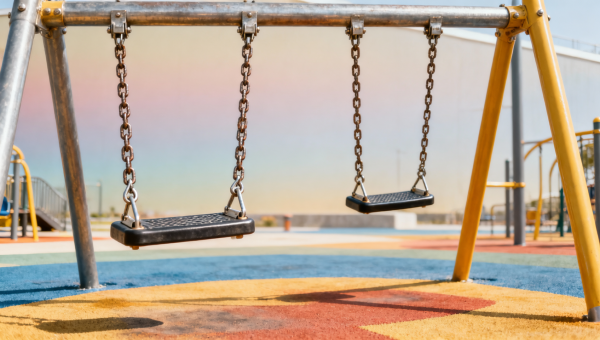
- Touch-temperature testing matters in hot seasons, especially for slides, handrails, and swing chains exposed to direct sun.
- Fastener checks should be intensified after winter, as freeze-thaw movement can reduce connection stability.
- Mold, algae, and surface contamination can change slip resistance even when structural parts appear intact.
- Maintenance logs should record weather-triggered actions separately from routine maintenance for clearer asset management.
Procurement criteria for buyers comparing outdoor and hybrid play solutions
For sourcing teams in sports and entertainment, weather exposure often changes the product mix itself. In a hot or storm-prone market, an operator may reduce the scale of purely outdoor installations and complement them with indoor playground extensions, shaded zones, or semi-covered activity areas. In high-value commercial developments, hybrid planning can improve usage continuity across 12 months rather than leaving the site underutilized during heat waves or rainy seasons.
This matters when comparing outdoor playground systems with adjacent revenue-generating attractions such as trampoline park zones, family entertainment areas, or hotel leisure spaces. A weather-smart safety plan should not ask only, “Which equipment is safest?” It should also ask, “Which combination of equipment remains commercially viable and operationally manageable under local climate conditions?”
Distributors and agents can create stronger proposals by segmenting clients into exposure profiles. A resort project with sea air and intense seasonal occupancy will need different recommendations from a school campus in a temperate zone. Similarly, a public park may prioritize durability and ease of inspection, while a private leisure venue may prioritize comfort features such as shade integration and lower surface heat.
When reviewing suppliers, buyers should request site-adapted configuration advice, replacement part availability, lead time expectations, and maintenance documentation. Typical lead times for commercial playground equipment can range from 4 to 12 weeks depending on customization, volume, and regional logistics. Weather-adapted components may affect timeline, but they often reduce service interruptions later.
Commercial evaluation factors for climate-sensitive projects
The checklist below is useful for business evaluators and procurement managers comparing multiple suppliers or planning reseller portfolios.
- Assess whether the supplier can recommend configurations by region, not just by age group or budget level.
- Compare maintenance complexity across materials, especially for swing assemblies, surfacing systems, and exposed metal parts.
- Verify spare parts strategy, because high-exposure sites may need faster replacement cycles for selected components.
- Review installation guidance for drainage, anchoring, and transition zones between outdoor and indoor recreation areas.
- Estimate annual upkeep effort over 3 to 5 years, not only acquisition cost in year 1.
Common sourcing mistakes in weather-exposed playground projects
One common mistake is specifying premium visible components while underfunding groundwork and drainage. Another is selecting surfacing only for appearance, without considering how it behaves after prolonged rain or temperature variation. A third mistake is assuming that a product suited for one region will transfer smoothly to another with very different humidity or UV conditions.
These mistakes are avoidable when weather is treated as a core sourcing variable. For GCT-oriented buyers operating in hospitality, education, leisure parks, or mixed-use commercial developments, that approach supports better lifecycle planning and more reliable decision-making across international markets.
Implementation roadmap and practical questions before purchase
A weather-aware playground safety plan works best when it is built into the project workflow from the earliest evaluation stage. This is especially important for B2B buyers managing tenders, distributor channels, or multi-site rollouts where specification errors can be multiplied across several locations. A simple 5-step process can improve both compliance readiness and long-term commercial performance.
Step 1 is climate mapping: define exposure patterns such as annual rain intensity, sun direction, winter severity, wind corridors, and nearby corrosive conditions. Step 2 is equipment matching: align materials, surfacing, and structural details to those conditions. Step 3 is maintenance planning: set inspection cycles and assign responsibilities. Step 4 is procurement validation: confirm documentation, lead time, and replacement support. Step 5 is post-installation review within the first 30 to 60 days of operation.
This process helps project teams move beyond brochure-level comparison. It also gives dealers and agents a clearer framework for communicating value to customers who may initially focus only on visible product features. Weather-adapted planning often supports smoother operation, fewer unexpected repairs, and a stronger user experience over the full asset life cycle.
Below are several practical questions that often arise during sourcing and project review.
How should buyers compare outdoor playground systems in hot climates?
Look at shade integration, color selection, material heat response, and inspection procedures for exposed contact points. Ask suppliers how they address 2 to 4 hours of peak direct sunlight and what operational precautions are recommended during the hottest part of the day.
Are playground swings more vulnerable to weather than other components?
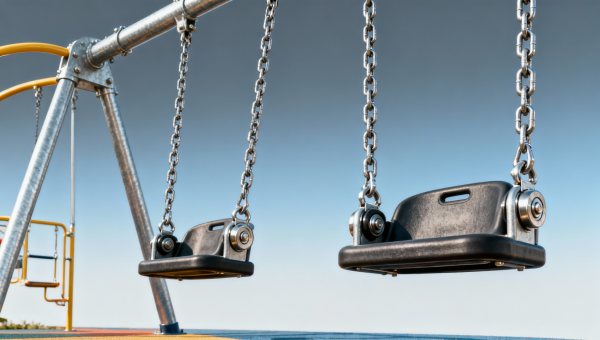
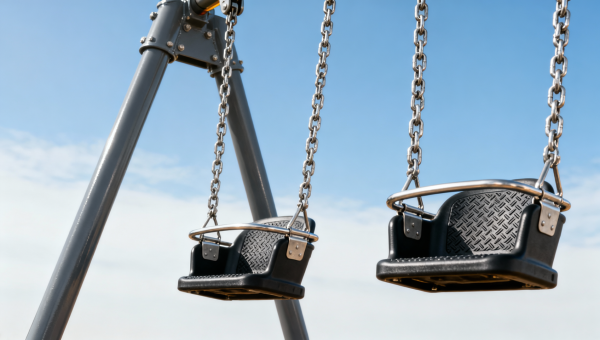
They often require closer monitoring because chains, hangers, seats, and moving connections experience repeated motion plus exposure. In humid or coastal conditions, wear and corrosion checks may need to occur every 7 to 14 days on heavily used commercial sites.
When does an indoor playground extension make sense?
It is especially valuable where outdoor usability is reduced by extreme heat, heavy rain, or long winter periods. Hybrid layouts can help operators maintain visitor engagement across more months of the year while reducing weather-related interruptions.
What should business evaluators request from suppliers?
Request climate-suitability guidance, recommended inspection intervals, component replacement advice, installation notes for drainage and anchoring, and expected lead times for spare parts. These details are often more valuable than generic feature lists when comparing commercial sourcing options.
Weather exposure changes outdoor playground safety plans at every stage, from design and materials to inspection schedules and long-term sourcing strategy. Buyers who account for UV, rain, freeze-thaw movement, and corrosive environments can make more reliable decisions on outdoor playground equipment, playground swings, hybrid indoor playground extensions, and related recreation solutions.
For procurement teams, distributors, and commercial project developers, the best results come from matching site conditions with realistic maintenance capacity and climate-appropriate specifications. If you are planning a leisure, hospitality, education, or public recreation project, now is the right time to review your weather-risk assumptions before finalizing equipment selection.
To explore sourcing options aligned with commercial performance, safety planning, and long-term operating value, contact GCT for tailored product guidance, project evaluation support, or more solution-focused insights for the sports and entertainment market.
Search News
Hot Articles
Popular Tags
Need ExpertConsultation?
Connect with our specialized leisureengineering team for procurementstrategies.
Recommended News
 Apr 17, 2026Popular Badminton AI Protocol Launched in ChengduPopular Badminton AI protocol launched in Chengdu — a game-changer for smart sports hardware, VR simulators & outdoor ride manufacturers targeting Asian youth academies.● Theme Park Strategist
 Apr 17, 2026EN 1176-7:2026 Enforced: AI Behavior Recognition Required for EU Outdoor Interactive Play EquipmentEN 1176-7:2026 is now enforced — AI behavior recognition is mandatory for EU outdoor interactive play equipment. Ensure CE compliance now.● Theme Park Strategist
 Apr 16, 2026EN 1176-7:2026 Enforces AI Safety Rules for EU Outdoor Interactive Play EquipmentEN 1176-7:2026 enforces AI safety rules for EU outdoor interactive play equipment — mandatory false-trigger ≤0.3% & local-only data processing. Act now to comply.● Theme Park Strategist
 Apr 13, 20262026 CKC China Karting Championship in Macau Sparks Export Interest for Domestic Racing GearThe 2026 CKC China Karting Championship in Macau showcased FIA-compliant racing gear, sparking export interest for domestic timing systems, carbon fiber kits & sustainable tires. Discover how this event opens global opportunities.● Theme Park Strategist
 Apr 13, 2026Japan Revises Sports Equipment Safety Standards: Mandatory Multilingual E-Manuals for Imported Fitness Gear from April 2026Japan's new Sports Equipment Safety Standards mandate multilingual e-manuals for imported fitness gear from 2026. Learn how this impacts global exporters and key compliance strategies for smooth market entry.● Theme Park Strategist
 Apr 10, 2026Middle East Tensions Raise Shipping Risks in Hormuz Strait, Air Freight Costs for Sports Equipment Surge 12%Middle East tensions escalate shipping risks in Hormuz Strait, causing a 12% surge in air freight costs for sports equipment. Learn how this impacts supply chains and strategies to mitigate delays.● Theme Park Strategist
 Apr 18, 20262026 Shanghai Sailing Open Adopts Domestic Smart Timing System2026 Shanghai Sailing Open adopts China's first ITU-R M.2412–certified smart timing system — a game-changer for marine sports exporters, integrators & event organizers worldwide.● Theme Park Strategist
 Apr 18, 2026EN 1176-7:2026 Enforced: AI Behavior Recognition Mandatory for EU Outdoor Play EquipmentEN 1176-7:2026 is now mandatory — AI behavior recognition required for EU outdoor play equipment. Ensure CE compliance, low-latency certification & market access before shipment.● Theme Park Strategist
 Apr 19, 2026Park benches built for coastal climates—what actually worksDiscover coastal-proof park benches, luxury furniture & custom hotel furniture built to last 25+ years in salt, sun & humidity—engineered for resorts, hotels & commercial spaces.● Theme Park Strategist
 Apr 19, 2026Why park benches fail after two seasons of outdoor usePark benches failing in 2 seasons? Discover why luxury furniture, hotel furniture, and commercial furniture specs matter—and how to choose resilient park benches, hotel chairs, and hotel tables.● Theme Park Strategist
 Apr 19, 2026Outdoor playground shade planning affects more than comfortOutdoor playground shade planning improves safety, durability, and visitor flow for outdoor playground, indoor playground, and trampoline park projects—explore smarter sourcing for swings and more.● Theme Park Strategist
 Apr 19, 2026Why playground swings fail early at busy public sitesPlayground swings at busy public sites fail early due to heavy traffic, weak materials, and poor maintenance. Compare outdoor playground, indoor playground, and trampoline park solutions for safer, longer-lasting performance.● Theme Park Strategist
 Apr 19, 2026Playground swings with fewer maintenance calls over timePlayground swings built for fewer maintenance calls: compare durable options for outdoor playground, indoor playground, and trampoline park projects with smarter lifecycle value.● Theme Park Strategist
 Apr 19, 2026How weather exposure changes outdoor playground safety plansOutdoor playground safety starts with weather planning. Learn how trampoline park, indoor playground, and playground swings buyers reduce risk, protect value, and choose climate-smart equipment.● Theme Park Strategist
 Apr 19, 2026Outdoor playground surfaces that hide higher lifetime costsOutdoor playground surface choices can raise hidden lifetime costs for trampoline park and indoor playground projects. Compare safer, longer-lasting options around playground swings.● Theme Park Strategist
 Apr 18, 2026Playground structures with integrated solar lighting: Is battery life consistent across seasons?Playground structures with integrated solar lighting: Discover seasonal battery performance data for leisure parks, theme park rides & inclusive playgrounds—backed by real-world climate testing and OEM validation.● Theme Park Strategist
 Apr 18, 2026Theme park rides using recycled steel: How does material origin affect fatigue testing?Theme park rides, playground swings & inclusive playground structures using recycled steel demand origin-aware fatigue testing—discover how material provenance impacts safety, durability & compliance.● Theme Park Strategist
 Apr 18, 2026Leisure park shade structures that fade unevenly—UV resistance vs. pigment qualityLeisure park shade structures fading unevenly? Discover why pigment quality—not just UV resistance—dictates longevity, brand integrity & ROI for playground structures, theme park rides & inclusive playgrounds.● Theme Park Strategist
 Apr 18, 2026Playground swings rated for 300kg: Does weight capacity include dynamic load?Playground swings rated for 300kg—do they handle real dynamic loads? Discover certified, inclusive playground structures for leisure parks, theme park rides & more.● Theme Park Strategist
 Apr 18, 2026Playground structures built for coastal climates—do salt-spray tests matter?Playground structures, inclusive playgrounds & theme park rides built for coastal climates—discover why ASTM B117 salt-spray testing matters for safety, compliance & TCO.● Theme Park Strategist
 Apr 18, 2026Theme park rides and service intervals: Why ‘5-year maintenance’ rarely holds upTheme park rides, playground swings & inclusive playground systems demand real-world maintenance—not '5-year' myths. Discover evidence-based service intervals, compliance benchmarks, and smarter sourcing strategies.● Theme Park Strategist
 Apr 18, 2026Leisure park flooring that wears faster than expected—here’s whyLeisure park flooring failing early? Discover why—linked to playground structures, inclusive playground specs, theme park rides & material science. Get data-backed solutions.● Theme Park Strategist
 Apr 18, 2026Playground swings with rust-resistant hardware—what’s actually tested?Playground swings with verified rust-resistant hardware—tested to ASTM F1487 & 2,000h salt spray. Also sourcing hotel beds, custom furniture, catering equipment, soundproofing materials, and instrument cables.● Theme Park Strategist
 Apr 18, 2026Custom furniture for leisure parks: When 'bespoke' means longer lead timesCustom furniture for leisure parks—covering playground swings, inclusive playgrounds, theme park rides & soundproofing materials. Discover how to balance bespoke quality with realistic lead times.● Theme Park Strategist