Why some soundproofing materials fail after installation
When soundproofing materials fail after installation, the cost goes far beyond noise complaints—it can disrupt guest satisfaction, brand standards, and hospitality procurement decisions. For buyers sourcing hotel furniture, hotel beds, hotel sofas, hotel chairs, hotel tables, hotel desks, hotel wardrobes, and other hotel room furniture, understanding acoustic performance is as critical as selecting luxury furniture, commercial furniture, catering equipment, and hotel equipment that meet long-term operational demands.
In hotel projects, acoustic failure rarely comes from one bad product alone. More often, it results from a mismatch between furniture design, room construction, installation practice, and expected sound control levels. A headboard fixed to a shared wall, a wardrobe with hollow backing, or a poorly sealed door surround can reduce the value of otherwise good soundproofing materials within weeks of opening.
For researchers, procurement teams, commercial evaluators, and distributors, the key question is not simply which acoustic product to buy. The real issue is why some systems perform well in the sample room but fail in actual guestroom use after 3 to 12 months. In hotel furniture sourcing, long-term acoustic reliability must be evaluated together with durability, maintenance cycles, and fit-out coordination.
Why installed soundproofing underperforms in hotel furniture projects
Many hotel acoustic complaints appear after installation because the sound path was not fully mapped during specification. Buyers may approve acoustic panels, underlays, or insulated partitions, but overlook indirect transmission through bed bases, bedside units, wall-mounted desks, sofa frames, or wardrobe anchoring points. In hospitality interiors, even a 3 mm to 5 mm gap around a junction can weaken the intended result.
Another common issue is treating soundproofing as a finishing accessory instead of a system. A hotel room contains multiple reflective and transmissive surfaces: flooring, wall panels, doors, windows, upholstered furniture, and service penetrations. If only one or two surfaces are upgraded, the room may still fail to meet practical expectations for adjacent-room privacy, corridor noise control, or elevator-side isolation.
In premium hotel furniture packages, acoustic weakness often hides behind aesthetic decisions. Decorative wall panels may be beautiful but hard-backed. Oversized mirrors can increase reflection. Thin upholstered headboards may improve appearance but add little low-frequency control. Procurement decisions based only on finish, lead time, and unit price can therefore create a noticeable acoustic gap at handover.
The table below outlines several typical post-installation failure points seen in hotel room furniture and fit-out coordination.
For hotel buyers, the lesson is practical: acoustic materials do not fail only because they are poor quality. They also fail when surrounding furniture components create flanking paths, when installers pierce isolated layers, or when operational conditions differ from the mock-up room. That is why sourcing decisions should consider the full furniture-and-fit-out interface rather than one product category in isolation.
The hidden role of hotel room furniture
Hotel beds, sofas, chairs, and casegoods influence room acoustics more than many teams expect. Upholstered furniture can help absorb mid and high frequencies, but only within a limited range. Hard-surfaced hotel tables, compact laminate desks, and large wardrobe faces reflect sound energy back into the room. This means acoustic planning should start at layout stage, not after FF&E approval.
In projects with 50 to 300 guestrooms, repeated furniture details can multiply one small acoustic mistake across the entire property. A single poorly detailed wall-mounted headboard can create the same complaint on 4 floors or more. Standardization helps procurement efficiency, but it also means poor detailing spreads quickly if not corrected before mass production.
Common material and installation mistakes that lead to failure
One of the biggest mistakes is selecting materials based on brochure claims instead of installed performance conditions. A sound-absorbing foam, textile panel, or resilient layer may work in laboratory-like conditions, yet perform badly when compressed behind fixed hotel furniture or exposed to cleaning moisture, luggage impact, or repeated housekeeping contact. In hospitality use, durability over 24 to 60 months matters as much as initial acoustic ratings.
Adhesive failure is another overlooked cause. Some acoustic layers are fixed with pressure-sensitive or construction adhesives that may lose bond strength under temperatures of 10°C to 35°C, or under fluctuating humidity near HVAC outlets and exterior walls. Once a panel edge lifts or an underlayer shifts, gaps form and the acoustic assembly no longer behaves as designed.
Compression set also affects post-installation results. Soft acoustic inserts placed under bed platforms, behind upholstered wall panels, or inside banquette backs can flatten over time. A material that loses thickness by 20% to 30% after load and use may also lose much of its damping value. This is especially important in hotel sofas, banquettes, and custom wall upholstery near guest contact zones.
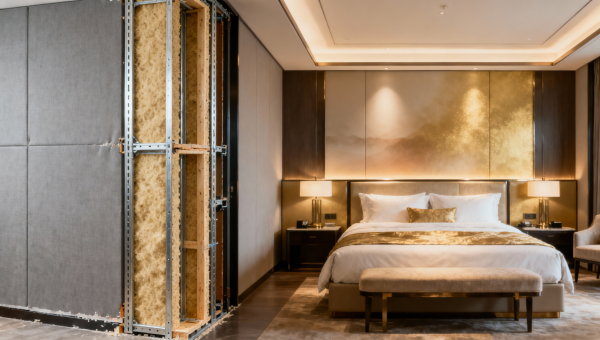
Beyond the material itself, installation sequencing often causes failure. If electricians, millworkers, and furniture installers work in separate phases without joint acoustic review, later trades may drill through barriers, leave service penetrations unsealed, or change fixing points. The acoustic design can therefore be compromised in the final 10% of installation, even when the first 90% was executed correctly.
Four recurring procurement-side errors
- Approving samples by touch and appearance only, without checking density, thickness range, and recovery after compression.
- Assuming soft furnishings alone will solve noise transfer, while walls, doors, and furniture fixings remain untreated.
- Using the same specification for business hotels, resorts, and long-stay properties, despite different occupancy patterns and noise profiles.
- Focusing on unit price savings of 5% to 8% while overlooking complaint management, rework labor, and room downtime costs.
Where failures show up first
In practice, the first warning signs usually appear around headboard walls, connecting doors, corridor-facing room entries, and furniture placed against service shafts. Guest complaints often mention voices, television sound, door slams, or trolley noise rather than undefined “poor insulation.” That complaint language helps procurement teams trace whether the issue is absorption inside the room, isolation between rooms, or impact transmission through furniture connections.
For distributors and sourcing agents, these failure patterns matter because they affect returns, replacement requests, and brand confidence. A supplier that understands both hotel furniture engineering and acoustic detailing is usually better positioned than one selling a generic soundproofing product without installation context.
How to evaluate soundproofing performance before procurement approval
A more reliable hotel procurement process uses layered evaluation rather than a single pass/fail check. Buyers should review the room as a combined system of wall build-up, door set, floor finish, ceiling edge, and furniture attachment details. At least 4 dimensions should be checked before approval: acoustic function, structural compatibility, cleaning durability, and maintenance access.
Mock-up rooms remain valuable, but they should be tested under realistic conditions. That means closing doors, switching on HVAC, simulating corridor trolley movement, and placing all major hotel room furniture in final positions. A bare room can give misleading acoustic impressions because furniture mass and surface reflectivity change the result significantly.
Procurement teams should also request practical specification data, not marketing-only language. Useful information includes nominal thickness, density range, compression behavior, recommended substrate, installation tolerance, and expected replacement cycle. Even when exact test reports vary by market, these operational details help compare one option against another with far greater accuracy.
The following table provides a procurement-oriented checklist for evaluating hotel acoustic materials alongside furniture integration.
This checklist shows that performance evaluation is not limited to laboratory acoustics. For hotel furniture buyers, dimensional coordination and installation method are equally important. A product with strong theoretical performance can still fail if it conflicts with wardrobe depth, bedhead fixing, or access panel requirements.
A five-step approval process
- Map noise sources by room type: corridor, adjacent room, plant room, lift core, and exterior facade.
- Review furniture layout against all shared walls and service zones.
- Approve material samples with technical data, not only finish swatches.
- Test one full mock-up room with installed hotel beds, desks, wardrobes, and seating.
- Issue installation details with tolerance checks before bulk fit-out begins.
This process usually adds only 7 to 14 days to pre-production coordination, but it can prevent months of complaint handling and post-opening remedial work. For large hospitality programs, that trade-off is commercially justified.
Matching acoustic strategy to hotel room furniture categories
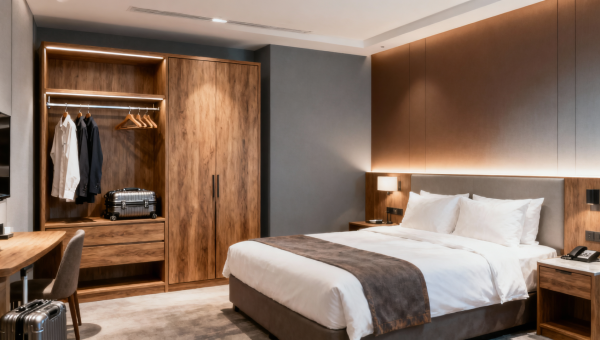
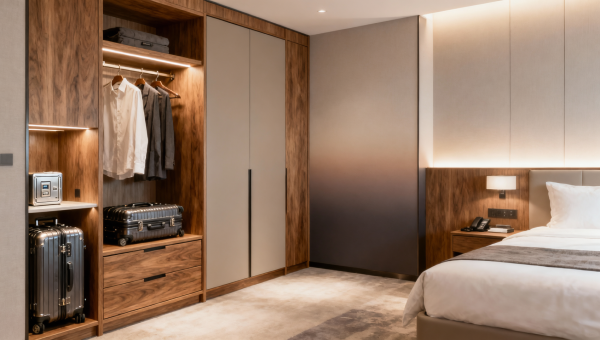
Not all hotel furniture contributes to acoustic control in the same way. Hotel beds and headboards often sit on the most sensitive shared wall. Hotel sofas and lounge chairs can soften reflections, but they do little to stop transmission between rooms. Hotel wardrobes and desks may either block, transmit, or even amplify noise depending on their backing, density, and fixing details.
This is why category-based sourcing matters. A buyer selecting casegoods for a business hotel with high weekday occupancy may prioritize dense cores, sealed backs, and anti-vibration feet. A resort project may place more emphasis on layered textiles, soft furnishing volume, and balcony interface control. The right specification depends on room type, stay duration, and acoustic exposure pattern.
The table below compares how common hotel furniture categories interact with acoustic performance after installation.
For distributors and project suppliers, category-specific advice adds real value. Rather than offering one “soundproof” answer, they can guide hotel owners toward a balanced combination of isolation, absorption, furniture detailing, and operational resilience. That is especially relevant for upscale and luxury furniture packages where guest expectations are higher and negative reviews spread faster.
Specification priorities by property type
- Business hotel: emphasize corridor isolation, desk and headboard detailing, and fast-clean materials with stable performance over high turnover.
- Resort hotel: focus on balcony door interfaces, larger upholstered furniture mix, and resistance to humidity variation.
- Long-stay property: prioritize wardrobe and storage detailing, appliance-adjacent noise control, and durable acoustic layers with lower maintenance frequency.
These distinctions affect procurement planning, MOQ discussions, and replacement strategies. A generic specification may save time at bidding stage, but it often creates expensive compromises after opening.
Implementation, maintenance, and supplier coordination for lasting results
Even the best sourcing decision can fail without disciplined implementation. In hotel fit-out, acoustic performance should be checked at three points: pre-installation review, first-room inspection, and final random room audit. On projects above 80 guestrooms, sampling 5% to 10% of installed rooms for detail verification is a practical quality-control step.
Maintenance planning matters as well. Acoustic textiles, panel edges, seals, and concealed backing materials can degrade through vacuum impact, cleaning chemicals, moisture exposure, or guest misuse. A product that appears stable at handover may require inspection after the first 6 months, then every 12 months, especially in high-occupancy urban properties.
Coordination between furniture supplier, contractor, and procurement manager should include written responsibility boundaries. Who seals the rear of a wardrobe against the wall? Who checks whether a headboard bracket cuts through an isolated layer? Who approves substitution if a specified panel is unavailable? These questions should be resolved before production release, not during site pressure.
For commercial buyers working with global sourcing platforms such as GCT, the advantage lies in comparing suppliers not only on price and finish options, but also on project communication quality, mock-up discipline, and integration capability across hotel furniture and related hotel equipment. Reliable sourcing increasingly depends on cross-category understanding rather than fragmented quotations.
Practical maintenance checklist
- Inspect seals, panel edges, and concealed joints within 30 to 60 days after opening.
- Recheck wall-mounted furniture fixings after the first occupancy cycle or seasonal HVAC shift.
- Replace damaged damping pads, gaskets, or soft inserts before guest complaints become recurring.
- Record acoustic complaints by room location to identify whether the issue is local or systematic.
- Review replacement materials against the original furniture detail to avoid creating new sound bridges.
FAQ: what buyers ask most often
How long should soundproofing materials last in hotel rooms? In a well-coordinated installation, many components should remain functional for 5 to 10 years, but soft inserts, exposed seals, and adhesive-based layers may need earlier review depending on humidity, cleaning intensity, and occupancy rate.
Are thicker materials always better? No. Thickness helps only when the material type, density, cavity condition, and fixing method match the application. A 25 mm product badly compressed behind furniture may perform worse than a correctly installed 12 mm system.
Can hotel furniture solve acoustic complaints on its own? Usually not. Furniture improves room feel and can reduce reflections, but room-to-room privacy depends on the wider assembly of wall, door, ceiling, floor, and furniture attachment points.
For hotel owners, operators, sourcing agents, and distributors, the main takeaway is clear: soundproofing materials usually fail after installation because the project treats acoustics as a product purchase rather than a coordinated system. In hotel furniture projects, long-term performance depends on design integration, realistic mock-up testing, installation discipline, and planned maintenance across beds, sofas, chairs, tables, desks, wardrobes, and surrounding fit-out elements.
If you are evaluating hotel furniture, luxury furniture, commercial furniture, or related hotel equipment for a new build or renovation, a sourcing strategy that connects acoustic reliability with furniture engineering will reduce operational risk and protect guest experience. Contact us to discuss a tailored commercial sourcing approach, compare supplier capabilities, or explore more hotel room furniture solutions aligned with long-term project performance.
Search News
Hot Articles
- Stage Lighting & TrussCCTV5 Snooker Broadcast Drives 37% Surge in Stage Lighting Export InquiriesApr 21, 2026
- Indoor PlaygroundVietnam Mandates Child Finger-Trap Sensors for Indoor Play EquipmentApr 21, 2026
- Stage Lighting & TrussGuangdong vs. Shanxi CBA Game Highlights Domestic Smart Arena LightingApr 21, 2026
Popular Tags
Need ExpertConsultation?
Connect with our specialized leisureengineering team for procurementstrategies.
Recommended News
 Apr 10, 2026RCEP Cuts ASEAN Hotel Furniture Tariffs to 0% for Chinese Bamboo ProductsRCEP cuts ASEAN hotel furniture tariffs to 0% for Chinese bamboo products. Explore how this benefits exporters, procurement teams & supply chains in Southeast Asia's booming hospitality sector.● Hospitality Sourcing Dir
 Apr 10, 2026US Hotel Association Updates 2026 Smart Room Tech Guidelines, Mandates UL 2900-2-2 CertificationUS Hotel Association mandates UL 2900-2-2 certification for smart room tech by 2026. Learn how this impacts IoT manufacturers and hotel chains' procurement strategies.● Hospitality Sourcing Dir
 Apr 10, 2026EU Mandates QR Codes for Hotel Linens: China Exporters Must Comply by April 2026EU mandates QR codes for hotel linens by 2026, impacting China's textile exporters. Learn compliance requirements for traceability, sustainability reporting, and supply chain adaptation.● Hospitality Sourcing Dir
 Apr 09, 2026Zibo Launches 'Treasure Shandong Through the Lens' Photo Tour, Themed Homestays Emerge as Cross-Border Marketing ToolDiscover Zibo's 'Treasure Shandong Through the Lens' photo tour featuring 32 themed homestays blending vintage cameras, Hanfu culture & industrial spaces. A groundbreaking cross-border marketing model attracting global influencers & platforms like Rakuten Travel.● Hospitality Sourcing Dir
 Apr 09, 2026Yangzhou Slender West Lake Flower Festival Opens, Blending Heritage and Tech for Luxury TourismDiscover the 2026 Yangzhou Slender West Lake Flower Festival, blending heritage crafts with AR technology for luxury tourism. Experience cultural performances, workshops, and themed stays attracting global travelers. Explore China's new era of experiential tourism.● Hospitality Sourcing Dir
 Apr 09, 2026New Team Travel Contracts Raise Compliance Standards for Overseas AgenciesNew team travel contracts enforce stricter compliance for overseas agencies, requiring rigorous vetting of Chinese suppliers. Learn how these 2026 regulations impact study tours, hotels, and global partnerships.● Hospitality Sourcing Dir
 Apr 09, 2026Shangyou County's Hotel Subsidy Policy Boosts China's MICE Tourism AppealShangyou County's 2026 hotel subsidy policy offers RMB 100 per room for MICE tourism, boosting China's appeal to international buyers. Discover how this strategic move enhances cost-effective accommodations for corporate events and study tours.● Hospitality Sourcing Dir
 Apr 21, 2026Open or closed hotel wardrobes for easier housekeeping?Hotel wardrobes affect housekeeping speed, guest appeal, and hospitality procurement. Compare open vs closed designs for hotel furniture, luxury furniture, and hotel room furniture planning.● Hospitality Sourcing Dir
 Apr 21, 2026Hotel wardrobes that fit luggage without wasting spaceHotel wardrobes that fit luggage smartly without wasting space—explore hotel furniture solutions that elevate hotel room furniture, support hospitality procurement, and enhance guest comfort.● Hospitality Sourcing Dir
 Apr 21, 2026Why hotel room furniture wears unevenly after openingHotel furniture wear starts unevenly from day one. Learn how hotel beds, hotel chairs, hotel desks and hotel room furniture perform in real use, with smart hospitality procurement tips.● Hospitality Sourcing Dir
 Apr 21, 2026Hotel room furniture packages that cut design mismatchHotel room furniture packages align hotel furniture, hotel beds, hotel chairs, hotel tables, and hotel desks with luxury furniture standards—reducing design mismatch and speeding hospitality procurement.● Hospitality Sourcing Dir
 Apr 21, 2026Low seat or deep seat hotel sofas for modern lobbies?Hotel furniture buyers compare low seat and deep seat hotel sofas for modern lobbies. Explore luxury furniture choices that improve comfort, traffic flow, brand image, and hospitality procurement value.● Hospitality Sourcing Dir
 Apr 21, 2026Hotel sofas that keep their shape in high traffic areasHotel sofas, hotel furniture, and hospitality furniture that keep shape in high-traffic areas—discover luxury furniture sourcing tips, durable commercial furniture specs, and smarter hospitality procurement.● Hospitality Sourcing Dir
 Apr 21, 2026Why hospitality furniture needs different specs by zoneHospitality furniture specs vary by zone. Learn how hotel furniture, hotel beds, hotel chairs, hotel tables, and hotel desks improve durability, ROI, and luxury guest experience.● Hospitality Sourcing Dir
 Apr 21, 2026Hospitality furniture that supports faster room turnoverHospitality furniture that speeds room turnover: compare hotel beds, hotel chairs, hotel tables, hotel desks and hotel sofas for easier cleaning, durability, and smarter hospitality procurement.● Hospitality Sourcing Dir
 Apr 21, 2026Where hotel equipment budgets usually go off trackHotel furniture and hotel equipment budgets often fail from hidden scope, logistics, and lifecycle costs. Learn smarter hospitality procurement for hotel beds, chairs, tables, and luxury furniture.● Hospitality Sourcing Dir
 Apr 21, 2026Hotel equipment upgrades that improve guest flow firstHotel equipment upgrades improve guest flow fast with hotel furniture, hotel beds, hotel chairs, catering equipment, and soundproofing materials—boost comfort, efficiency, and procurement ROI.● Hospitality Sourcing Dir
 Apr 21, 2026What shortens the life of commercial furniture in hotelsHotel furniture and commercial furniture wear out fast when hotel beds, hotel chairs, hotel tables, hotel desks, and hotel sofas face heavy use, poor maintenance, and weak materials. Learn smart hospitality procurement tips.● Hospitality Sourcing Dir
 Apr 21, 2026Commercial furniture trends hotels are actually adoptingCommercial furniture trends hotels are adopting: luxury furniture, hotel beds, hotel chairs, hotel tables and hotel sofas that improve hotel furniture sourcing, durability, and hospitality procurement value.● Hospitality Sourcing Dir
 Apr 21, 2026How to spot hotel furniture built for daily wearHotel furniture buying guide: learn how to assess hotel beds, hotel chairs, hotel tables, and hospitality furniture for daily wear, lower maintenance, and smarter hospitality procurement.● Hospitality Sourcing Dir
 Apr 21, 2026Hotel furniture mistakes that age a room too quicklyHotel furniture buying guide: avoid costly hotel beds, hotel chairs, and hotel room furniture mistakes. Discover luxury furniture tips for durable, brand-right hospitality procurement.● Hospitality Sourcing Dir
 Apr 21, 2026Why some soundproofing materials fail after installationLearn why soundproofing materials fail after installation in hotel furniture projects. Explore hotel beds, hotel sofas, hotel wardrobes and hospitality procurement tips for lasting acoustic performance.● Hospitality Sourcing Dir
 Apr 21, 2026Soundproofing materials that work best between guest roomsSoundproofing materials for hotel furniture projects: discover the best systems between guest rooms, from mineral wool to acoustic doors, to improve comfort, protect reviews, and support hospitality procurement.● Hospitality Sourcing Dir
 Apr 21, 2026How firm should hotel beds be for mixed guest profiles?Hotel beds for mixed guest profiles: learn how hotel furniture and hospitality procurement teams balance comfort, durability, and luxury furniture standards to improve guest satisfaction.● Hospitality Sourcing Dir