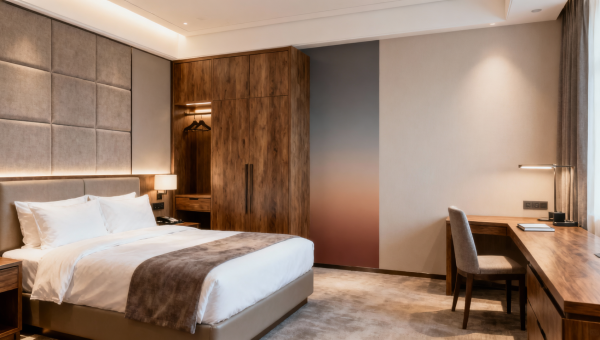
Hotel wardrobes that fit luggage without wasting space
In modern hospitality procurement, hotel wardrobes must do more than store clothes—they need to fit luggage efficiently without sacrificing circulation, aesthetics, or guest comfort. For buyers comparing hotel furniture, hospitality furniture, and commercial furniture solutions, the right wardrobe design can improve room usability, support luxury furniture standards, and strengthen overall hotel room furniture value.
Why luggage-friendly hotel wardrobes have become a practical procurement priority
In many guest rooms, wardrobes are still designed around hanging garments first and luggage second. That approach no longer matches actual traveler behavior. Business guests often arrive with 20–28 inch suitcases, while longer-stay guests may carry 2 pieces of baggage plus backpacks or cabin cases. When hotel wardrobes cannot absorb that volume, luggage moves to the floor, entry zone, or bed bench, reducing circulation and making the room feel smaller than its nominal area.
For procurement teams, this is not only a design issue. It affects guest perception, housekeeping efficiency, and room durability. A poorly planned wardrobe can create repeated corner impact, door obstruction, and surface wear within the first 12–24 months of operation. In contrast, a luggage-friendly wardrobe helps hotels protect usable space, maintain visual order, and support premium positioning even in compact room formats.
This is especially relevant in urban hotels, airport properties, serviced apartments, and upscale select-service brands where room footprints are tightly controlled. In a room of roughly 20–28 square meters, every 100–150 mm of wardrobe depth and every swing path matters. The best hotel furniture suppliers therefore treat wardrobe design as part of the full guest movement plan, not as an isolated storage unit.
For information researchers and commercial evaluators, the key question is simple: can the wardrobe handle luggage without wasting space elsewhere? That means reviewing dimensions, door type, internal zoning, hardware durability, installation method, and maintenance access as one integrated commercial furniture decision.
- Guest-side value: better circulation, cleaner room appearance, and easier access to luggage during short stays of 1–3 nights.
- Operational value: less clutter for housekeeping, fewer impact points near entry areas, and smoother room resets between check-out and check-in.
- Commercial value: stronger alignment between hotel room furniture design intent and actual usage patterns across standard, deluxe, and suite categories.
What buyers should redefine as “space efficiency”
Space efficiency in hotel wardrobes is not the same as minimizing cabinet size. A very shallow wardrobe may save millimeters on paper but force luggage into visible guest areas. True efficiency means balancing 3 factors: storage capacity, circulation clearance, and visual neatness. In procurement review, these 3 factors should be assessed together during mock-up approval or room sample evaluation.
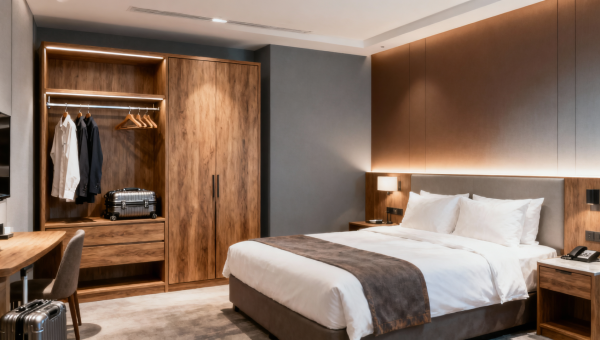
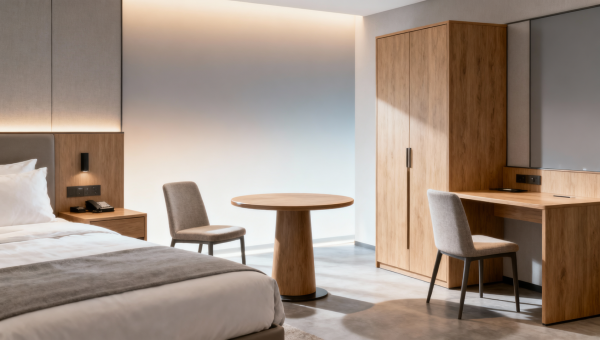
A wardrobe that integrates hanging space, one luggage bay, and one accessory shelf often performs better than a larger traditional wardrobe with unused long-hang volume. This is why many hospitality furniture specifications now prioritize mixed-use internal zoning over purely formal symmetry.
Core planning principle
If a wardrobe cannot store at least one standard suitcase while keeping the door operation and room walkway functional, it is usually underperforming for contemporary hotel use. That simple principle helps buyers screen options quickly before moving into material and pricing comparisons.
Which wardrobe layouts fit luggage without making the room feel crowded?
Different room types require different wardrobe strategies. A compact city hotel may favor open or semi-open niche wardrobes, while a full-service property may require enclosed casegoods for a more polished luxury furniture appearance. The important point is not whether the wardrobe is open or closed, but whether the luggage zone is intentionally planned for real use dimensions rather than leftover internal space.
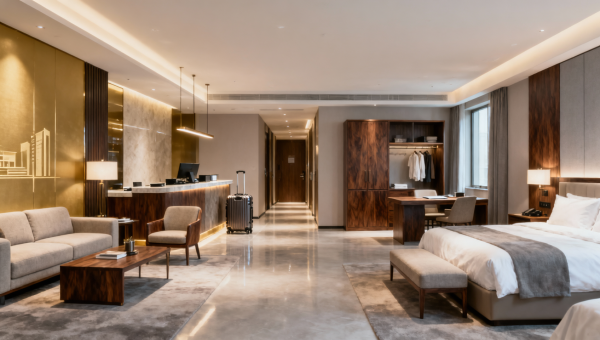
In hospitality furniture projects, four layouts are common: full-height enclosed wardrobe, wardrobe with integrated luggage bench, open closet niche, and hybrid millwork wall system. Each can work well, but only when matched to room depth, guest profile, and housekeeping workflow. A short-stay airport hotel, for example, may benefit from direct-access luggage placement, while an upscale leisure hotel may prioritize concealed storage and cleaner sightlines.
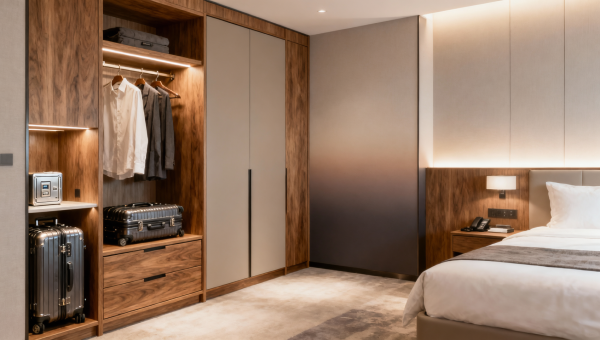
A practical rule used by many specifiers is to verify whether a 24–26 inch suitcase can be stored without blocking drawers, safe access, or adjacent bedside movement. If the answer is no, the wardrobe may look elegant in renderings but perform poorly in operation. For distributors and project agents, this point is often where showroom appeal diverges from commercial suitability.
The table below compares common hotel wardrobe layouts from a procurement perspective, including spatial behavior, luggage handling, and room-category fit. It is useful when narrowing product direction before requesting shop drawings or OEM customization details.
From a space-saving viewpoint, integrated bench and hybrid solutions often perform best because they convert dead volume into purposeful storage. However, they require stronger coordination between furniture supplier, interior designer, and site installer. A layout that looks compact but creates service difficulty later may increase operating cost more than it saves in material.
Door type matters more than many buyers expect
Door style directly changes room usability. Swing doors need free arc clearance, while sliding doors reduce obstruction but demand reliable track quality and maintenance planning. In rooms where bed-to-wardrobe clearance is limited, the choice between swing and sliding can determine whether luggage can be accessed comfortably during a 2-night business stay.
For many commercial furniture applications, soft-close hinges or damped sliding systems are preferred to reduce guest noise and hardware shock. Buyers should ask not only about the mechanism type but also about replacement access and spare part continuity over a 3–5 year operational period.
When open storage is the better choice
Open storage is often underestimated. In compact hospitality furniture design, an open luggage shelf below a hanging rail can outperform a closed wardrobe because it removes door conflict and speeds room use. It works especially well when paired with disciplined lighting, durable finishes, and a clear housekeeping presentation standard.
What dimensions and technical details should procurement teams check first?
Hotel wardrobe procurement should begin with measurable performance criteria. The most common mistake is approving appearance boards before validating usable internal geometry. A wardrobe may meet brand style requirements but still fail on luggage fit, safe access, or hanger swing. For this reason, many experienced buyers start with 5 key checks: internal depth, clear opening width, luggage platform height, hanging length, and hardware cycle suitability.
Typical project ranges vary by room type, but many commercial hotel wardrobes are reviewed around 550–650 mm overall depth when enclosed, with open luggage shelves often designed to handle cabin and medium suitcase formats. Clearance planning also matters outside the wardrobe. A difference of 80–120 mm in front clearance can decide whether a guest can open a case fully without colliding with the bed edge or desk return.
Material and hardware choices have equal importance. Hospitality furniture faces frequent loading, impact, and cleaning cycles. High-pressure laminate, melamine-faced panels, veneer with protective coating, and engineered stone luggage tops may all be suitable, depending on positioning and budget. What matters is whether the finish resists abrasion, edge chipping, and moisture exposure under real housekeeping conditions.
The table below summarizes practical specification points for buyers comparing hotel room furniture suppliers. These are not rigid universal numbers, but common review ranges that support faster technical discussions, sample validation, and RFQ alignment.
For procurement teams, the key takeaway is that visual dimensions are never enough. Always ask for usable internal dimensions, not just external millwork size. This is particularly important when the wardrobe also includes a safe, minibar, ironing station, or drawer stack, since each added function can reduce effective luggage volume.
A 5-point technical review checklist
- Confirm clear internal width after side panels, partitions, and hardware intrusion are deducted.
- Verify whether one medium suitcase can be placed and opened without blocking the safe or drawer pull.
- Check impact-prone edges at the luggage shelf, toe kick, and door corners.
- Review lighting, ventilation, and access if the unit contains enclosed storage or electrical components.
- Request mock-up photos or sample-room validation before confirming bulk production.
Compliance and commercial-quality considerations
Depending on market and project location, buyers may need to review fire behavior of materials, low-emission panel options, and hardware safety requirements. While the exact standards vary by country and contract, it is good practice to align documentation early, especially for cross-border supply. This helps prevent redesign during the final 2–4 weeks before production release.
For international sourcing, GCT adds value by helping buyers compare suppliers not only by appearance and price, but also by manufacturability, documentation readiness, and project coordination capability. In hotel furniture procurement, these factors often determine whether a project moves smoothly from approved drawing to compliant delivery.
How should buyers compare cost, customization, and long-term value?
The lowest initial quotation rarely produces the best wardrobe solution for hotels. Buyers need to compare at least 3 cost layers: factory price, installation and logistics impact, and operational cost over time. A wardrobe with weak edge protection, low-grade tracks, or poor internal planning may appear economical at tender stage but create replacement, repair, and guest satisfaction issues later.
Customization also changes the cost equation. Standard modules can shorten production by 2–4 weeks and simplify replacement parts, while fully bespoke wardrobes offer stronger room identity and better spatial integration. The decision should depend on room count, brand consistency requirements, and project rollout complexity. For chain hotels, semi-custom solutions often balance procurement speed with adequate visual differentiation.
Distributors and agents should also assess how easily a wardrobe system can be adapted across multiple property types. A supplier with strong OEM or ODM capability may help create a family of hotel room furniture solutions using shared materials and hardware platforms, reducing sampling complexity and improving margin control across different tenders.
The comparison table below can help procurement teams evaluate whether a standard, semi-custom, or bespoke wardrobe direction is most appropriate for the project pipeline.
In many cases, semi-custom hotel wardrobes produce the strongest value because they allow luggage-focused internal planning without forcing a fully bespoke cost structure. The best choice depends on room standardization, lead time pressure, and whether the project team can manage drawing revisions efficiently.
What hidden costs should evaluators watch?
Common hidden costs include installation delays caused by inaccurate site dimensions, damage claims from weak packaging, replacement hardware with long replenishment cycles, and maintenance access problems once the wardrobe is built into a millwork wall. These costs do not always appear in the initial quote but can materially affect project ROI within the first operating year.
A disciplined sourcing process usually includes 4 stages: requirement definition, technical validation, sample or mock-up confirmation, and mass production control. Compressing or skipping one stage may save days at the start but often adds weeks later if corrections are required after installation.
A practical budgeting view
Budget discussions should focus on lifecycle suitability rather than headline unit price. For example, if a slightly stronger finish or better hardware extends serviceability over a 3–5 year period, the higher initial spend may reduce replacement frequency and protect room presentation more effectively than the cheaper alternative.
Common mistakes, buyer questions, and how to avoid specification gaps
Many wardrobe issues appear only after mock-up installation or early operation. Typical problems include luggage shelves that are too narrow, doors colliding with adjacent furniture, hanging zones that waste vertical volume, and integrated safes that steal usable baggage space. These issues are preventable when procurement, design, and factory teams review the wardrobe as part of the whole room function instead of treating it as a standalone cabinet.
Another common mistake is assuming all guest profiles behave the same way. Corporate travelers, family guests, and extended-stay occupants use storage differently. A 1-night airport stay may prioritize instant luggage access, while a 5–7 night leisure stay benefits from more concealed organization. Good hotel furniture sourcing therefore starts with room-use assumptions, not just finish boards.
For procurement teams under schedule pressure, FAQ-style review can help surface specification gaps early. The questions below reflect what buyers, distributors, and commercial evaluators often ask when comparing hospitality furniture suppliers and wardrobe concepts.
How do I know if a hotel wardrobe is really suitable for luggage?
Ask for usable internal dimensions and a luggage-fit demonstration, not only a rendered image. A suitable wardrobe should accommodate at least one common suitcase size while preserving safe access, drawer use, and room circulation. Reviewing the sample room with a real case or dimensional mock-up is often more reliable than reading a generic specification sheet.
Is a separate luggage rack still necessary?
Not always. In many modern hotel room furniture schemes, the wardrobe or millwork unit already integrates a luggage platform. A separate rack is most useful when flexibility is needed across multiple guest behaviors or when room layout prevents direct wardrobe access. If integrated storage works well, removing a separate rack can save floor space and simplify housekeeping.
What is the usual lead time for custom hotel wardrobes?
Lead time varies by complexity, quantity, and approval speed. In practice, buyers often plan several stages: drawing confirmation, sample review, production, and shipping. Standardized solutions generally move faster than bespoke millwork, while projects with multiple finish combinations or cross-border compliance documentation need more buffer. Confirm critical milestones before final PO release.
Which specification details are most often missed?
The most frequently missed items are clear internal dimensions, door opening conflict, safe placement, toe-kick protection, ventilation in enclosed compartments, and replacement access for hardware. These details may seem minor individually, but together they determine whether the wardrobe performs well after handover.
A quick pre-order checklist
- Confirm room type and expected guest stay pattern before choosing the wardrobe layout.
- Review internal zoning for hanging, luggage, safe, and accessory storage as 4 separate functions.
- Check whether the finish and hardware are aligned with the intended hotel grade and maintenance resources.
- Request sample, mock-up, or shop drawing validation before scaling to full room quantities.
Why work with GCT when sourcing hotel wardrobes and related hotel room furniture?
For global buyers, finding hotel wardrobes that fit luggage without wasting space is rarely just a product search. It is a sourcing judgment that involves room planning, commercial furniture comparability, supplier communication, customization scope, and delivery reliability. GCT supports this process by connecting procurement logic with category-focused market intelligence across hospitality and other commercial sectors.
This matters when your team needs more than catalog browsing. You may need help comparing OEM and ODM options, interpreting supplier capabilities, aligning aesthetics with operational practicality, or preparing questions for technical review. GCT is built for that kind of B2B decision environment, where sourcing choices must satisfy design goals, project schedules, and commercial accountability at the same time.
For procurement managers, business evaluators, and channel partners, the practical benefit is a more structured path from research to shortlist. Instead of relying on generic furniture descriptions, you can focus on project-relevant variables such as luggage accommodation, room-fit logic, finish durability, customization feasibility, and supply-chain responsiveness across multiple markets.
If you are comparing hotel furniture suppliers or planning a wardrobe program for new-build, renovation, or brand rollout projects, the next step should be specific. Bring your room layout, target market, quantity range, and preferred finish direction into the conversation. That allows faster evaluation and more accurate supplier matching.
What you can discuss with us
- Wardrobe dimensions and internal zoning based on your room plan and luggage-use scenario.
- Selection between standard, semi-custom, and bespoke hotel room furniture solutions.
- Indicative production and delivery cycle planning, including sample and approval stages.
- Material, finish, and hardware direction for budget, upscale, or luxury furniture positioning.
- Documentation, compliance considerations, and sourcing support for cross-border hospitality projects.
Contact us for a more precise sourcing discussion
If you need support with parameter confirmation, product selection, custom wardrobe design, certification-related questions, sample coordination, or quotation comparison, contact GCT with your project brief. A focused discussion around room dimensions, target hotel category, quantity band, and delivery expectations can significantly improve sourcing accuracy before RFQ finalization.
For distributors, sourcing agents, and commercial buyers managing multiple hotel furniture opportunities, this approach also helps standardize evaluation across projects. That means fewer specification gaps, better supplier screening, and a stronger basis for commercial negotiation.
Search News
Hot Articles
- Stage Lighting & TrussCCTV5 Snooker Broadcast Drives 37% Surge in Stage Lighting Export InquiriesApr 21, 2026
- Indoor PlaygroundVietnam Mandates Child Finger-Trap Sensors for Indoor Play EquipmentApr 21, 2026
- Stage Lighting & TrussGuangdong vs. Shanxi CBA Game Highlights Domestic Smart Arena LightingApr 21, 2026
Popular Tags
Need ExpertConsultation?
Connect with our specialized leisureengineering team for procurementstrategies.
Recommended News
 Apr 10, 2026RCEP Cuts ASEAN Hotel Furniture Tariffs to 0% for Chinese Bamboo ProductsRCEP cuts ASEAN hotel furniture tariffs to 0% for Chinese bamboo products. Explore how this benefits exporters, procurement teams & supply chains in Southeast Asia's booming hospitality sector.● Hospitality Sourcing Dir
 Apr 10, 2026US Hotel Association Updates 2026 Smart Room Tech Guidelines, Mandates UL 2900-2-2 CertificationUS Hotel Association mandates UL 2900-2-2 certification for smart room tech by 2026. Learn how this impacts IoT manufacturers and hotel chains' procurement strategies.● Hospitality Sourcing Dir
 Apr 10, 2026EU Mandates QR Codes for Hotel Linens: China Exporters Must Comply by April 2026EU mandates QR codes for hotel linens by 2026, impacting China's textile exporters. Learn compliance requirements for traceability, sustainability reporting, and supply chain adaptation.● Hospitality Sourcing Dir
 Apr 09, 2026Zibo Launches 'Treasure Shandong Through the Lens' Photo Tour, Themed Homestays Emerge as Cross-Border Marketing ToolDiscover Zibo's 'Treasure Shandong Through the Lens' photo tour featuring 32 themed homestays blending vintage cameras, Hanfu culture & industrial spaces. A groundbreaking cross-border marketing model attracting global influencers & platforms like Rakuten Travel.● Hospitality Sourcing Dir
 Apr 09, 2026Yangzhou Slender West Lake Flower Festival Opens, Blending Heritage and Tech for Luxury TourismDiscover the 2026 Yangzhou Slender West Lake Flower Festival, blending heritage crafts with AR technology for luxury tourism. Experience cultural performances, workshops, and themed stays attracting global travelers. Explore China's new era of experiential tourism.● Hospitality Sourcing Dir
 Apr 09, 2026New Team Travel Contracts Raise Compliance Standards for Overseas AgenciesNew team travel contracts enforce stricter compliance for overseas agencies, requiring rigorous vetting of Chinese suppliers. Learn how these 2026 regulations impact study tours, hotels, and global partnerships.● Hospitality Sourcing Dir
 Apr 09, 2026Shangyou County's Hotel Subsidy Policy Boosts China's MICE Tourism AppealShangyou County's 2026 hotel subsidy policy offers RMB 100 per room for MICE tourism, boosting China's appeal to international buyers. Discover how this strategic move enhances cost-effective accommodations for corporate events and study tours.● Hospitality Sourcing Dir
 Apr 21, 2026Open or closed hotel wardrobes for easier housekeeping?Hotel wardrobes affect housekeeping speed, guest appeal, and hospitality procurement. Compare open vs closed designs for hotel furniture, luxury furniture, and hotel room furniture planning.● Hospitality Sourcing Dir
 Apr 21, 2026Hotel wardrobes that fit luggage without wasting spaceHotel wardrobes that fit luggage smartly without wasting space—explore hotel furniture solutions that elevate hotel room furniture, support hospitality procurement, and enhance guest comfort.● Hospitality Sourcing Dir
 Apr 21, 2026Why hotel room furniture wears unevenly after openingHotel furniture wear starts unevenly from day one. Learn how hotel beds, hotel chairs, hotel desks and hotel room furniture perform in real use, with smart hospitality procurement tips.● Hospitality Sourcing Dir
 Apr 21, 2026Hotel room furniture packages that cut design mismatchHotel room furniture packages align hotel furniture, hotel beds, hotel chairs, hotel tables, and hotel desks with luxury furniture standards—reducing design mismatch and speeding hospitality procurement.● Hospitality Sourcing Dir
 Apr 21, 2026Low seat or deep seat hotel sofas for modern lobbies?Hotel furniture buyers compare low seat and deep seat hotel sofas for modern lobbies. Explore luxury furniture choices that improve comfort, traffic flow, brand image, and hospitality procurement value.● Hospitality Sourcing Dir
 Apr 21, 2026Hotel sofas that keep their shape in high traffic areasHotel sofas, hotel furniture, and hospitality furniture that keep shape in high-traffic areas—discover luxury furniture sourcing tips, durable commercial furniture specs, and smarter hospitality procurement.● Hospitality Sourcing Dir
 Apr 21, 2026Why hospitality furniture needs different specs by zoneHospitality furniture specs vary by zone. Learn how hotel furniture, hotel beds, hotel chairs, hotel tables, and hotel desks improve durability, ROI, and luxury guest experience.● Hospitality Sourcing Dir
 Apr 21, 2026Hospitality furniture that supports faster room turnoverHospitality furniture that speeds room turnover: compare hotel beds, hotel chairs, hotel tables, hotel desks and hotel sofas for easier cleaning, durability, and smarter hospitality procurement.● Hospitality Sourcing Dir
 Apr 21, 2026Where hotel equipment budgets usually go off trackHotel furniture and hotel equipment budgets often fail from hidden scope, logistics, and lifecycle costs. Learn smarter hospitality procurement for hotel beds, chairs, tables, and luxury furniture.● Hospitality Sourcing Dir
 Apr 21, 2026Hotel equipment upgrades that improve guest flow firstHotel equipment upgrades improve guest flow fast with hotel furniture, hotel beds, hotel chairs, catering equipment, and soundproofing materials—boost comfort, efficiency, and procurement ROI.● Hospitality Sourcing Dir
 Apr 21, 2026What shortens the life of commercial furniture in hotelsHotel furniture and commercial furniture wear out fast when hotel beds, hotel chairs, hotel tables, hotel desks, and hotel sofas face heavy use, poor maintenance, and weak materials. Learn smart hospitality procurement tips.● Hospitality Sourcing Dir
 Apr 21, 2026Commercial furniture trends hotels are actually adoptingCommercial furniture trends hotels are adopting: luxury furniture, hotel beds, hotel chairs, hotel tables and hotel sofas that improve hotel furniture sourcing, durability, and hospitality procurement value.● Hospitality Sourcing Dir
 Apr 21, 2026How to spot hotel furniture built for daily wearHotel furniture buying guide: learn how to assess hotel beds, hotel chairs, hotel tables, and hospitality furniture for daily wear, lower maintenance, and smarter hospitality procurement.● Hospitality Sourcing Dir
 Apr 21, 2026Hotel furniture mistakes that age a room too quicklyHotel furniture buying guide: avoid costly hotel beds, hotel chairs, and hotel room furniture mistakes. Discover luxury furniture tips for durable, brand-right hospitality procurement.● Hospitality Sourcing Dir
 Apr 21, 2026Why some soundproofing materials fail after installationLearn why soundproofing materials fail after installation in hotel furniture projects. Explore hotel beds, hotel sofas, hotel wardrobes and hospitality procurement tips for lasting acoustic performance.● Hospitality Sourcing Dir
 Apr 21, 2026Soundproofing materials that work best between guest roomsSoundproofing materials for hotel furniture projects: discover the best systems between guest rooms, from mineral wool to acoustic doors, to improve comfort, protect reviews, and support hospitality procurement.● Hospitality Sourcing Dir
 Apr 21, 2026How firm should hotel beds be for mixed guest profiles?Hotel beds for mixed guest profiles: learn how hotel furniture and hospitality procurement teams balance comfort, durability, and luxury furniture standards to improve guest satisfaction.● Hospitality Sourcing Dir