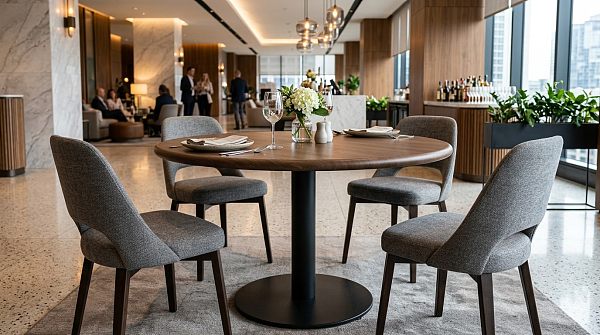
Choosing Luxury Hotel Restaurant Furniture: Comfort, Durability and Style
Choose luxury hotel restaurant furniture by testing three things together: whether guests can sit comfortably through the intended meal, whether the construction can withstand the restaurant’s service pattern, and whether the finish supports the hotel’s design without becoming difficult to maintain. A beautiful chair that stains easily or cannot be repaired may cost more over its useful life than a better-specified alternative.
The trade-offs become visible in daily operation. Breakfast seating may be moved and cleaned repeatedly, while a fine-dining chair needs to remain comfortable through a longer meal. Start with the way each dining area will be used, then compare samples against a written specification rather than selecting from photographs or material descriptions alone.
Define the setting before comparing designs
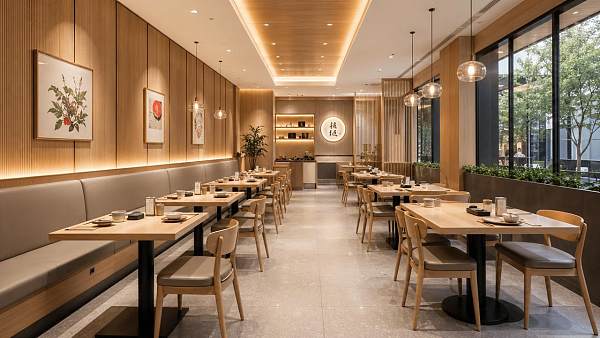
Map the restaurant into its actual operating zones: main dining, banquettes, bar seating, private rooms, and any terrace or semi-outdoor area. Each can call for a different construction even when the pieces share a visual language. A lightweight chair can make daily resetting easier; a heavier upholstered armchair may be appropriate where tables turn less frequently and staff rarely need to move it.
Record the expected service pattern, cleaning routines and storage needs. Ask operations staff which furniture is lifted, stacked or repositioned, and whether equipment must pass through the dining room. Furniture intended for occasional rearrangement should have stable joints and manageable weight; a design advertised as stackable should be checked for its actual stacking method and the protection between contact points.
Establish the required quantities by furniture type, including accessible seating and any replacement units the property wishes to hold. Avoid applying one specification to every area simply to simplify ordering: a bar stool, lounge chair and dining chair impose different demands on their joints, footrests and upholstery.
Test comfort in the dining position
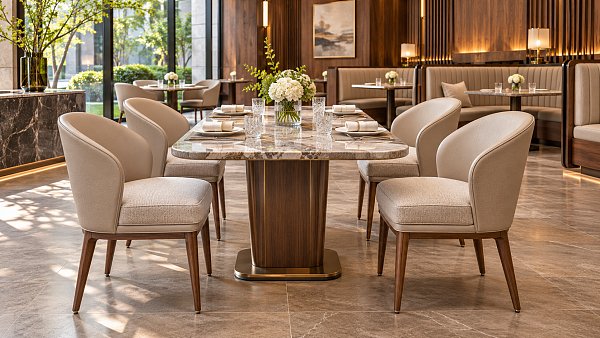
Comfort is not just a soft cushion. Guests need to sit at the table without raising their shoulders, hitting their knees or feeling that the seat edge cuts into the back of the legs. Place a sample with the proposed table, not beside an unrelated showroom table, and assess the combination while sitting upright and leaning back.
Check the clearance between the seat and underside of the tabletop, including any apron, pedestal or reinforcing rail. On armchairs, confirm that the arms fit beneath the table where intended; otherwise chairs may project into circulation routes even when pushed in. A table base can also restrict foot space or prevent chairs from sitting squarely at the table.
Invite staff and several people of different body sizes to sit in the sample for a period comparable to the intended dining experience. Look for pressure at the seat edge, inadequate back support, excessive seat depth and difficulty getting up. Deep, low seating may look inviting but can make dining and standing uncomfortable. Conversely, an overly upright, firm chair may be acceptable for short service but less suitable for a long tasting menu.
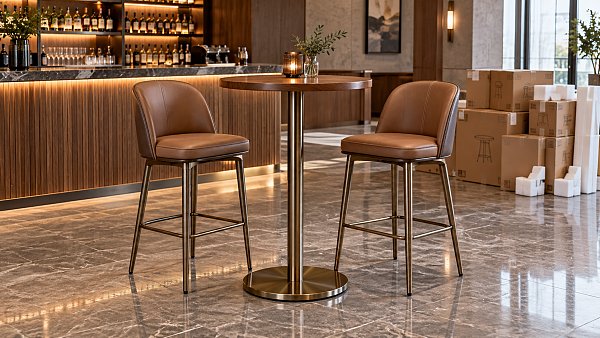
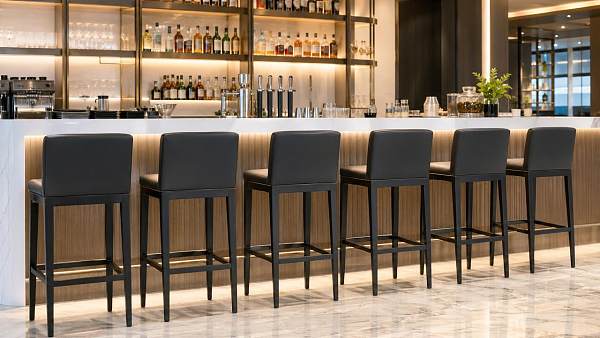
For stools, assess the relationship between seat height, counter height and footrest position. A footrest should support a natural posture and be positioned so that guests can mount and leave the stool without awkward movement. Inspect whether the footrest has a replaceable or protective surface, as footwear can quickly mark exposed finishes.
Look beyond the visible upholstery
Commercial-grade construction is a claim to verify, not a substitute for a specification. Request a description of the frame material, joint method, internal supports and components that can be serviced. Inspect an exposed construction sample or drawing when the finished chair conceals the critical details.
Frames and joints
Solid timber can provide a warm, refined appearance, but performance depends on timber preparation, joint design and assembly, not species alone. Look closely at connections between legs, rails and backrests; these areas carry repeated sideways movement. Ask how joints are reinforced and whether loose joints can be repaired without destroying the finish.
Metal frames can offer a slim profile and dependable support, but weld quality, wall thickness, corrosion protection and attachment points still matter. Examine welds for a consistent finish and check that exposed edges are smooth. In humid or semi-outdoor locations, confirm that the complete assembly—including fasteners and any concealed components—is suitable for the environment, rather than assuming a metal frame is automatically weather resistant.
Engineered wood and molded components can also be appropriate when designed for the application. Request details of the material and fastening method, especially where screws enter repeatedly stressed or thin sections. A heavy chair is not necessarily stronger, and a light one is not necessarily fragile; the load path and joint construction matter more than weight alone.
Seat support and cushioning
Ask what sits beneath the cushion: a rigid panel, webbing, springs or another support system. The combination affects comfort, repairability and how the seat feels after repeated use. Request the foam type and density in the quotation so that a later substitution cannot be made solely on appearance. Density by itself does not establish comfort or service life; assess it alongside firmness, thickness and the support underneath.
For upholstered backs and fixed seats, inspect seam placement and how the covering is attached. Edges that rub against tables, chair backs or adjacent furniture are likely wear points. Ask whether individual cushions, glides and other high-contact parts can be replaced, and whether reupholstery requires specialist disassembly.
Choose surfaces for spills, cleaning and appearance
A restaurant finish must tolerate its actual cleaning process. Ask the supplier for written care instructions before approving a fabric, leather, coated textile or tabletop finish. Compare those instructions with the property’s detergents, disinfectants and cleaning frequency. A material that requires a prohibited solvent or cannot tolerate a routinely used cleaning product creates an operational conflict, regardless of its appearance.
Abrasion test results are useful for comparing fabrics tested by the same method, but they do not predict every failure. Food oils, seam slippage, discoloration and aggressive cleaning can affect an upholstery choice independently of abrasion. Obtain a sufficiently large sample to assess texture and color under the restaurant’s lighting, then conduct a discreet cleaning trial using the proposed products and the supplier’s instructions. A trial does not replace formal test evidence.
For tabletops, consider the whole edge and underside as well as the top surface. Water can reach seams, fixings and exposed substrates during cleaning. Ask how damaged edges can be repaired and whether the finish can be matched later. High-gloss surfaces may suit the design but can make fingerprints, scratches and reflections more conspicuous.
Protect the design without locking in maintenance problems
Provide suppliers with drawings or reference samples that identify the intended finish, dimensions and visible details. Include the grain direction of veneer, metal sheen, stitching pattern and the extent of natural variation that is acceptable. A small finish chip may not reveal how a material looks across a full tabletop or several adjacent chairs, so approve a representative production sample where feasible.
Consider the room as a working composition rather than a collection of individual pieces. A chair can be visually elegant on its own yet appear crowded when repeated around closely spaced tables. Use a scaled layout to check chair pull-back space, staff movement and access to doors and service points. Confirm accessible routes and seating arrangements against the requirements applicable to the property; a decorative layout should not be assumed compliant.
Specify floor protection as part of the furniture, not as an afterthought. The right glide depends on the flooring and whether chairs are dragged or lifted. Ask for replaceable glides and test them on the actual floor finish for movement, noise and marking. Felt, plastic and other glide materials can behave differently when exposed to moisture or debris.
Compare quotations on the same basis
Request itemized proposals against a common schedule. Without one, a lower quote may reflect a different foam, thinner upholstery, omitted installation or a less durable finish rather than a genuine saving. Record the agreed model, dimensions, materials, finish references and quantities for each line item.
For each proposal, clarify the following before making a comparison:
- Scope: whether delivery, packaging removal, assembly and placement are included, and who supplies protective materials for the finished floor.
- Timing: production and transit assumptions, approval deadlines, and the process for reporting delays or changing the delivery sequence.
- Documentation: drawings, care instructions, relevant test reports and identification of the factory or subcontracted processes where appropriate.
- After-sales support: warranty terms and exclusions, spare-part availability, repair procedures and the treatment of transit damage.
- Cost of ownership: anticipated cleaning, replacement covers, glides, refinishing and local repair, in addition to the purchase price.
Do not assume a warranty covers stains, cleaning damage, fabric wear or commercial use. Read the exclusions and confirm who assesses a claim, where replacement parts would ship from and who pays for labor. Ask how long matching materials and components are expected to remain available, while recognizing that future availability should be addressed in the purchase agreement rather than treated as a certainty.
Verify compliance and supplier capability before release
Fire performance, structural safety, accessibility and chemical requirements depend on the destination, occupancy and product. Identify the applicable requirements with the project’s responsible design and compliance team before issuing the final specification. Ask for reports that identify the tested product or material, test method and issuing laboratory; check whether the report applies to the proposed combination of upholstery, foam and construction. A fabric report alone should not automatically be treated as evidence for an entire upholstered chair.
Review the supplier’s ability to produce the approved specification consistently. Useful evidence includes a production drawing, a representative sample, a quality-control plan and a clear process for approving material substitutions. For custom pieces, agree on dimensional and finish tolerances, labeling, packaging and inspection points. Confirm whether the supplier can produce repeat orders or replacement components to the same specification, and how changes in materials would be communicated.
Before final acceptance, inspect an agreed sample of the delivered furniture against the approved reference. Check stability on a level surface, visible finish, seams, glides, dimensions and the fit of chairs with tables. Record defects and quantities before packaging is discarded, and follow the contract’s notification procedure. Keep the approved specifications, care guidance and component references with the property’s maintenance records so that future repairs do not depend on matching a photograph.
Search News
Hot Articles
Popular Tags
Need ExpertConsultation?
Connect with our specialized leisureengineering team for procurementstrategies.
Recommended News
 Nov 17, 2026Choosing Luxury Hotel Restaurant Furniture: Comfort, Durability and StyleChoose luxury hotel restaurant furniture that balances guest comfort, lasting durability and distinctive style. Explore practical tips for smarter purchasing.● Hospitality Sourcing Dir
 Oct 23, 2026Hotel Bar Furniture Prices: What to Budget for Stools, Tables, and DeliveryCompare hotel bar furniture price allowances for stools and tables, plus delivery and installation costs. Build a realistic budget, spot hidden charges, and buy with confidence.● Hospitality Sourcing Dir
 Oct 16, 2026Buying Hotel Lobby Furniture Wholesale: MOQs, Freight Costs, and Lead TimesBuying hotel lobby furniture wholesale? Compare MOQs, freight costs, and lead times to avoid hidden fees, protect your opening date, and source smarter with this practical guide.● Hospitality Sourcing Dir
 Oct 04, 2026Fast-Casual Restaurant Interiors: Design Choices That Improve Speed and Guest FlowRestaurant interiors for fast casual brands: discover design choices that improve guest flow, speed service, streamline pickup, and elevate every visit.● Hospitality Sourcing Dir
 Aug 31, 2026Do Supplier Product Specifications Always Match Design Drawings?Do product specs from suppliers always match design drawings? Discover how to prevent costly mismatches with revision control, shop drawings, samples, tolerances, and inspections.● Hospitality Sourcing Dir
 Jul 25, 2026How to Plan Restaurant Commercial Space Design for Better Workflow and Guest ExperienceRestaurant commercial space design starts with workflow, not style. Learn how to improve kitchen flow, guest comfort, and service efficiency with smarter restaurant planning.● Hospitality Sourcing Dir
 Jul 14, 2026Low Maintenance Hotel Outdoor Furniture: Best Materials for Poolsides, Patios, and RooftopsLow maintenance hotel outdoor furniture guide: discover the best materials for poolsides, patios, and rooftops to cut upkeep, improve durability, and elevate guest appeal.● Hospitality Sourcing Dir
 Jul 13, 2026FDA Rule Tightens Coating Tests for Restaurant FurnitureFDA Rule Tightens Coating Tests for Restaurant Furniture: learn how the 2026 FDA migration testing update may impact exports, compliance timelines, suppliers, and U.S.-bound orders.● Hospitality Sourcing Dir
 Jun 13, 2026How to Choose Hotel Outdoor Furniture for Pools, Patios, and Resort TerracesHotel outdoor furniture buying guide for pools, patios, and resort terraces. Learn how to balance durability, comfort, safety, and style for smarter hospitality sourcing.● Hospitality Sourcing Dir
 Jun 01, 2026How to choose folding event tables that last?Folding event tables buying guide: compare materials, load ratings, storage, safety, and supplier checks to choose durable tables for venues, schools, catering, and events.● Hospitality Sourcing Dir
 May 08, 2026Poker Tables Wholesale: MDF or Solid Wood for Heavy Use?Poker tables wholesale guide: compare MDF vs solid wood for heavy-use casinos, hotels, and events. Learn which build delivers durability, lower maintenance, and better ROI.● Hospitality Sourcing Dir
 May 06, 2026Indoor bleachers seating: fixed or retractable for tighter spaces?Indoor bleachers seating for tight spaces: compare fixed vs. retractable options for schools and multipurpose venues, with insights on safety, flexibility, lifecycle value, and smarter project planning.● Hospitality Sourcing Dir
 May 06, 2026Outdoor stadium seating mistakes that raise maintenance costsOutdoor stadium seating mistakes can quietly raise maintenance costs. Learn how better material, drainage, fixing, and service planning cuts repairs and protects long-term venue value.● Hospitality Sourcing Dir
 May 04, 2026Wholesale LED Menu Boards: Brightness Is Not the Only MetricWholesale LED menu boards are about more than brightness. Discover how color consistency, viewing angle, power efficiency, and reliability impact long-term performance and smarter sourcing.● Hospitality Sourcing Dir
 May 04, 2026Digital Signage for Restaurants: What Drives Real Menu Sales?Digital signage for restaurants drives real menu sales through smarter content, screen placement, timing, and optimization. Learn what truly boosts upsells, AOV, and menu performance.● Hospitality Sourcing Dir
 May 03, 2026Hotel pool lounge chairs: materials that survive sun and chlorineHotel pool lounge chairs buying guide: compare aluminum, resin, sling, and hardware materials that resist sun, chlorine, and heavy use for longer life and lower maintenance.● Hospitality Sourcing Dir
 May 03, 2026Outdoor rattan dining sets: which weave lasts in commercial useOutdoor rattan dining sets: discover which commercial weave lasts longest. Compare flat vs half-round options for durability, cleaning efficiency, and lower lifecycle cost.● Hospitality Sourcing Dir
 May 03, 2026Commercial patio umbrellas need more than UV fabric outdoorsCommercial patio umbrellas need more than UV fabric. Discover how wind stability, corrosion resistance, frame strength, and maintenance impact safer, longer-lasting outdoor projects.● Hospitality Sourcing Dir
 May 02, 2026Folding event tables that stay stable on uneven banquet floorsFolding event tables that stay stable on uneven banquet floors help reduce wobble, speed setup, and improve guest experience. Discover key features buyers should compare.● Hospitality Sourcing Dir
 May 02, 2026Banquet chairs wholesale: stacking height can change storage costsBanquet chairs wholesale decisions should consider stacking height, because smarter storage, faster handling, and lower transport costs can significantly improve long-term venue profitability.● Hospitality Sourcing Dir
 May 02, 2026When wholesale melamine plates look premium and when they do notWholesale melamine plates can look refined or cheap. Learn how finish, weight, design, and supplier quality affect premium appeal before you source for hospitality or retail.● Hospitality Sourcing Dir
 May 01, 2026Restaurant Booth Seating That Saves Space Without Feeling TightRestaurant booth seating that saves space without feeling cramped—discover smart dimensions, durable specs, and layout tips to boost comfort, traffic flow, and revenue.● Hospitality Sourcing Dir
 May 01, 2026How to Choose Commercial Bar Stools for High-Traffic VenuesCommercial bar stools for high-traffic venues: learn how to compare durability, safety, comfort, maintenance, and supplier reliability to choose seating that lasts and performs.● Hospitality Sourcing Dir
 Apr 28, 2026Why Hotel Tables Often Fail at Edges, Bases, and Surface FinishHotel tables often fail at edges, bases, and surface finish. Compare hotel furniture, custom furniture, luxury furniture, hotel chairs, hotel beds, and hotel equipment before you buy.● Hospitality Sourcing Dir