Ice skating rink equipment that causes the most downtime
For project managers, unplanned stoppages in an ice rink can quickly escalate into budget overruns, safety risks, and unhappy clients. Understanding which ice skating rink equipment causes the most downtime is essential for maintaining schedule certainty and long-term operational reliability. This article explores the highest-risk systems, common failure points, and practical ways to reduce disruptions across commercial ice rink projects.
In most commercial facilities, the equipment that causes the most downtime is not usually the most visible element, such as the resurfacer or dasher boards. The biggest operational risk typically comes from the refrigeration plant, followed by ice slab piping and controls, HVAC and dehumidification systems, electrical distribution and backup power, and then ice maintenance equipment. For project managers, the key issue is not just which asset fails most often, but which failure creates the longest outage, the highest recovery cost, and the greatest impact on safety, opening schedules, and contractual performance.
If your responsibility includes planning, procurement, construction coordination, commissioning, or lifecycle budgeting, the right question is this: which ice skating rink equipment deserves the most design scrutiny, supplier vetting, redundancy planning, and preventive maintenance support? That is where downtime risk is actually controlled.
What project managers should know first: downtime is driven by system criticality, not just failure frequency
When people discuss ice skating rink equipment, they often focus on visible or user-facing components. But in commercial projects, downtime severity depends on how difficult the asset is to repair, how quickly replacement parts can be sourced, whether specialized technicians are required, and whether the affected system has redundancy.
A minor failure in a skate rental area may be inconvenient, but a compressor trip in the refrigeration system can shut down the entire rink. A damaged panel on the dasher board can often be isolated and repaired without stopping all operations. By contrast, a glycol leak under the slab or a dehumidification failure that creates heavy condensation can force suspension of activities for safety reasons.
That is why project managers should classify equipment by downtime impact across four dimensions: total operational dependency, mean time to repair, supplier response time, and risk of secondary damage. This framework is much more useful than judging equipment only by initial purchase cost.
The refrigeration system is the number one source of major rink downtime
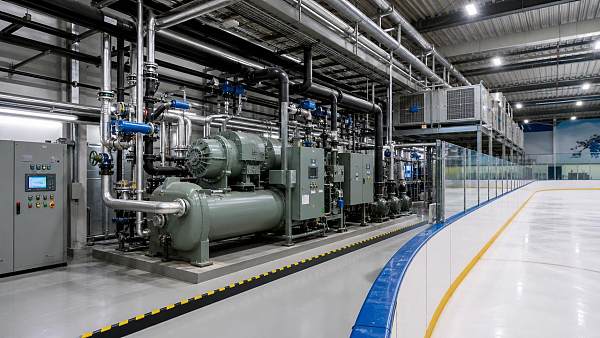
If the goal is to identify the ice skating rink equipment that causes the most downtime, refrigeration equipment almost always ranks first. Without a stable refrigeration plant, the rink cannot maintain the ice sheet, and most failures in this category affect the entire facility rather than a single zone.
Critical components include compressors, condensers, evaporators, pumps, valves, heat exchangers, refrigerant controls, and the plant automation interface. Failures may result from poor commissioning, dirty heat exchange surfaces, oil management issues, refrigerant leaks, pump seal failure, control sensor drift, or electrical instability. In older installations, obsolescence of controls and unavailable spare parts often turn a manageable fault into a prolonged shutdown.
For project managers, the most important distinction is between frequency and consequence. Compressors may not fail every month, but when they do, downtime can last from several hours to multiple days depending on system design, technician availability, and whether temporary cooling alternatives exist. In high-traffic or competition venues, even a short outage can trigger revenue loss, event disruption, and reputational damage.
There are also design-stage decisions that strongly influence future downtime. Plants with no redundancy, undersized pipework, poor access for maintenance, or tightly integrated single-source controls are harder to recover when something goes wrong. A low bid at procurement can become expensive very quickly if the selected system lacks serviceability in the local market.
To reduce this risk, project teams should prioritize redundant capacity where feasible, demand detailed commissioning records, confirm local service coverage before purchase, and specify a critical spares package at handover. For international projects, spare parts logistics matter almost as much as equipment quality.
Ice slab piping and subfloor systems fail less often, but create the longest and most expensive disruptions
For pure duration of disruption, slab piping and subfloor systems may be even more serious than mechanical plant faults. These components are hidden beneath the ice and concrete structure, which means failures are difficult to detect, difficult to access, and expensive to correct.
Common problems include glycol leaks, pipe corrosion, joint failure, insulation defects, vapor barrier problems, subfloor frost heave, and uneven slab cooling caused by circulation imbalance. While these issues may develop slowly, they can eventually degrade ice quality, create soft spots, produce structural stress, or require partial shutdown for invasive repair.
From a project management perspective, this is where lifecycle thinking is critical. Poor installation quality, inadequate pressure testing, shortcuts in material selection, and weak documentation during construction are major predictors of long-term downtime. Once the rink is completed, remediation can involve destructive investigation, slab opening, pipe replacement, and lengthy recommissioning.
These failures are especially disruptive because they affect more than equipment uptime. They interfere with structural integrity, ice consistency, safety assurance, and insurance exposure. A facility may technically remain partially operable, yet still fail to meet event, training, or public use standards.
The best control strategy is front-loaded: strict contractor qualification, transparent as-built records, documented pressure and leak testing, independent commissioning oversight, and clear accountability between refrigeration, civil, and insulation trades. Project managers should treat under-slab work as a risk area that deserves premium supervision, not back-of-house invisibility.
HVAC and dehumidification problems are a leading cause of avoidable shutdowns and poor user experience
Many non-specialists underestimate how strongly HVAC and dehumidification performance affects rink uptime. In reality, inadequate air handling is one of the most common causes of operational instability in indoor ice facilities.
When temperature, humidity, and airflow are not properly controlled, the rink may experience fog, condensation on structural elements, dripping onto the ice surface, frost buildup, spectator discomfort, corrosion acceleration, and poor visibility. Even if the refrigeration system is functioning, these conditions can make the facility unsafe or unsuitable for scheduled use.
Typical failure points include dehumidifier malfunction, sensor calibration drift, blocked drains, control sequence conflicts, poor duct balancing, undersized air distribution, and integration problems between HVAC and refrigeration logic. In retrofits, the issue is often not one broken machine, but a mismatch between system design and current occupancy loads.
For project managers, this category is important because downtime here is often preventable. Compared with hidden slab repairs, HVAC-related interruptions usually stem from insufficient design coordination, weak controls integration, or deferred maintenance. Yet the business impact is still substantial: unhappy users, shortened skating sessions, increased resurfacing demand, and repeated callouts.
During planning and procurement, it is worth asking suppliers and designers not only for capacity data, but for psychrometric performance under peak occupancy, door opening frequency, local climate variation, and event-driven usage changes. A rink used for public skating, hockey, and entertainment events will place very different demands on air management.
Controls and automation failures create disproportionate disruption because diagnosis takes time
Modern ice skating rink equipment depends heavily on controls. Sensors, programmable logic controllers, human-machine interfaces, alarms, remote monitoring, and sequencing software tie the refrigeration plant, pumps, HVAC, and safety systems together. When controls fail, the hardest part is often not the repair itself, but identifying the root cause.
Symptoms may appear as nuisance shutdowns, unstable ice temperature, unexplained energy spikes, false alarms, or equipment short cycling. In some facilities, operators respond manually for weeks before discovering that the underlying issue is a failed sensor, incorrect programming logic, network communication fault, or undocumented change to setpoints.
This is a major concern for project managers because controls-related downtime is often prolonged by documentation gaps. If the integrator does not provide clear point lists, control narratives, override procedures, backup logic, and password management at handover, future troubleshooting becomes dependent on a limited group of specialists. That creates response bottlenecks and vendor lock-in.
To reduce risk, projects should require full controls documentation, operator training, secure remote diagnostics, and a practical escalation path for failures. Controls should also be commissioned under real operating conditions, not only in factory-style test modes. A technically complete handover package can save days of downtime over the life of the rink.
Electrical distribution and backup power issues can stop the rink instantly
Electrical infrastructure is sometimes overlooked because it supports every system rather than appearing as specialized rink equipment. But from an uptime standpoint, switchgear, motor control centers, variable frequency drives, cable terminations, and emergency power arrangements are critical failure points.
Power instability can trip compressors, disable pumps, interrupt controls, and compromise safety systems. In some cases, the initial electrical event lasts only seconds, but the restart sequence, inspection requirement, or equipment damage causes much longer downtime. Sensitive components such as drives and control boards are particularly vulnerable to voltage fluctuations and poor grounding.
Project managers should pay close attention to load analysis, startup sequencing, harmonics, surge protection, redundancy for essential circuits, and the relationship between the utility supply and plant restart strategy. A facility may have excellent refrigeration hardware, but still suffer frequent stoppages if the electrical design is not robust.
For venues with contractual event obligations or premium customer expectations, backup power planning should be discussed early. Not every rink requires full plant redundancy on generator supply, but critical controls, safety systems, and selective mechanical loads may justify protected continuity.
Ice resurfacers and maintenance equipment fail often enough to affect schedules, even if they do not always cause full closure
Among the more visible types of ice skating rink equipment, the ice resurfacer is one of the most operationally sensitive assets. It may not always shut the whole facility for days, but when it fails, the effect on daily scheduling is immediate.
Problems commonly involve battery degradation in electric units, hydraulic leaks, blade issues, tire wear, water system malfunctions, drive motor faults, or neglected preventive service. A resurfacer breakdown can compress event turnaround times, reduce ice quality, and increase labor strain as teams attempt temporary workarounds.
For project managers involved in procurement or handover, the lesson is straightforward: uptime depends on maintenance support and consumable availability as much as on machine brand. A resurfacer supplied without local technical support, battery management guidance, or fast parts access can become a recurring operational headache.
Similar logic applies to edge tools, edgers, water treatment systems, and skate drying or rental support equipment. These assets may not have the same catastrophic impact as refrigeration failure, but they still affect service continuity and customer satisfaction. In facilities with tight booking calendars, frequent minor interruptions can be almost as damaging as occasional major outages.
Dasher boards, glass, and access systems usually rank lower for total downtime, but still matter for safety and event readiness
Boards, gates, safety glass, netting, and player access systems are not usually the top causes of long-duration shutdowns, but they can still stop specific activities or delay event certification. Damage from impacts, poor installation alignment, loose hardware, or low-quality materials can create safety concerns that require immediate correction.
For multi-use commercial venues, these systems matter because they sit at the intersection of safety compliance, user experience, and maintenance responsiveness. A cracked glass panel or failing gate latch may not melt the ice, but it can cancel a match, interrupt a training schedule, or expose the operator to liability.
Project managers should therefore avoid treating these packages as purely cosmetic or low-priority procurement items. Serviceability, modular replacement, spare panel strategy, and compliance with relevant standards should be considered during supplier evaluation.
How to evaluate downtime risk when sourcing ice skating rink equipment
For commercial buyers and project leads, the best sourcing decision is rarely the cheapest headline price. A more useful evaluation method is to score each major equipment package against downtime risk indicators.
Start with six practical questions. First, if this equipment fails, does the whole rink stop or only one function? Second, how long does diagnosis normally take? Third, are critical spare parts stocked locally or internationally? Fourth, can trained service personnel respond quickly? Fifth, does the design include redundancy or graceful degradation? Sixth, is the handover package detailed enough for future troubleshooting?
This approach helps project teams compare suppliers beyond brochures and nominal specifications. Two refrigeration systems may offer similar capacity, but the one with stronger controls transparency, regional service presence, easier maintenance access, and available spare compressors may present far lower lifecycle risk.
It also improves stakeholder communication. Owners, operators, consultants, and procurement teams do not always define value the same way. A downtime-based evaluation framework creates a common language that links technical choices to business outcomes.
Practical steps to reduce downtime before the rink opens
The most effective downtime reduction strategy begins long before operations start. Many chronic failures are rooted in planning, coordination, installation, and commissioning decisions made during the project phase.
First, align the design team around maintainability, not only performance. Equipment clearances, access routes, lifting provisions, isolation valves, controls visibility, and service platforms all affect future repair time. Second, verify supplier support capability in the actual project region, including parts stock, technician coverage, and response commitments.
Third, require integrated commissioning. Rink systems do not operate in isolation, so the refrigeration plant, HVAC, controls, power, and resurfacing workflow should be tested together under realistic load conditions. Fourth, define a critical spare parts list before handover. Fifth, insist on complete as-built documents, sequence descriptions, alarm logic, training records, and warranty escalation contacts.
Finally, involve the future operator early. Project teams often close out construction successfully while leaving the maintenance team underprepared for real-world troubleshooting. A smooth transition from project delivery to operational readiness is one of the strongest predictors of lower downtime in the first years of use.
Final takeaway for project managers
When evaluating which ice skating rink equipment causes the most downtime, project managers should place the greatest attention on refrigeration systems first, then slab piping and subfloor assemblies, HVAC and dehumidification, controls, and electrical infrastructure. Ice resurfacers and board systems also matter, but they usually rank lower in terms of full-facility shutdown impact.
The bigger lesson is that downtime is shaped by design quality, commissioning discipline, service access, documentation, and supplier support just as much as by equipment brand. In commercial rink projects, the smartest investment is often not the lowest-cost equipment package, but the one that reduces recovery time when failures occur.
If you are sourcing ice skating rink equipment for a new build, retrofit, or multi-site program, prioritize systems that combine technical reliability with strong lifecycle support. That is how you protect project schedules, control operating risk, and deliver an ice facility that performs consistently long after opening day.
Search News
Hot Articles
Popular Tags
Need ExpertConsultation?
Connect with our specialized leisureengineering team for procurementstrategies.
Recommended News
 Jun 05, 2026Safari Tents Wholesale: How to Compare Frame Materials, Sizes, and MOQSafari tents wholesale guide: compare frame materials, tent sizes, and MOQ to reduce sourcing risk, control costs, and choose a scalable supplier for profitable hospitality projects.● Hospitality Sourcing Dir
 May 25, 2026RCEP ASEAN Origin Rules Adjusted for Travel Services Outdoor GearRCEP ASEAN origin rules updated for travel services outdoor gear — zero tariffs from 1 Aug 2026 if 60%+ Chinese materials & RCEP traceability code applied.● Hospitality Sourcing Dir
 May 18, 2026How to judge simultaneous interpretation equipment qualitySimultaneous interpretation equipment quality affects clarity, stability, and event success. Learn the key checklist, testing points, and sourcing tips to choose with confidence.● Hospitality Sourcing Dir
 May 18, 2026What to check before choosing tour guide systems wholesaleTour guide systems wholesale: learn what to check before buying, from audio stability and certifications to battery life, customization, and supplier support.● Hospitality Sourcing Dir
 May 14, 2026China's MCT Launches Travel Services Overseas Compliance GuideChina's MCT Overseas Compliance Guide helps travel & entertainment firms navigate GDPR, CCPA & ESG rules—boost global trust and market access.● Hospitality Sourcing Dir
 May 13, 2026China's MCT Launches 'Travel Services' Overseas Compliance GuideChina's MCT Travel Services Compliance Guide: Essential for sports tourism, study-abroad & customized tour operators expanding to EU/US markets under GDPR, CCPA & CSDDD.● Hospitality Sourcing Dir
 May 09, 2026Inflatable clear bubble tents and the privacy trade-offInflatable clear bubble tents offer immersive appeal, but is the privacy trade-off worth it? Explore scenario-based insights for resorts, events, dining, and public spaces.● Hospitality Sourcing Dir
 May 09, 2026Camping glamping tents: what guests notice before anything elseCamping glamping tents guests love start with first impressions—space, privacy, materials, light, and comfort. Discover what buyers should prioritize to boost appeal and bookings.● Hospitality Sourcing Dir
 May 09, 2026Safari tents wholesale and the weatherproofing details that matterSafari tents wholesale buyers now prioritize weatherproofing. Learn which waterproof, windproof, ventilation, and corrosion details reduce risk, protect uptime, and improve long-term value.● Hospitality Sourcing Dir
 May 09, 2026Geodesic dome tents: are they practical for year-round stays?Geodesic dome tents can work for year-round stays—but only with the right insulation, ventilation, and structural planning. Discover what makes them practical, comfortable, and cost-effective.● Hospitality Sourcing Dir
 May 09, 2026Inflatable paddle boards commercial buyers often overlook thisInflatable paddle boards commercial buyers often miss the factors that drive long-term value—durability, safety, compliance, and supplier consistency. Learn what to check before you buy.● Hospitality Sourcing Dir
 May 09, 2026Wholesale jet skis: what determines long-term service costs?Wholesale jet skis buyers should look beyond unit price. Discover how durability, parts access, corrosion resistance, and warranty support shape long-term service costs and fleet profitability.● Hospitality Sourcing Dir
 May 09, 2026Inflatable docks: which designs hold up in busy marinas?Inflatable docks for busy marinas: discover which designs deliver superior rigidity, slip resistance, and durability for safer boarding and lower maintenance.● Hospitality Sourcing Dir
 May 09, 2026Ice skating rink equipment that causes the most downtimeIce skating rink equipment causing the most downtime starts with refrigeration, controls, HVAC, and power. Learn the highest-risk systems and smart ways to cut outages.● Hospitality Sourcing Dir
 May 09, 2026Synthetic ice panels wholesale: what affects glide quality?Synthetic ice panels wholesale: discover what really affects glide quality, from polymer formulation and seam precision to maintenance needs, so you can compare suppliers with confidence.● Hospitality Sourcing Dir
 May 09, 2026Why ski resort equipment budgets often miss hidden costsSki resort equipment budgets often miss freight, installation, compliance, and service costs. Learn the hidden drivers behind overruns and budget smarter for stronger ROI.● Hospitality Sourcing Dir
 May 09, 2026Artificial snow mats vs real snow for beginner ski zonesArtificial snow mats vs real snow: discover which option gives beginner ski zones safer training, longer seasons, lower operating risk, and stronger commercial value.● Hospitality Sourcing Dir
 May 09, 2026What changes first when ski lift parts start to wear out?Ski lift parts often show wear through vibration, noise, heat, and tracking changes first. Learn the key early warning signs to improve safety, reduce downtime, and plan smarter maintenance.● Hospitality Sourcing Dir
 May 09, 2026Are snow making machines worth it in low-snow winters?Snow making machines: are they worth the cost in low-snow winters? Explore ROI, energy use, seasonal reliability, and smart investment strategies to protect winter revenue.● Hospitality Sourcing Dir
 May 08, 2026Custom Fiberglass Statues That Hold Up OutdoorsFiberglass statues custom solutions for outdoor commercial spaces: discover durable, weather-ready designs that strengthen branding, reduce maintenance, and enhance long-term project value.● Hospitality Sourcing Dir
 May 03, 2026Zunyi Liquor League: Fengrongjiao Wins, AR+Digital Twin System Drives 130% Export Inquiry GrowthZunyi Liquor League sparks global interest: Fengrongjiao’s win + AR/digital twin system drives 130% export inquiry growth — key for liquor tourism, smart hardware & ASEAN compliance.● Hospitality Sourcing Dir
 Apr 25, 2026Discover the Best of the Silk Road: Top Xi'an Hot Tourism Routes for 2026● Hospitality Sourcing Dir
 Apr 22, 2026Peak of China: The Ultimate 7-Day Central Plains Heritage Odyssey 2026Plan a 7-day Henan heritage tour in 2026 with Luoyang, Shaolin Temple and Kaifeng highlights, plus visa-free transit and rail tips.● Hospitality Sourcing Dir