Inflatable docks: which designs hold up in busy marinas?
In busy marinas, inflatable docks are judged by far more than their ability to float. They face concentrated foot traffic, uneven point loads from gear and boarding ramps, constant UV exposure, wake impact, abrasion from tenders, and frequent wet-dry cycles. Under these conditions, design details determine service life. Some inflatable dock platforms remain stable and predictable through repeated commercial use, while others soften, twist, delaminate, or require excessive upkeep. For waterfront operators, hospitality venues, leisure facilities, and marine project planners, the key evaluation is which inflatable dock designs combine rigidity, deck safety, repairability, and operational efficiency in high-turnover environments.
Core design principles behind durable inflatable docks
The best-performing inflatable docks usually share a similar engineering logic: high internal stiffness, balanced buoyancy, reinforced connection zones, and a deck surface that remains usable when wet. In marina use, the challenge is dynamic loading rather than simple flotation. When several people board from one edge, the platform must resist rolling and edge collapse. When a tender contacts the side, the structure must absorb impact without seam stress spreading through the body of the dock.
Most commercial-grade inflatable dock systems rely on drop-stitch construction. Thousands of internal threads connect the upper and lower fabric layers, allowing the platform to hold high pressure and remain relatively flat. This is a major step above low-pressure air chambers, which may work for casual recreation but often lack the rigidity needed for busy marinas. Material quality also matters. Reinforced PVC remains common because it is cost-effective and repairable, while TPU-based structures can offer better abrasion resistance, flexibility, and long-term performance in demanding marine conditions.
Another important principle is footprint geometry. Wider platforms with well-distributed buoyancy chambers generally handle traffic better than narrow layouts. Thickness also improves performance, but thickness alone does not guarantee stability. A thick inflatable dock with weak edge bonding or poor chamber balance may still flex too much at boarding points. In commercial settings, the complete structural design matters more than any single specification.
Current marina conditions shaping inflatable dock selection
Demand for modular, portable marine infrastructure has expanded across hospitality, recreation, event operations, and temporary waterfront development. As a result, inflatable docks are now evaluated against standards that were once reserved for fixed floating systems. The most common selection pressures in modern marinas include:
- High boarding frequency from tenders, jet skis, and small service craft
- Need for stable passenger transfer in hospitality and excursion settings
- Reduced maintenance windows during peak seasonal use
- Exposure to salt, fuel residue, sunscreen, and cleaning chemicals
- Requirement for modular expansion, relocation, or temporary installation
These conditions have shifted attention from simple portability to lifecycle performance. In other words, the most attractive inflatable dock is not necessarily the lightest or cheapest, but the one that maintains shape, traction, and seam integrity with minimal operational disruption.
Which inflatable dock designs hold up best under heavy use
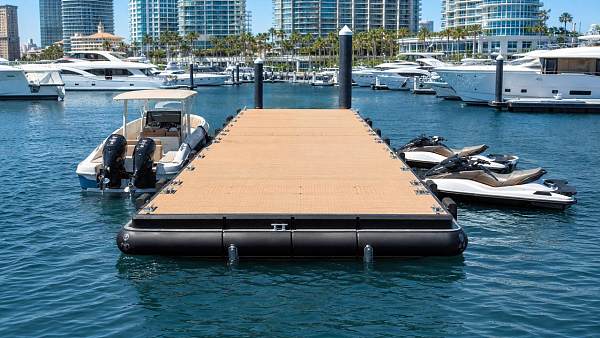
Among common inflatable docks, rectangular high-pressure modular platforms tend to perform best in busy marinas because they distribute loads evenly and connect easily into larger floating layouts. Their broad contact area improves stability for boarding, staging, and equipment handling. When fitted with reinforced sidewalls and multiple tie-down points, they are often the most dependable choice for commercial duty.
High-pressure rectangular platforms
These are usually the most robust all-purpose inflatable dock solution. Their advantages include predictable deck shape, efficient modular expansion, and better compatibility with gangways, cleats, ladders, and floating walkways. In marinas with frequent passenger transfer, they generally outperform novelty shapes or narrow recreational platforms.
Catamaran-style or dual-chamber edge-stable designs
Designs that use separated buoyancy zones or raised side tubes can improve roll resistance at the edges. This is valuable where boarding occurs from one side only or where smaller craft repeatedly come alongside. These inflatable docks can feel more secure in active berthing conditions, though they may be bulkier to store and transport.
Inflatable cubes and highly modular interlocking units
Cubic and small interlocking formats offer flexibility, but not all are suitable for high-traffic marinas. They can be effective for temporary event layouts or changing waterfront footprints, yet their long-term performance depends heavily on connection design. Weak joints become the first failure point under wake movement and repeated loading. For commercial use, modularity should never come at the expense of structural continuity.
Low-pressure leisure mats
These are the least suitable inflatable dock option for busy marinas. They may be comfortable for sunbathing or occasional swimming access, but they lack the stiffness, edge security, and deck reliability needed for repeated boarding operations. In practical terms, they are better classified as recreational inflatables than true working docks.
Operational value for commercial waterfront environments
Well-designed inflatable docks create value because they shorten installation time, reduce the need for permanent marine works, and support flexible site planning. This matters across hotel waterfronts, beach clubs, island transfers, marine events, educational waterfront programs, and temporary leisure developments. A durable inflatable dock can function as a landing point, swim platform, service transfer station, or modular event extension without the permitting burden of a fixed structure in every location.
From a business continuity perspective, portable dock systems also help operators respond to seasonality. They can be deployed during peak demand, repositioned for changing currents or berth usage, and removed during severe weather periods. However, this flexibility only pays off when the dock is engineered for repeat inflation cycles, repeated anchoring, and regular handling by on-site teams.
Practical selection criteria and maintenance considerations
When comparing inflatable docks, technical review should focus on total operating conditions rather than brochure claims. A platform that looks similar on paper may perform very differently once exposed to real marina traffic. The most useful checks include material thickness, seam method, pressure rating, deck traction, hardware grade, and recommended occupancy under dynamic load.
- Choose high-pressure construction: This is the clearest indicator of stiffness and working-dock performance.
- Inspect edge and corner reinforcement: These areas take the most abuse from boarding and craft contact.
- Review deck finish carefully: Soft foam comfort is not enough; slip resistance and cleanability are essential.
- Confirm marine-grade hardware: D-rings, handles, valves, and anchor points should resist corrosion and repeated strain.
- Plan for repair access: Spare valves, patch compatibility, and documented maintenance procedures reduce downtime.
- Match shape to traffic pattern: If boarding occurs from one edge, prioritize side stability over compact packing size.
Maintenance discipline is equally important. Even the best inflatable dock design can degrade early if stored wet, inflated beyond specification, dragged across rough surfaces, or left unprotected during extreme weather. Routine rinsing, pressure checks, seam inspection, and controlled storage conditions significantly improve lifespan. For high-use sites, scheduled inspection logs are more valuable than reactive repairs.
A grounded approach to specifying inflatable docks
In demanding marinas, the inflatable docks that hold up best are usually high-pressure, drop-stitch platforms with reinforced perimeters, reliable modular connections, and a deck surface built for repeated wet use. Designs optimized only for recreation tend to fall short where traffic density, edge loading, and impact exposure are constant. The most dependable solutions balance rigidity, user safety, transport flexibility, and practical maintenance.
A sound next step is to compare candidate inflatable dock systems against actual marina conditions: boarding frequency, vessel type, mooring method, storage cycle, UV intensity, and required service life. Using this framework makes it easier to separate temporary leisure products from commercial-grade floating infrastructure and identify the inflatable dock design that will remain stable, durable, and efficient over time.
Search News
Hot Articles
Popular Tags
Need ExpertConsultation?
Connect with our specialized leisureengineering team for procurementstrategies.
Recommended News
 Jun 05, 2026Safari Tents Wholesale: How to Compare Frame Materials, Sizes, and MOQSafari tents wholesale guide: compare frame materials, tent sizes, and MOQ to reduce sourcing risk, control costs, and choose a scalable supplier for profitable hospitality projects.● Hospitality Sourcing Dir
 May 25, 2026RCEP ASEAN Origin Rules Adjusted for Travel Services Outdoor GearRCEP ASEAN origin rules updated for travel services outdoor gear — zero tariffs from 1 Aug 2026 if 60%+ Chinese materials & RCEP traceability code applied.● Hospitality Sourcing Dir
 May 18, 2026How to judge simultaneous interpretation equipment qualitySimultaneous interpretation equipment quality affects clarity, stability, and event success. Learn the key checklist, testing points, and sourcing tips to choose with confidence.● Hospitality Sourcing Dir
 May 18, 2026What to check before choosing tour guide systems wholesaleTour guide systems wholesale: learn what to check before buying, from audio stability and certifications to battery life, customization, and supplier support.● Hospitality Sourcing Dir
 May 14, 2026China's MCT Launches Travel Services Overseas Compliance GuideChina's MCT Overseas Compliance Guide helps travel & entertainment firms navigate GDPR, CCPA & ESG rules—boost global trust and market access.● Hospitality Sourcing Dir
 May 13, 2026China's MCT Launches 'Travel Services' Overseas Compliance GuideChina's MCT Travel Services Compliance Guide: Essential for sports tourism, study-abroad & customized tour operators expanding to EU/US markets under GDPR, CCPA & CSDDD.● Hospitality Sourcing Dir
 May 09, 2026Inflatable clear bubble tents and the privacy trade-offInflatable clear bubble tents offer immersive appeal, but is the privacy trade-off worth it? Explore scenario-based insights for resorts, events, dining, and public spaces.● Hospitality Sourcing Dir
 May 09, 2026Camping glamping tents: what guests notice before anything elseCamping glamping tents guests love start with first impressions—space, privacy, materials, light, and comfort. Discover what buyers should prioritize to boost appeal and bookings.● Hospitality Sourcing Dir
 May 09, 2026Safari tents wholesale and the weatherproofing details that matterSafari tents wholesale buyers now prioritize weatherproofing. Learn which waterproof, windproof, ventilation, and corrosion details reduce risk, protect uptime, and improve long-term value.● Hospitality Sourcing Dir
 May 09, 2026Geodesic dome tents: are they practical for year-round stays?Geodesic dome tents can work for year-round stays—but only with the right insulation, ventilation, and structural planning. Discover what makes them practical, comfortable, and cost-effective.● Hospitality Sourcing Dir
 May 09, 2026Inflatable paddle boards commercial buyers often overlook thisInflatable paddle boards commercial buyers often miss the factors that drive long-term value—durability, safety, compliance, and supplier consistency. Learn what to check before you buy.● Hospitality Sourcing Dir
 May 09, 2026Wholesale jet skis: what determines long-term service costs?Wholesale jet skis buyers should look beyond unit price. Discover how durability, parts access, corrosion resistance, and warranty support shape long-term service costs and fleet profitability.● Hospitality Sourcing Dir
 May 09, 2026Inflatable docks: which designs hold up in busy marinas?Inflatable docks for busy marinas: discover which designs deliver superior rigidity, slip resistance, and durability for safer boarding and lower maintenance.● Hospitality Sourcing Dir
 May 09, 2026Ice skating rink equipment that causes the most downtimeIce skating rink equipment causing the most downtime starts with refrigeration, controls, HVAC, and power. Learn the highest-risk systems and smart ways to cut outages.● Hospitality Sourcing Dir
 May 09, 2026Synthetic ice panels wholesale: what affects glide quality?Synthetic ice panels wholesale: discover what really affects glide quality, from polymer formulation and seam precision to maintenance needs, so you can compare suppliers with confidence.● Hospitality Sourcing Dir
 May 09, 2026Why ski resort equipment budgets often miss hidden costsSki resort equipment budgets often miss freight, installation, compliance, and service costs. Learn the hidden drivers behind overruns and budget smarter for stronger ROI.● Hospitality Sourcing Dir
 May 09, 2026Artificial snow mats vs real snow for beginner ski zonesArtificial snow mats vs real snow: discover which option gives beginner ski zones safer training, longer seasons, lower operating risk, and stronger commercial value.● Hospitality Sourcing Dir
 May 09, 2026What changes first when ski lift parts start to wear out?Ski lift parts often show wear through vibration, noise, heat, and tracking changes first. Learn the key early warning signs to improve safety, reduce downtime, and plan smarter maintenance.● Hospitality Sourcing Dir
 May 09, 2026Are snow making machines worth it in low-snow winters?Snow making machines: are they worth the cost in low-snow winters? Explore ROI, energy use, seasonal reliability, and smart investment strategies to protect winter revenue.● Hospitality Sourcing Dir
 May 08, 2026Custom Fiberglass Statues That Hold Up OutdoorsFiberglass statues custom solutions for outdoor commercial spaces: discover durable, weather-ready designs that strengthen branding, reduce maintenance, and enhance long-term project value.● Hospitality Sourcing Dir
 May 03, 2026Zunyi Liquor League: Fengrongjiao Wins, AR+Digital Twin System Drives 130% Export Inquiry GrowthZunyi Liquor League sparks global interest: Fengrongjiao’s win + AR/digital twin system drives 130% export inquiry growth — key for liquor tourism, smart hardware & ASEAN compliance.● Hospitality Sourcing Dir
 Apr 25, 2026Discover the Best of the Silk Road: Top Xi'an Hot Tourism Routes for 2026● Hospitality Sourcing Dir
 Apr 22, 2026Peak of China: The Ultimate 7-Day Central Plains Heritage Odyssey 2026Plan a 7-day Henan heritage tour in 2026 with Luoyang, Shaolin Temple and Kaifeng highlights, plus visa-free transit and rail tips.● Hospitality Sourcing Dir