What changes first when ski lift parts start to wear out?
When ski lift parts begin to wear out, the first changes are rarely dramatic—they appear as low-level vibration, faint tonal shifts, slower engagement, irregular tracking, or a braking feel that seems slightly less crisp than normal. In ropeway operations, these early symptoms matter because they emerge before visible failure, and they often indicate stress spreading from one component to adjacent systems. A reliable inspection program therefore starts by understanding which ski lift parts typically show measurable change first, how those changes present in daily operation, and what that means for safety, availability, and lifecycle cost. In commercial leisure infrastructure, that knowledge supports better planning, cleaner maintenance records, and more defensible decisions around repair, refurbishment, and replacement.
Early wear in ski lift parts: what changes first
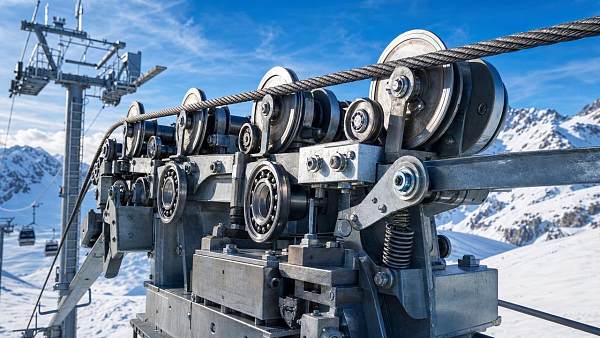
Not all ski lift parts age at the same rate. Components exposed to continuous motion, friction, load cycling, weather, and contamination usually show the first deviations. In most systems, the earliest changes are found in bearings, sheave liners, brake surfaces, rollers, grips, bushings, hydraulic seals, and electrical contact elements. These parts do not always fail first, but they often reveal the first evidence that the system is moving away from baseline performance.
A useful distinction is the difference between wear that is normal and wear that is accelerating. Normal wear appears gradually and remains predictable across inspection intervals. Accelerating wear is different: vibration increases faster than expected, noise shifts in frequency, heat patterns become inconsistent, lubricant darkens unusually quickly, or adjustment intervals shorten. When ski lift parts begin to display these patterns, the issue is no longer routine aging; it is a sign that alignment, loading, lubrication, contamination control, or component compatibility may need closer review.
This matters beyond mountain operations alone. In the broader commercial sourcing environment, ski lift parts sit within a high-consequence category of mechanical infrastructure where service continuity, documented traceability, and compliance readiness directly affect asset value. A small change in a wear part can influence customer flow, staffing efficiency, downtime risk, and insurance exposure.
Operational signals that usually appear before visible damage
The earliest warning signs are often sensory and measurable long before a part looks obviously damaged. Teams that rely only on visual checks may miss the first stage of deterioration. In practice, the following signals tend to appear first when ski lift parts start wearing out:
- Slight vibration increase at terminals, towers, or drive assemblies
- New or changing noise, especially humming, chirping, scraping, or intermittent knocking
- Uneven rope travel or minor tracking inconsistency over sheaves
- Longer response time in braking or grip engagement systems
- Localized temperature rise around bearings, motors, gearboxes, or brake packs
- Lubricant leakage, discoloration, metal fines, or contamination
- Irregular seat, carrier, or hanger movement under normal load
- Sensor faults or intermittent electrical feedback anomalies
These signals are valuable because they help narrow the likely wear zone before disassembly begins. For example, a high-pitched rotational noise paired with moderate heat may point toward bearing fatigue, while uneven carrier passage with no significant heat increase may suggest liner wear, roller irregularity, or grip-related tolerance drift. Good diagnostics treat these signs as patterns rather than isolated defects.
Where wear is most often detected first
Although design varies by lift type and manufacturer, several ski lift parts consistently deserve priority attention because they operate at the intersection of motion, pressure, and environment.
Among all ski lift parts, bearings are often the clearest early indicator because small internal surface changes quickly translate into sound, temperature, and vibration variation. Sheave liners are another high-attention category because wear can remain subtle while still affecting rope behavior. Brake-related ski lift parts may not show obvious material loss at first, but response inconsistency is itself a serious maintenance signal.
Why early detection has commercial and operational value
The value of identifying early wear in ski lift parts goes beyond preventing breakdown. It improves planning quality across maintenance scheduling, spare parts stocking, service contracts, and sourcing strategy. Replacing a targeted wear component during a controlled interval is usually less disruptive than responding to secondary damage after a part has degraded too far. One worn bearing can affect shaft alignment, adjacent housings, drive efficiency, and brake performance. One deteriorated liner can influence rope contact conditions and accelerate wear elsewhere.
From a business standpoint, early detection supports four practical outcomes:
- Lower unplanned downtime through condition-based intervention
- Better capital timing by separating routine wear from structural renewal
- Improved compliance documentation for audits, insurance, and safety reviews
- More accurate sourcing decisions for OEM, equivalent, or custom replacement ski lift parts
This is especially relevant in the global trade context, where lead times, material certifications, dimensional tolerances, and supplier traceability can differ significantly. A delayed decision on ski lift parts replacement can turn a manageable service event into a logistics and availability problem at peak operating periods.
Typical wear patterns by system area
Different lift zones reveal different first-stage symptoms. Reviewing ski lift parts by system area helps create a more focused inspection route.
Practical inspection and maintenance considerations
A strong inspection strategy does not start with disassembly; it starts with baseline comparison. The most useful maintenance records for ski lift parts include vibration trend data, temperature checks, lubrication intervals, torque verification, brake response measurements, liner wear observations, and recurring fault history. Without baseline data, early wear is easy to dismiss as normal operating character.
Several practical steps improve detection quality:
- Group ski lift parts by failure consequence, not only by replacement cost.
- Use repeatable inspection points for sound, temperature, and movement checks.
- Treat lubricant condition as a diagnostic tool, not merely a service consumable.
- Investigate paired symptoms, such as heat plus noise or leakage plus slower response.
- Confirm part compatibility carefully when sourcing non-original ski lift parts.
- Document small deviations early so trend acceleration becomes visible over time.
It is also important not to over-focus on one visible component. Wear in ski lift parts is often systemic. A part may appear to be the problem while actually reflecting misalignment, poor sealing, contamination ingress, incorrect preload, or tension imbalance elsewhere in the system. That is why effective maintenance combines component inspection with root-cause review.
A practical next step for sourcing and lifecycle planning
The first changes in worn ski lift parts are usually small but highly informative: a bearing runs warmer, a sheave liner tracks unevenly, a brake engages less decisively, or a sensor begins to signal intermittently. These are not minor details; they are early lifecycle markers that help determine whether maintenance should be corrective, preventive, or strategic. For any operation managing ropeway infrastructure, the most effective next step is to align inspection data with a structured replacement plan that ranks ski lift parts by wear behavior, criticality, lead time, and certification requirements.
A disciplined review of service logs, component traceability, and sourcing options can reveal which ski lift parts should be stocked, which should be monitored more closely, and which are better addressed through scheduled overhaul. In commercial trade terms, this approach protects uptime, strengthens safety assurance, and supports more confident procurement decisions across the full operating life of the asset.
Search News
Hot Articles
Popular Tags
Need ExpertConsultation?
Connect with our specialized leisureengineering team for procurementstrategies.
Recommended News
 Jun 05, 2026Safari Tents Wholesale: How to Compare Frame Materials, Sizes, and MOQSafari tents wholesale guide: compare frame materials, tent sizes, and MOQ to reduce sourcing risk, control costs, and choose a scalable supplier for profitable hospitality projects.● Hospitality Sourcing Dir
 May 25, 2026RCEP ASEAN Origin Rules Adjusted for Travel Services Outdoor GearRCEP ASEAN origin rules updated for travel services outdoor gear — zero tariffs from 1 Aug 2026 if 60%+ Chinese materials & RCEP traceability code applied.● Hospitality Sourcing Dir
 May 18, 2026How to judge simultaneous interpretation equipment qualitySimultaneous interpretation equipment quality affects clarity, stability, and event success. Learn the key checklist, testing points, and sourcing tips to choose with confidence.● Hospitality Sourcing Dir
 May 18, 2026What to check before choosing tour guide systems wholesaleTour guide systems wholesale: learn what to check before buying, from audio stability and certifications to battery life, customization, and supplier support.● Hospitality Sourcing Dir
 May 14, 2026China's MCT Launches Travel Services Overseas Compliance GuideChina's MCT Overseas Compliance Guide helps travel & entertainment firms navigate GDPR, CCPA & ESG rules—boost global trust and market access.● Hospitality Sourcing Dir
 May 13, 2026China's MCT Launches 'Travel Services' Overseas Compliance GuideChina's MCT Travel Services Compliance Guide: Essential for sports tourism, study-abroad & customized tour operators expanding to EU/US markets under GDPR, CCPA & CSDDD.● Hospitality Sourcing Dir
 May 09, 2026Inflatable clear bubble tents and the privacy trade-offInflatable clear bubble tents offer immersive appeal, but is the privacy trade-off worth it? Explore scenario-based insights for resorts, events, dining, and public spaces.● Hospitality Sourcing Dir
 May 09, 2026Camping glamping tents: what guests notice before anything elseCamping glamping tents guests love start with first impressions—space, privacy, materials, light, and comfort. Discover what buyers should prioritize to boost appeal and bookings.● Hospitality Sourcing Dir
 May 09, 2026Safari tents wholesale and the weatherproofing details that matterSafari tents wholesale buyers now prioritize weatherproofing. Learn which waterproof, windproof, ventilation, and corrosion details reduce risk, protect uptime, and improve long-term value.● Hospitality Sourcing Dir
 May 09, 2026Geodesic dome tents: are they practical for year-round stays?Geodesic dome tents can work for year-round stays—but only with the right insulation, ventilation, and structural planning. Discover what makes them practical, comfortable, and cost-effective.● Hospitality Sourcing Dir
 May 09, 2026Inflatable paddle boards commercial buyers often overlook thisInflatable paddle boards commercial buyers often miss the factors that drive long-term value—durability, safety, compliance, and supplier consistency. Learn what to check before you buy.● Hospitality Sourcing Dir
 May 09, 2026Wholesale jet skis: what determines long-term service costs?Wholesale jet skis buyers should look beyond unit price. Discover how durability, parts access, corrosion resistance, and warranty support shape long-term service costs and fleet profitability.● Hospitality Sourcing Dir
 May 09, 2026Inflatable docks: which designs hold up in busy marinas?Inflatable docks for busy marinas: discover which designs deliver superior rigidity, slip resistance, and durability for safer boarding and lower maintenance.● Hospitality Sourcing Dir
 May 09, 2026Ice skating rink equipment that causes the most downtimeIce skating rink equipment causing the most downtime starts with refrigeration, controls, HVAC, and power. Learn the highest-risk systems and smart ways to cut outages.● Hospitality Sourcing Dir
 May 09, 2026Synthetic ice panels wholesale: what affects glide quality?Synthetic ice panels wholesale: discover what really affects glide quality, from polymer formulation and seam precision to maintenance needs, so you can compare suppliers with confidence.● Hospitality Sourcing Dir
 May 09, 2026Why ski resort equipment budgets often miss hidden costsSki resort equipment budgets often miss freight, installation, compliance, and service costs. Learn the hidden drivers behind overruns and budget smarter for stronger ROI.● Hospitality Sourcing Dir
 May 09, 2026Artificial snow mats vs real snow for beginner ski zonesArtificial snow mats vs real snow: discover which option gives beginner ski zones safer training, longer seasons, lower operating risk, and stronger commercial value.● Hospitality Sourcing Dir
 May 09, 2026What changes first when ski lift parts start to wear out?Ski lift parts often show wear through vibration, noise, heat, and tracking changes first. Learn the key early warning signs to improve safety, reduce downtime, and plan smarter maintenance.● Hospitality Sourcing Dir
 May 09, 2026Are snow making machines worth it in low-snow winters?Snow making machines: are they worth the cost in low-snow winters? Explore ROI, energy use, seasonal reliability, and smart investment strategies to protect winter revenue.● Hospitality Sourcing Dir
 May 08, 2026Custom Fiberglass Statues That Hold Up OutdoorsFiberglass statues custom solutions for outdoor commercial spaces: discover durable, weather-ready designs that strengthen branding, reduce maintenance, and enhance long-term project value.● Hospitality Sourcing Dir
 May 03, 2026Zunyi Liquor League: Fengrongjiao Wins, AR+Digital Twin System Drives 130% Export Inquiry GrowthZunyi Liquor League sparks global interest: Fengrongjiao’s win + AR/digital twin system drives 130% export inquiry growth — key for liquor tourism, smart hardware & ASEAN compliance.● Hospitality Sourcing Dir
 Apr 25, 2026Discover the Best of the Silk Road: Top Xi'an Hot Tourism Routes for 2026● Hospitality Sourcing Dir
 Apr 22, 2026Peak of China: The Ultimate 7-Day Central Plains Heritage Odyssey 2026Plan a 7-day Henan heritage tour in 2026 with Luoyang, Shaolin Temple and Kaifeng highlights, plus visa-free transit and rail tips.● Hospitality Sourcing Dir